
Periyalvar, traditionally known as Vishnuchittar, occupies a distinctive and deeply moving place among the twelve Azhwars of the Sri Vaishnava tradition. His life is remembered not merely as the biography of a Tamil poet-saint, but as a theological turning point in the language of bhakti. In him, devotion becomes protective, tender, anxious, maternal, and astonishingly intimate.
Most devotional traditions speak of the human being seeking refuge in the Divine. The devotee asks for protection, liberation, wisdom, health, prosperity, or grace. Periyalvar reverses this expected movement. In his hymns and in the memory preserved by Sri Vaishnava tradition, he appears as the devotee who worries about the Lord, blesses the Lord, and sings for the Lord’s well-being. This is the emotional and theological brilliance of his legacy.
The name Periyalvar means “the great Azhwar.” The title is not simply an honorific of seniority or fame. It reflects the greatness of a devotee whose love was so complete that he could not remain a passive worshipper. His devotion moved beyond reverence into vatsalya bhakti, the devotional mood of parental affection. In this mode, the devotee does not stand at a distance before the Divine; the devotee holds, protects, feeds, adorns, and worries over the Divine as a beloved child.
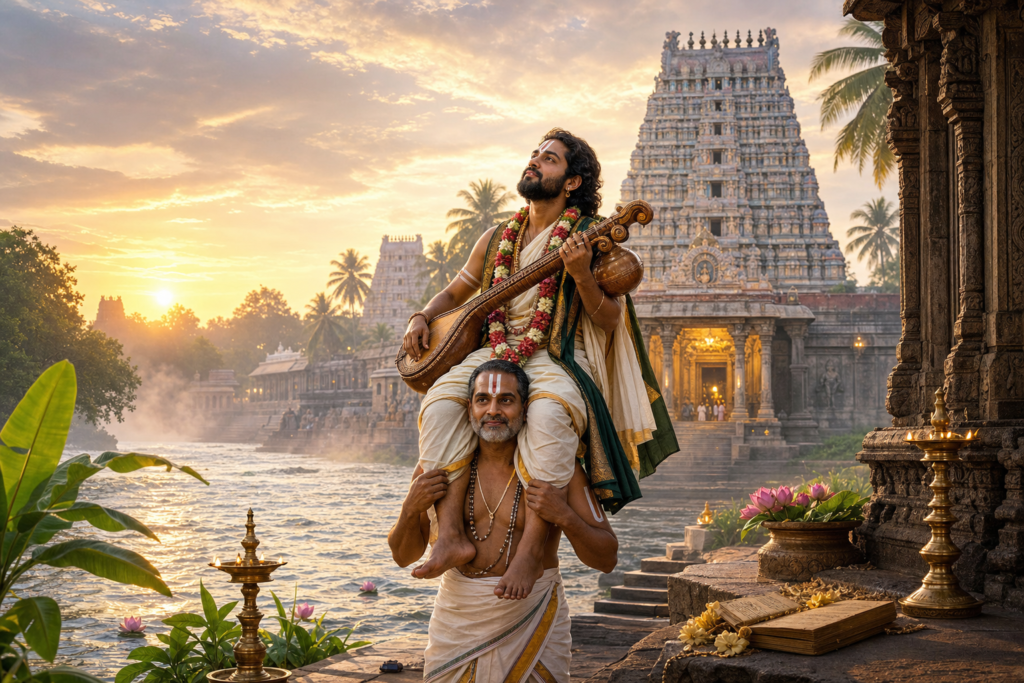
Vishnuchittar is associated with Srivilliputhur in present-day Tamil Nadu, a town central to the sacred geography of Sri Vaishnavism. Srivilliputhur is revered both as the place of Periyalvar and as the sacred home of Andal, the only woman among the twelve Azhwars. The temple tradition of Srivilliputhur, especially its association with Vatapatrasayi Vishnu and Andal, preserves the living memory of Periyalvar’s devotion through ritual, poetry, festivals, and daily worship.
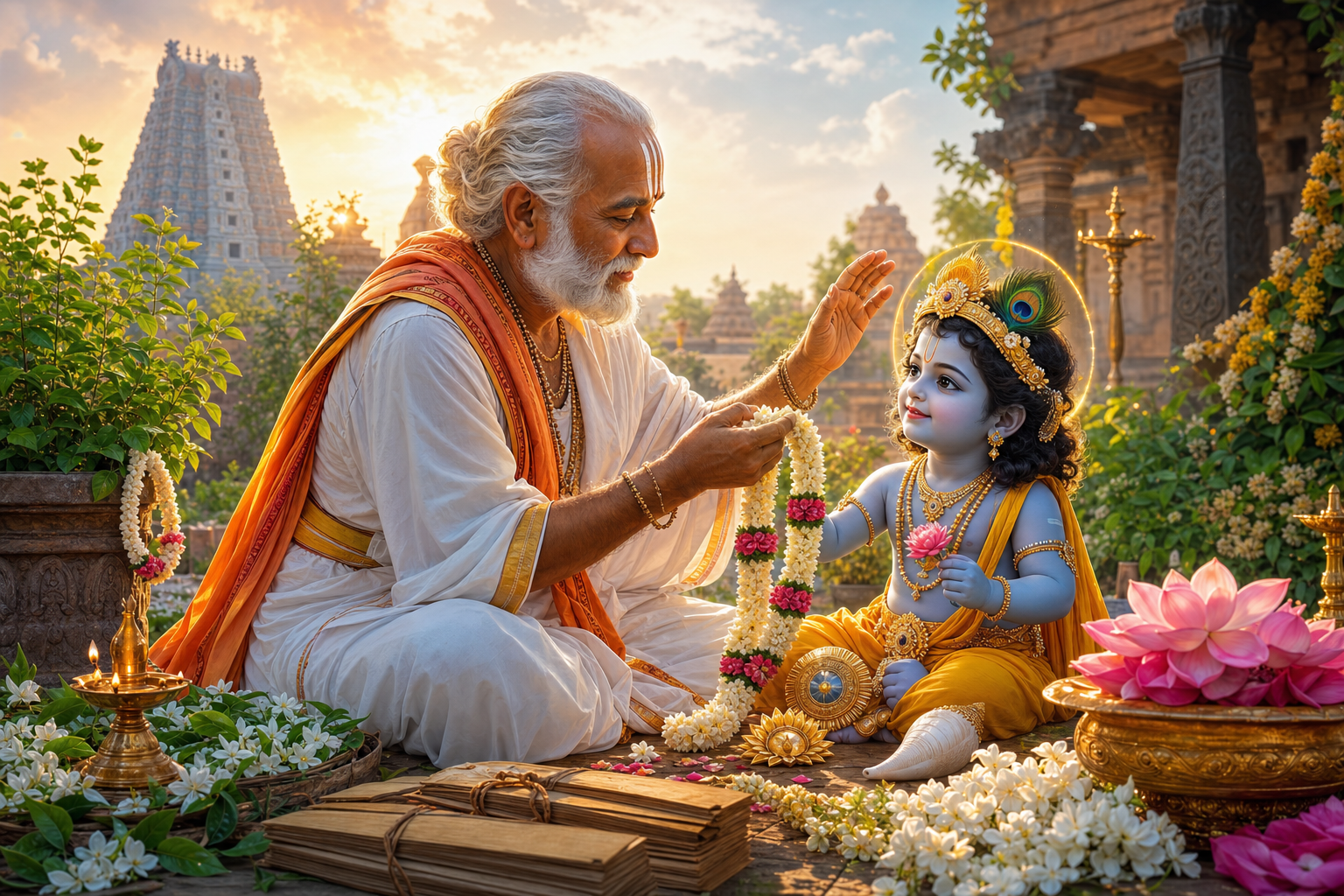
Tradition remembers Vishnuchittar as a humble devotee who served Vishnu by preparing flower garlands. This detail is theologically important. His service was not based on royal power, scholastic pride, or social ambition. It was an offering of beauty, fragrance, discipline, and love. The act of stringing flowers becomes a form of contemplative practice, where the hands work while the mind rests in Vishnu.
Such service reflects a central insight of Hindu spirituality: devotion is not limited to formal debate, ritual complexity, or philosophical abstraction. Bhakti can be lived through daily care. A garland made with attention becomes theology in visible form. A garden becomes a place of sadhana. A simple act, repeated with purity of intention, becomes a bridge between the human and the Divine.
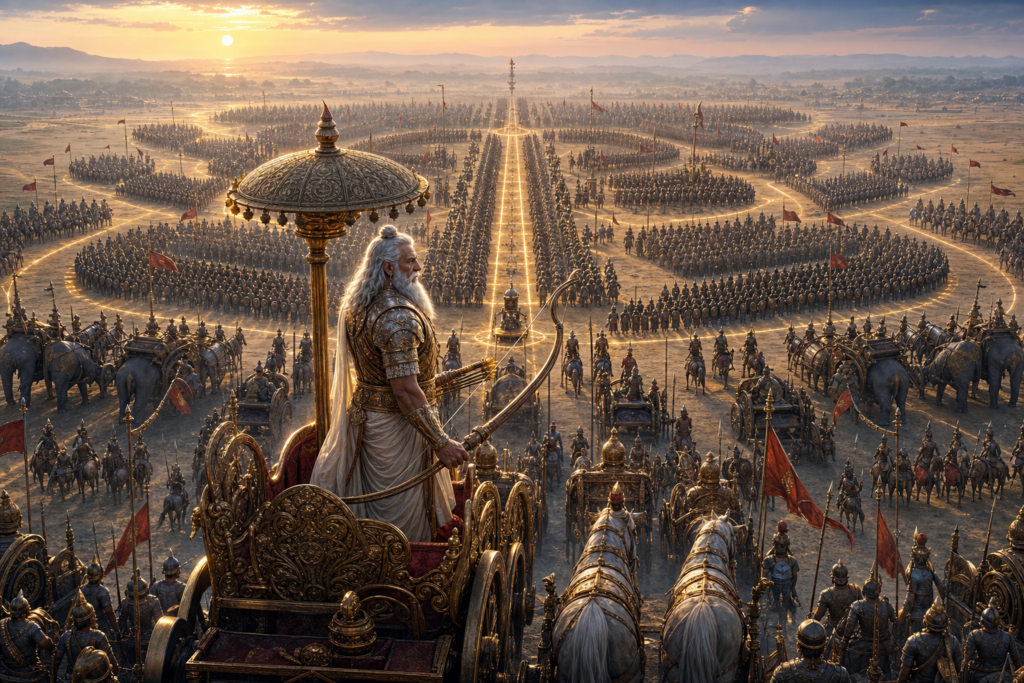
Periyalvar’s life is closely connected with the Pandya court in traditional accounts. A celebrated narrative describes a royal assembly in which scholars were invited to establish the highest truth and the path to liberation. Vishnuchittar, though personally humble and not driven by intellectual pride, is said to have entered the debate through divine prompting. His declaration of Vishnu as the supreme refuge won the assembly, and the king honored him publicly.
The deeper meaning of this episode is not merely that a devotee defeated scholars in debate. It shows the Sri Vaishnava conviction that divine grace can speak through humility. Vishnuchittar’s authority does not arise from egoistic mastery. It arises from surrender, service, and the presence of Vishnu in his consciousness. This theme remains central to bhakti traditions across Hinduism: true knowledge is fulfilled only when it becomes devotion.
After the royal recognition, tradition says that Vishnuchittar was taken in procession on an elephant. At that moment, Vishnu appeared with divine splendor. A conventional devotee might have asked for blessings. Vishnuchittar did something startling. Seeing the Lord exposed before crowds, he became concerned for the Lord’s safety and spontaneously sang blessings for Him. This became the celebrated Tiruppallandu.
Tiruppallandu is among the most beloved hymns in Sri Vaishnava liturgy. Its opening mood is a benediction directed toward Vishnu Himself: may the Lord live and flourish for countless years. The emotional reversal is profound. The eternal Lord, who is beyond decay, is blessed by the devotee. The immortal is lovingly guarded by the mortal. The cosmic protector is protected by love.
This is not a contradiction in theology. It is a refinement of devotional experience. At the metaphysical level, Vishnu needs no protection. At the level of bhakti rasa, love does not calculate metaphysical hierarchy. A mother knows that her child may be strong, gifted, or destined for greatness, yet she still worries whether the child has eaten, slept, and remained safe. Periyalvar brings this humanly recognizable tenderness into the highest devotional expression.
Periyalvar’s contribution is therefore not only literary but psychological and theological. He reveals that devotion can include concern, vulnerability, and protective affection. In many religious settings, fear and distance dominate the relationship between the worshipper and the sacred. Periyalvar’s bhakti offers a different grammar. The Divine is adored with awe, but also embraced with intimacy.
His major works, Tiruppallandu and Periyalvar Tirumoli, form part of the Naalayira Divya Prabandham, the Tamil devotional canon of four thousand verses sung by the Azhwars. This canon holds a foundational place in Sri Vaishnavism because it brings Vedic truth into Tamil poetic experience. The Divya Prabandham is often described as the Tamil Veda, not as a replacement for Sanskrit revelation, but as a devotional flowering of the same sacred vision.
The Azhwars were instrumental in shaping the devotional culture of South India. Their hymns sanctified temples, landscapes, emotions, and everyday life. They gave voice to longing, surrender, wonder, grief, joy, and ecstatic union with Vishnu. Periyalvar’s special contribution within this tradition is his intense focus on Krishna as the divine child and on the parental mood of love.
In Periyalvar Tirumoli, the child Krishna becomes the center of devotional imagination. The poet does not merely praise Krishna as the supreme Lord; he enters the emotional world of Yashoda, the mother of Krishna. Through this devotional identification, Periyalvar explores the paradox of the Infinite appearing as a child who crawls, plays, steals butter, smiles, cries, and captivates the household.
Theologically, this is a sophisticated form of meditation. Krishna’s childhood is not treated as a charming anecdote alone. It becomes a way of contemplating the accessibility of the Divine. The same Reality that sustains the cosmos becomes approachable in the form of a child. The mind that cannot grasp infinity can love a child. The heart that trembles before cosmic majesty can melt before Krishna’s playfulness.
Vatsalya Rasa in Hinduism is one of the most refined expressions of devotional emotion. It appears prominently in Krishna bhakti, where the devotee may approach the Lord as parent, friend, servant, beloved, or child. Periyalvar’s genius lies in giving poetic and liturgical force to the parental mode. His hymns show that parental love is not spiritually inferior to philosophical contemplation; it can itself become a direct path to God-realisation.
This devotional vision carries a universal emotional appeal. The anxiety of love is a human experience found in every home. Parents worry over children; elders worry over the young; those who love deeply become alert to danger even when danger is unlikely. Periyalvar sanctifies that emotion. He shows that protective love, when purified of possessiveness and directed toward the Divine, becomes worship.
Periyalvar is also inseparable from Andal. Traditional accounts say that he found the child Kodhai near a tulasi plant in the temple garden and raised her with devotion. She later came to be known as Andal, one of the most luminous figures in Tamil bhakti and the only female Azhwar. Her works, especially Tiruppavai and Nachiyar Tirumoli, remain central to Vaishnava worship and Tamil spiritual literature.
The relationship between Periyalvar and Andal is among the most tender episodes in the history of Hindu saints. He is remembered not only as a poet and devotee, but also as a father. His home becomes a sacred space where devotion is transmitted through affection, discipline, song, and service. Andal’s later spiritual greatness does not diminish Periyalvar’s role; rather, it reveals the power of a devotional household shaped by sincerity.
The garland tradition associated with Andal further enriches this legacy. Andal is said to have worn the garlands before they were offered to Vishnu, and Vishnu accepted them with delight. Periyalvar’s initial concern gave way to a deeper revelation: the Lord accepts love marked by intimacy. In this tradition, ritual purity is not emptied of meaning, but fulfilled by bhakti. The garland becomes a symbol of embodied devotion.
Historically, Periyalvar is often placed in the early medieval period, with some modern studies associating him with the ninth century. Traditional Sri Vaishnava accounts situate the Azhwars in sacred time, while historical scholarship approaches them through literary, inscriptional, and political evidence. Both perspectives contribute to understanding his legacy: one preserves devotional memory, and the other examines the cultural world in which Tamil Vaishnava poetry flourished.
The academic study of Periyalvar must therefore respect the layered nature of the tradition. Hagiography, temple practice, poetic theology, and historical reconstruction do not always speak in the same language. Yet each reveals something important. The devotional tradition tells how Periyalvar is loved. The literary tradition shows how he sang. The temple tradition shows how his memory is embodied. Historical inquiry helps situate his work in South Indian religious culture.
Periyalvar’s association with Srivilliputhur remains especially significant. The Srivilliputhur Andal Temple is one of the 108 Divya Desams, the sacred Vishnu temples celebrated by the Azhwars. The town’s identity is shaped by Periyalvar and Andal together. Their memory is not confined to books; it lives in festivals, recitations, temple processions, domestic worship, music, and the devotional calendar of Tamil Nadu.
Festivals connected with Periyalvar and Andal demonstrate how poetry becomes public culture. During temple celebrations, hymns from the Naalayira Divya Prabandham are recited, processional deities are honored, and devotees participate in a shared ritual memory. Such festivals are not merely commemorative events. They renew the relationship between text, temple, community, and sacred geography.
In Sri Vaishnava temples, the recitation of Azhwar hymns is an essential part of worship. This liturgical role shows that Periyalvar’s poetry is not treated as private religious emotion alone. It has become a public theological voice. His blessings for Vishnu are sung by generations of devotees, allowing his protective love to become part of the collective devotional consciousness.
Periyalvar’s bhakti also contributes to the broader unity of dharmic traditions. Hinduism, Buddhism, Jainism, and Sikhism each preserve, in different ways, the importance of devotion, compassion, ethical discipline, humility, and liberation from ego. Periyalvar’s life speaks especially to the dharmic principle that spiritual greatness is measured not by domination but by surrender, service, and purified love.
His example is particularly valuable in a modern age that often confuses visibility with depth. Periyalvar did not seek prominence. His greatness emerged through a life of service, through garlands, hymns, humility, and care. His story suggests that the most enduring spiritual influence often begins in hidden discipline. A person who serves quietly may become the voice through which a whole tradition remembers how to love.
There is also a social dimension to his legacy. The Azhwar tradition helped make high devotional theology available through Tamil language and poetic expression. This democratizing power of bhakti is central to South Indian religious history. Sacred truth was not confined to elite discourse; it was sung in a language of emotion, locality, temple experience, and human relationship.
Periyalvar’s hymns demonstrate that Tamil literature is not only an artistic treasure but also a theological archive. His poetry preserves metaphysics through feeling. It communicates doctrine through image, rhythm, and tenderness. For scholars of Hinduism, Tamil culture, religious literature, and bhakti tradition, Periyalvar stands as a key figure in understanding how devotion became both personal and civilizational.
The emotional center of Periyalvar’s life remains his concern for Vishnu. This concern should not be misunderstood as theological naivety. It is a mature devotional state in which love becomes stronger than fear, hierarchy, and self-interest. The devotee who blesses God has forgotten himself completely. That forgetfulness of ego is itself a form of liberation.
In practical spiritual terms, Periyalvar teaches that bhakti is not an escape from responsibility. It refines responsibility. The same care one brings to a child, a family, a community, or a sacred duty can become spiritual practice when infused with awareness of the Divine. His life asks devotees to consider whether worship is merely verbal praise or whether it includes attention, tenderness, and service.
His story also challenges purely transactional religion. Periyalvar does not approach Vishnu primarily to receive something. He approaches in order to offer. He offers flowers, songs, blessings, concern, and his entire emotional life. In this sense, he represents one of the highest forms of devotion: love that seeks no reward except the joy of loving.
Periyalvar’s relationship with Krishna further reveals the richness of Hindu devotional theology. The child Krishna is not a reduction of divinity but a revelation of divine nearness. The cosmic Lord becomes small enough to be loved without fear. Through this image, Periyalvar gives devotees a way to approach the Absolute through affection, memory, imagination, and song.
For contemporary readers, Periyalvar remains relevant because his devotion humanizes theology without weakening it. He shows that spiritual life need not be emotionally sterile. Love, concern, beauty, humility, and parental tenderness can become precise instruments of realization. His bhakti is soft in emotional texture but powerful in theological depth.
Periyalvar is therefore best understood not only as one of the twelve Azhwars, but as a master of devotional intimacy. His life unites Tamil poetry, Vaishnava theology, temple culture, Krishna bhakti, and the sanctification of parental love. He stands as a reminder that the Divine may be worshipped with folded hands, studied with disciplined intellect, served through daily action, and loved with the fierce tenderness of a parent.
The greatness of Periyalvar lies in this unforgettable reversal: the devotee blesses the Lord. In that moment, the boundaries between theology and love dissolve. Vishnuchittar becomes Periyalvar because his heart is vast enough to worry for the Eternal. His legacy continues wherever Tiruppallandu is sung, wherever Andal is remembered, and wherever devotion becomes an act of protective, selfless, and luminous love.
Inspired by this post on Hindu Pad.





Leave a Reply
You must be logged in to post a comment.