
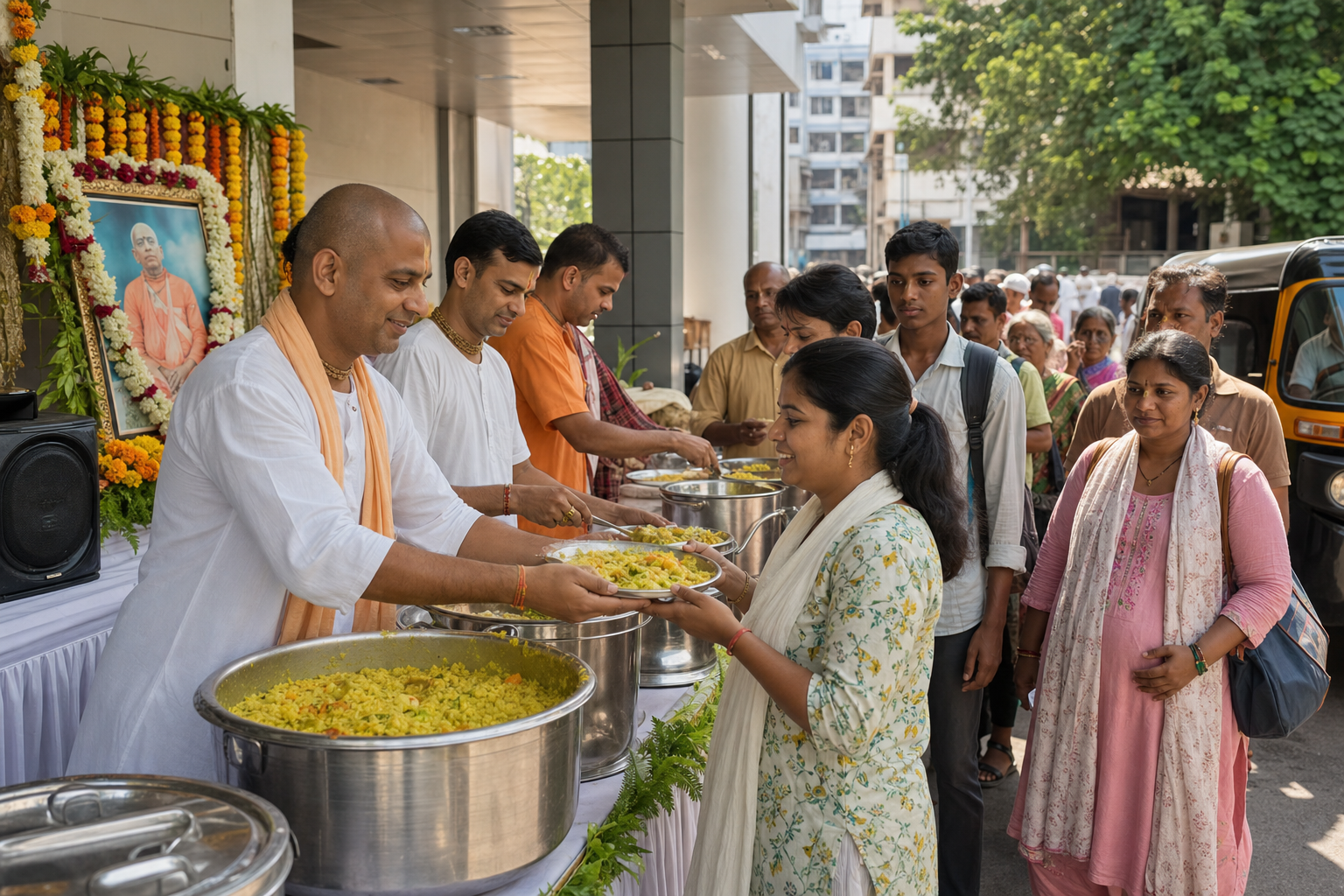
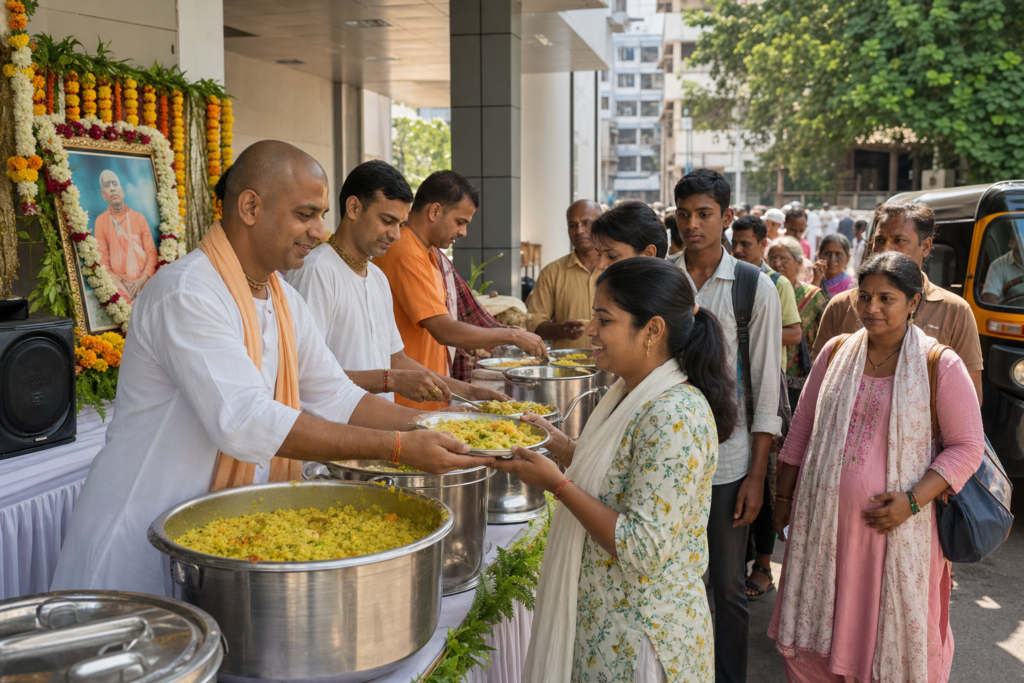
Hare Krishna TV’s Khichadi Prasadam distribution program in Mira Road represents a practical example of how devotional service, food security, and community welfare can converge in a disciplined daily initiative. Initiated in January 2026, the program is described as an effort inspired by the mercy of Srila Prabhupada and rooted in the Vaishnava understanding that food offered with devotion becomes prasadam, a sacred gift meant to nourish both body and consciousness.
The service takes place every day at 12:30 PM in Mira Road (East), near Indira Gandhi Hospital. This location is socially significant because a government hospital commonly serves patients and families from economically vulnerable backgrounds. For many people waiting for treatment, caring for relatives, commuting for work, studying, or managing daily-wage uncertainty, a hot meal at the right time is not a small convenience; it can become a dependable point of relief within an otherwise demanding day.
At present, the Hare Krishna TV and ISKCON Desire Tree team distributes approximately 350 to 400 portions of hot Khichadi Prasadam daily. The recipients include pregnant women, students, laborers, rickshaw drivers, patients’ attendants, and other members of the surrounding community. This range of beneficiaries shows that the program is not limited to one social category. It responds to a basic human need that crosses age, occupation, income level, and circumstance.
Khichadi is especially well suited for such a service because it is simple, digestible, nourishing, and culturally familiar across much of India. Traditionally prepared with rice, dal, mild spices, and sometimes vegetables, khichadi provides carbohydrates, plant-based protein, warmth, and satiety in a form that is easy to serve at scale. In a hospital-adjacent setting, this practicality matters. Food distributed in such spaces must be reliable, acceptable to many people, and suitable for those who may already be physically or emotionally strained.
The deeper significance of the initiative lies in the dharmic idea of seva. In the Grihastha Ashram, householders are traditionally encouraged to serve according to their capacity, supporting society through hospitality, charity, responsibility, and care for those in need. Hare Krishna TV’s program gives that principle a concrete public expression. It moves dharma from abstraction into routine: cooking, transporting, serving, coordinating, and returning the next day to do the same work again.
In Vaishnava practice, prasadam is not merely food distribution in the ordinary administrative sense. Food is first prepared and offered to the Lord, and then shared as mercy. This transforms the act of feeding into a form of spiritual culture. The recipient receives nourishment without the transactionality that often defines urban life. The server is reminded that service is not an act of superiority but an offering. The community witnesses a model of welfare grounded in humility rather than publicity.
The program also observes Ekadashi by distributing special Ekadashi prasadam. This detail is important because it shows sensitivity to devotional discipline and the Vaishnava calendar. Ekadashi is traditionally associated with fasting, restraint, remembrance, and spiritual focus. By adjusting the prasadam served on that day, the initiative maintains religious integrity while continuing its public service function. The discipline of the calendar and the compassion of feeding are therefore held together, rather than treated as separate priorities.
During distribution, Srila Prabhupada’s kirtan is played, creating a spiritual atmosphere around the act of service. In practical terms, sound changes the emotional quality of a public space. A meal line near a hospital can easily feel anonymous or stressful, but kirtan introduces remembrance, calm, and devotional identity. For regular recipients, this may make the experience more than a queue for food; it becomes a brief encounter with dignity, order, and sacred sound.
Reports from the service indicate that many regular recipients depend on the daily meal and have requested that the distribution continue indefinitely. Such responses are socially meaningful. When people begin to depend on a service, it reveals both the usefulness of the initiative and the seriousness of the surrounding need. It also places a moral responsibility on the organizers to maintain consistency, food quality, hygiene, and punctuality, because trust grows when service is predictable.
From a community development perspective, the program demonstrates several strengths. The timing is fixed, the location is need-sensitive, the food item is practical, the distribution volume is substantial, and the beneficiaries are drawn from everyday working and caregiving populations. These features make the initiative more effective than irregular charity. Food relief becomes most valuable when it is dependable enough for people to plan around it, especially for those living with uncertain income or medical expenses.
The hospital context also deserves careful attention. Families who come to government hospitals often face costs beyond medical treatment: travel, lost wages, medicines, diagnostic tests, and meals away from home. A single plate of prasadam cannot remove all these burdens, but it can reduce immediate distress. For a pregnant woman, a student, a laborer, or a rickshaw driver, one hot meal at midday may preserve energy, reduce anxiety, and provide a moment of human care in a difficult schedule.
There is also an important cultural continuity in this form of service. Across dharmic traditions, food sharing has long been a visible expression of compassion. Hindu prasadam distribution, Sikh langar, Jain emphasis on ahimsa and food discipline, and Buddhist traditions of offering and community support all point toward a shared civilizational ethic: nourishment should not be separated from dignity. Hare Krishna TV’s initiative stands within this wider dharmic landscape, where feeding others is not only welfare but a form of spiritual responsibility.
The program’s current scale, 350 to 400 portions daily, is already significant. Yet the available report notes that there is scope to double the distribution quantity. If this expansion is pursued, the most important considerations would be operational sustainability, kitchen capacity, volunteer coordination, food safety, ingredient sourcing, transport logistics, and crowd management. A larger service can reach more people, but it also requires stronger systems so that quality and punctuality are not compromised.
In technical terms, community meal programs depend on a chain of disciplined processes. Ingredients must be procured in sufficient quantity, stored safely, cooked hygienically, packed or transported efficiently, served in an orderly manner, and cleaned up responsibly. When the same process repeats daily, small weaknesses can accumulate. Therefore, the strength of a prasadam distribution program is not measured only by the number of plates served but also by consistency, cleanliness, respect for recipients, and the ability to continue without exhaustion.
For this reason, the spiritual framework of seva is operationally useful as well as devotional. When volunteers see the work as service to the Lord and compassion toward society, repetitive tasks acquire meaning. Stirring a large vessel of khichadi, arranging portions, standing in the afternoon heat, or serving people one by one becomes part of sadhana. This inner orientation helps protect the service from becoming mechanical, while the daily discipline protects good intention from remaining merely sentimental.
The initiative also offers a quiet corrective to the isolation often seen in urban life. Cities can place thousands of people near one another without creating real community. A prasadam distribution point changes that pattern, even if briefly. People gather, receive, listen, and leave with food in hand. The act is simple, but repeated daily it creates a social memory: at this place, at this time, someone serves without asking who a person is, what they earn, or what they can return.
Such programs should be understood neither as spectacle nor as a substitute for structural solutions to poverty and healthcare access. Their value lies in immediate compassion. A society needs policy, infrastructure, hospitals, employment, and social protection, but it also needs communities that respond directly to suffering. Hare Krishna TV’s Khichadi Prasadam distribution belongs to this second category: it does not claim to solve every problem, but it addresses hunger where hunger is visible.
The emotional force of the program comes from its modesty. There is no complexity in the recipient’s experience: a person arrives, receives hot prasadam, and is treated as worthy of care. Yet behind that simplicity stands a large philosophical inheritance. Srila Prabhupada repeatedly emphasized the distribution of prasadam as a central expression of Krishna consciousness, because it combines devotion, compassion, and outreach in a form that ordinary people can immediately understand.
Hare Krishna TV’s Mira Road seva therefore deserves attention as a model of dharmic community service. It integrates Vaishnava theology, household responsibility, food relief, sacred sound, and public welfare into a daily practice. Its impact is seen not only in the number of portions served but in the trust of those who return, the dignity offered to those in need, and the reminder that spirituality becomes most persuasive when it is served hot, on time, and with humility.
Inspired by this post on Dandavats.








Leave a Reply
You must be logged in to post a comment.