
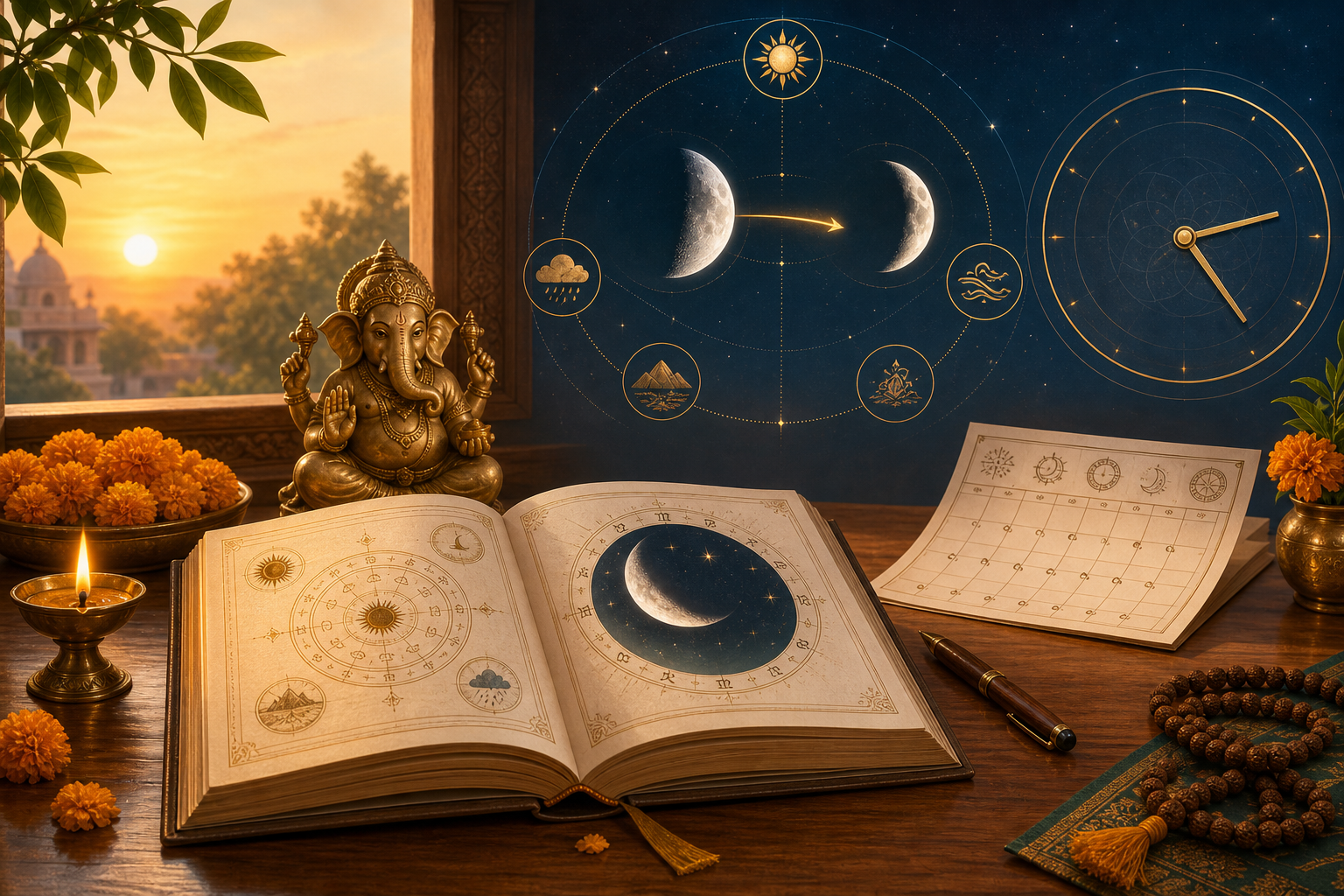
July 4, 2026 Panchang is centered on Krishna Paksha Chaturthi, the fourth lunar day of the waning phase of the Moon, which continues until 9:42 AM on July 4 in the referenced Panchang tradition for most regions. After 9:42 AM, Krishna Paksha Panchami begins, marking the fifth lunar day of the dark fortnight. In the Gregorian calendar, July 4, 2026 falls on a Saturday; therefore, any reference to Sunday should be treated as a weekday mismatch rather than a change in the lunar observance itself.
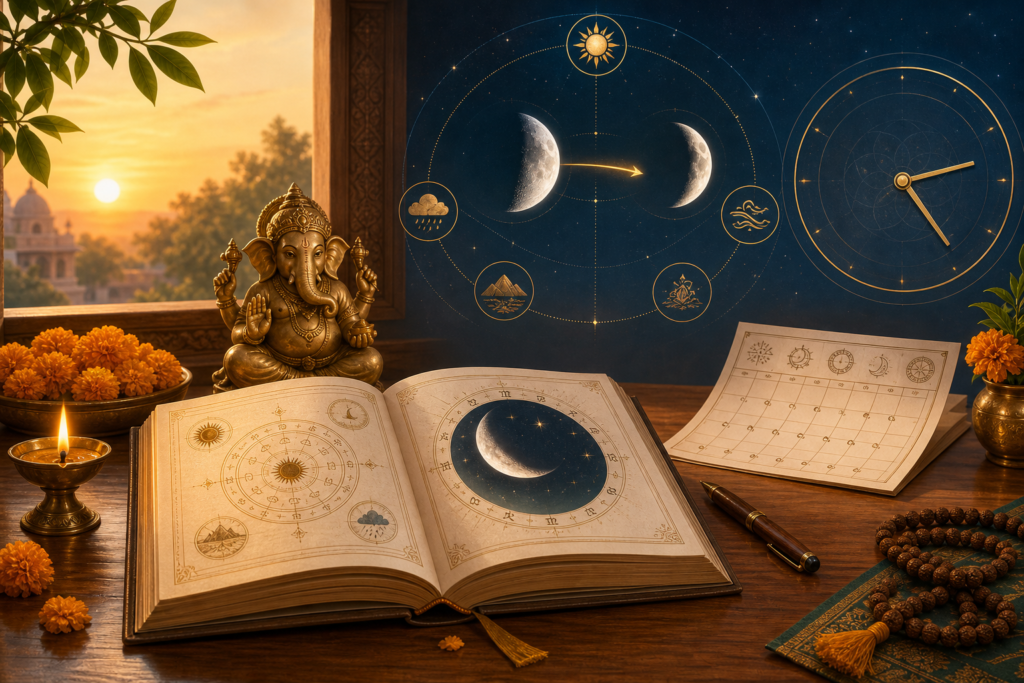
A Panchang is not merely a date list. It is a technical Hindu calendar system that brings together five key limbs of time: tithi, vara, nakshatra, yoga, and karana. These elements are used in Hindu tradition to understand the quality of a day, select suitable periods for worship, and avoid careless timing for important undertakings. The same framework is also respected across many dharmic cultural settings, where lunar rhythm, seasonal awareness, and disciplined daily conduct are treated as part of an integrated way of life.
The most important detail for July 4, 2026 is the tithi transition. Krishna Paksha Chaturthi remains active until 9:42 AM, after which Krishna Paksha Panchami takes over. This means that rituals, vratas, and observances associated specifically with Chaturthi should be understood with reference to the period before the stated transition time, while Panchami-related activities are more properly associated with the period after 9:42 AM. Since Panchang calculations are tied to local sunrise, longitude, latitude, and time zone, regional Panchang references should always be checked for exact ritual use.
Krishna Paksha refers to the waning or dark half of the lunar month, the period between Purnima and Amavasya. Symbolically, this phase is often associated with withdrawal, introspection, reduction, repair, and inward discipline. In practical household life, many people experience Krishna Paksha as a useful reminder to simplify routines, complete pending tasks, review personal habits, and return attention to prayer, japa, study, and self-correction.
Chaturthi, the fourth tithi, has a strong association with obstacle-awareness and disciplined effort in many Hindu traditions, particularly because of its connection with Sri Ganesha worship. A Krishna Paksha Chaturthi is often approached with humility, restraint, and care. It is not simply a day for fearfully avoiding action; rather, it invites a more thoughtful style of action, where decisions are taken after reflection and where ego-driven haste is reduced.
After 9:42 AM, Panchami begins. Panchami is the fifth tithi and is traditionally viewed in many calendars as a more stabilizing lunar marker than the preceding Chaturthi. The shift from Chaturthi to Panchami gives the day a two-part character: the early portion carries the Chaturthi emphasis on removing obstacles and correcting imbalance, while the later portion can be read as more supportive for gradual movement, learning, healing, and steady household responsibilities.
For those using this Panchang for daily planning, the key principle is not superstition but alignment. A person may begin the day with a simple prayer, avoid unnecessary conflict, complete essential duties, and reserve major ceremonial decisions for a locally verified Shubh Muhurat. This approach preserves the practical wisdom of the Hindu calendar while keeping it grounded in responsibility, clarity, and respect for regional practice.
The term Shubh Muhurat refers to a favorable time window selected after considering several Panchang factors together. Tithi alone is important, but it is not the whole calculation. A complete muhurat assessment also examines nakshatra, yoga, karana, weekday, sunrise, planetary conditions, and the nature of the intended activity. For example, a time suitable for daily worship may not automatically be suitable for marriage, housewarming, business inauguration, travel, or major financial commitments.
Because the provided source segment gives the tithi but does not provide the exact nakshatra or rashi for the location, those details should not be assumed universally. Nakshatra changes according to the Moon’s position, and rashi indicates the zodiac sign occupied by the Moon at the relevant time. Both are location-sensitive when used in a daily Panchang format. A household in India, a temple in North America, and a practitioner in Europe may consult the same broad date but still need locally adjusted timings.
Rahu Kaal is another important timing factor in daily Panchang use. It is traditionally treated as unsuitable for beginning major new ventures, although routine duties, ongoing work, worship, and necessary responsibilities are not usually abandoned because of it. On a Saturday, Rahu Kaal is commonly associated with the third segment of the daytime period when the day is divided from sunrise to sunset. The exact clock time must be calculated from local sunrise and sunset rather than copied mechanically from another region.
Choghadiya is often consulted for practical daily timing, especially in western Indian traditions. It divides the day and night into segments such as Amrit, Shubh, Labh, Char, Rog, Kaal, and Udveg. When people speak of a good time on July 4, 2026, a sound method is to combine the tithi information with local Choghadiya, Rahu Kaal, Yamaganda, Gulika, and the intended purpose of the activity. This prevents a shallow reading of the Panchang and supports better decision-making.
From a technical perspective, a tithi is determined by the angular distance between the Sun and the Moon. Each tithi corresponds to a 12-degree elongation difference. Since the Moon’s speed varies, a tithi does not always match a civil day neatly. This is why a tithi can begin or end at any hour, and why the July 4, 2026 Panchang specifically notes the Chaturthi ending at 9:42 AM before Panchami begins.
This also explains why a Panchang is more precise than a simple wall calendar. A civil date begins at midnight, but many Hindu observances are connected to sunrise, moonrise, or the presence of a tithi during a specific ritual period. For vrat, puja, sankalpa, and temple observances, the relevant rule may depend on whether the tithi prevails at sunrise, moonrise, pradoshakala, madhyahna, or another defined segment of the day.
For daily Hindu practice, July 4, 2026 can be approached with a balanced discipline. The Chaturthi portion before 9:42 AM is suitable for prayerful removal of obstacles, quiet self-review, and offering respect to Sri Ganesha according to family tradition. The Panchami period afterward can support steadier tasks, scriptural reading, family duties, and calm preparation for the coming days of Krishna Paksha.
In many homes, the Panchang has an emotional role as well as a ritual one. It connects grandparents, parents, and children through shared questions: What is the tithi today? Is there a vrat? When should the lamp be lit? Which time should be avoided for a new beginning? These small daily conversations preserve cultural memory without needing grand public celebration. They make dharma part of ordinary time.
Such daily observance also supports unity among dharmic traditions. Hinduism, Buddhism, Jainism, and Sikhism have distinct theological foundations and ritual systems, yet each preserves a deep respect for disciplined time, ethical conduct, remembrance, restraint, and inner refinement. A Panchang entry, when presented carefully, should therefore be read not as sectarian separation but as one expression of a broader civilizational habit: living with awareness rather than impulse.
For readers seeking practical guidance, the safest conclusion is straightforward. On July 4, 2026, Krishna Paksha Chaturthi continues until 9:42 AM, and Krishna Paksha Panchami follows. Major rituals, vrats, and muhurat-sensitive ceremonies should be confirmed with a local Panchang or a knowledgeable priest because sunrise, moonrise, nakshatra, rashi, and regional rules can alter the final recommendation. Everyday worship, study, charity, and self-discipline remain meaningful throughout the day.
The deeper value of this Panchang entry lies in the discipline it encourages. Time is not treated as empty space to be consumed, but as a sacred field in which action, intention, and awareness meet. July 4, 2026 therefore becomes more than a date. It becomes an invitation to plan carefully, act humbly, and remain connected to the lunar wisdom of the Hindu calendar.
Inspired by this post on Hindu Blog.


Leave a Reply
You must be logged in to post a comment.