
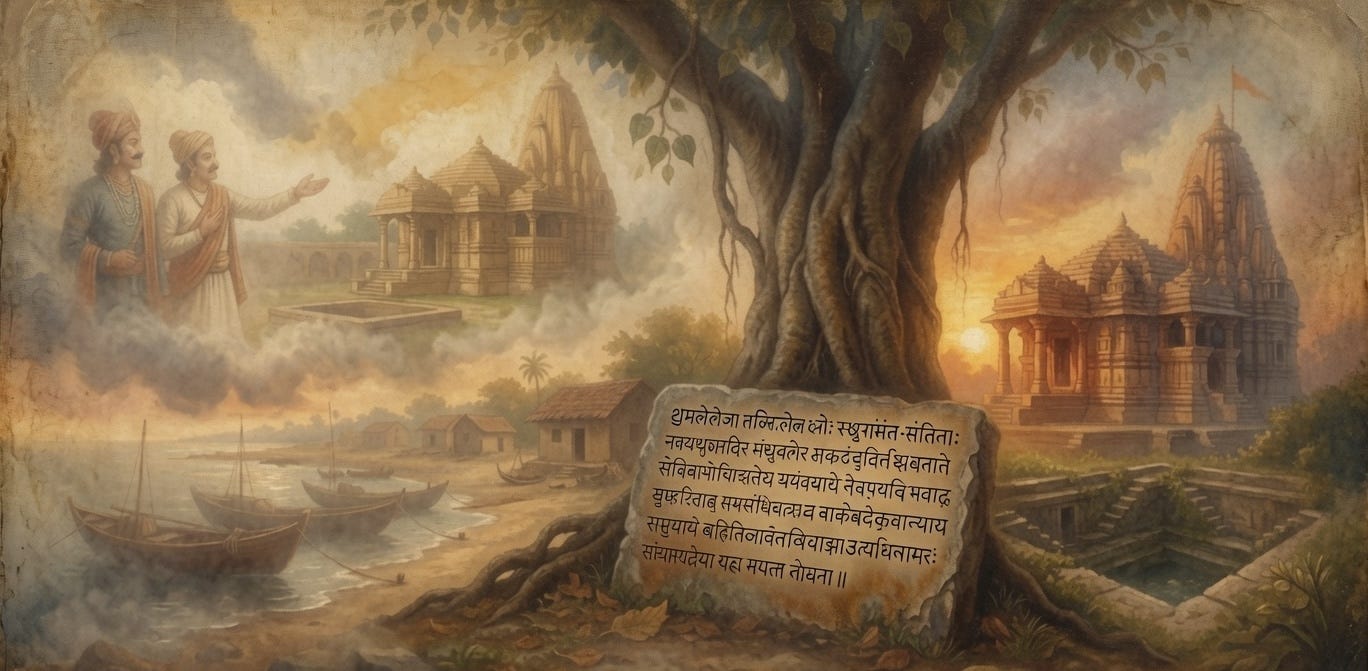
Dhamlej, a coastal settlement in present-day Gujarat, is usually described today as a quiet fishing and agrarian village. Yet older records point to a far deeper identity: the place was once remembered as MŪla-GayĀ, a sacred site associated with a major Surya Kshetra in Saurashtra-Desha. This contrast between a modest contemporary village and a once-revered sacred geography is not merely nostalgic. It raises an important historical question about how religious memory, temple networks, pilgrimage routes, and local place names can fade from public consciousness while still surviving in inscriptions, field reports, and fragments of oral tradition.
The older name, MŪla-Gayā, immediately suggests ritual depth. It evokes a sacred landscape rather than an ordinary administrative location. Dhamlej lies roughly 33 kilometres south of Sri Somanatha Kshetra, placing it within one of western India’s most historically charged coastal zones. The Saurashtra coast was not only a maritime and agrarian region; it was also a dense religious landscape where temples, tirthas, kundas, inscriptions, and pilgrimage circuits shaped community identity across generations.
The importance of Dhamlej becomes clearer when it is studied alongside Modhera, Somanatha, Prabhāsa-Pattana, Sutrapada, Kadvar, and Patan. These places formed part of a sacred and cultural continuum in Gujarat, where devotion to Surya, Shiva, Vishnu, and other deities coexisted with Jain traditions and local forms of worship. Such sites demonstrate the broad, interconnected character of Dharma in western India, where Hindu and Jain patrons, ministers, merchants, Brahmanas, and local rulers contributed to religious institutions, learning, water infrastructure, and public welfare.
The Dhamlej Sun Temple appears to have suffered repeated destruction and reconstruction, a pattern known from several medieval sacred sites in Gujarat and Saurashtra. The central historical significance of this pattern is not simply loss; it is resilience. Communities did not abandon their sacred spaces after political disruption. They rebuilt, repaired, endowed, recorded, and remembered. That recurring act of restoration is one of the most important themes in the study of Indian temple history.
In the 1870s, Major J.W. Watson, then President of the Maharajasthanik Court of Kathiawar, surveyed the Saurashtra coast and noted the remarkable abundance of inscriptions and ancient religious remains. His observations are valuable because they show that the region was already recognized in the nineteenth century as epigraphically rich and historically under-examined. Watson urged the Archaeological Department to treat the area as worthy of serious scrutiny, an appeal that remains relevant for scholars of Gujarat, temple architecture, and medieval Indian history.
The most important record associated with this discussion is the Dhamleja Inscription, numbered 39 and dated 23 June 1380 CE. Its value lies in the way it preserves a local act of restoration within a wider political environment. Medieval inscriptions often appear terse, formulaic, or technical at first glance, but they can reveal a great deal when read carefully. They preserve names, offices, religious affiliations, land grants, public works, sacred geography, and the social priorities of ruling elites and local communities.
The inscription belongs to a period when Gurjara-Desha was politically unsettled. The memory of earlier invasions, the weakening of regional Hindu polities, and the expansion of Sultanate power created a difficult environment for older institutions. Yet the record shows that local leadership remained active. It documents not only damage and disorder, but also continuity, repair, devotion, and institutional renewal.
In 1939, the epigraphist, archaeologist, and historian D.B. Diskalkar visited Dhamleja and examined the inscription. His description is especially important because it anchors the record to a specific sacred landscape. He described Dhamleja as an old village in the southern part of the Junagadh state, situated about 11 miles southeast of Sutrapada. To the west of the village, he recorded a celebrated kunda called Vishnu Gaya, also known as Cakra Tirtha. The inscription, according to his account, was lying there under a pipala tree.
This reference to Vishnu Gaya Kunda is one of the most intriguing elements in the Dhamlej tradition. A kunda is not a decorative feature; it is a ritual water body, often linked to pilgrimage, purification, ancestral rites, temple worship, and the social life of a sacred settlement. If Vishnu Gaya Kunda or Cakra Tirtha still survives in some form, it would be an important heritage marker for Dhamlej and for the broader sacred geography of Saurashtra.
The uncertain present condition of the kunda highlights a larger challenge in Indian heritage preservation. Many sacred sites do not disappear suddenly. They become ordinary-looking places. A kunda becomes a neglected pond, a temple fragment becomes building material, an inscription becomes a stone under a tree, and a sacred name becomes a phonetic memory in a modern village name. The emotional force of Dhamlej lies precisely in this slow fading of visible memory.
The political background of the inscription is equally important. Four centuries after Mahmud of Ghazni’s raid on Somanatha, Saurashtra again faced military and political pressure during the Khalji and Tughlaq periods. Ala-ud-din Khalji’s campaigns, followed by later instability under the Delhi Sultanate, contributed to the weakening of older regional powers in Gujarat. Yet the picture was not one of total collapse. Local dynasties, chiefs, and ministers continued to act, negotiate, govern, and patronize religious institutions wherever political space allowed.
In 1377, Firoz Shah Tughlaq appointed Farhat-ul-Mulk as governor of Gujarat. The title suggested wide authority, but actual control over Gurjara-Desha appears to have been uneven. Several Hindu rulers had either rebelled or reasserted local autonomy. In Junagadh and its surrounding regions, the Chudasamas remained influential, and the Vājā Raja Bharma exercised authority over Prabhāsa. This is the setting in which the Dhamleja inscription should be understood.
The central figure in the inscription is Karma Simha, also remembered in corrupted form as Karamśi. He was the celebrated Chief Minister, or Mukhya-Sachiva, of Raja Bharma. His identity is especially meaningful because he is described as a devout Porwal Jaina, with Porwal understood as a corruption of Prāgvāṭa. This detail is vital for a balanced reading of the record. A Jain minister restored a Surya Mandira and rejuvenated a sacred kunda at Mūla-Gayā. The inscription therefore reflects the shared civilizational culture of Dharma rather than a narrow sectarian boundary.
Karma Simha’s restoration of the ruined Surya Mandira is a major act of cultural preservation. Sun worship in India has a long and complex history, visible in Vedic references, Puranic traditions, temple architecture, pilgrimage practice, and regional ritual life. In Gujarat, the most famous example is Modhera, but Dhamlej appears to have belonged to the same wider world of Surya devotion. The Dhamlej record suggests that sacred status was not limited to monumental temples that remain architecturally famous today; some once-important sites now survive mainly through inscriptions and historical notices.
The inscription also records Karma Simha’s public works. He built a large trough at the city gate of Prabhāsa-Pattana so that cattle could drink water. This detail may seem modest compared with temple restoration, but it is historically significant. Medieval Indian religious patronage often included water management, animal care, feeding arrangements, rest houses, wells, tanks, and grants for learning. Dharma, in this setting, was expressed not only through worship but also through practical welfare.
Karma Simha’s ancestry is also presented as distinguished. His father, Rāṇō (Rāṇa), is described as one who protected Brahmanas, safeguarded Dharma, and maintained prosperity during a time of political distress. Such genealogical references served more than family pride. They linked personal merit to public responsibility and placed the minister within a lineage of service to kings, temples, scholars, and the social order.

The inscription further presents Karma Simha as a devout Bhakta who regularly performed the afternoon Ārādhana of Somanatha. The text’s phrase, Mādhyānhikīm anudinaṁ, indicates daily discipline rather than occasional ceremonial association. This matters because it shows how political service and religious observance could coexist in the life of a medieval minister. The record is not merely administrative; it is devotional, social, and civilizational.
One of Karma Simha’s most consequential acts was persuading Raja Bharma to grant a village to Brahmanas as an Agrahara. Such grants supported sacred learning, teaching, ritual continuity, and the preservation of textual traditions. The village was named Meghapura, or Mēghapurāgrahāram, in honour of Karma Simha’s elder brother, Megha-Nripa, who had attained Svarga. This grant connects memory, kinship, education, and Dharma into a single act of patronage.
The Dhamleja inscription therefore offers a compact but powerful window into medieval Gujarat. It speaks of a restored Surya Mandira, a revived kunda, a cattle trough at Prabhāsa-Pattana, a Brahmana settlement, a Jain minister, a regional Hindu ruler, and a landscape marked by political uncertainty. Few records of this size carry so many layers of meaning.
Major Watson’s interpretation of the inscription emphasized that Gujarat and the peninsula were experiencing disorder, yet local rulers and ministers were actively rebuilding places of worship. His reading remains useful, though it should be expressed in measured historical language. The inscription confirms that sacred institutions continued to matter deeply even when political sovereignty was unstable. Reconstruction was not merely architectural; it was an assertion of continuity, dignity, and community responsibility.
The coastal stretch covering Kadvar, Patan, Sutrapada, and Dhamleja was described by Watson as rich in inscriptions and ancient temples, perhaps even more ancient in some respects than its more famous neighbour, Somanatha. This observation should encourage renewed scholarly attention. Somanatha rightly occupies a central place in Indian historical memory, but the surrounding sacred network deserves equal care. Great temples rarely stand alone; they are usually part of wider cultural landscapes.
Dhamlej also invites a more technical discussion of historical method. The reconstruction of such a site depends on epigraphy, toponymy, field archaeology, archival reports, regional histories, oral traditions, hydrological mapping, and architectural fragment analysis. A single inscription can establish a date and patron, but the full story requires interdisciplinary work. The location of Vishnu Gaya Kunda, the survival of temple fragments, the continuity of local worship, and the evolution from Mūla-Gayā to Dhamlej all require careful study.
Toponymy is particularly important here. The question of how Mūla-Gayā became Dhamlej is not a minor curiosity. Place names often change through Prakritization, regional pronunciation, administrative recording, Persianate and colonial transcription, migration, and popular usage. Some names preserve sacred meaning; others lose it. In the case of Dhamlej, the transformation may conceal a long chain of linguistic and social change that has not yet been adequately documented.
The story also demonstrates the importance of Jain contributions to Indian cultural preservation. Karma Simha’s role challenges simplistic divisions between Hindu and Jain heritage. In practice, medieval western India often saw Jain ministers, merchants, and patrons supporting a wider religious ecology. Temples, libraries, tirthas, water bodies, and learning institutions frequently benefited from this shared cultural environment. This is especially relevant today, when unity among Hinduism, Jainism, Buddhism, and Sikhism is best strengthened through accurate knowledge of historical cooperation.
Dhamlej should therefore be understood not as an isolated lost temple story, but as part of a larger Dharmic pattern: communities preserving sacred spaces through public works, inscriptions, donations, learning, and ritual continuity. This pattern appears across India in different forms, from temple tanks in the south to Jain libraries in Gujarat, Buddhist monastic remains in eastern India, Sikh gurdwaras tied to historical memory, and Hindu pilgrimage routes sustained by local communities. The details differ, but the underlying principle is similar: sacred geography survives through care.
The modern transformation of Dhamlej into a destination associated with beaches and nearby tourist attractions should be approached with caution and responsibility. Tourism can support local economies, but it can also flatten historical depth if heritage is reduced to scenery. A place like Dhamlej needs documentation before development erases subtle clues. Its sacred water bodies, inscriptions, old stones, temple remains, and oral memories should be mapped and preserved with community participation.
There is also a human dimension to this subject. Many readers have experienced the strange feeling of visiting a quiet village, an old pond, or a neglected shrine and sensing that the place once carried a larger meaning. Dhamlej belongs to that category of sites where the visible present does not fully explain the historical past. Such places ask for patient attention rather than quick consumption.
The Dhamleja inscription dated 23 June 1380 CE is thus more than an epigraphic entry. It is a record of restoration in a time of pressure, of Jain participation in a broader Dharmic sacred landscape, of Surya worship beyond the famous temple of Modhera, and of the continuing importance of Saurashtra’s coastal heritage. It preserves a moment when political uncertainty did not prevent religious and civic renewal.
The unresolved question of Vishnu Gaya Kunda remains central. If the kunda still exists, even in altered form, it deserves careful identification, protection, and study. If it has disappeared, its memory should still be recorded through maps, inscriptions, local testimony, and historical analysis. Heritage preservation begins by refusing to let silence become the final record.
Dhamlej, once remembered as Mūla-Gayā, deserves a place in discussions of Gujarat history, Hindu temples, Jain patronage, archaeological preservation, and sacred geography. Its story is not only about what was lost. It is also about what can still be recovered through disciplined research, respectful memory, and a renewed commitment to protecting India’s layered civilizational heritage.
|| Om Sri Arkāya namaḥ ||
Inspired by this post on Dharma Dispatch.









Leave a Reply
You must be logged in to post a comment.