
Ugadi, also written as Yugadi, will be observed in 2026 on Thursday, 19 March. In the Telugu and Kannada calendrical traditions, this day marks the beginning of the New Year and the opening of Sri Parabhava nama Samvatsara, also written as Sri Parabhava Nama Samvatsaram, in the traditional Hindu Panchangam. The festival is especially important in Andhra Pradesh, Telangana, and Karnataka, where it is treated not merely as a calendar change but as a civilizational moment of renewal, reflection, and disciplined hope.
The word Ugadi or Yugadi is commonly understood through the Sanskrit roots yuga, meaning era or age, and adi, meaning beginning. In that sense, Ugadi signifies the beginning of an era. This etymology gives the festival its philosophical weight: the New Year is not only a date to be noticed but a threshold to be crossed consciously. It invites families, communities, and individuals to examine time as sacred, cyclical, and ethically meaningful.
In 2026, Ugadi begins the Sri Parabhava nama Samvatsara in the sixty-year Samvatsara cycle used in many Hindu calendrical systems. The Samvatsara system is one of the most sophisticated features of the Hindu lunisolar calendar. Instead of counting years only as numbers, the tradition gives each year a distinct name within a repeating sixty-year cycle. This allows time to be remembered culturally, ritually, and astrologically, connecting domestic observance with a larger inherited framework of Panchang, astronomy, and sacred memory.
Ugadi falls on Chaitra Shukla Pratipada, the first day of the bright fortnight of the month of Chaitra. This placement is important because Chaitra is associated with spring, new growth, and the fresh rhythm of agricultural and seasonal life. The festival therefore stands at the meeting point of lunar calculation, seasonal transition, and cultural celebration. It is a day when the movement of celestial time becomes visible in household rituals, temple visits, food traditions, and community gatherings.
For Telugu-speaking communities, Ugadi is the Telugu New Year. For Kannada-speaking communities, Yugadi is the Kannada New Year. The difference in pronunciation and regional expression does not weaken the unity of the festival; instead, it shows the richness of Indian cultural diversity. Andhra Pradesh, Telangana, and Karnataka each preserve distinctive customs, foods, songs, greetings, and family practices, yet the underlying symbolism remains shared: renewal, acceptance, gratitude, and dharmic orientation for the year ahead.
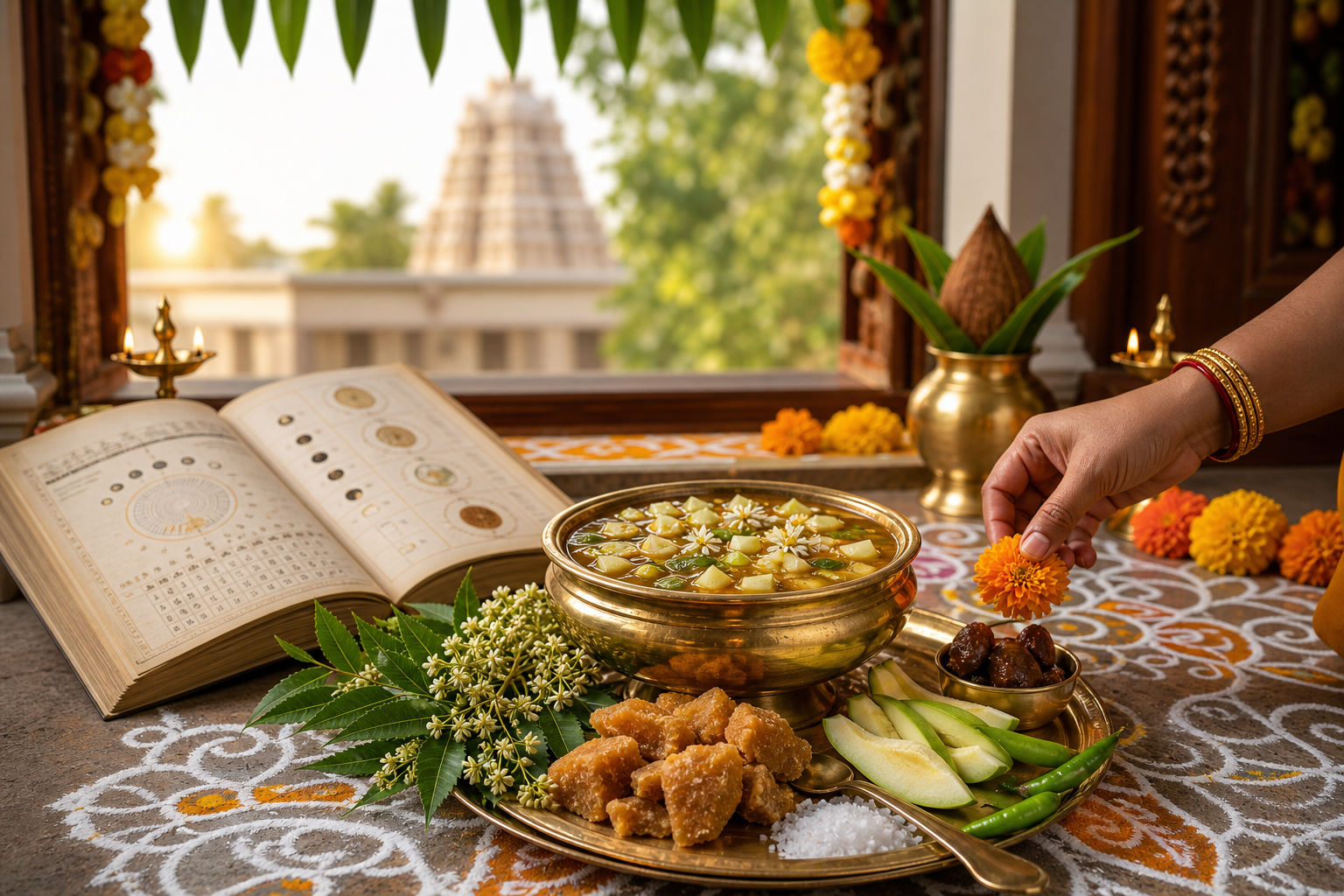
One of the most recognizable elements of Ugadi is Ugadi Pachadi in Telugu households and Bevu Bella in Kannada households. This preparation is not simply a festive food; it is a compressed philosophy of life. It traditionally combines different tastes, including sweetness, bitterness, sourness, saltiness, spice, and tang. Each taste points toward a human experience: joy, sorrow, surprise, difficulty, anger, and calm acceptance. By tasting them together at the start of the year, the household ritually acknowledges that life cannot be reduced to comfort alone.
This symbolism gives Ugadi its emotional power. In many homes, the first spoon of Ugadi Pachadi or Bevu Bella is remembered from childhood as a moment of affectionate instruction. Elders may not deliver long philosophical lectures, yet the food itself teaches balance. It says that a meaningful life requires the strength to receive sweetness without arrogance and bitterness without despair. In this way, the festival turns ordinary ingredients into ethical education.
The household preparations for Ugadi also reflect an older understanding of purity and order. Homes are cleaned, entrances may be decorated with mango leaves, and rangoli or muggu designs may be drawn at the threshold. These practices are often treated as decorative customs, but their function is deeper. They mark the home as a sacred space ready to receive auspiciousness, discipline, and social warmth. The threshold becomes a symbolic border between the old year and the new one.
Temple visits are also central to Ugadi celebrations. Devotees seek blessings for health, clarity, prosperity, and protection in the coming year. In a dharmic understanding, such prayers are not only requests for personal success. They are also an affirmation that human effort should be aligned with duty, restraint, compassion, and reverence. Ugadi therefore combines celebration with responsibility, making the New Year a moral beginning rather than a purely festive one.
Another major feature of the day is Panchanga Shravanam, the ceremonial listening to the Panchangam or traditional almanac. During Panchanga Shravanam, learned priests or scholars explain the broad features of the coming year, including tithi, nakshatra, planetary movements, seasonal indications, and general predictions. Even for people who approach astrology with varying degrees of belief, the practice remains culturally significant because it brings the community together around the disciplined study of time.
The technical structure of the Panchangam rests on five limbs: tithi, vara, nakshatra, yoga, and karana. These five elements help determine ritual timing and interpret the quality of a day within the Hindu calendar. Ugadi, being Chaitra Shukla Pratipada, is therefore not selected arbitrarily. It is embedded in a precise lunisolar system that links lunar phases, solar movement, and ritual practice. This calendar science is one reason the festival remains intellectually important as well as emotionally meaningful.
Ugadi also coincides with the beginning of Vasant Navratri or Chaitra Navratri in many traditions. This association expands the spiritual atmosphere of the day. While Ugadi emphasizes the New Year in Telugu and Kannada communities, Chaitra Navratri turns attention toward Devi worship, discipline, fasting, and inner purification. The shared timing shows how multiple strands of Hindu practice can coexist harmoniously: family renewal, calendrical transition, Shakti worship, and preparation for Sri Rama Navami all unfold within the same sacred season.
The relationship between Ugadi and Gudi Padwa is another important cultural connection. While Andhra Pradesh, Telangana, and Karnataka celebrate Ugadi or Yugadi, Maharashtra celebrates Gudi Padwa around the same calendrical moment. Both festivals mark the New Year according to related lunisolar traditions. This parallel demonstrates the unity of dharmic time across regional languages and customs. Local expressions differ, but the underlying recognition of Chaitra Shukla Pratipada as a beginning remains widely shared.
The 2026 observance is especially identified with Sri Parabhava nama Samvatsara. In traditional usage, the name of the year becomes part of greetings, Panchangam references, religious documents, festival announcements, and community memory. For many families, learning the Samvatsara name is part of belonging to a living tradition. It gives the year a personality within the cultural imagination and reminds people that time is not empty; it is named, honored, and ritually entered.
Food traditions beyond Ugadi Pachadi and Bevu Bella vary across regions. Telugu households may prepare festive dishes such as pulihora, bobbatlu, payasam, and other family-specific recipes. Kannada households may prepare holige, kosambari, and seasonal dishes associated with celebration and hospitality. These foods carry memory across generations. A recipe prepared every Ugadi becomes a form of cultural archive, preserving not only taste but also language, kinship, migration stories, and the emotional continuity of family life.
Ugadi greetings also play a quiet but important social role. Wishes exchanged among relatives, neighbors, and friends renew bonds that may have weakened during the year. In modern life, when families are often dispersed across India and the global diaspora, a simple Ugadi greeting can carry emotional significance. It reconnects people to ancestral calendars even when they live in different time zones, speak multiple languages, or practice their traditions in urban and international settings.
For diaspora communities in the United States, the United Kingdom, Europe, the Gulf, Singapore, Malaysia, Australia, and New Zealand, Ugadi often becomes a community event as much as a household observance. Cultural associations may organize Panchanga Shravanam, music, dance, temple programs, language activities, and shared meals. These gatherings help younger generations understand that Ugadi is not an isolated ritual but part of a broader Hindu cultural heritage rooted in timekeeping, memory, ethics, and community life.
From an academic perspective, Ugadi is valuable because it brings together several layers of Indian civilization: Sanskrit etymology, regional languages, domestic ritual, temple practice, food symbolism, calendrical astronomy, oral transmission, and community identity. It cannot be reduced to a single category such as festival, New Year, or religious observance. It is all of these at once. That complexity is precisely what makes Ugadi enduring.
The festival also offers a constructive model for unity among dharmic traditions. Hinduism, Buddhism, Jainism, and Sikhism each preserve distinct practices, yet all value ethical reflection, disciplined living, reverence for time, and the cultivation of inner maturity. Ugadi belongs specifically to Hindu Telugu and Kannada traditions, but its message of renewal and balanced acceptance can be appreciated across dharmic communities. The festival encourages shared respect without erasing difference.
In contemporary society, Ugadi remains relevant because it resists the shallow idea that a New Year is only about celebration or consumption. The festival asks a more demanding question: how should a person enter time? The answer offered by tradition is clear. One should begin with purification, gratitude, remembrance, community, prayer, realistic acceptance, and renewed commitment to dharma. This makes Ugadi a practical spiritual framework rather than a nostalgic cultural marker.
Ugadi 2026, observed on Thursday, 19 March, will therefore mark more than the start of the Telugu and Kannada New Year. It will open Sri Parabhava nama Samvatsara with a call to balance sweetness and bitterness, tradition and adaptation, personal aspiration and social responsibility. For families in Andhra Pradesh, Telangana, Karnataka, and the wider diaspora, the day remains a powerful reminder that every beginning is meaningful when it is entered with clarity, humility, and reverence.
Inspired by this post on Hindu Pad.








Leave a Reply
You must be logged in to post a comment.