
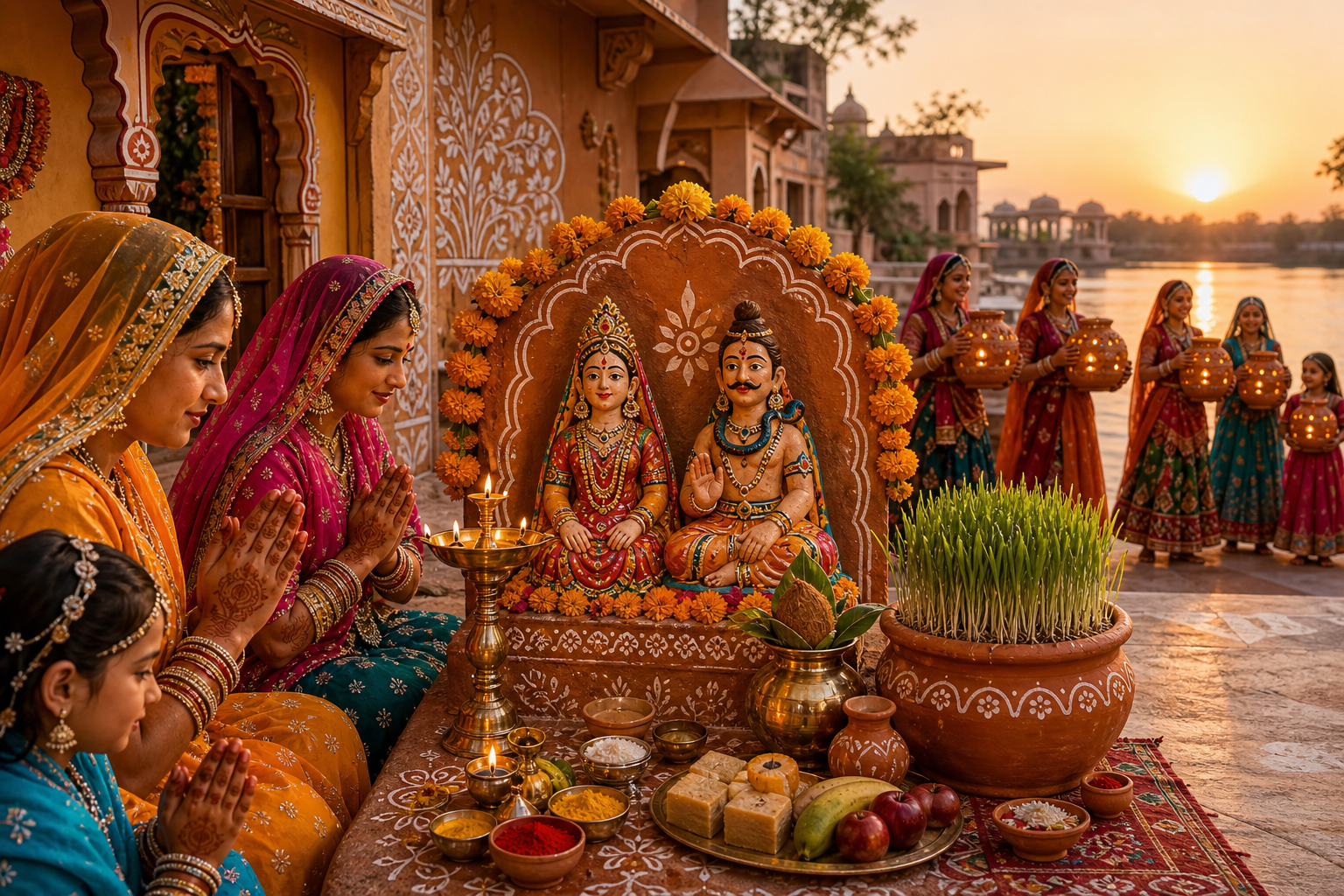
Gangaur Teej Vrat is one of the most graceful and symbolically rich observances in the Hindu festival calendar, especially in Rajasthan and in several communities across northern and western India. The vrat centers on the worship of Goddess Gauri, a beloved form of Parvati, along with Lord Shiva, often lovingly addressed in regional tradition as Isar. It is not merely a domestic ritual for marital well-being; it is also a seasonal celebration of spring, fertility, renewal, feminine devotion, community memory, and the sacred continuity of family life.
The observance traditionally begins after Holi and continues through a period commonly described as sixteen or eighteen days, depending on regional practice, family custom, and local panchang interpretation. The culmination is associated with Chaitra Shukla Tritiya, when decorated images of Gauri and Shiva are worshipped and, in many places, ceremonially taken in procession for immersion or symbolic farewell. This timing is important because Gangaur stands at the threshold between the exuberance of Holi and the disciplined devotional rhythm of Chaitra, transforming festive color into sacred commitment.
The central question of what to do on Gangaur Teej Vrat can be answered at three levels: the physical rituals performed at home and in community, the ethical discipline of fasting and restraint, and the inner meaning of devotion to Gauri and Shiva. At the practical level, women prepare images or symbolic forms of Gauri, observe fasting or dietary discipline, water sprouted grains, sing traditional songs, offer puja, decorate the divine images, and participate in collective processions. At the spiritual level, the vrat cultivates steadiness, hope, relational harmony, gratitude, and respect for the sacred feminine.
Married women traditionally observe Gangaur for the long life, health, and well-being of their husbands and for the stability of household life. Unmarried girls observe it for the blessing of a worthy spouse and a harmonious future family. In a broader dharmic understanding, however, the vrat is not confined to a narrow social purpose. It honors the complementarity of Shiva and Shakti, the union of consciousness and creative energy, and the ideal of relationships rooted in mutual dignity, self-discipline, loyalty, and spiritual purpose.
The first preparation is internal and domestic cleanliness. The place of worship is cleaned, the puja area is arranged, and the household atmosphere is made calm and auspicious. A small altar may be prepared with a clean cloth, a kalasha, flowers, incense, lamp, water, grains, kumkum, turmeric, sandal paste, rice, fruits, sweets, and other offerings used according to family tradition. The emphasis is not on display but on shuchi and shraddha, meaning purity and sincere devotion.
A distinctive Gangaur ritual is the collection of ashes from the Holi fire and the sowing of wheat or barley seeds in those ashes or in a prepared earthen vessel. These seeds are watered daily until they sprout. This act has deep agricultural and symbolic meaning. Holi represents burning away the old, while the sprouting grains represent renewal, fertility, continuity, and the return of life through disciplined care. The daily watering is a small but powerful vrata discipline: devotion is not completed in a single dramatic moment but sustained through repeated attention.
Clay or wooden images of Gauri, and in many traditions Gauri with Isar, are prepared or installed. In some households, simple earthen images are made fresh each year. In others, wooden images are preserved and repainted annually. The form may be elaborate or modest, but the principle remains the same: the devotee gives visible form to a subtle ideal. Gauri is invoked as auspiciousness, beauty, strength, chastity, fertility, compassion, and inner power. Shiva is invoked as steadiness, renunciation, consciousness, and protective grace.
During the daily observance, the devotee may bathe early, wear clean or traditional clothes, light a lamp, offer water, flowers, kumkum, turmeric, rice, and seasonal food items, and recite prayers or regional songs dedicated to Gauri and Shiva. Many communities preserve Gangaur songs through oral tradition, and these songs are as important as formal mantra in maintaining cultural memory. They carry the emotional texture of the festival: longing, celebration, affection, humor, sisterhood, and reverence.
Fasting is another important component of Gangaur Vrat. In many traditions, women eat only one meal a day during the observance, while others follow a lighter or more localized dietary rule. The form of fasting should be guided by health, age, family custom, and practical capacity. A dharmic fast is not meant to harm the body. Its purpose is to train desire, refine attention, and transform ordinary appetite into devotional awareness. Those with medical conditions, pregnancy, or physical vulnerability may adapt the fast with guidance from elders and qualified health professionals.
One of the most recognizable customs is the ghudlia or earthen pot ritual, especially associated with Rajasthan. Women and girls carry an earthen pot with small holes and a lamp placed inside it, often while singing folk songs in groups. The glowing lamp within the perforated pot becomes a visual metaphor for inner light shining through the body, the home, and the community. In some regions, young girls receive sweets, gifts, or small tokens from elders, reinforcing intergenerational affection and social blessing.
Mehendi, ornaments, colorful dress, and festive adornment also form part of the Gangaur experience. These should not be reduced to surface decoration. In traditional Hindu aesthetics, beauty itself can become an offering when it is aligned with auspiciousness and restraint. The decorated hands, the painted images, the fresh garments, the flowers, and the lamps all express the idea that sacred life is not separate from embodied life. The home, the body, the village, and the divine image are all made worthy of worship.
The last three days of Gangaur are especially significant. The images of Gauri and Shiva are decorated with particular care, dressed beautifully, and treated almost as living presences. Devotees may offer special puja, sing songs, prepare traditional foods, and gather with other women in the neighborhood or community. The festival becomes both private vrata and public culture. This balance is one of the reasons Gangaur has remained vibrant across generations: it gives women a sacred space for devotion, artistry, leadership, and community bonding.
On the concluding day, the decorated images are often carried in procession to a water body such as a pond, lake, river, well, or community tank. After puja and offerings, the images may be immersed or ceremonially returned, depending on local custom. The immersion is not a dismissal of the deity; it is a ritual recognition that divine presence moves between form and formlessness. The clay returns to water, the seasonal vow concludes, and the blessings of Gauri and Shiva are carried back into ordinary household life.
A traditional Gangaur Puja sequence may include purification of the worship space, lighting of the deepa, invocation of Gauri and Shiva, offering of water and achamana, application of turmeric and kumkum, offering of flowers and akshata, presentation of naivedya, recitation of prayers or songs, circumambulation, aarti, and respectful distribution of prasad. Regional families may add specific katha, songs, vows, or gestures inherited from mothers and grandmothers. Such inherited details should be preserved wherever possible because they carry living cultural knowledge.
The use of wheat and barley sprouts deserves special attention. In agrarian society, sprouting grains were never a casual object; they represented future food, prosperity, and the continuity of life. By watering the seeds daily, the devotee participates in a miniature act of cultivation. The ritual connects domestic spirituality with ecology. It reminds the household that food, marriage, fertility, rain, soil, and divine grace are interconnected. In this sense, Gangaur is not only a festival of women but also a festival of the earth.
The worship of Gauri also carries a profound theological meaning within Sanatana Dharma. Parvati is not merely the consort of Shiva; she is Shakti, the dynamic power without which Shiva remains still and unmanifest. Their union teaches that household life and spiritual life need not be opposed. Discipline and affection, renunciation and beauty, stillness and movement, masculine and feminine principles can coexist in harmony. Gangaur translates this philosophy into daily ritual action.
For unmarried girls, the vrat has traditionally been connected with the prayer for a suitable husband. In modern interpretation, this may be understood more deeply as a prayer for a life partner marked by integrity, steadiness, compassion, and dharmic responsibility. The aspiration is not simply marriage as a social event but marriage as a sacred partnership. Such a reading preserves the traditional intention while speaking meaningfully to contemporary life.
For married women, the prayer for the husband’s long life and well-being is part of a larger household ethic. It reflects care, commitment, and the desire for shared prosperity. A balanced dharmic understanding also recognizes that household harmony is reciprocal. The blessings of Gauri and Shiva point toward mutual respect, emotional steadiness, truthfulness, responsibility, and protection of the family as a sacred unit.
The emotional power of Gangaur lies in its combination of intimacy and community. Many families remember the festival through the sounds of women singing in courtyards, the smell of wet earth around sprouting grains, the glow of lamps inside earthen pots, and the excitement of young girls receiving blessings from elders. These memories are not ornamental; they are how dharma becomes embodied across generations. Ritual survives when it is loved, repeated, and understood.
There are also practical points to observe. The puja materials should be clean and respectfully handled. The fast should be undertaken with physical prudence. The daily watering of the seeds should be consistent. The images should be decorated with care but without unnecessary extravagance. If immersion is practiced, eco-friendly clay and natural colors should be preferred so that devotion does not harm water bodies. A ritual aligned with dharma must also respect ecological responsibility.
In families where the exact procedure is not known, the best approach is to follow the local panchang, consult elders, and keep the worship simple. A sincere offering of water, flowers, lamp, prayer, and disciplined conduct is better than an elaborate ritual performed mechanically. The traditional framework can be preserved without anxiety: install or worship Gauri and Shiva, observe the chosen fast, care for the sprouted grains, sing or recite prayers, offer puja, and conclude with gratitude.
Gangaur also offers a useful example of unity among dharmic traditions. While the festival is specifically Hindu in theology and ritual form, its values resonate widely across dharmic life: reverence for disciplined practice, respect for household ethics, honor for feminine spiritual power, gratitude to nature, and the transmission of wisdom through community. These values are not divisive. They strengthen cultural confidence while allowing respectful coexistence with the wider family of Indic spiritual traditions, including Hinduism, Buddhism, Jainism, and Sikhism.
At its best, Gangaur Teej Vrat is not a superstition or a social formality. It is a carefully layered observance that joins vrata, puja, ecology, seasonal rhythm, women’s cultural leadership, family continuity, and devotion to Shiva and Shakti. The devotee who performs it with sincerity learns patience through fasting, tenderness through daily care of sprouts, beauty through decoration, humility through prayer, and belonging through shared songs and processions.
Therefore, the essential acts on Gangaur Teej Vrat are clear: worship Goddess Gauri and Lord Shiva, maintain purity and devotion, observe the fast according to capacity, sow and water wheat or barley seeds, decorate the divine images, sing traditional songs, honor young girls and elders, perform puja during the final days, and conclude with a respectful farewell or immersion. Beneath these actions lies the true purpose of the vrat: to bring auspiciousness into the home, harmony into relationships, discipline into the mind, and reverence into everyday life.
Inspired by this post on Hindu Pad.
