
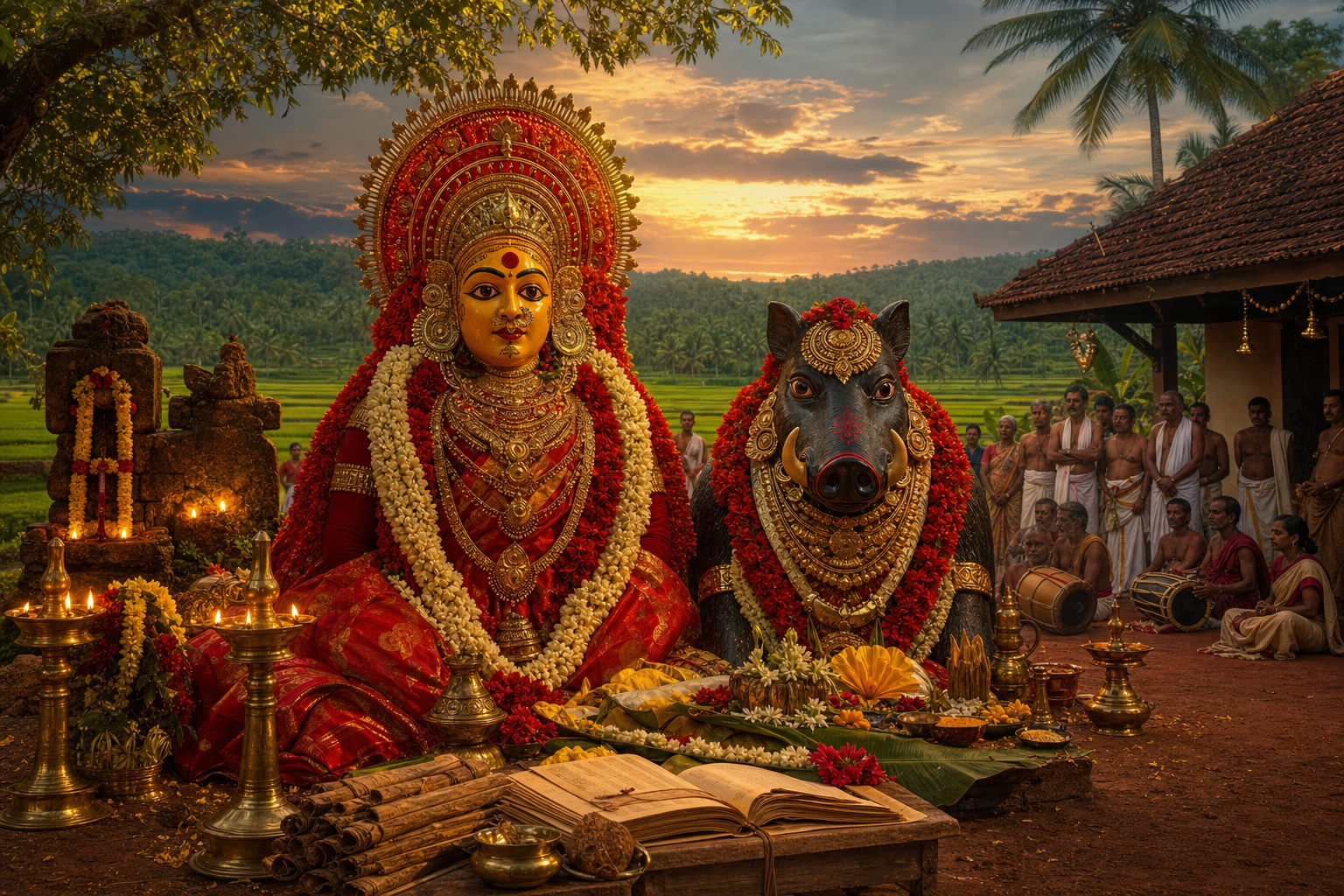
Thage Thangadi Sathyolu is best understood as a sacred expression of kinship, truth, and moral responsibility within the living religious world of Tulunadu. In the devotional imagination of coastal Karnataka and the Tulu-speaking regions of northern Kerala, Kallurti and Panjurli are not merely figures from folklore; they are daivas whose presence is experienced through ritual, oral memory, community arbitration, ecological awareness, and the everyday ethics of family life. Their stories preserve a distinctive regional form of Hindu culture in which dharma is not only discussed as philosophy but enacted through performance, vow, remembrance, and public accountability.
The phrase Thage Thangadi Sathyolu evokes the emotional and ethical force of a brother-sister bond. In Tulunadu, kinship is rarely treated as a private sentiment alone. It becomes a structure through which society understands loyalty, protection, truth, obligation, and justice. When Kallurti and Panjurli are remembered together in devotional speech, the relationship points toward a larger cultural idea: the divine does not stand apart from human relationships but enters them, disciplines them, and gives them sacred meaning.
Kallurti is revered as a powerful folk goddess associated with justice, protection, moral order, and fierce compassion. Oral traditions present her as a force that cannot remain silent before injustice. She represents the dignity of the wronged, the strength of a sister who remembers, and the sacred anger that arises when truth is violated. In many Tulu narratives, Kallurti is closely connected with the sculptor-daiva Kalkuda, and regional traditions preserve variations in how her relationships are narrated. Such variation is not a weakness of the tradition; it is a feature of oral culture, where memory lives through performance, place, lineage, and ritual context.
Panjurli Daiva is widely venerated as a guardian spirit linked with the wild boar, agrarian protection, fertility, boundary-keeping, and the safeguarding of cultivated land. The boar is an especially meaningful symbol in an agricultural landscape. It can destroy crops, unsettle fields, and disrupt human order, yet in sacred imagination that same force becomes protective when ritually honored and morally integrated. Panjurli therefore embodies a refined ecological insight: nature is not conquered by contempt, but respected through relationship, restraint, and reverence.
Tulunadu’s daiva tradition belongs to the wider field of Bhuta Kola, Daiva Kola, and Daiva Nema, ritual systems in which divine beings are invoked through music, costume, dance, trance, oral recitation, and community participation. These ceremonies are not theatrical entertainment in the ordinary sense. They are ritual events in which memory becomes visible and social truth is publicly examined. The daiva is approached as a living moral authority, and the assembled community becomes a witness to the restoration of order.
The technical structure of Bhuta Kola reveals a sophisticated cultural system. Ritual specialists prepare the body, costume, ornaments, facial design, voice, movement, and sacred space so that the daiva may be ritually embodied. Drums, chants, lamps, offerings, and recitations create an environment in which the human performer becomes a channel of divine presence. The performance often includes paddanas, the oral narrative songs that preserve the origins, journeys, conflicts, vows, and powers of the daivas. Through paddanas, Tulunadu maintains an archive that is sung rather than stored, embodied rather than merely written.
The importance of paddanas cannot be overstated. They function as oral history, ritual theology, ethical instruction, and social memory. They preserve names of places, families, conflicts, migrations, promises, and transformations. In an academic sense, they are a form of indigenous historiography; in a devotional sense, they are acts of remembrance. They show how Tulunadu’s sacred traditions are not isolated from society but deeply woven into land, labor, lineage, and local justice.
Kallurti’s role in this world is especially striking because she embodies the moral seriousness of feminine power. She is not reduced to gentleness alone, nor is her fierceness treated as disorder. Her anger is meaningful because it is tied to truth. Her protection is powerful because it arises from compassion. Her justice is feared because it is not arbitrary. In this way, Kallurti belongs to the broader Indic understanding of Shakti, where the feminine divine can nourish, protect, warn, correct, and, when necessary, confront adharma.
Panjurli’s sacred personality complements this moral field through guardianship of land and community. As Panjurli Daiva is associated with the boar, the tradition remembers the thin line between wilderness and cultivation. Fields, forests, households, cattle paths, water sources, and village boundaries all require protection. Panjurli is therefore not only a deity of fear or power but also a daiva of balance. The ritual honoring of Panjurli expresses gratitude for the land and acknowledges that human prosperity depends upon ecological discipline.
When Kallurti and Panjurli are placed within the emotional frame of sibling daivas, their sacred bond becomes a teaching on complementary forms of protection. Kallurti protects truth, honor, and moral dignity. Panjurli protects land, fertility, boundaries, and communal welfare. Together, they represent a complete vision of dharmic life: justice must be rooted in compassion, and prosperity must be governed by restraint. The family, the field, the village, and the sacred world are not separate compartments; they are interdependent realms of responsibility.
This interdependence explains why daiva worship in Tulunadu has historically carried both religious and civic significance. In many communities, Daiva Kola has served as a sacred forum where disputes are heard, vows are remembered, and moral obligations are clarified. Land conflicts, family tensions, questions of betrayal, broken promises, and unresolved grievances may be brought into the presence of the daiva. The ritual does not function like a modern court, yet it reflects a profound cultural conviction: justice requires more than procedure; it requires truthfulness before the sacred.
The daiva’s authority is rooted in public accountability. The community gathers, listens, remembers, and accepts that human actions carry consequences. This gives Bhuta Kola a social depth that is often missed when it is viewed only as performance. It is also a form of ethical pedagogy. Children watching the ritual learn that dishonesty, arrogance, exploitation, and disrespect for elders or land are not merely private failings. They disturb the moral fabric of the community.
The emotional power of Kallurti and Panjurli lies in their closeness to ordinary life. Their sacred world is not distant, abstract, or confined to elite textual spaces. It is found in paddy fields, ancestral homes, village shrines, seasonal festivals, family vows, ritual objects, lamps, drums, and remembered stories. This nearness gives the tradition its enduring strength. Devotees often approach the daivas not only for grand metaphysical answers but for protection, healing, justice, reconciliation, and courage in difficult circumstances.
From the perspective of Hindu cultural heritage, the daiva tradition of Tulunadu demonstrates the extraordinary plurality of Sanatana Dharma. The sacred is encountered through Vedic recitation in one context, temple worship in another, philosophical inquiry in another, and daiva embodiment in yet another. These forms need not be placed in opposition. They reveal the civilizational ability of Hindu traditions to hold textual, oral, regional, folk, philosophical, and ritual streams within a shared dharmic universe.
This point is important for unity among dharmic traditions. Hinduism, Buddhism, Jainism, and Sikhism have developed distinct theologies, practices, lineages, and institutional forms, yet they share a deep civilizational respect for discipline, memory, ethical action, self-transformation, and reverence for truth. Tulunadu’s daiva traditions add to this wider dharmic conversation by emphasizing lived accountability, ancestral continuity, gratitude to the land, and the sacred dignity of community life.
The worship of Kallurti and Panjurli also helps correct a common misunderstanding about folk traditions. Folk does not mean simplistic, primitive, or marginal. In Tulunadu, folk practice contains theology, law, aesthetics, ecology, psychology, and social philosophy. The ritual costume encodes identity. The dance expresses controlled divine intensity. The paddana preserves historical consciousness. The oracle dramatizes moral seriousness. The offering affirms reciprocity. The gathered community renews belonging.
Kallurti’s fierce compassion is especially relevant in contemporary life because it speaks to the problem of injustice within intimate spaces. Families and communities can preserve love only when they also preserve truth. A bond that ignores wrongdoing becomes weak; a bond that corrects with dignity becomes sacred. Kallurti’s memory teaches that compassion is not passivity. It can include firmness, confrontation, and the refusal to let the vulnerable be abandoned.
Panjurli’s symbolism is equally contemporary. In an age of environmental exhaustion, agricultural anxiety, and weakening bonds between people and land, Panjurli Daiva offers an indigenous model of ecological ethics. The field is not merely an economic asset. The forest is not merely unused land. Animals are not merely threats or resources. The world is relational, and human beings live well only when they understand the powers around them with humility.
The sibling motif deepens this ecological and ethical teaching. A brother-sister bond in Indian cultural memory often carries affection, duty, protection, playful difference, and solemn responsibility. When applied to daivas, it becomes a sacred grammar for understanding balance. Kallurti’s moral fire and Panjurli’s agrarian guardianship are not competing powers. They stand as related energies within a shared order, reminding devotees that justice and prosperity must protect one another.
The rituals connected with these daivas also preserve regional identity without rejecting broader Hindu belonging. Tulunadu has its own language, foodways, social histories, coastal economy, temple networks, serpent worship traditions, daiva shrines, Yakshagana heritage, and oral epics. Yet these regional forms participate in larger Indic patterns of honoring ancestors, protecting dharma, sacralizing land, and recognizing divine presence in multiple forms. This is unity through diversity, not uniformity through erasure.
Modern attention to Tulunadu’s daivas has grown through scholarship, cultural documentation, and popular media. This visibility can be useful when it encourages respect, but it also requires care. Kallurti, Panjurli, and other daivas should not be reduced to cinematic imagery or exotic spectacle. Their meaning comes from living communities, ritual lineages, hereditary performers, oral specialists, household traditions, and devotees who continue to approach them with reverence.
Academic study of these traditions must therefore remain attentive to both structure and sentiment. It can analyze ritual sequence, social function, gender symbolism, agrarian ecology, and oral literature, but it must also recognize that devotees experience the daivas as living presences. A purely external description may record the costume and music while missing the trembling seriousness of the vow, the silence before the oracle, or the relief felt when a long conflict is ritually resolved.
The living force of Kallurti and Panjurli is also visible in the way their stories travel across generations. Elders tell children about the daivas not only to entertain them but to teach caution, courage, and reverence. Families remember occasions when vows were made or blessings were sought. Villages remember the consequences of neglecting sacred obligations. Through these memories, the daivas remain part of moral education, not merely ritual calendar.
In this sense, Thage Thangadi Sathyolu is more than a devotional phrase. It is a compact cultural philosophy. It says that truth must be relational, that kinship must be ethical, that divine power must protect the vulnerable, and that memory must serve justice. It also suggests that sacred bonds are not sentimental decorations; they are disciplines that bind people to duties larger than personal convenience.
Kallurti and Panjurli continue to matter because they address permanent human concerns through the language of a particular region. Every society must ask how truth is protected, how land is respected, how anger is purified, how community disputes are resolved, how ancestral memory is preserved, and how power is restrained by dharma. Tulunadu answers these questions through daiva worship, ritual performance, oral narrative, and sacred kinship.
The enduring appeal of these sibling daivas lies in their ability to unite fear and affection, justice and mercy, land and lineage, ritual and daily life. Kallurti reminds society that truth has a protective motherly force. Panjurli reminds society that nature’s power must be honored before it can bless human prosperity. Together, they form a sacred vision of Tulunadu in which the divine is not distant from the village path, the family courtyard, the cultivated field, or the wounded human heart.
To study Kallurti and Panjurli is therefore to enter a world where Hindu folklore, cultural heritage, ecological intelligence, and spiritual practice meet. Their stories are not frozen relics of the past. They remain living frameworks through which communities negotiate belonging, justice, gratitude, and courage. In honoring them, Tulunadu preserves not only two revered daivas but also a profound dharmic lesson: sacred life is sustained when truth, protection, kinship, and reverence for the land are held together.
Inspired by this post on Hindu Blog.




Leave a Reply
You must be logged in to post a comment.