
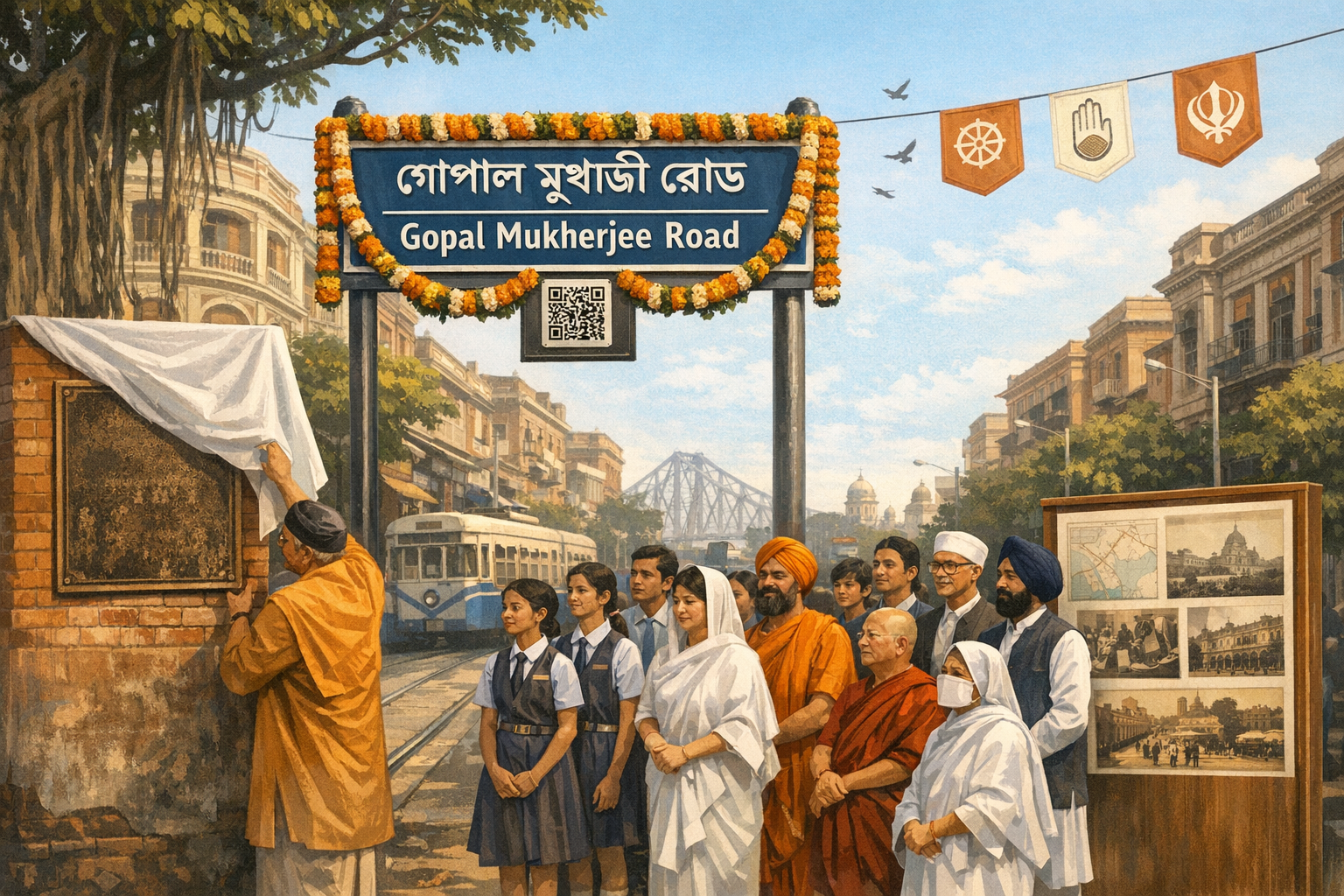
West Bengal Day 2026 was observed across the state on 20 June with an emphasis on historical remembrance, civic pride, and interfaith harmony among the dharmic traditions of Hinduism, Buddhism, Jainism, and Sikhism. The day’s landmark urban decision in Kolkata—renaming Suhrawardy Avenue as Gopal Mukherjee Road—was framed as an act of equitable public memory that foregrounds civil courage during the tumultuous years preceding Independence. In parallel, the government honored the legacy of Dr. Syama Prasad Mookerjee, highlighting his role in public life, education, and national integration.
June 20 carries distinctive historical significance in Bengal’s modern journey. On 20 June 1947, the Bengal Legislative Assembly convened to decide the province’s constitutional future, a process that culminated in the partition of Bengal and the creation of West Bengal within the Indian Union. Commemorating West Bengal Day on this date situates present civic celebrations within the larger arc of constitutional choice, democratic procedure, and the difficult moral economy of partition—while striving to transform a day of historic decision into a platform for unity, reflection, and renewal.
The observance of West Bengal Day alongside enduring cultural touchstones such as Poila Boishakh and Paschimbanga Dibas demonstrates that collective identity in Bengal is layered rather than singular. These markers operate in complementary registers: Poila Boishakh nurtures civilizational continuity and cultural joy; Paschimbanga Dibas emphasizes state identity; and 20 June foregrounds constitutional history. Ensuring that these commemorations are mutually reinforcing enables an inclusive public calendar in which communities across the region can see their experiences and aspirations represented.
Across districts, the 2026 observances featured heritage walks, school seminars, and archival exhibitions that explored the transformations of Bengal from the late colonial period to contemporary times. Programming focused on accessible public education: curated panels explained the constitutional context of 1947, community historians shared oral histories of migration and resettlement, and youth groups documented local heritage sites. These initiatives promoted intergenerational dialogue, inviting families to connect personal narratives with documentary sources and curated timelines.
The public commemoration of Dr. Syama Prasad Mookerjee situated his contributions within three intersecting domains: higher education, governance, and constitutional debate. As a vice-chancellor of Calcutta University, he strengthened academic standards and institutional autonomy; as a public representative and later Union minister, he underscored industrial development and national self-reliance; and in the fraught negotiations of the late 1940s, he advocated arrangements intended to safeguard cultural plurality and the security of vulnerable populations. In the 2026 observance, his legacy was interpreted through the lens of democratic dissent and institution-building—emphasizing civic responsibility across ideological lines.
The renaming of Suhrawardy Avenue to Gopal Mukherjee Road generated thoughtful discussion about the ethics of urban toponymy in postcolonial societies. Place names are not merely directional; they shape collective memory, inter-community empathy, and educational inquiry. Aligning street names with locally resonant histories is a policy instrument that can elevate civic values and encourage citizens to engage critically with contested pasts while upholding present-day commitments to coexistence and the unity of dharmic traditions.
Huseyn Shaheed Suhrawardy remains a complex figure in Bengal’s twentieth-century history—serving as Premier of Bengal in 1946 and later as Pakistan’s Prime Minister. In Kolkata’s collective memory, his tenure is debated in relation to the 1946 disturbances, with scholarly assessments emphasizing the need to examine archival evidence, administrative constraints, and the broader political climate. Acknowledging this complexity is foundational to ethical remembrance: it permits critique without erasure, and it supports a civic culture oriented toward learning over recrimination.
Gopal Chandra Mukherjee (widely known as Gopal Mukherjee or Gopal Patha) is remembered in many neighborhoods for organizing community self-defence during the violence of 1946. In popular narratives, he symbolizes grassroots mobilization to protect lives and restore order amid breakdowns of civic security. Contemporary reinterpretations stress that such remembrance should be channeled toward commitments to peacebuilding, neighborhood solidarity, and cross-community welfare—principles that resonate with the dharmic ethos of protecting life and upholding dignity.
Public response to the renaming highlighted two complementary imperatives: first, to honor acts of local courage and social service; and second, to preserve the historian’s duty to document, analyze, and contextualize. Civil-society stakeholders recommended that new street signage be accompanied by QR codes linking to open-access resources explaining the historical context of both names—thereby transforming a symbolic change into a living classroom for residents, visitors, and students.
West Bengal’s plural civilizational fabric—shaped by Hindu, Buddhist, Jain, and Sikh contributions—formed the moral and pedagogical core of the day’s messaging. Buddhist monastic remains at Moghalmari in Paschim Medinipur, Jain heritage in Purulia’s temple clusters, and the historic Sikh presence in Kolkata’s gurdwaras together attest to centuries of knowledge, devotion, and service. By explicitly integrating these strands, West Bengal Day 2026 positioned unity among dharmic traditions not as rhetoric, but as a lived social ethic and policy priority.
Educational programming encouraged schools and colleges to approach 1905 and 1947 in tandem—showing how the first Partition of Bengal under Curzon and the later partition in 1947 produced distinct but interconnected legacies. The approach balanced macro-history (constitutional frameworks, administrative realignments, and migration) with micro-history (village records, family letters, and neighborhood oral testimonies). Students reported that this dual frame yielded a more empathetic understanding of displacement, resilience, and the rebuilding of livelihoods.
In a state globally recognized for its intangible cultural heritage—exemplified by Durga Puja’s UNESCO inscription—West Bengal Day’s design aligned with best practices in heritage stewardship: documentation, community participation, and interpretive clarity. District-level exhibitions drew connections between ritual arts, artisanal economies, and social solidarity, underscoring how cultural practices can anchor welfare networks, civic volunteering, and disaster response.
Policy discussions surrounding the renaming emphasized process integrity: municipal resolutions, public notifications, multilingual signage (Bengali and English), and phased logistical updates to emergency services, navigation platforms, and postal systems. Planners recommended that renamings be accompanied by micro-histories on official portals, curated by multidisciplinary committees of historians, archivists, urban designers, and community representatives to ensure factual accuracy and interpretive balance.
Memory policy in diverse societies benefits from a two-level framework. At the commemorative level, symbolic acts—like West Bengal Day or street renamings—should articulate inclusive values and honor civic courage. At the curricular level, robust historical instruction should present the full spectrum of archival evidence, scholarly debates, and regional perspectives, including those from Hindu, Buddhist, Jain, and Sikh communities. Together, these levels reduce polarization by transforming memory from a site of contestation into a shared pursuit of understanding.
Civic organizations used the occasion to foreground service. Blood-donation camps at gurdwaras and temples, interfaith food-distribution drives, and heritage-cleanup initiatives at neighborhood shrines and public parks converted remembrance into actionable solidarity. These efforts aligned with the dharmic principle of seva, reaffirming that the truest tribute to past sacrifices is present-day care for neighbors, irrespective of sect or social location.
For many families in Kolkata, the day stirred intergenerational storytelling. Grandparents recounted the anxieties of 1947 and the slow work of rebuilding; younger members connected these personal histories to maps, photographs, and digitized newspapers accessed at community libraries. In such settings, the new name—Gopal Mukherjee Road—became a conversational bridge, prompting questions about responsibility in times of crisis and the civic skills needed to keep neighborhoods safe and cohesive today.
The diaspora dimension also featured prominently. Associations from London to New Jersey convened hybrid panels on “Bengal after Partition,” highlighting entrepreneurs, scholars, and social workers who have sustained cultural and economic linkages with the state. Diaspora forums emphasized that unity among dharmic traditions is a source of soft power and shared purpose, nourishing educational exchanges, philanthropy, and sustainable development partnerships.
From a governance perspective, West Bengal Day 2026 provided a scaffold for long-horizon initiatives: digitizing district archives; training teachers in oral-history methods; and creating open datasets on heritage sites to support conservation, tourism, and local livelihoods. These measures align with national objectives for cultural documentation and with international norms that treat heritage as a public good requiring transparency, community custodianship, and interdepartmental coordination.
The day’s messaging repeatedly underscored that memory is healthiest when it is truthful, empathetic, and future-oriented. Truthfulness requires careful use of sources and acknowledgment of complexity; empathy demands recognition of suffering across lines of class, creed, and community; and future-orientation calls for transforming knowledge into policy that reduces vulnerability and enhances social trust. Such calibration helps ensure that remembrance strengthens rather than fractures the social fabric.
In summary, West Bengal Day 2026 advanced three strategic goals: it situated 20 June within a rigorous, accessible account of Bengal’s constitutional history; it used urban toponymy—the renaming of Suhrawardy Avenue as Gopal Mukherjee Road—as a pedagogical catalyst rather than a partisan instrument; and it affirmed, through programming and service, the unity of the dharmic traditions that have shaped the region’s civilizational journey. The outcome was a commemoration that looked unflinchingly at the past while investing deliberately in a shared, secure, and compassionate future.
Inspired by this post on Struggle for Hindu Existence.








Leave a Reply
You must be logged in to post a comment.