
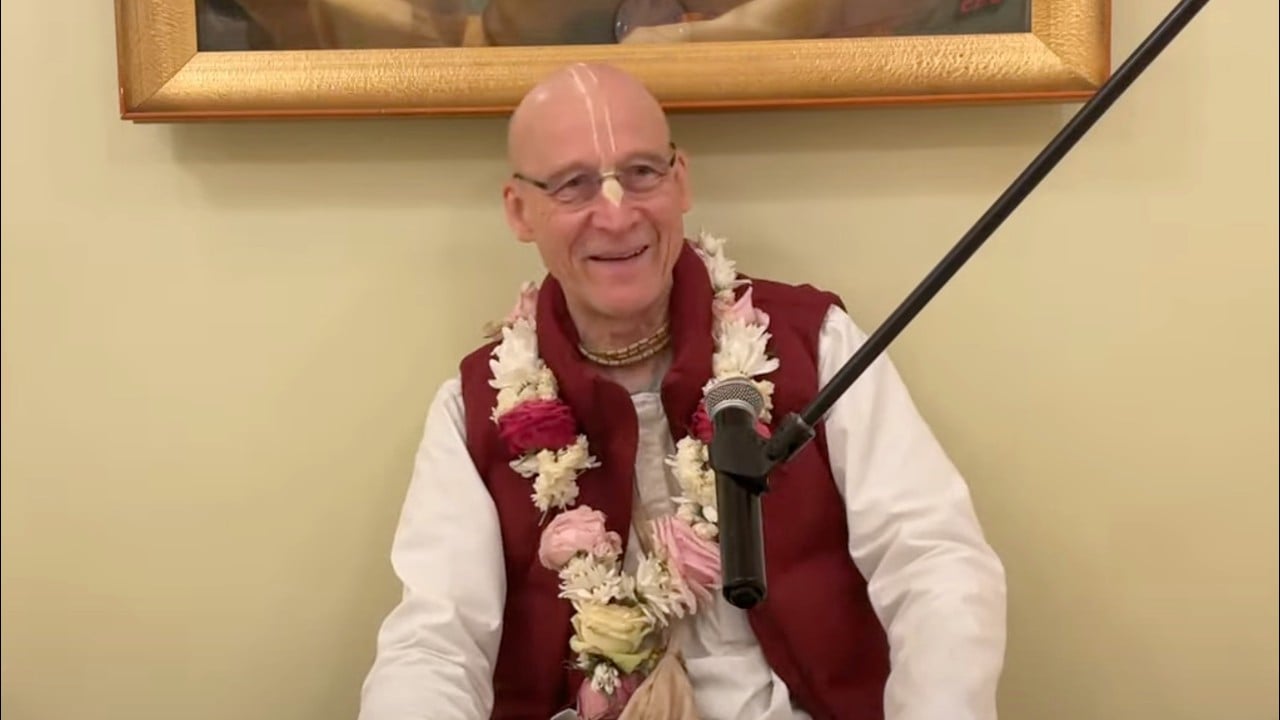
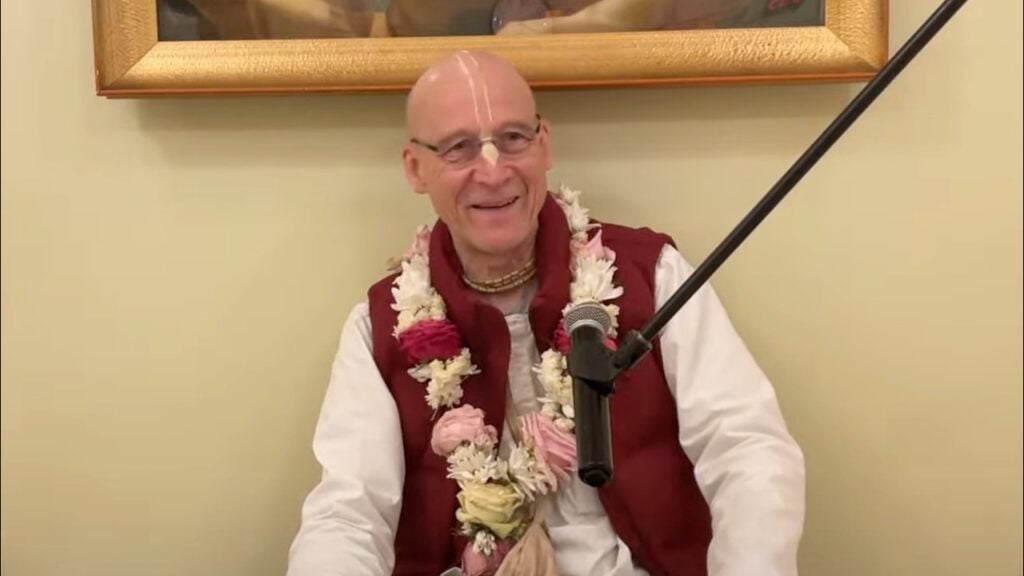
On 21 June 2026, the Hare Krishna Melbourne community hosted a Śrīmad Bhāgavatam morning class delivered by HG Aniruddha Prabhu, focusing on SB 10.7.19. The session, part of the daily 7:30 a.m. stream, invited a careful reading of Canto 10, Chapter 7 within the wider devotional and philosophical landscape of bhakti-yoga.
This class situated verse 10.7.19 amid the early childhood pastimes in Vraja, where episodes of awe and danger refract the paradox of divinity appearing as a child. The chapter’s narrative arc, centered on the whirlwind demon Tṛṇāvarta and the community’s protective response, frames the verse as an exploration of maternal vigilance, communal ritual, and the certainty of divine guardianship.
In textual terms, the verse is embedded within the community’s astonishment that repeated threats dissolve in ways that intensify affection rather than fear. The juxtaposition of vulnerability and omnipotence foregrounds vātsalya-rasa (parental devotion), a key aesthetic category through which devotion is felt, shared, and ethically expressed in daily life.
Drawing on the classical Vaishnava commentarial tradition, the class highlighted how luminaries such as Śrīdhara Svāmī and Jīva Gosvāmī read these events not as anomalies but as revelatory pedagogy: obstacles become instruments for awakening remembrance, the heart of śravaṇa (hearing) and smaraṇa (sacred recollection). The verse, accordingly, is less a report of miracle than an invitation to perceive meaning in the rhythm of protection, gratitude, and renewed care.
From a hermeneutic standpoint, the discussion modeled a triangulation of śāstra (text), ācārya (lineage commentary), and anubhava (lived experience). By correlating the verse with daily sādhana—chanting, kīrtana, study, and mindful service—the class translated ancient narrative into present-moment practice without diluting textual rigor.
The narrative’s maternal center of gravity also underscores how dharma operates as guardianship. The mothers of Vraja respond to danger not with despair, but with recommitment to protective rites and community solidarity; the class emphasized this as an ethic of care applicable to families navigating contemporary uncertainties, including digital overload, fractured attention, and value transmission across generations.
Philosophically, the text affirms a non-competitive relationship between human agency and divine agency. Vigilance, prudence, and ritual action are not abandoned to providence; rather, they are dignified by it. This alignment mirrors core teachings across the bhakti tradition: effort is meaningful, yet grace is decisive.
The session further explored how early-morning contemplation stabilizes attention and mood, noting convergences with empirical research on contemplative practice that associates consistent morning routines with improved focus and emotional regulation. While not framed as clinical advice, the point was clear: regular śravaṇa at the day’s outset becomes a scaffold for ethical clarity and relational warmth.
To anchor practice, the class revisited the nine processes of bhakti (navadhā-bhakti)—śravaṇa, kīrtana, smaraṇa, pāda-sevana, arcana, vandana, dāsya, sakhya, and ātma-nivedana—and showed how a single verse can catalyze multiple modalities of engagement. Verse-centered reflection may begin in hearing and evolve into gratitude, service, and quiet offering throughout the day.
In keeping with the civilizational ethos of dharmic unity, the discussion drew gentle parallels with Buddhist paritta recitations that cultivate fearless compassion, the Jain Namokār Mantra’s steadying humility, and Sikh Ardaas and kīrtan that bind community through remembrance. These traditions converge on a shared grammar of protection-through-virtue: ahiṁsā, karuṇā, satya, and sevā.
Socio-culturally, a daily Śrīmad Bhāgavatam class operates as living heritage for diaspora communities. Beyond information, it transmits cadence—how a community breathes, remembers, and relates. Participants often describe a quiet confidence after class, a felt sense that attention has been re-ordered around what is enduring.
The class also acknowledged textual humility: transmission histories and verse enumerations can vary across editions, inviting readers to value guidance from a stable guru–śāstra–sādhu framework. Such humility protects study from both dogmatism and relativism, keeping inquiry devotional and dialogical.
Practically, families were encouraged to translate the verse’s protective ethos into simple, sustainable routines—shared readings at breakfast, one kīrtan melody everyone knows, and device-free windows that honor presence. These are small, repeatable gestures that enact vātsalya-rasa in contemporary homes.
For students of theology and philosophy, SB 10.7.19 offers a compact case study in theodicy resolved not by abstraction but by relationship: danger does not negate goodness; it occasions deeper trust and wiser care. For practitioners, the verse provides a daily litmus test—does practice make one gentler, more attentive, and more available to serve?
Situated within Melbourne’s winter light on 21 June 2026, the class by HG Aniruddha Prabhu thus became both exegesis and experience: a measured, text-faithful reading that nourished emotion without sentimentality and affirmed discipline without austerity. The resulting synthesis—head, heart, and hands aligned—is what sustains bhakti across times and geographies.
In sum, this exploration of Śrīmad Bhāgavatam 10.7.19 advanced an integrative vision consonant with the blog’s aim: unity among the dharmic traditions through shared values and respectful study. The morning cadence at 7:30 a.m. remains a trustworthy container for such unity—quiet, consistent, and welcoming.
Inspired by this post on Dandavats.








Leave a Reply
You must be logged in to post a comment.