
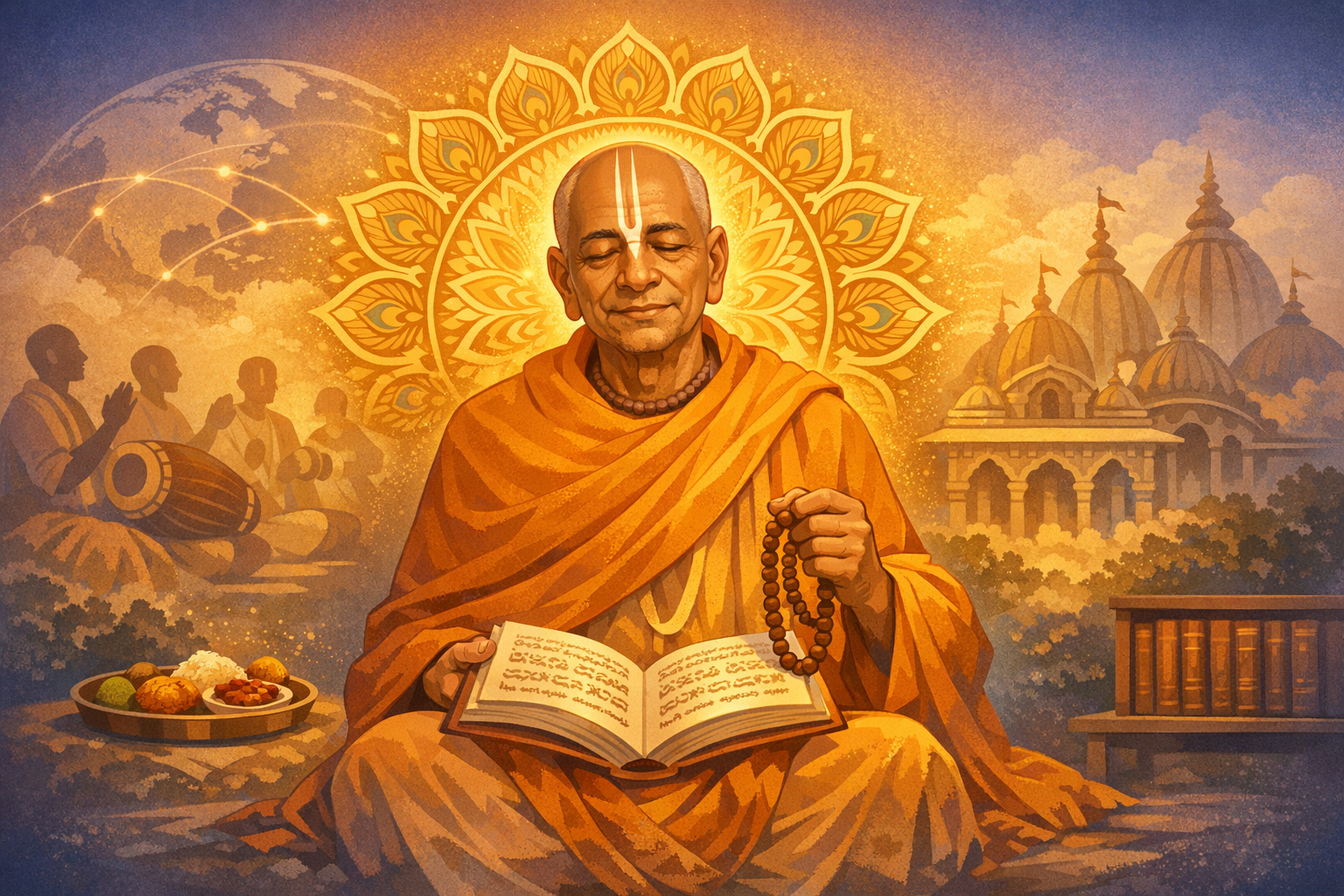
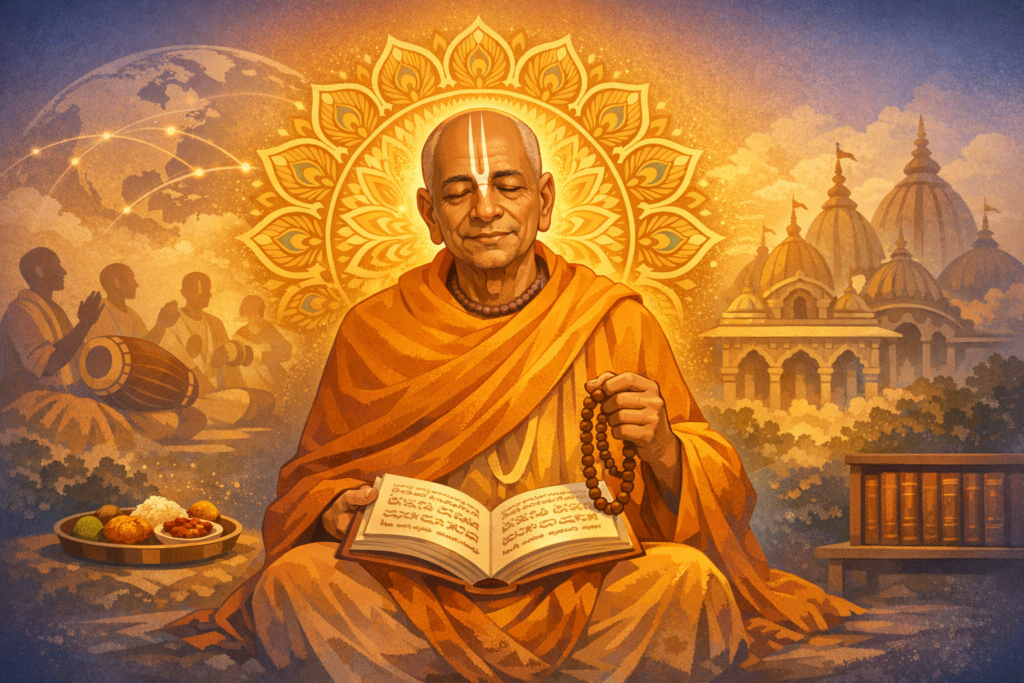
A. C. Bhaktivedanta Swami Srila Prabhupada (20th century) is widely recognized as a universal spiritual guide who founded the International Society for Krishna Consciousness (ISKCON), popularly known as the Hare Krishna Movement. His life-work advanced KRISHNA BHAKTI across boundaries of caste, creed, community, nationality, and language, offering a practical path of bhakti-yoga suited to modern life while remaining anchored in the classical Vaishnava tradition.
This exploration presents the golden insights distilled from Srila Prabhupada’s widely studied teachings and commentaries, framed in an academically rigorous yet accessible manner. Instead of isolated aphorisms, it organizes his core messages thematically—devotional practice, ethical discipline, scriptural hermeneutics, community life, and inter-dharmic harmony—so that readers gain both conceptual clarity and practical direction.
Historically, his work stands in the Gaudiya Vaishnava lineage of Sri Chaitanya (16th century), which emphasizes nama-sankirtana, the collective glorification of the Divine Name. Establishing ISKCON in 1966 in New York, Srila Prabhupada catalyzed a global devotional renaissance, integrating kirtan, scriptural education, temple worship, and community service into a coherent movement that reached thousands of practitioners and seekers worldwide.
Philosophically, his presentation centers on bhakti-yoga—the cultivation of loving devotion to Sri Krishna as the Supreme Person (Bhagavan). This approach articulates a relational theism in which the atman (self) realizes its eternal identity through service (seva) and remembrance (smarana) of the Divine, harmonizing metaphysical insight with daily conduct. The result is a lived theology in which knowledge (jnana), action (karma), and devotion (bhakti) converge.
Textually, his commentarial corpus on the Bhagavad-gita, Srimad-Bhagavatam, and Caitanya-caritamrita follows the classical hermeneutic triad—guru, sadhu, and shastra—seeking fidelity to parampara (disciplic succession). His translation philosophy, epitomized by the title “Bhagavad-gita As It Is,” aims to preserve original meanings while providing expansive expository purports that connect scriptural principles to contemporary ethical, social, and personal contexts.
Central to practice is chanting the maha-mantra, Hare Krishna, Hare Krishna, Krishna Krishna, Hare Hare / Hare Rama, Hare Rama, Rama Rama, Hare Hare, which Gaudiya Vaishnavism prescribes as especially efficacious in Kali-yuga. Beyond liturgical chant, Srila Prabhupada taught that the Holy Name can be engaged as a steady contemplative discipline (japa) that shapes attention, emotion, and intention, and as congregational kirtan that builds fellowship and shared purpose.
Daily sadhana integrates fixed rounds of japa with scriptural study (svadhyaya), deity worship (arcana), service to community (seva), and association with devotees (satsanga). The routine is designed to stabilize attention, elevate the heart, and translate insight into conduct. Practitioners often describe noticeable improvements in focus, temperance, and meaning-making when these elements are sustained in balance.
Srila Prabhupada also emphasized ethical disciplines—no meat-eating, no intoxication, no illicit sex, and no gambling—not as negations but as guardrails that conserve vital energy, refine attention, and foster sattva (clarity and harmony). In practical terms, these principles support mental steadiness, relational integrity, and healthful lifestyle habits aligned with the broader Hindu way of life.
Socially, he advocated varna-ashrama-dharma in its classical sense—roles and responsibilities guided by guna (qualities) and karma (work), not birth. This vocational and ethical framework encourages individuals to align temperament, skill, and service, while rejecting casteism. The emphasis on character and contribution invites inclusive spiritual citizenship and reduces barriers that fragment society.
Institutionally, ISKCON’s growth drew upon robust governance, transparent accounting, and the primacy of education and publishing. Book distribution, prasadam outreach, festivals, and temple communities were positioned as platforms for learning and service. The model illustrates how devotional organizations can blend spiritual aims with professional management, thereby sustaining momentum and widening access.
Food sanctification (prasadam) and public kirtan created hospitable spaces where strangers became friends through shared music, dialogue, and wholesome meals. These practices not only disseminate core teachings but also provide low-barrier points of entry for seekers and families, reflecting a community-first ethos that remains central to the Hare Krishna Movement.
In inter-dharmic perspective, Srila Prabhupada’s focus on compassion (daya), non-harm (ahimsa), truth-seeking (satya), and service (seva) harmonizes with foundational values honored across Hinduism, Buddhism, Jainism, and Sikhism. While remaining rooted in Vaishnava theology, his method respects sincere spiritual striving everywhere and encourages cooperation among dharmic traditions for social welfare and inner transformation.
At the level of self-understanding, a consistent emphasis is placed on recognizing the distinction between body and atman, and cultivating practices that reorient identity from consumption and status to service and remembrance. This shift, supported by the dynamics of the three gunas (sattva, rajas, tamas), offers a diagnostic for inner growth: clarity increases as attachment and lethargy diminish, and devotion consolidates insight into purpose.
Educationally, the movement’s publishing endeavors and structured courses foster scriptural literacy, critical reflection, and practical ethics. The accessible language of translations alongside Sanskrit and Bengali source materials helps students develop both devotional appreciation and analytic competence, bridging tradition and modern scholarship.
Engagement with science and society formed another strand of Srila Prabhupada’s legacy. Dialogue initiatives invited inquiry into consciousness and the limits of reductionism, encouraging respectful conversation rather than polemic. The broader outcome is an ethos where faith and reason are seen as complementary tools for comprehending reality and guiding action.
Golden insight one: devotion is both method and goal. Bhakti-yoga is not merely an emotion; it is an integrated discipline of thought, word, and deed in which love of the Divine matures through service, remembrance, and moral integrity. Outcomes are assessed not by sentiment alone but by sustained transformation in conduct and character.
Golden insight two: the Holy Name is universally accessible. Chanting requires no prior qualification of wealth, birth, or education, allowing people from diverse backgrounds to begin immediately. This non-exclusionary doorway to practice aligns with the civilizational vision of Sanatana Dharma—that spiritual realization is a human inheritance.
Golden insight three: service purifies and unites. Seva to the Divine expressed through care for persons, places, and pedagogy cultivates humility and solidarity. Communities cohering around service-based friendship demonstrate resilience and shared purpose, turning spiritual ideals into social capacities.
Golden insight four: simplicity supports contemplation. “Simple living and high thinking” summarizes a practical ecology—responsible consumption, regular routines, and reflective study—through which attention becomes available for remembrance, duty, and compassion.
Golden insight five: unity in diversity is strength. Vaishnava practice thrives without erasing difference, and its cooperative posture invites dialogue with Buddhism, Jainism, and Sikhism around shared commitments to ahimsa, meditation, self-discipline, kirtan/simran, and seva. This inter-dharmic companionship advances collective well-being while honoring distinct lineages.
For contemporary practitioners, a sustainable routine might begin with early-morning chanting, followed by study of the Bhagavad-gita or Srimad-Bhagavatam, and a clear plan for service to family, community, or temple. Even brief, consistent periods of daily sadhana can anchor the day and progressively reshape habits.
Dietary mindfulness through sattvic prasadam, periodic digital quietude, and evening reflection on gratitude and learning consolidate gains made during the day. Many householders find that these small, repeatable structures cultivate steadiness without demanding withdrawal from responsibilities.
Regular association—whether through satsanga, kirtan, seva projects, or interfaith service—prevents isolation and maintains inspiration. Meeting others on the path, including those from sister dharmic traditions, reinforces both humility and curiosity, two qualities Srila Prabhupada repeatedly modeled in conversation and correspondence.
Common misconceptions benefit from clarification. Bhakti is not escapism from social duty but a disciplined framework that refines character and deepens accountability. Chanting is not passive repetition; it is deliberate attention training that re-patterns speech and thought. Ethical guardrails are not punitive; they are strategic supports for freedom from compulsion.
Students seeking primary sources can turn to Bhagavad-gita As It Is, the multi-volume Srimad-Bhagavatam with purports, and Caitanya-caritamrita, along with introductory works like The Science of Self-Realization and Nectar of Devotion. These texts outline theology, practice, aesthetics (rasa), and ethics in a mutually reinforcing architecture.
Srila Prabhupada’s legacy demonstrates that an ancient path can be transmitted with clarity and compassion in the modern world. By uniting heartfelt devotion with rigorous study and actionable ethics, his golden insights continue to illuminate a way of life in which inward realization and outward service stand together—advancing harmony within Hinduism and fostering kinship with Buddhism, Jainism, and Sikhism for the good of all.
Inspired by this post on Hindu Pad.







Leave a Reply
You must be logged in to post a comment.