
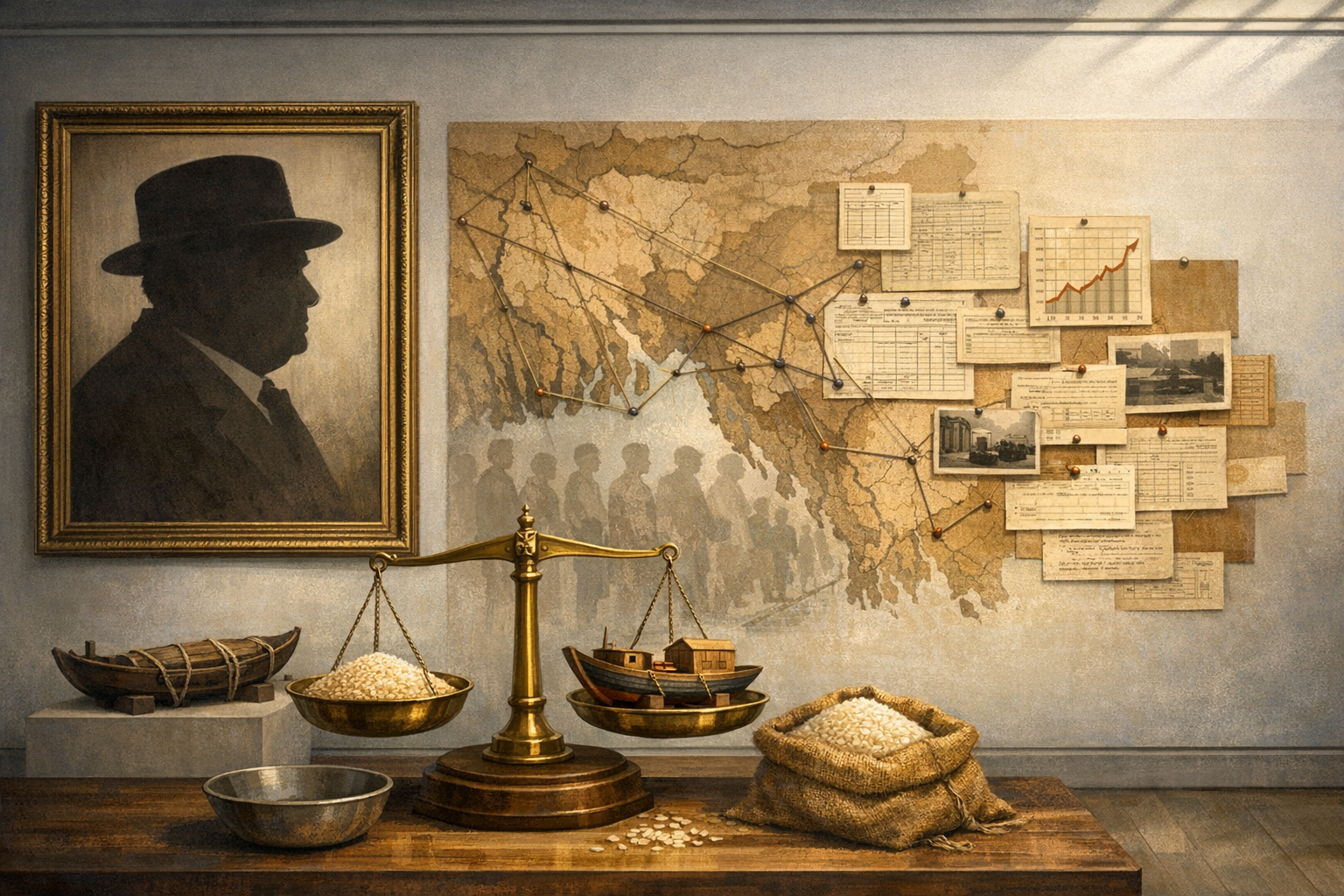
A major exhibition at London’s National Portrait Gallery has renewed global scrutiny of Winston Churchill’s wartime leadership and its entanglement with the Bengal Famine of 1943. By reframing familiar images of Britain’s World War II prime minister against the stark archival record of colonial governance, food policy, and wartime logistics, the display reopens a question that continues to resonate across India and the South Asian diaspora: to what extent did imperial decisions, racial attitudes, and policy priorities intensify one of the worst humanitarian crises under British Colonial Rule?
The Bengal Famine of 1943 led to the deaths of an estimated two to three million people. It unfolded in a region already stressed by the Japanese occupation of Burma in 1942, which abruptly cut off a major external source of rice, and by the cumulative shocks of a devastating 1942 cyclone along the Bengal coast and disease in the rice crop. Those supply shocks converged with wartime inflation, market dislocation, and administrative restrictions, producing what economists would later describe as an “entitlement failure,” where large segments of the population could no longer command sufficient food even when grain existed somewhere in the broader system.
Within British India, emergency controls intended to stabilize Calcutta’s industrial workforce and maintain wartime production often had the unintended effect of fragmenting Bengal’s internal markets. Movement restrictions, rice procurement schemes, and an uneven price-control regime created incentives for hoarding, arbitrage, and black-market activity. At the same time, the military’s “denial policies”notably the destruction, confiscation, or immobilization of tens of thousands of country boats along the coast to deny potential transport assets to a feared Japanese landingcrippled the very logistics that rural communities depended upon to move grain, fish, and essentials. The result was a lethal combination: disrupted supply, distorted prices, and broken last-mile distribution.
At the imperial center, shipping priorities during World War II became a pivotal constraint. Britain’s War Cabinet faced acute tonnage shortages amid competing demands from Mediterranean operations, the Atlantic, and other theaters. In this context, requests from the Government of India for large-scale grain imports were repeatedly delayed, downscaled, or deferred. Only later in 1943 and more substantially in 1944, particularly after Lord Wavell succeeded Lord Linlithgow as Viceroy, did relief shipments increase, along with a more concerted effort to rationalize distribution. That sequence is central to ongoing debates about culpability and the ethics of wartime prioritization.
Churchill’s recorded statements also inform the discussion of moral responsibility. The oft-cited remark, “I hate Indians. They are a beastly people with a beastly religion,” appears in the private diaries of Leo Amery, the Secretary of State for India. Historians interpret such comments, together with Cabinet correspondence from the period, as evidence of a racialized policy climate that shaped how famine signals were perceived and acted upon. While supporters argue Churchill operated under extraordinary constraints and global threats, critics contend that explicit prejudices and the framing of India primarily as a strategic asset affected the timeliness and scale of relief.
Scholarly opinion remains divided. One line of research, associated with authors such as Madhusree Mukerjee, emphasizes the War Cabinet’s decisions on shipping allocations, price policy, and Bengal’s market quarantines as decisive drivers that transformed scarcity into catastrophe. A second line, including work by economic historians such as Amartya Sen, Cormac Ó Gráda, and Tirthankar Roy, stresses the interplay of environmental shocks, entitlement collapse, and administrative error, cautioning against monocausal attributions. Across this spectrum, however, there is significant convergence on two points: first, that the famine was not an inevitable outcome of nature alone; and second, that earlier, larger, and better-coordinated relieflogistical, financial, and nutritionalcould have dramatically reduced mortality.
The curatorial choice to juxtapose public portraits with lesser-seen documents and testimonies underscores how national myths and colonial realities diverge. Portraiture tends to encode triumph, leadership, and resolve. Archival records of ration cards, grain movement controls, shipping cables, provincial minutes, and famine photographs tell a more granular story of who bore the heaviest costs of those virtues when filtered through the hierarchies of the British Raj. The exhibition’s lens is not iconoclastic for its own sake; it is a demand that commemoration be tethered to evidence.
Contextual nuance is equally essential in assessing Churchill’s broader relationship to South Asia and to religious communities. Churchill supported official efforts during the 1940s to facilitate an Islamic cultural center and a mosque in London, and he was a significant figure in the war and post-war politics that culminated in Partition and the creation of Pakistan. Claims that he “nearly converted to Islam” circulate widely but rest primarily on a playful private letter cautioning him against such a step; serious biographers generally treat this as a whimsical exchange rather than a plan or theological inclination. These complexities do not cancel the record of racially charged comments about Indians; they do, however, remind readers that historical figures often contain contradictions that resist simple categorization.
Why does the Bengal Famine still cut so deeply into public debate more than eighty years later? In Indiaand among Hindu, Buddhist, Jain, and Sikh families across the global diasporathe memory is not abstract. It lives in oral histories of grandparents who queued for hours for a ration chit; in stories of entire villages pawning heirlooms for a few seers of rice; in the recollection that hunger made no distinctions among communities. That shared suffering, traversing dharmic traditions, can serve as a powerful basis for unity today, reinforcing a commitment to human dignity that transcends sectarian lines and cautions against any attempt to communalize the past.
The historiographical controversy also matters for present-day policy. The Bengal experience shows how quickly supply shocks can tip into famine when administration restricts movement, market signals become distorted, and logistics degrade. It highlights the ethical stakes of shipping and sanctions in wartime, the life-and-death consequences of information delays and denial, and the need for strong institutional mechanismsearly-warning systems, transparent price data, interoperable transport, and emergency nutrition programsto prevent entitlement failures from spiraling into mass mortality.
Public institutions face a dual responsibility when revisiting figures like Churchill: to retain analytical rigor and to expand moral imagination. Analytical rigor requires weighing counter-evidence, acknowledging uncertainty where records conflict, and distinguishing between direct intent and culpable neglect. Moral imagination asks how narratives of victory can be told without rendering invisible those who paid its hidden costs. The National Portrait Gallery’s intervention is a reminder that national memory is healthiest when it is capacious enough to include uncomfortable evidence.
For readers seeking a concise orientation to the core evidentiary strands, several themes recur across the literature on the Bengal Famine of 1943. First, environmental and geopolitical shocks created severe stress, but they did not, on their own, predetermine famine-scale mortality. Second, colonial policy choicesmovement restrictions, price and procurement regimes, denial policies, and delayed shippingmagnified vulnerability among the rural poor. Third, relief became meaningfully more effective after institutional shifts in late 1943 and into 1944, underscoring the counterfactual that faster, larger action could have saved many lives. Finally, the discourse of race in official circles appears, in multiple sources, to have narrowed the perceived urgency of Indian suffering.
The contemporary conversation benefits when it stays anchored to such verifiable elements rather than to partisan caricature. Framing the famine as a right-versus-left proxy war obscures how complex systems failed ordinary people. A more humane and dharmic approach is to hold together two commitments: historical honesty about colonial racism and policy failure, and solidarity among Hindu, Buddhist, Jain, and Sikh communities whose elders endured the same hunger and grief. That synthesis resists both erasure and recrimination.
Those who wish to explore the multimedia dimension of the current debate can consult the following recording, which expands on the exhibition’s themes and the archival trail they draw upon: http://www.hinduhumanrights.info/wp-content/uploads/2026/06/YTDown_YouTube_London-Exhibition-Proves-Churchill-Kille_Media_VM_JWKT5Rhw_001_1080p.mp4
In the end, the question is not whether portraits of Churchill should exist; it is whether their interpretive frames can bear the weight of the historical record. Evidence shows that the Bengal Famine of 1943 was compoundedseverelyby choices made under British Colonial Rule. Ethics demands that those choices be remembered alongside the better-known achievements of wartime leadership. And the living legacy of empire calls for an inclusive memory culture that centers shared humanity, encourages dharmic unity, and transforms remembrance into vigilance.
Inspired by this post on Hindu Human Rights Blog.
