
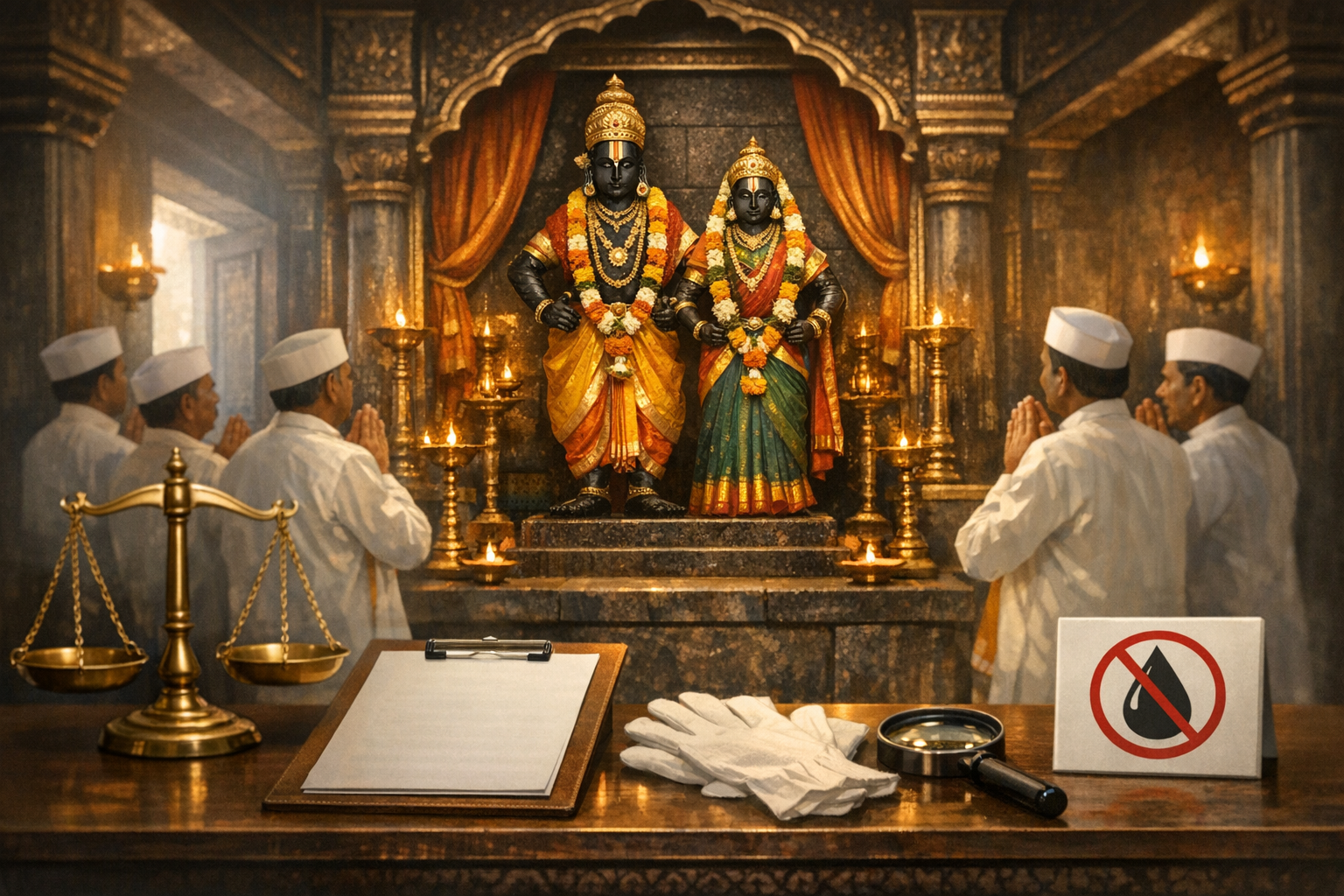
The Maharashtra Mandir Mahasangh and Warkari organizations have publicly opposed a proposed chemical coating on the sacred Shri Vitthal-Rukmini idols at Pandharpur, cautioning that any harm to the murtis could invite court intervention and criminal proceedings. Their position reflects a broad concern within the dharmic community that living religious heritage must be safeguarded through conservation practices that respect both material integrity and the sanctity of ritual life.
Pandharpur’s Shri Vitthal-Rukmini Mandir is a center of devotion and a linchpin of the Warkari sampradaya, drawing lakhs of pilgrims during Ashadhi Wari and throughout the year. For devotees, the murtis are not only historic artifacts but living divinities, intimately woven into daily darshan, abhishekam, shringar, and shared ritual memory. Any surface intervention, therefore, is not a purely technical choice; it directly intersects with spiritual practice, community identity, and intergenerational continuity.
At the time of writing, only the opposition to the proposed chemical coating is publicly indicated; specific product names, application parameters, and approvals have not been detailed in open sources. Nevertheless, the debate raises well-established questions in heritage preservation: What constitutes best practice when the object is both an antiquity and a living icon? How should conservation science, ritual usage, and community consent be balanced to prevent unintended damage or disruption of worship?
In technical terms, surface treatments for stone or composite idols typically fall into categories such as cleaning, consolidation, and protective coatings. These may include hydrophobic silanes/siloxanes, acrylic resins (for example, Paraloid-type formulations), microcrystalline waxes, or other polymeric barriers designed to reduce soiling or moisture ingress. While such materials can, in certain contexts, stabilize friable substrates or slow deterioration, their long-term performance on dense, dark stone in high-touch, ritual environments is complex and context-dependent.
Ritual compatibility is the central concern in a living temple such as Pandharpur. Abhishekam with panchamrita, application of kumkum and chandana, and the tactile devotion of countless hands can interact unpredictably with coatings, potentially altering surface sheen, color tone, or frictional response. Coatings may also change water-vapor exchange, concentrate salts below treated layers, or trap oils and pigments from rituals—outcomes that are aesthetically and spiritually unacceptable and practically difficult to reverse.
Global charters and national manuals converge on key principles applicable here: minimum intervention, material compatibility, reversibility (or at least retreatability), and exhaustive pre-testing. The ICOMOS Venice Charter (1964), the Nara Document on Authenticity (1994), and Indian conservation guidance, including practices followed by the ASI and INTACH, emphasize that the cultural significance of a sacred object includes its ritual life and patina, not merely its physical form. In practical terms, this means avoiding any treatment that could diminish the murti’s devotional character or disrupt customary worship.
Legal and governance dimensions also warrant careful attention. Damage or defilement of a place of worship can attract criminal liability under provisions such as Sections 295–297 of the Indian Penal Code, while stewardship responsibilities of temple trusts may be scrutinized under the Maharashtra Public Trusts Act, 1950. Where an idol qualifies as an “antiquity,” additional statutory considerations may arise under heritage and antiquities regulations. Consequently, any intervention demands diligent due process, documentary transparency, and expert oversight.
Stakeholders extend beyond the immediate custodians to include the Warkari community, the Maharashtra Mandir Mahasangh, conservation scientists, art historians, ritual specialists (archakas), legal experts, and relevant state heritage authorities. A constructive path requires a multi-disciplinary review that integrates conservation ethics with ritual practice. Transparent consultation and recorded consensus are especially important to uphold public trust and to protect the sanctity and safety of the Shri Vitthal-Rukmini idols.
A robust technical process—if any conservation is ever contemplated—would include: (1) non-invasive documentation (high-resolution photography, photogrammetry, or 3D scanning) to establish a baseline; (2) condition mapping of micro-cracking, surface accretions, and prior repairs; (3) material characterization (for example, petrographic microscopy, XRD for mineral phases, and, where ethically permissible, micro-sampling); and (4) laboratory trials on inert mock-ups that replicate ritual conditions (exposure to panchamrita, oil, vermilion, turmeric, and regular handling) to assess interactions and stability over time.
If a protective measure is still considered after rigorous review, test patches must be localized, fully documented, and evaluated against quantifiable acceptance criteria before any broader application. These criteria should include: colorimetry (ΔE) to confirm negligible visual change; gloss and texture measurements to avoid artificial sheen; water contact angle and capillary uptake to ensure that hydrophobicity does not compromise vapor permeability; and salt crystallization tests to prevent sub-surface damage. Above all, the chosen material should be reversible or, at minimum, retreatable with no harm to the substrate.
Experience from South Asian contexts shows that coatings on dark, dense stones can unintentionally deepen color, attract soot, or become sticky under ritual oils and incense smoke. In high-traffic shrines, mechanical abrasion from touch and textiles accelerates coating degradation, producing patchy surfaces that are harder to address than untreated stone. These outcomes underscore why many conservators prefer meticulous dry-cleaning, micro-chemical cleaning restricted to accretions, and micro-repairs over blanket coatings in active temples.
Monitoring and maintenance are as critical as the initial decision. Even a seemingly benign intervention without a preventive conservation plan—covering environmental management, ritual-material interfaces, and cleaning protocols—can lead to cumulative harm. Scheduled condition assessments, photographic registers, and a clear stoppage protocol in case of adverse effects form the backbone of a responsible heritage management system in a living shrine.
Beyond technicalities, the present concern resonates across dharmic traditions. Jain marble icons, Buddhist bronzes, and Sikh relics have similarly required conservation choices that honor both material longevity and living maryada. A shared dharmic ethic—rooted in seva, ahimsa, and reverence for inherited sacred forms—encourages minimal, reversible action and prioritizes community-informed consent. This alignment nurtures unity among Hindu, Buddhist, Jain, and Sikh stakeholders in the collective stewardship of subcontinental heritage.
In light of these principles, a pragmatic roadmap for the Shri Vitthal-Rukmini context would include: (1) a publicly accessible statement of intent; (2) constitution of an independent, multi-disciplinary review panel; (3) baseline documentation and a risk register; (4) laboratory and mock-up trials that simulate ritual conditions; (5) definition of strict acceptance thresholds; (6) limited, fully reversible testing only with recorded consent; (7) a veto mechanism that halts work at the first sign of adverse outcomes; and (8) a long-term preventive conservation and monitoring plan with annual community reporting.
The position articulated by the Maharashtra Mandir Mahasangh and Warkari organizations—opposing chemical coating and warning of legal recourse in case of harm—accords with widely accepted conservation ethics for active temples: avoid irreversible treatments, respect ritual integrity, and ensure rigorous scrutiny before any intervention. This approach balances devotion and science, aligning preservation of material substance with the living, experiential sanctity that defines Pandharpur.
Ultimately, safeguarding Shri Vitthal-Rukmini is not only a matter of preventing physical damage; it is an affirmation that cultural heritage in a living shrine is inseparable from worship, memory, and shared dharmic life. A consensus-based, technically sound, and spiritually sensitive path offers the surest protection—now and for generations who will continue to find solace, guidance, and unity in the darshan of Pandharpur’s beloved deities.
Inspired by this post on Hindu Jagruti Samiti.









Leave a Reply
You must be logged in to post a comment.