
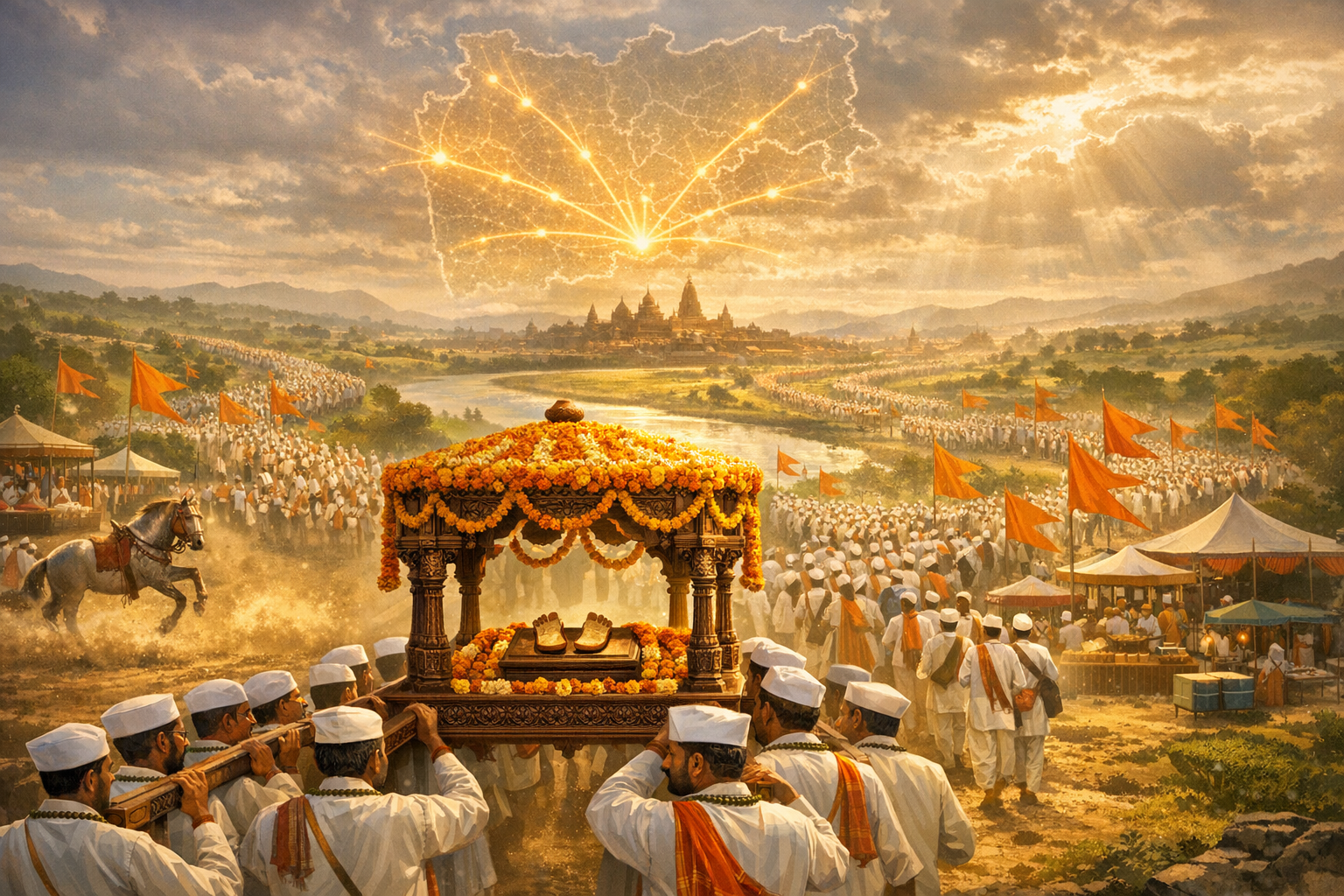
Pandharpur’s Ashadhi Wari (Ashadi Waari) is commonly associated with the two most visible processions—the Palkhis bearing the padukas of Sant Tukaram Maharaj from Dehu and Sant Dnyaneshwar Maharaj from Alandi. In practice, Maharashtra sustains a far denser devotional web: approximately forty-three traditional Palkhi yatras converge on Pandharpur each year, advancing in coordinated stages across districts and linguistic-cultural zones to arrive for Ashadhi Ekadashi at the Vithoba–Rakhumai temple.
This wider network of Palkhi yatras matters for history, culture, and living faith. It preserves the Varkari sampradaya’s egalitarian bhakti, embodies the sanctified mobility of “tirtha-yatra” in motion, and activates a distributed system of community care—annadan, shared song, and daily discipline—that temporarily transforms rural roads into moving places of worship. The scale is substantial: lakhs of Varkaris travel on foot for two to three weeks, forming dindis (cohesive devotional groups) that maintain internal order, collective rhythm, and devotional practice.
The Varkari sampradaya’s theology is simple and far-reaching: devotion to Vithoba (Vitthal), ethical restraint, collective singing of abhangs and the Haripath, and a vow to perform darshan in Pandharpur during the great waari. Socially, the tradition has long emphasized inclusivity—welcoming participants across caste, class, language, gender, and profession—and cultivating seva, humility, and kirtan as shared disciplines that erase boundaries along the route.
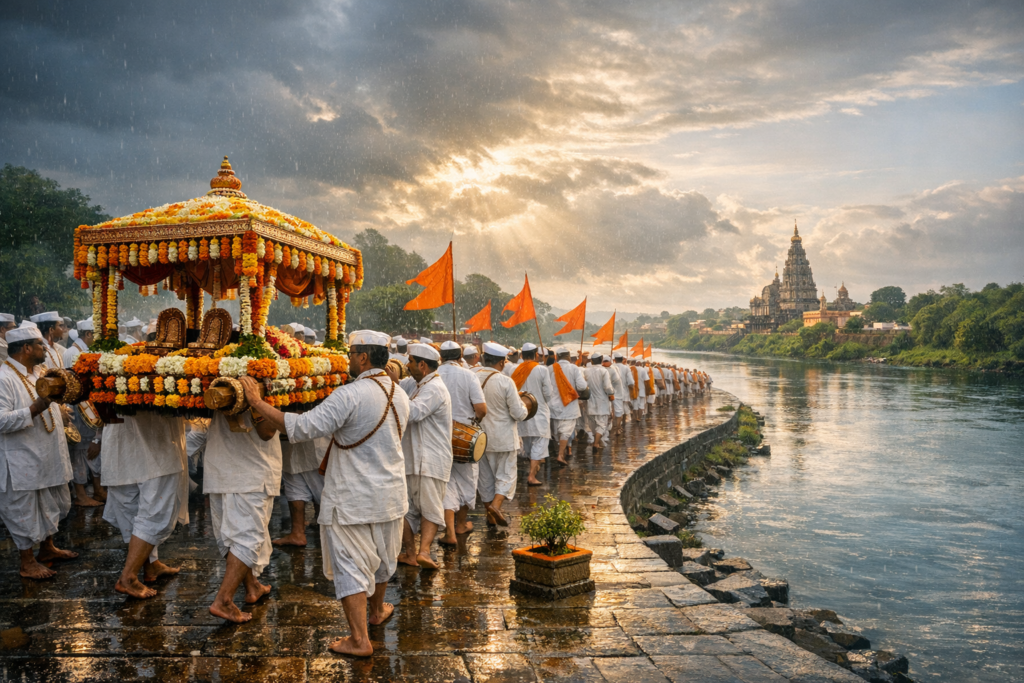
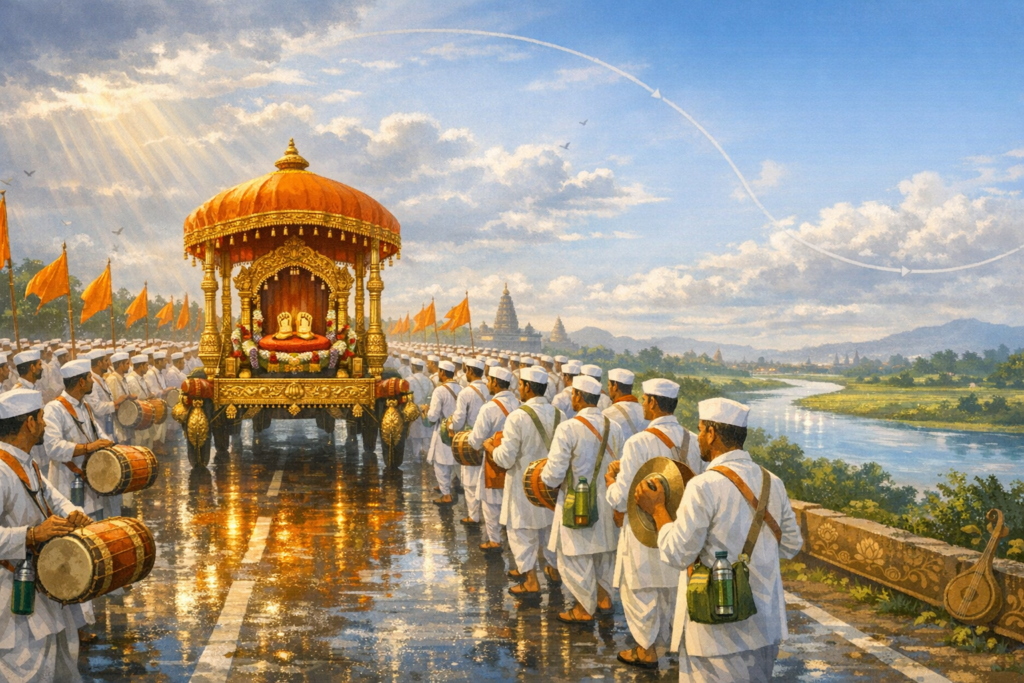
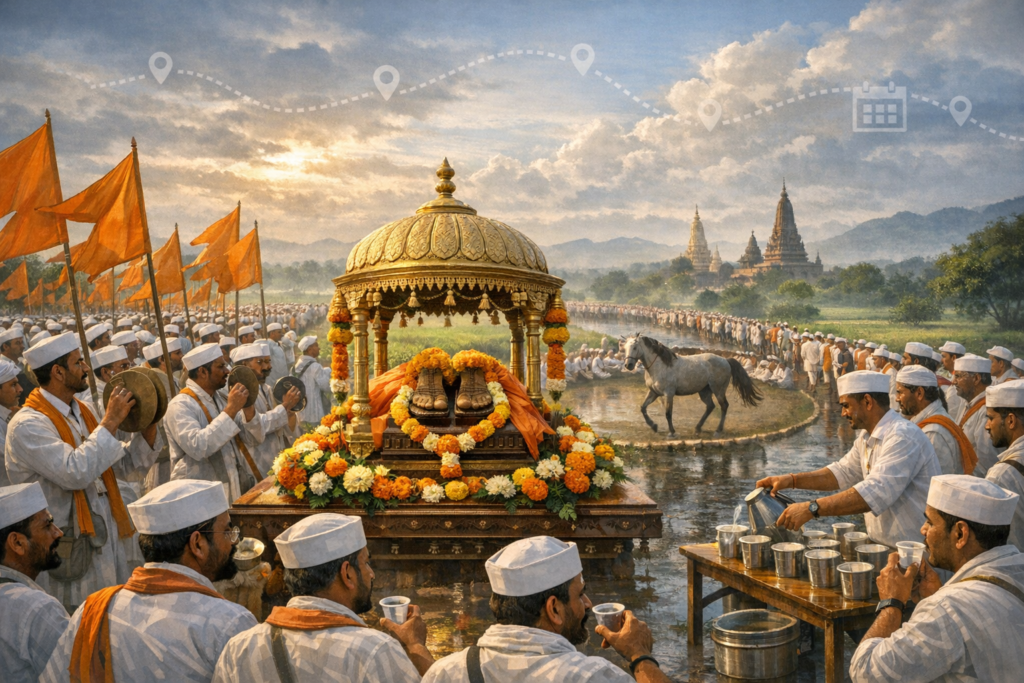
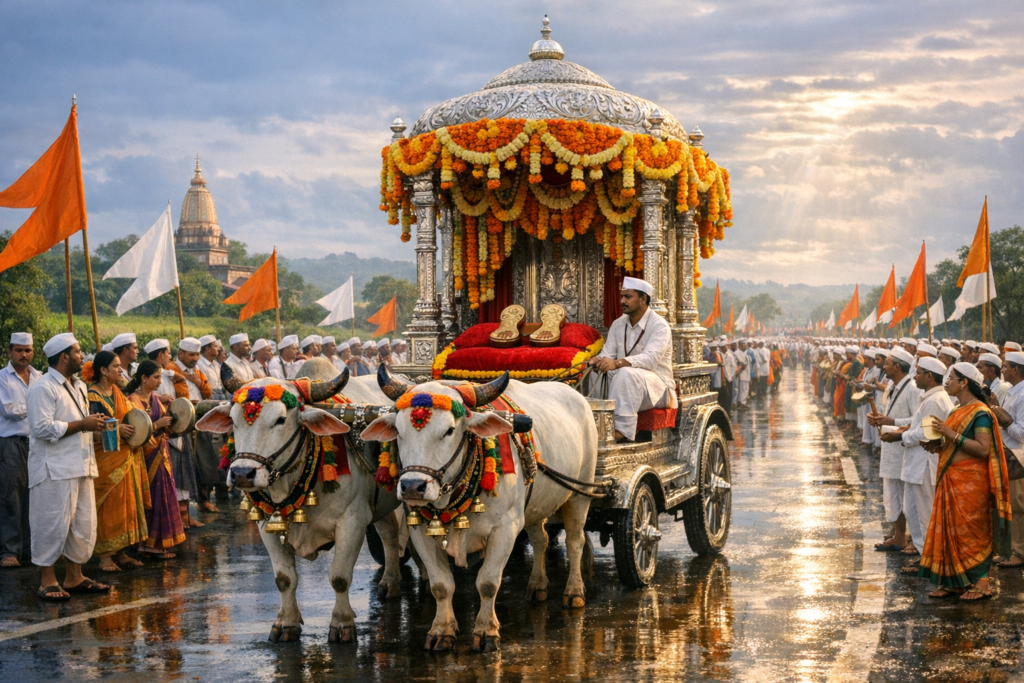
Ritually, the Palkhi is a mobile shrine housing the padukas of a Sant, carried in a palanquin and escorted by dindis that move in a carefully ordered file marked by zenda (saffron flags). Daily milestones include the pre-dawn gajar, collective recitation, abhang kirtan, and the celebrated ringan, where a horse circles a sacred space, stirring dust that Varkaris consider auspicious. Sasan dindis—historic dindis with traditional precedence—anchor continuity, while hundreds of other dindis align behind them, preserving order at a walking cadence of roughly 3–4 km per hour.
Geographically, the forty-three Palkhis trace multiple corridors that feed into the main waari spine: the Pune region (Dehu, Alandi, and surrounding talukas); the Marathwada belt (Paithan, Chhatrapati Sambhajinagar, Jalna, Parbhani, Nanded); the Western and Southern corridors (Satara, Sangli, Kolhapur); and the Northern Khandesh stretch (Dhule, Jalgaon). Smaller contingents join along the way, and variations occur by year, but the cumulative system forms a state-wide devotional lattice converging on Solapur district.
Typical Palkhi itineraries cover 15–25 km per day for about 18–22 days, with pre-declared halts for rest, hygiene, and annadan. Camps function as self-contained ecosystems—water points, first-aid tents, temporary sanitation blocks, and kirtan mandaps—co-run by local administrations, trusts, and volunteer networks. The final halts near Wakhri on the banks of the Chandrabhaga are especially resonant, as the wave of dindis reforms into a single devotional front for Vithoba darshan.
Beyond the two iconic Palkhis, several processions consistently receive statewide attention. The Sant Eknath Maharaj Palkhi (Paithan to Pandharpur) begins at the historic seat of Eknath’s sadhana in Paithan (Marathwada) and typically traverses roughly 250–300 km. Its liturgical flavor is marked by the recitation of Eknath’s abhangs and the performance tradition of bharud, carrying forward his emphases on social equality, inner discipline, and accessible devotion.
The Sant Namdev Maharaj Palkhi (from Narsi Namdev in Nanded district) honors a Sant whose compositions also appear in the Guru Granth Sahib, a remarkable bridge across dharmic traditions. Kirtan associated with Namdev underscores humility and direct devotion to the Divine, a theme recognizable in Sikh kirtan, Vaishnava bhakti, Jain stavan, and Buddhist metta chanting—demonstrating how shared ethical and musical vocabularies can nurture unity without erasing distinct practices.
Other regularly observed Palkhis honor sants such as Sant Chokhamela (strongly associated with Mangalwedha), Sant Savata Mali (revered among cultivator communities across the Phaltan–Satara–Solapur belt), Sant Gora Kumbhar (linked with the pottery traditions of Dharashiv/Osmanabad), and Sant Janabai (traditions recalling Gangakhed). The precise halts and sizes of these Palkhis vary, yet their cumulative presence is well established across district records and Varkari institutional memory.
Daily ritual grammar along the route remains strikingly consistent. Devotees chant “Gyanba Tukaram!” and “Vitthal Vitthal Jay Hari Vitthal!” in call-and-response, recite the Haripath, and gather for pravachan and kirtan in the evenings. The ringan remains a central experiential moment, as does the collective smarana of abhangs where poetry, music, and ethics merge into a single act of public devotion.
Participation scales are significant. Across all Palkhis and stages, total footfall during the Ashadhi cycle often reaches into the low millions. On Ashadhi Ekadashi itself, Pandharpur’s capacity is stretched as processions funnel through the town’s narrow arteries to the Chandrabhaga and the temple complex. Crowd-management protocols—zonal barricading, time-staggered darshan windows, medical triage nodes, and one-way pedestrian loops—are now routine features of administrative planning.
Operationally, the waari functions as a state-wide partnership. District authorities coordinate road repairs and potable water supplies; police and home guards manage intersections, night halts, and high-density nodes; health departments deploy mobile clinics, ambulances, and heat-stress response teams; municipal bodies arrange sanitation lines and daily waste evacuation. Volunteer organizations conduct annadan, distribute chappals and rain capes, and run lost-and-found counters for vulnerable pilgrims.
Health, safety, and monsoon resilience are recurrent priorities. Recommended footcare (regular bandaging, toe-nail trimming, and dry sock changes), water discipline (small, frequent hydration), and monsoon-aware packing (lightweight rain gear, quick-dry clothing) mitigate common injuries. During heavy rain, dindis temporarily shorten marching legs and increase medical rest stops, with contingency shelters identified in advance at schools, panchayat halls, and temples.
Environmental stewardship has grown into a formal pillar. “Nirmal Waari, Swastha Waari, Surakshit Waari” campaigns emphasize plastic-free darshan queues, steel or areca-leaf plate distribution at annadan points, grey-water drainage plans at halts, and Chandrabhaga bank-cleanups before and after the peak day. Composting of biodegradable waste at larger halts and backhauling of non-biodegradables protect agricultural soils and river ecology.
Economically, the waari encourages micro-entrepreneurship along the route: cobblers, herbal oil vendors, rain-gear sellers, fruit sellers, and transporters sustain a seasonal economy that benefits small towns and villages. Local arts—powadas, ovi, and kirtan traditions—receive renewed patronage, strengthening intangible cultural heritage networks in situ rather than in distant urban venues.
Documentation and coordination increasingly leverage digital tools. Dindi registries, route maps, and halt schedules are shared via messaging groups; health alerts and weather advisories travel quickly to dindi mukhis; and simple QR-based coordination at annadan counters reduces queues and food waste. GIS mapping of crowd densities helps administrations pre-position barricading and medical teams at pressure points.
The Ashadhi Wari also exemplifies unity across dharmic families. While its theology and iconography are Vaishnava, its ethics—seva, nonviolence, humility, and liberation through naam-smaran—resonate with core values in Hinduism, Buddhism, Jainism, and Sikhism. Namdev’s presence in the Guru Granth Sahib, the langar-like annadan practices, the Jain and Buddhist embrace of disciplined walking and compassionate conduct, and the Hindu bhakti emphasis on accessible devotion all point to a shared civilizational grammar of spiritual coexistence.
Respectful participation norms are well understood. Maintaining lane discipline within one’s dindi, yielding priority to sasan dindis, keeping footwear and photography away from the paduka and aarti zones, and practicing minimal-litter travel are considered essential. New participants are advised to register with a dindi, observe the group’s daily sadhana schedule, and coordinate medical and logistical needs through the dindi mukhi.
The widespread reality is clear: not only two but about forty-three Palkhi yatras animate the Ashadhi Wari. This decentralized, living heritage unites districts and communities in a moving temple of song, service, and discipline, ensuring that the road to Pandharpur remains a shared pathway to devotion—and a reminder that dharmic traditions thrive when unity in spiritual diversity is both honored and organized.
Inspired by this post on Hindu Pad.






Leave a Reply
You must be logged in to post a comment.