
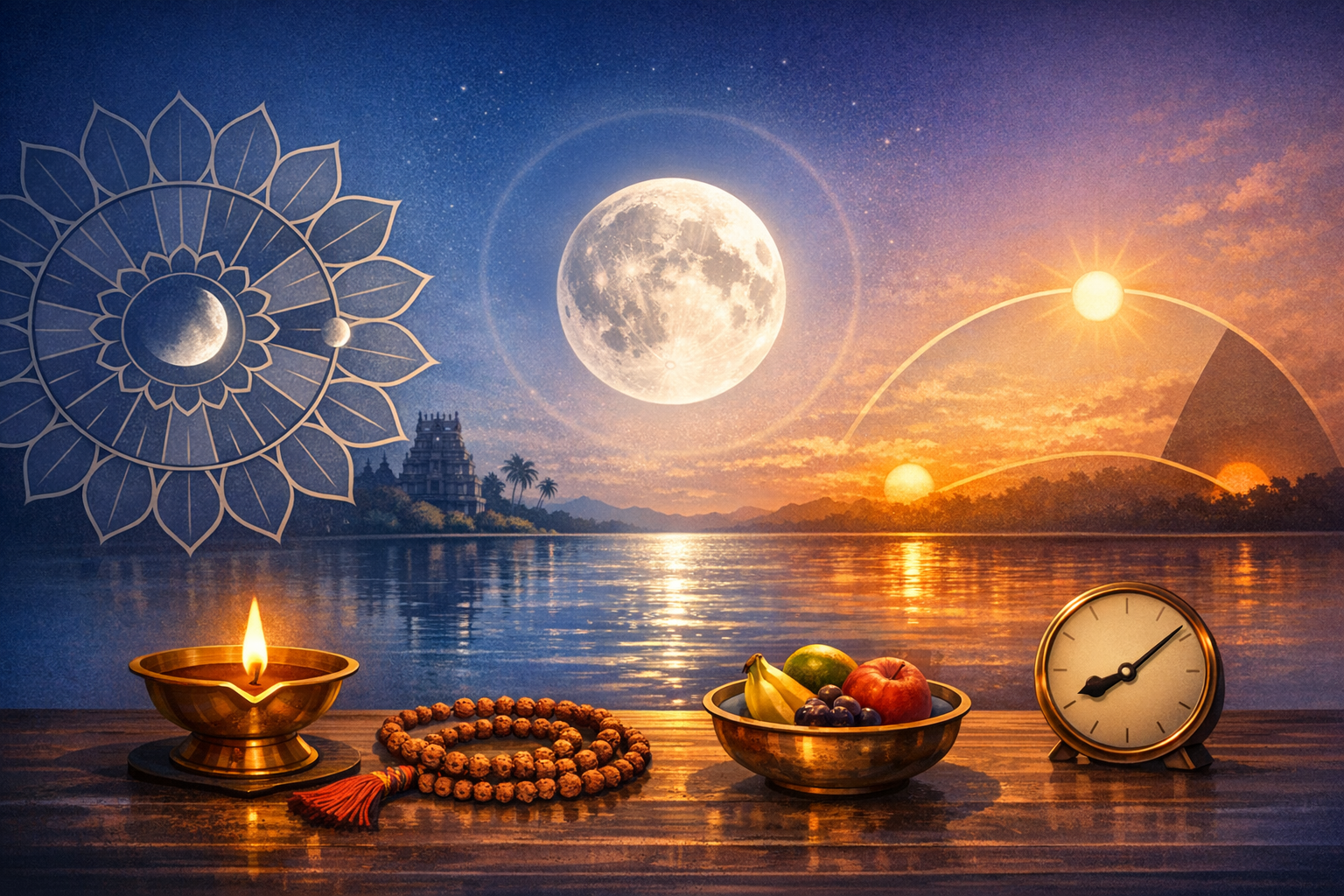
Wednesday, June 24, 2026 in the Hindu calendar and Panchang marks the transition from Shukla Paksha Dashami to Shukla Paksha Ekadashi. In most regions, Shukla Paksha Dashami prevails until 8:09 PM (IST) on June 24. From 8:09 PM (IST) onward, the tithi becomes Shukla Paksha Ekadashi, the eleventh lunar day of the waxing phase of the Moon.
Understanding the tithi provides both astronomical and spiritual context. A tithi is defined by the angular elongation between the Moon and the Sun; each tithi spans 12 degrees of this relative separation. Because the Moon’s velocity varies, each tithi may be slightly longer or shorter than a civil day. Dashami, the tenth tithi, is often associated with consolidation, discipline, and steady progress, while Ekadashi emphasizes vrata, mindful restraint, and inner purification across many dharmic traditions.
For Ekadashi fasting (vrat nirnaya), the commonly accepted rule is that the fast is observed on the civil day when Ekadashi tithi prevails at local sunrise. Given that Ekadashi begins at 8:09 PM (IST) on June 24, Ekadashi is expected to be present at sunrise on Thursday, June 25, 2026 for most locations in India; therefore, most householders and temples will observe the Ekadashi fast on June 25. Local panchang guidance should always be followed, since regional calculations and time zones may shift this determination.
Smarta and Vaishnava traditions sometimes apply distinct refinements to Ekadashi observance. Vaishnava calendars, for instance, often avoid a sunrise that is considered viddha (mixed) with the prior tithi and may designate Vaishnava Ekadashi accordingly. Parana (the fast-breaking) is typically done on Dwadashi, after sunrise and after the Hari Vasara period (the first one-fourth of Dwadashi) has elapsed. Exact parana windows are location-specific and should be confirmed from a reliable local Panchang.
Beyond the tithi, the daily Panchang includes Nakshatra, Yoga, Karana, and the Moon’s Rashi (sidereal sign). These elements are calculated from precise sidereal longitudes and can vary by location and the ayanamsa adopted (e.g., Lahiri/Chitrapaksha). As a result, Nakshatra and Rashi for June 24, 2026 may be listed slightly differently across regional almanacs. Practitioners should consult a trusted local Panchang for the site-specific Nakshatra, Rashi, Yoga, and Karana applicable to their city.
When planning activities, many refer to Shubh Muhurat windows. Abhijit Muhurat, which centers around local solar midday, is traditionally viewed as a generally auspicious period suitable for undertakings that require clarity and resolve. Brahma Muhurta, in the last portion of the pre-dawn night, is favored for japa, dhyana, and scriptural study because of its naturally sattvic quality. Godhuli Bela, around sunset, can be conducive to gentle devotional practices and family prayer.
Equally important are the intervals generally avoided for fresh ventures: Rahu Kaal, Yamaganda, and Gulika Kaal. On Wednesdays, Rahu Kaal commonly falls around the middle of the day (approximately 12:00–13:30 when sunrise is near 06:00), Yamaganda occurs earlier in the morning, and Gulika Kaal follows thereafter. These periods are computed by dividing the daylight span into eight equal parts, so their exact timing shifts with local sunrise and sunset. Checking a local Panchang or Choghadiya for one’s city ensures accuracy.
Shukla Paksha Dashami during the day offers a reflective bridge into Ekadashi. Many households use Dashami to simplify diet, reduce sensory overload, and set sankalpa for the next day’s vrata. Gentle acts of seva, quiet study of the Bhagavad Gita, Vishnu Sahasranama, or other chosen texts, and light evening sadhana prepare body and mind for the more focused observances of Ekadashi.
As Ekadashi commences at 8:09 PM (IST) on June 24, the principal observance for most will be on June 25. Ekadashi vrata emphasizes mindful intake and inner restraint. Householders commonly adopt a simplified or phalahara diet, and those who are able may observe nirjala or upavasa under proper guidance. Individuals with medical conditions, elders, and expecting mothers should adapt observances prudently, prioritizing health and well-being in line with dharma’s emphasis on compassionate responsibility.
Parana on Dwadashi is a spiritually significant completion of the vow. The traditional guidance is to break the fast after sunrise, within the prescribed Dwadashi window, avoiding the Hari Vasara period. A light, sattvic parana—often beginning with water or milk and fruits—helps the system transition gently. As always, the exact parana timing depends on local sunrise and the end of Dwadashi and should be taken from a dependable local Panchang.
Regional calendar systems influence month names and festival pointers. North Indian Purnimanta calendars and South Indian Amanta calendars may label lunar months differently even while agreeing on the underlying tithi. Diaspora communities outside India should likewise convert all Panchang times to their local time zones and verify with a trusted regional source.
Nakshatra and Rashi play distinct roles in personal and communal planning. Nakshatra, based on the Moon’s position among the 27 lunar mansions, can inform the tone of the day’s devotional and professional activities. The Moon’s Rashi offers a broader psychological backdrop. For June 24, 2026, these will be determined by the Moon’s sidereal longitude at the practitioner’s location; minor differences in ayanamsa and local time can shift the boundary by minutes, underscoring the importance of a city-specific Panchang.
Choghadiya, used widely in western and northern regions, supplements daily planning. Amrit and Labh choghadiyas are often preferred for auspicious beginnings, while Udveg and Rog are generally avoided. Since Choghadiya segments are derived from the local day and night durations, practitioners benefit from checking a city-level Panchang rather than relying on generic tables.
From a unifying dharmic perspective, Ekadashi’s emphasis on restraint and clarity resonates across Hinduism, Buddhism, Jainism, and Sikhism. Buddhist Uposatha days cultivate sila and meditation; Jain upavasa refines ahimsa and self-discipline; Sikh practice centers on simran, seva, and truthful living. The shared heart of these observances is inner purification and compassion in action, affirming unity in spiritual diversity.
Many practitioners report that consciously integrating the day’s Panchang cues improves focus and well-being. A calm pre-dawn practice in Brahma Muhurta, avoidance of Rahu Kaal for new ventures when feasible, and use of Abhijit Muhurat for decision-making can align outer choices with inner intention. Families often experience these cycles as opportunities to reconnect, simplify routines, and nurture collective resilience.
A practical checklist for June 24, 2026 includes noting the Dashami-to-Ekadashi transition at 8:09 PM (IST), confirming local sunrise and sunset for precise Rahu Kaal and other kaalams, and setting a modest Dashami evening routine that supports the next day’s Ekadashi vrata. Those outside India should convert the tithi transition to local time and verify Nakshatra and Rashi from a regional Panchang.
In sum, June 24, 2026 offers a measured ascent from Shukla Paksha Dashami into Shukla Paksha Ekadashi. With thoughtful planning—observing Shubh Muhurat, avoiding Rahu Kaal, and honoring local Panchang specifics—practitioners can engage the day with clarity and poise. The spirit of the observance is inclusive and integrative, encouraging practices that deepen inner quietude and extend kindness outward, in harmony with the wider dharmic family.
Inspired by this post on Hindu Blog.







Leave a Reply
You must be logged in to post a comment.