
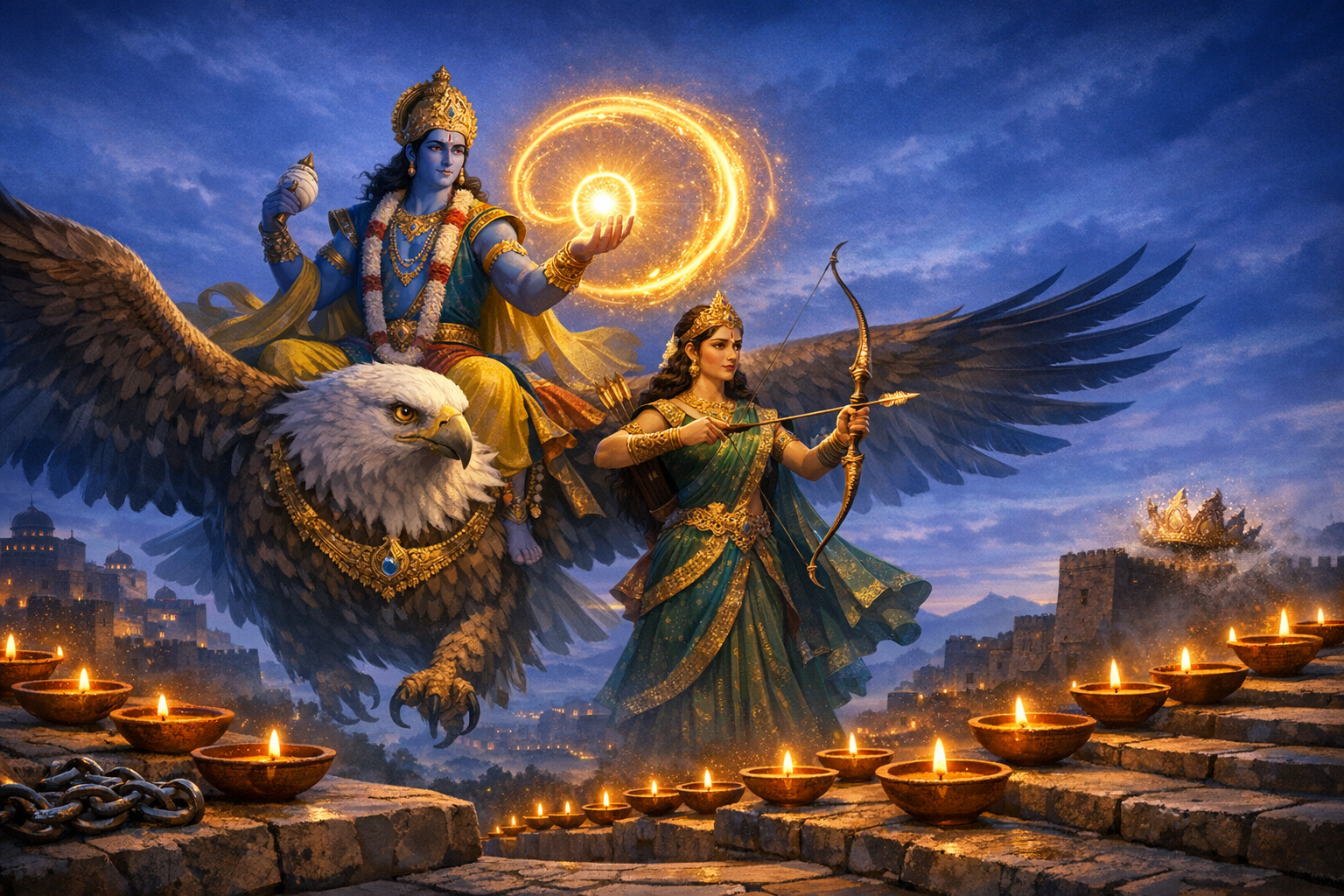
The luminous lamps of Naraka Chaturdashi, observed on the eve of Deepavali in many parts of India, recall a profound narrative: the rise and fall of Narakasura (Bhaumasura) and the ultimate triumph of dharma over adharma. Read as both history preserved in itihasa-purana memory and as ethical allegory, this account turns on a striking motif—the Vaishnavastra, the divinely charged weapon aligned with Vishnu’s preserving power—and on how sacred force can be redeemed only when yoked to righteous intent. In tracing Narakasura’s arc from blessed origins to catastrophic overreach, the story also offers a shared moral vocabulary that resonates with core values cherished across Hinduism, Buddhism, Jainism, and Sikhism: restraint, clarity of purpose, service, and inner transformation.
According to classical Purāṇic tellings, Narakasura’s origin follows the Varaha avatara of Vishnu. When Lord Vishnu as Varaha rescued the earth (Bhudevi) from cosmic waters, a drop of divine perspiration is said to have fallen upon Bhudevi’s lap. From this auspicious yet humble beginning, Naraka—also called Bhauma, the “son of Bhumi”—was born, signifying an intimate link to the earth’s fecundity and order. Theologically, this origin situates Narakasura not as an alien force but as a being whose destiny was meant to harmonize with preservation (sthiti), making his later departure into adharma all the more tragic and instructive.
Early accounts often frame Narakasura as capable and promising, endowed with strength and learning. Over time, however, intoxicated by power and aligned with asuric companions, he deviated from the path of dharma. He established dominion over Pragjyotisha (commonly associated with the Kamarupa-Assam region), fortifying it with intricate moats, rugged ramparts, and sorcerous defenses. In many retellings, he subjugated devas, seized the earrings of Aditi (Indra’s mother), and imprisoned thousands of royal maidens, each act marking a deeper descent into adharma and a violation of cosmic balance (ṛta).
The Vaishnavastra occupies a pivotal conceptual place in this canvas. In the itihāsa-purāṇa tradition, a Vaishnava-astra channels Vishnu’s protecting energy; in some texts it overlaps with what is termed Nārāyaṇāstra. While terminology varies across sources and schools, a consistent theme persists: Vaishnava-sourced astras are not merely destructive implements but expressions of order-restoring intelligence that, when confronted with their own divine source, become quiescent rather than catastrophic.
Mahābhārata episodes clarify this principle. When Bhagadatta deploys a Vaishnavastra against Arjuna, Krishna absorbs it harmlessly—a theological demonstration that the weapon recognizes and returns to its origin. Likewise, Ashvatthama’s Nārāyaṇāstra (Drona Parva) forces the Pāṇḍava army to lay down arms in surrender, after which the weapon dissipates. These scenes underscore an ethic: sacred power is inherently aligned with preservation and cannot be wielded effectively against the One from whom it emanates.
Within the Narakasura cycle, classical sources such as the Vishnu Purana and the Bhagavata Purana chiefly describe torrents of missiles, pikes, javelins, śataghnis, and sorcerous impediments, with Krishna methodically neutralizing each. Certain regional kathās and later retellings attribute to Narakasura the attempted use or appropriation of a Vaishnavastra; even in these versions, the outcome follows the same theological logic seen elsewhere—the Vaishnava force cannot counter its source and either returns benignly or is absorbed by Krishna’s presence. Whether one follows the strictly classical enumerations of weapons or the extended regional memory, the narrative coherence remains intact: misapplied sacred force collapses before the ground of dharma.
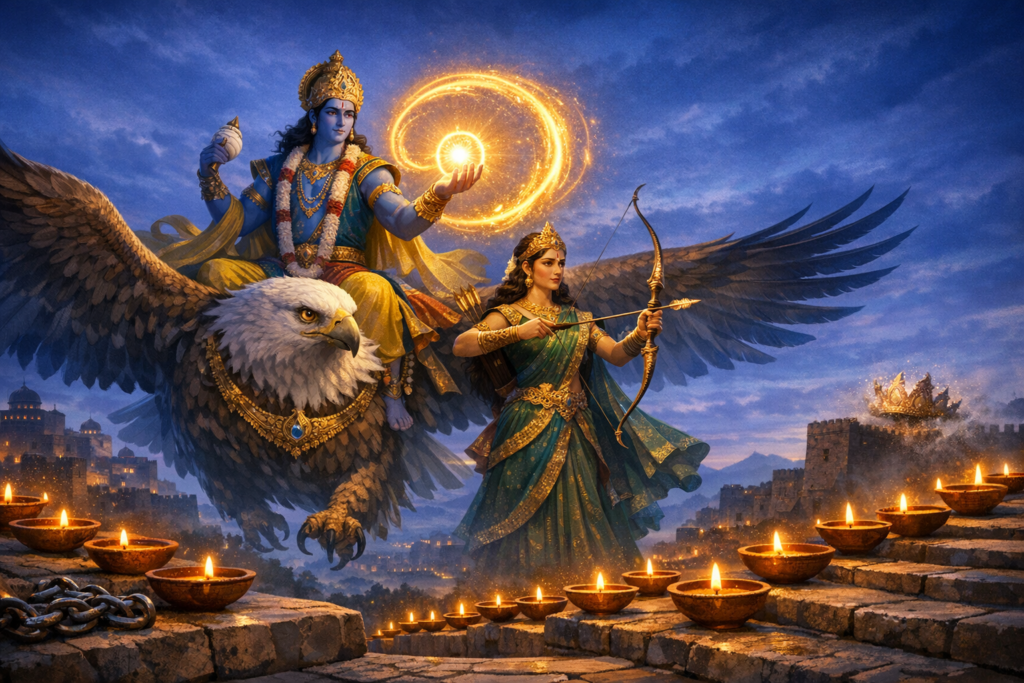
The campaign itself is vivid and decisive. Mounted on Garuda, Krishna advances upon Pragjyotisha through layers of magical darkness and iron fortifications, defeating the formidable guardian Mura—thereby earning the epithet Murāri—and cutting through the city’s defenses. The culmination pits the preserver of cosmic order against a ruler who had inverted the very purpose of power. In some widespread tellings, Satyabhama, understood as an embodiment or reflection of Bhudevi, accompanies Krishna; recalling a boon that Narakasura could be felled only by his mother, Satyabhama’s presence becomes the ethical and metaphysical key to the asura’s defeat. Other recensions attribute the final strike to Krishna’s Sudarshana Chakra. Both strands converge on the same moral end: adharma, even if spectacularly armed, cannot outlast dharma-yuddha.
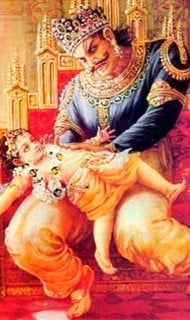
The aftermath restores balance. The captive maidens are freed and honored; the earrings of Aditi are returned; stolen treasures are restituted to their rightful guardians, re-establishing the rhythms of custodianship central to dharma. Facing his end, Narakasura is said to request one final boon—that his death be commemorated not in despair but in light, so future generations remember the victory of clarity over confusion, service over subjugation. This prayer ripens into the observance of Naraka Chaturdashi (often called Choti Diwali), when families light lamps pre-dawn, perform abhyanga snana, and celebrate the dawn of ethical renewal.
As living practice, Naraka Chaturdashi invites reflection as much as celebration. For many households, the pre-sunrise oil bath is not merely a ritual act; it is an annual remembrance that inner obscurations—anger, greed, delusion, pride, and envy—are the true “asuras” to be disarmed. Children hear how Krishna became Murāri, adults recall the boon that redirected violence into a plea for light, and communities experience the quiet solidarity that comes from turning outward toward service after turning inward toward purification.
The narrative also sustains an inclusive dharmic reading consonant with the blog’s commitment to harmony among Hinduism, Buddhism, Jainism, and Sikhism. Buddhist teachings on the kleshas, Jain commitments to ahiṃsā and the taming of kaṣāyas, and Sikh emphasis on conquering kām, krodh, lobh, moh, and ahaṅkār all converge with the Hindu lesson that true power is self-mastery in the service of the common good. In this light, the Vaishnavastra becomes a symbol not of domination but of preservation—a reminder that force attains legitimacy only when calibrated by compassion, restraint, and responsibility.
Read text-critically, the core arc is remarkably stable across sources even where details vary. The Bhagavata Purana (notably in the Kṛṣṇa narrative), the Vishnu Purana, and regional retellings such as in Harivaṃśa literature present complementary emphases—whether on Satyabhama’s role, the catalog of astras, or the contours of Pragjyotisha’s defenses. The Mahābhārata’s treatment of Vaishnava-aligned astras provides the broader theological grammar: an energy ordered to preservation resists misuse and recognizes its source.
For contemporary readers, three takeaways feel particularly relevant. First, origins carry responsibility: Narakasura’s being, linked to Bhudevi and Varaha, suggests that gifts untethered from ethics curdle into harm. Second, means matter as much as ends: even celestial weapons cannot dignify unrighteous intent. Third, remembrance must be constructive: lighting lamps is not mere commemoration but a pledge to illumine public life with fairness, courage, and care. In short, Naraka Chaturdashi is a festival of ethical clarity.
Ultimately, the story of Narakasura and the Vaishnavastra is less about supernatural spectacle and more about the choreography of conscience. The preserver’s weapon is, at heart, a commitment—to protect the vulnerable, to restore what is stolen, and to transform even a final request into a shared good. When lamps are lit before dawn, they signal that the real battleground is within and that the brightest victories are those that leave everyone—across regions, communities, and dharmic traditions—safer, freer, and more at peace.
Inspired by this post on Hindu Blog.


Leave a Reply
You must be logged in to post a comment.