
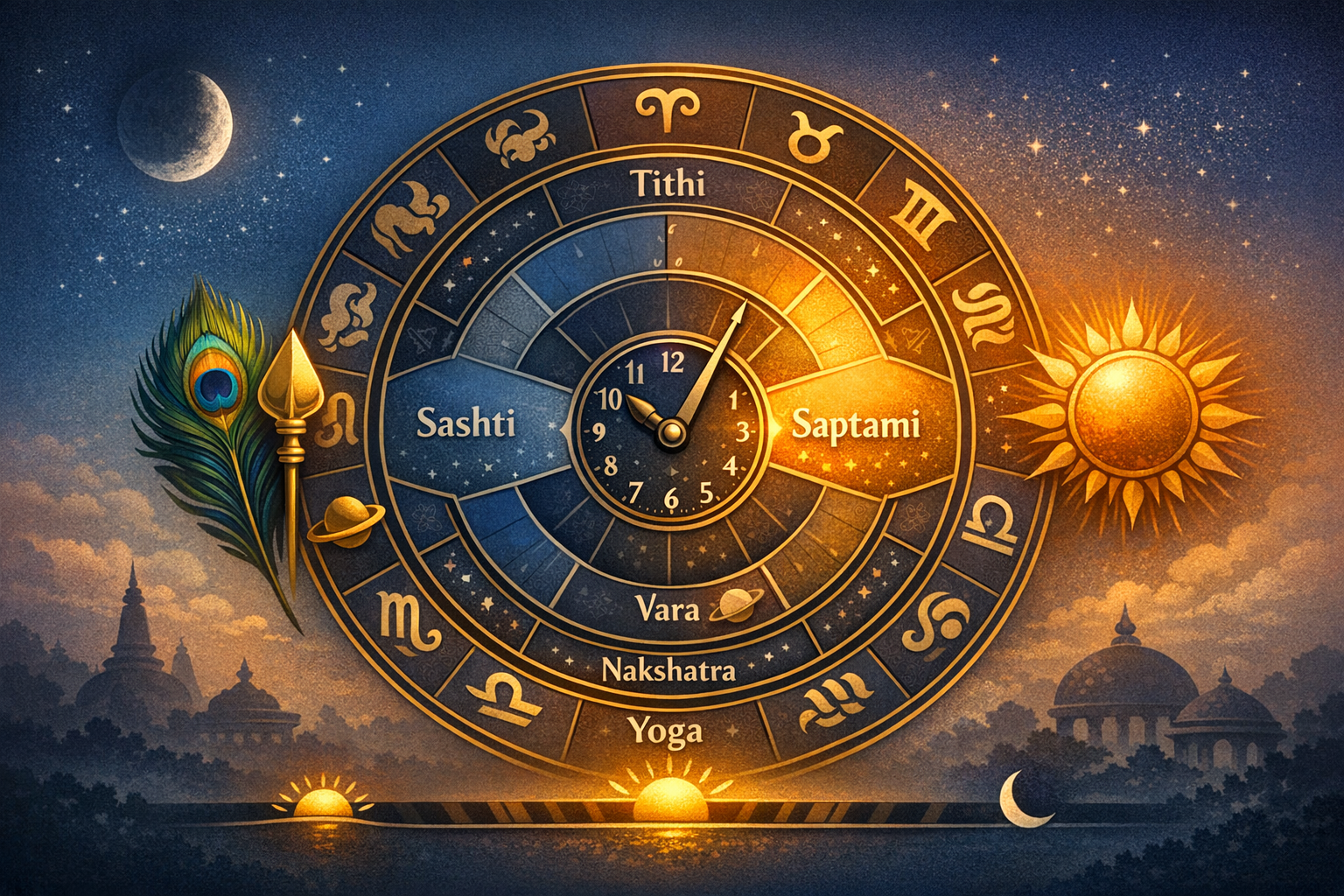
Saturday, June 6, 2026, in the Hindu calendar (Panchang) falls in Krishna Paksha. The day begins with Krishna Paksha Sashti (the sixth lunar day of the waning phase) and remains so until 10:06 PM (IST). From 10:06 PM onward, the tithi transitions to Krishna Paksha Saptami (the seventh lunar day of the waning phase). These timings are calculated for most regions using standard Panchang conventions; location-specific differences may arise due to longitude, latitude, and local sunrise.
Panchang (pañcāṅga) literally means “five limbs,” referring to Tithi (lunar day), Vara (weekday), Nakshatra (lunar mansion), Yoga (luni-solar sum), and Karana (half-tithi segment). Together, they frame the temporal matrix in which devotional life, samskaras, temple rites, and everyday decisions are harmonized. As a cornerstone of the Daily Hindu Calendar, Panchang also connects meaningfully with broader Dharmic rhythms observed across Buddhism, Jainism, and Sikhism, nurturing a shared appreciation for sacred time.
Technically, a tithi is defined by the elongation between the Moon’s and Sun’s geocentric ecliptic longitudes. Each tithi advances when this angular difference increases by 12°. Formally, tithi index = ⌊(Moon Longitude − Sun Longitude)/12°⌋ + 1, evaluated in the Nirayana (sidereal) framework with an ayanāṃśa (commonly Lahiri). Because the Moon’s motion is non-uniform and sunrise is location-dependent, tithi start–end times vary by place and date, which explains why Panchangs may list slightly different intervals for the same civil day.
Krishna Paksha symbolizes a contemplative arc of the month, favoring introspection, simplification, and inward-turning practices. Many households experience the waning fortnight as naturally conducive to meditation, japa, and scriptural study. Parallel cadences are evident across other Dharmic traditions: Buddhist Uposatha observances in the dark half, Jain upavāsa patterns aligned to lunar dates, and Sikh reflection routines anchored to pre-dawn and sunrise. In this way, sacred time fosters a unifying ethos of discipline and remembrance throughout the Dharmic family.
Krishna Paksha Sashti carries a distinctive association with Skanda/Subrahmanya (Kartikeya). Devotees often undertake the Skanda Sashti vrata monthly, reciting hymns such as Subrahmanya Bhujangam or Skanda Sashti Kavacham and offering simple satvik naivedya. Acts of seva, study of dharma-śāstra passages on restraint, and compassionate conduct are traditionally encouraged. Those seeking to align actions with Sashti’s devata-centric energy may plan key worship and sankalpas before 10:06 PM, while maintaining satvik observances thereafter.
With the tithi change at 10:06 PM, the day moves into Krishna Paksha Saptami, a lunar date traditionally linked with Surya (the Sun). While the particularly renowned Ratha Saptami falls in Shukla Paksha, Krishna Paksha Saptami still supports Surya-oriented sadhana: morning Arghya to Surya, Surya Namaskar, or parayana of Aditya Hridayam on the following dawn. Many practitioners structure the late evening as a quiet bridgefrom Skanda-focused devotion into a Surya-anchored resolve for clarity, health, and steadfastness.
Regarding Shubh Muhurat on June 6, 2026, general guidelines apply. Abhijit Muhurta sits symmetrically around local midday (approximately 24 minutes before and after the local solar noon) and is often considered favorable, provided it is not eclipsed by adverse elements in the local Panchang. Rahu Kalam, Yamaganda, and Gulika Kalam should be avoided for initiating new undertakings. Because these depend on dividing the daylight (sunrise to sunset) into eight equal parts, their exact spans vary by season and location; on Saturdays, Rahu Kalam typically falls in the earlier morning segment, but one should compute precisely from local sunrise to ensure accuracy.
Nakshatra denotes the star-lunar mansion occupied by the Moon, shaping the day’s emotional tenor and the compatibility of activities. For precise Nakshatra on June 6, 2026, consult a location-adjusted Panchang. Practitioners commonly assess Tarabalam and Chandrabalamstrengths evaluated relative to one’s Janma Nakshatra and Chandra Rashito refine decision-making. This method ensures that even broadly auspicious intervals are personalized to one’s natal configurations, a hallmark of the Panchang’s granularity.
Yoga and Karana offer additional technical refinement. Yoga is computed from the sum of Sun and Moon longitudes and classifies the day’s overarching qualitative pattern (e.g., Siddha, Shubha, Dhriti). Karana, being half a tithi, changes more frequently (e.g., Bava, Balava, Kaulava, Taitila, Garaja, Vanija, Vishti) and is particularly referenced in muhurta texts for task-specific alignment. Given their sensitivity to the exact tithi boundaries, authoritative values for Yoga and Karana should be drawn from a trusted, locality-specific Daily Hindu Calendar.
Rashi (the sidereal sign) of the MoonChandra Rashiacts as a background field for mood, receptivity, and intuitive decision-making. On any given date, observing whether the Moon occupies a house that is 6th, 8th, or 12th from one’s Janma Rashi provides a simple filter for caution, while favorable placements (1st, 3rd, 5th, 7th, 9th, 11th) often support momentum. This practical heuristic, used alongside Nakshatra-based Tarabalam, helps householders select windows that are both astrologically considerate and pragmatically workable.
For temple visits, family observances, and study, June 6, 2026 offers a thoughtful cadence: engage Skanda-oriented worship and vows during Krishna Paksha Sashti, and, with the tithi’s shift at 10:06 PM, cultivate Surya-centered resolve carried into the next dawn. Across Dharmic traditions, such intentional timing supports a shared culture of mindfulnessHindu households calibrate puja and japa; Buddhist communities may align contemplation with the lunar half; Jain practitioners emphasize ahiṃsā and vrata; Sikh families honor Nitnem around sunrise and sunseteach weaving unity through disciplined timekeeping.
Practical notes help avoid confusion. Panchang values are sensitive to (1) time zone conversions, (2) whether a Panchang uses sunrise-to-sunrise dating or civil midnight rollovers, (3) local ayanāṃśa choice, and (4) daylight-saving effects outside India. When living outside IST, convert the tithi end time (10:06 PM IST) to the local zone and re-check nakshatra, yoga, and karana in a reliable, region-specific Panchang to maintain precision in Shubh Muhurat planning.
In summary, Saturday, June 6, 2026, is best understood as a day of two currents: Krishna Paksha Sashti’s Skanda-centric discipline until 10:06 PM (IST) and Krishna Paksha Saptami’s Surya-anchored clarity thereafter. By reading the Panchang’s five limbsTithi, Vara, Nakshatra, Yoga, and Karanatogether with Rahu Kalam, Yamaganda, Gulika, Abhijit Muhurta, and one’s Janma Nakshatra/Chandra Rashi, practitioners anchor daily life in a time-tested, inclusive methodology that honors the unity and diversity of the Dharmic family.
Inspired by this post on Hindu Blog.
