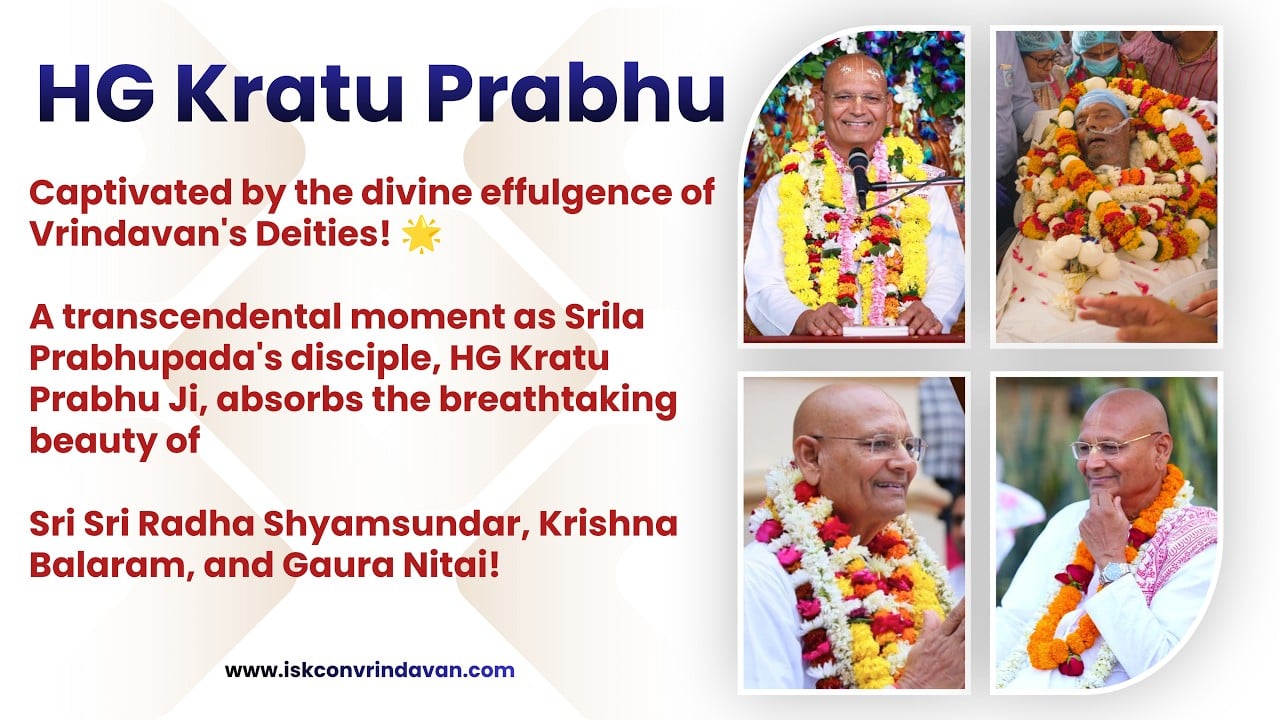
In loving remembrance and divine association of HG Kratu Prabhu Ji, this reflection contemplates a life wholly dedicated to Srila Prabhupada’s mission and the service of the Lord, situated within the sacred aesthetics, theology, and lived tradition of Vrindavan Dham. The phrase “a soul fully absorbed” aptly characterizes a practitioner whose orientation to Krishna bhakti exemplified unwavering sadhana, compassionate mentorship, and service (seva) aligned with Gaudiya Vaishnavism’s ideals.
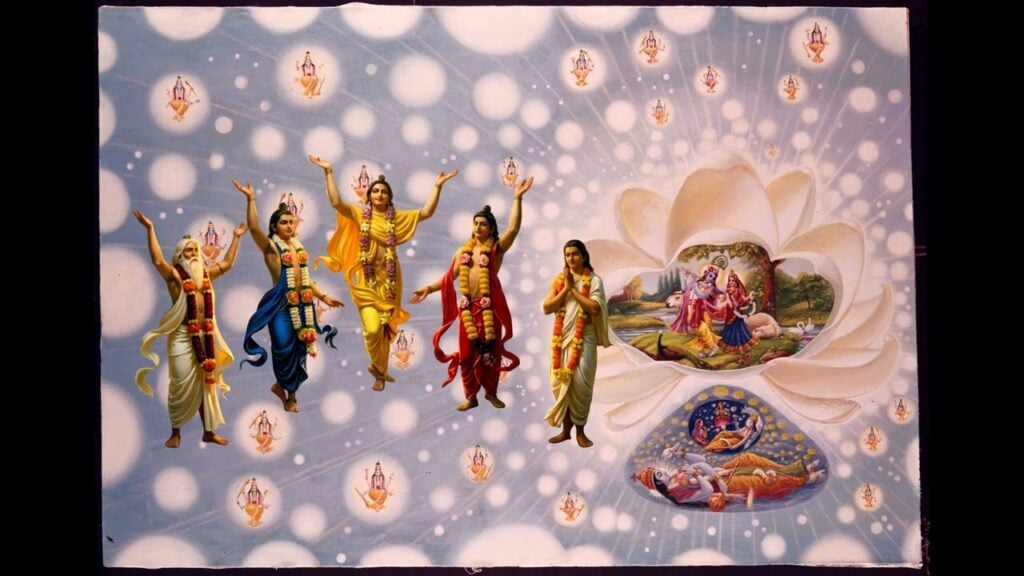
Vrindavan Dham occupies a unique place in the religious geography of India and within the Gaudiya Vaishnava tradition that ISKCON Vrindavan carries forward. The Dham is not merely a physical locale but an ontological category: a sacred environment in which the Lord’s names, forms, qualities, and pastimes (nama, rupa, guna, lila) are understood as both historically situated and eternally present. This theological framingoften summarized as dhama-tattvagrounds the aesthetic and emotional experience of pilgrimage, darshan, and kirtan.
From an academic perspective, the phenomenology of Vrindavan centers on how space, sound, memory, and ritual conduct converge to form a total devotional ecology. The Yamuna’s flow, the Govardhan parikrama path, and the network of lila-sthalis (sites sanctified by remembered pastimes) constitute a cartography of sacred memory. Devotees routinely observe that this landscape teaches through embodied practice: the feet learn through parikrama, the tongue through kirtan and japa, and the heart through seva and satsanga.
HG Kratu Prabhu Ji is remembered for embodying these practices with humility and rigor. His life narrative, as repeatedly recalled by those who served alongside him, emphasizes consistency in bhakti-yoga, fidelity to guru-parampara, and careful guidance of communities connected to ISKCON Vrindavan. The alignment with Srila Prabhupada’s mission appears not as a slogan but as daily discipline: study of Bhagavad-Gita and Srimad-Bhagavatam, kirtan rooted in scriptural understanding, and practical leadership in cultivating a culture of service.
Within the Gaudiya Vaishnava framework, bhakti-yoga proceeds through intelligible stages of cultivation, beginning with faith and association and maturing through steady practice into refined devotion. This trajectory explains why Vrindavan Dhamexperienced through parikrama, sankirtana, and sevafunctions as both classroom and sanctuary. It offers the rigor of a living tradition and the intimacy of a spiritual home, harmonizing theological claims with practical disciplines.
ISKCON Vrindavan, centered around the Krishna-Balaram Mandir, has long presented this integration of devotion and scholarship in accessible forms: congregational chanting (sankirtana), scriptural seminars, and festivals that translate theological tenets into communal celebration. HG Kratu Prabhu Ji’s contributions are widely associated with this synthesis: careful exposition of texts, pastoral care for devotee communities, and a steady emphasis on humility and cooperation across diverse backgrounds.
The aesthetics of Vrindavan Dhamits kirtan melodies, temple architecture, and ritual rhythmsare not ornamental. They are pedagogical. Gaudiya Vaishnavism deliberately uses beauty (rasa) to stabilize and elevate consciousness. In this view, music and mantra act as cognitive scaffolding, guiding attention from distraction to remembrance (smaranam) and transforming emotion into devotionally aligned sentiment.
Pilgrimage practices in the Vraja region reflect this pedagogy. The traditional Vraja-mandala parikrama encircles approximately eighty-four kos (a classical measure), translating into a demanding but formative devotion-in-motion across dozens of sacred sites. Likewise, the Govardhan parikramacommonly observed at roughly twenty-one to twenty-three kilometers depending on routecondenses the journey into a single, immersive loop of prayer, reflection, and service-minded resolve.
Technical discussions within Gaudiya theology often highlight that the holy name (nama) is non-different from the Lord (nami), articulating why kirtan is treated as both method and realization. This non-difference frames the devotional claim that sound can directly reshape consciousness. In practice, this means that the routine of attentive japa, congregational kirtan, and scripturally informed study operates as a reliable, testable disciplineexperientially verifiable through sustained application.
In accounts offered by many pilgrims and residents, HG Kratu Prabhu Ji’s life mirrored this steadiness. Narratives frequently reference his encouragement to harmonize zeal with humility, to value team service over individual profile, and to measure advancement not by perfect externals but by sincerity, steadiness, and compassion. Such guidance resonates with Srila Prabhupada’s mission: cultivating devotion that is both heartfelt and institutionally responsible.
Beyond the confines of any single institution, Vrindavan Dham also illuminates a broader dharmic conversation. Shared values such as ahimsa (central to Jain traditions), metta/karuna (in Buddhism), and the centrality of kirtan and seva (deeply cherished in Sikh practice) form bridges of recognition. This consonance of ethics and practicenon-violence, compassion, community singing, and serviceencourages unity among dharmic traditions while preserving their distinct theologies.
In this spirit, the remembrance of HG Kratu Prabhu Ji invites an inclusive lens: to see Vrindavan’s devotional culture as part of a wider Indic tapestry in which diverse soteriologies converge around character formation, disciplined compassion, and reverence for the sacred. Such a lens advances mutual respect across Hinduism, Buddhism, Jainism, and Sikhism without erasing doctrinal nuance.
Contemporary stewardship of Vrindavan’s heritage necessarily includes environmental care and ethical pilgrimage. Responsible parikrama, river respect for the Yamuna, and sensitivity to local communities illustrate how seva extends beyond temple walls. This outlook aligns well with dharmic ethics writ large, demonstrating that spiritual integrity and social responsibility are mutually reinforcing.
For practitioners seeking practical guidance, several patterns stand out from this legacy. Daily japa practiced with attention, regular scriptural study anchored in commentarial traditions, and consistent seva in one’s community form the backbone of sustainable bhakti-yoga. Periodic yatra to Vrindavan Dham can deepen realization, while the culture of kirtan translates devotion into shared joy and resilience.
In the hermeneutics of devotion, authority (guru), scripture (shastra), and practice (sadhana) must cohere. Observers routinely note that HG Kratu Prabhu Ji modeled this triangulation: fidelity to the disciplic succession, clarity in scriptural teaching, and a lived practice that emphasized humility over display. This coherence strengthens communities and minimizes the gaps that can appear between aspiration and daily conduct.
While Vrindavan’s beauty is often described in lyrical termscool Yamuna breezes, temple bells at mangala-arati, the cadence of mridanga and kartalsits deepest power is formative. By orienting perception and action toward Krishna, the Dham educates in the language of lived virtues: patience in queues, care in speech, and generosity during festivals. The outcome is practical: more attentive minds, softer hearts, and steadier hands for service.
Tributes to HG Kratu Prabhu Ji consistently emphasize encouragement rather than charisma, steadiness rather than spectacle. This has strategic implications for community building. When leaders normalize scriptural study, daily sadhana, and shared responsibility, they craft environments where newcomers and elders flourish together, where differences are navigated by reference to principle rather than personality.
An additional lesson from Vrindavan’s devotional culture is the transformative role of congregational sound. Sankirtana organizes time, aligns breath and voice, and forges social synchronization that reduces isolation. In a digital age defined by distraction, this analog discipline becomes a cognitive and relational stabilizerits benefits observable even in secular research on group singing and collective ritual.
Ultimately, the remembrance of HG Kratu Prabhu Ji is not only retrospective. It is a call to continue Srila Prabhupada’s mission through integrity in practice, clarity in teaching, and kindness in service. To be “fully absorbed in the divine beauty of Vrindavan Dham” is to allow place, sound, scripture, and community to reshape the contours of daily lifeso that devotion matures into character, and character matures into service that uplifts all.
May this remembrance inspire unity among dharmic traditions through shared virtues of ahimsa, compassion, kirtan, and seva, honoring both the distinctiveness and the deep affinity that bind these paths. In that unity, the devotional message of Vrindavanembodied so steadily by HG Kratu Prabhu Jifinds its fullest contemporary expression.
Inspired by this post on Dandavats.