
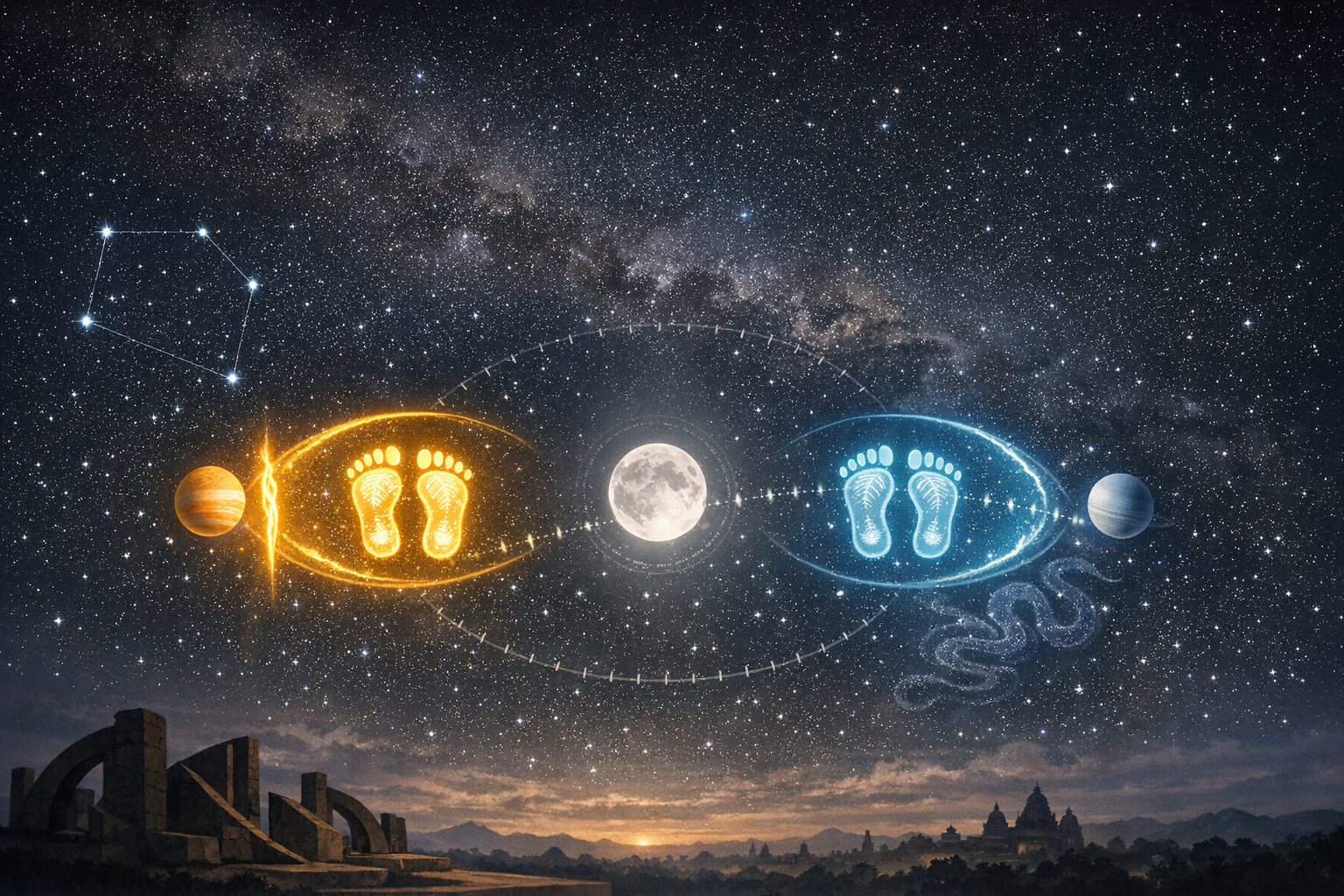
Bhadra literally means “auspicious” or “beautiful,” and in Hindu astronomy (Jyotiṣa), the term gives its radiance to a paired lunar mansion: Purva Bhadrapada and Uttara Bhadrapada. These two nakshatras occupy adjacent spans of the sidereal ecliptic and together preserve one of the most evocative images in Vedic sky-lore: the “former” and “latter” blessed feet (bhadra + pada), a poetic expression that binds observation, ritual timekeeping, and inner discipline into a single, memorable constellation of meaning.
Since Vedic times, the Moon’s path has been articulated into 27 equal segments (nakshatras), each 13°20′ in length, reflecting the Moon’s average sidereal period of about 27.3 days. This division—central to the Panchanga (almanac) and to muhurta (auspicious time selection)—is foundational to Hindu calendrics, temple ritual schedules, and personal observances. Some traditions also enumerate a 28th segment, Abhijit, inserted without disturbing the basic 27-part framework.
Across early Sanskrit sources, nakshatra lists appear with remarkable continuity. The Vedanga Jyotisha (c. late 2nd–early 1st millennium BCE), Brahmana literature, and later Siddhantas anchor this lunar-mansion system historically and methodologically. While textual redactions complicate exact dating, the continuity of names and usage across centuries signals a living scientific-ritual tradition, sustained by observation and refined by computation.
Within this framework, the two Bhadrapadas form a consecutive pair. Purva Bhadrapada (the “former” blessed foot) spans 20° of Kumbha (Aquarius) to 3°20′ of Meena (Pisces). Uttara Bhadrapada (the “latter” blessed foot) follows from 3°20′ to 16°40′ of Meena. In the night sky, these sectors intersect star-fields commonly associated with Pegasus and Andromeda; in South Indian calendrical parlance, they are widely known as Poorattathi (Purva Bhadrapada) and Uthrattathi (Uttara Bhadrapada). Observers often use the Great Square of Pegasus—formed by Markab, Scheat, Algenib, and Alpheratz—as a visual gateway to these regions, noting the Moon’s passage through the square on Bhadrapada nights.
In classical Jyotiṣa correspondences, Purva Bhadrapada is governed by Guru (Jupiter) and presided over by Aja Ekapada, a Rudra aspect linked to lightning, heat, and upright stability; Uttara Bhadrapada is ruled by Shani (Saturn) and presided over by Ahirbudhnya, the serpent of the deep, associated with stillness, profundity, and the creative substratum of waters. These deity-lord pairings encode a philosophical contrast: the fiery impetus of idealism and moral intensity (Jupiter–Aja Ekapada) maturing into the contemplative depth and sustained discipline (Saturn–Ahirbudhnya) that carry endeavors to completion.
Traditional imagery reinforces this progression. Purva Bhadrapada is symbolized by a sword, a two-faced figure, or the front legs of a funerary cot—metaphors for cutting through falsity, confronting dualities, and initiating transformative rites. Uttara Bhadrapada, in turn, is symbolized by the back legs of the same cot or by twins—signs of consolidation, steadiness, and the quiet custodianship of foundations after initial breakthroughs. Together, the “two feet” evoke a full stride: aspiration and anchor, intensity and endurance.
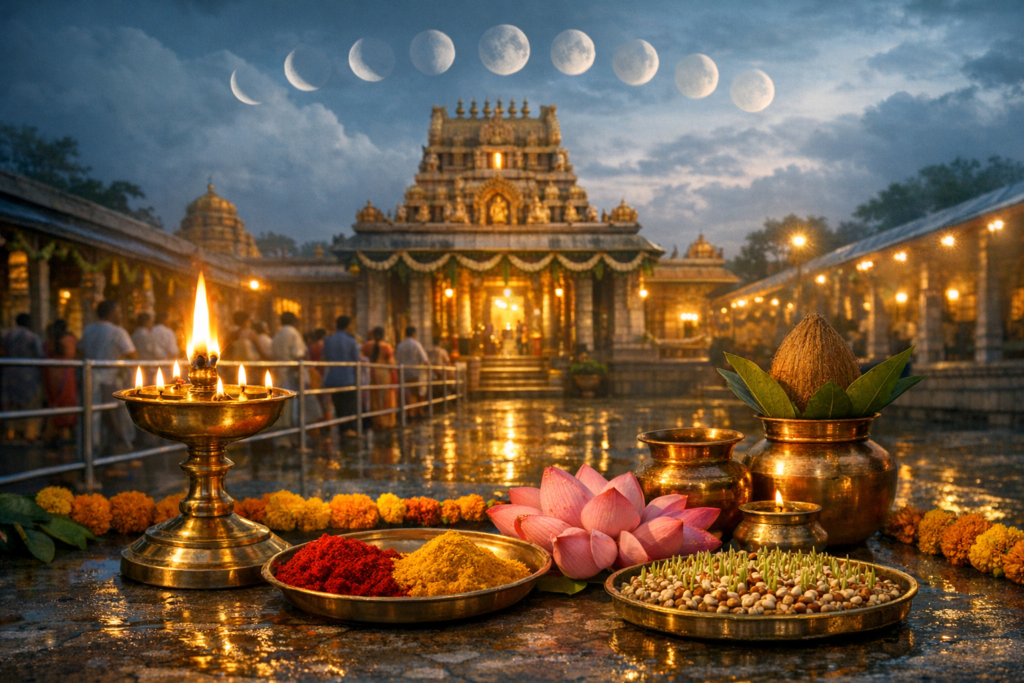
Calendrically, the lunar month Bhadrapada (Bhadon in North Indian vernaculars) takes its name from the full Moon’s proximity to these nakshatras, usually falling across August–September. Many communities observe Ganesha Chaturthi and Anant Chaturdashi in Bhadrapada, while Jain traditions often situate Paryushana in the same seasonal window. In the Punjab region, Sikh communities long relied on the Bikrami calendar—whose Bhadon corresponds to Bhadrapada—before the adoption of the solar Nanakshahi system, preserving an enduring cultural memory of the lunar sky’s role in shared timekeeping.
In everyday Panchanga use, nakshatra is one of five limbs—tithi (lunar day), vara (weekday), nakshatra (lunar mansion), yoga (solar–lunar angular sum), and karana (half-tithi). Muhurta decisions for travel, rites of passage, homa, and temple festivals consider the lunar mansion in concert with these other limbs. Local parampara (lineage) and regional smriti guide whether Purva or Uttara Bhadrapada is preferred, neutral, or to be avoided for a given action, underscoring that auspiciousness emerges from an integrated evaluation rather than any single factor.
An observational approach deepens appreciation. On a clear evening in late monsoon months, the Great Square of Pegasus rises in the east after sunset. Tracking the waxing Moon as it approaches and then traverses this asterism offers a direct way to witness the sequence from Shatabhisha to Dhanishtha, Shatabhisha, and onward to Purva Bhadrapada and Uttara Bhadrapada, embodying how ancient sky-watchers blended empirical note-taking with poetic naming.
From a computational perspective, determining a person’s current nakshatra involves calculating the Moon’s sidereal ecliptic longitude for the given place, date, and time. Subtract the ayanamsha (precessional correction) from the tropical longitude to obtain the sidereal value; then divide the result by 13°20′ (13.333…°). The integer part (0–26) identifies the nakshatra index in the standard 27-lot sequence. In Indian practice, the Lahiri (Chitrapaksha) ayanamsha is widely used in almanacs, although other ayanamshas (e.g., Raman, Krishnamurti) exist. Differences are small but can shift the boundary between adjacent mansions for charts cast near cusps.
The Bhadrapadas carry additional technical layers. Each nakshatra is divided into four padas (quarters) of 3°20′, which map into the Navamsha and other divisional charts employed for refined timing and character analysis in Jyotiṣa. Thus, while the full span of Purva or Uttara Bhadrapada communicates a general ethos, a given pada often nuances the theme—e.g., Jupiter’s expansiveness in Purva Bhadrapada may emphasize ethical idealism in one quarter and incisive truth-telling in another; Saturn’s steadiness in Uttara Bhadrapada may accentuate contemplative austerity in one pada and community guardianship in another.
A frequent source of confusion is the term “Bhadra” in popular Panchanga parlance for the Vishti Karana, which many traditions avoid for initiating auspicious tasks. Despite the shared root word, this “Bhadra” (Vishti Karana) is a technical karana classification and is conceptually distinct from the nakshatra-name element “Bhadra” in Bhadrapada. Clarity on nomenclature safeguards both ritual accuracy and the graceful connotation of “Bhadra” as auspicious in the context of the two Bhadrapadas.
Across dharmic traditions, these sky divisions function as a shared cultural-astronomical grammar. Hindu, Buddhist, and Jain communities historically employed lunisolar schemes rooted in nakshatras for fasts, festivals, and observances; Sikh communities engaging the Bikrami calendar likewise preserved the same seasonal anchors and vocabulary. This common sky fosters unity: one set of stars, many paths of reverence—each honoring the rhythms of nature without erasing the diversity of practice.
Comparative history underlines this universality. Arabic manāzil al-qamar and Chinese xiu represent parallel lunar mansion systems, demonstrating that careful naked-eye astronomy naturally invites an ecliptic partitioning for practical timekeeping. Yet the Indian nakshatra names, myths, and deities—exemplified by the Bhadrapadas—uniquely interweave cosmology, ethics, and ritual, illuminating how scientific observation and spiritual imagination can co-evolve without contradiction.
For practitioners, the Bhadrapadas model a full arc of endeavor. Purva Bhadrapada’s Jupiterian intensity cuts through indecision and summons sincerity; Uttara Bhadrapada’s Saturnine depth consolidates that momentum into lasting virtue and communal steadiness. Read in this light, “the former and the latter blessed feet” become a universal lesson: progress requires both the courage to begin and the patience to complete—an insight as helpful to study and work as to sadhana.
In sum, Bhadra in Hindu astronomy is not a single term but a constellation of meanings. It names a venerable astronomical framework for tracking the Moon, a calendrical anchor for Bhadrapada observances, and two adjacent nakshatras whose complementary qualities guide aspiration into grounded achievement. Whether approached through sky-gazing, Panchanga study, or meditation on the paired symbols and deities, the Bhadrapadas invite a balanced, compassionate engagement with time—shared across Hinduism, Buddhism, Jainism, and Sikhism as a testament to India’s living celestial heritage.
Inspired by this post on Hindu Blog.



Leave a Reply
You must be logged in to post a comment.