Hindu Ekta Andolan and allied civil-society groups have urged authorities to pause large-scale observances related to the Urs of Rehan Malik within the precincts of Vishalgad Fort, emphasising the need to protect the fort’s sanctity, structural integrity, and legal compliance. Framed correctly, the concern is a heritage-conservation and public-safety question rather than a dispute of faith, aligning with the commitment to unity among Hindu, Buddhist, Jain, and Sikh traditions and to respectful coexistence with all communities.
Vishalgad Fort, set in the Western Ghats of Maharashtra, is not merely stonework on a ridge; it is a living palimpsest of memory and valor. Known historically as Khelna, the fort became inseparable from the legacy of Chhatrapati Shivaji, especially in the public imagination surrounding the 1660 Panhala–Vishalgad episode and the legendary stand at Ghodkhind, later revered as Pavan Khind. Its ramparts, gateways, water systems, and shrines embody layered material culture that demands careful stewardship.
For countless families across Maharashtra, weekend walks on these weathered ramparts are rites of remembrancemoments when elders narrate episodes of fortitude, children trace carved stones with curiosity, and local communities experience belonging. This emotional bond explains why public appeals for vigilance over Vishalgad’s fabric evoke strong responses across dharmic communities that revere historical sites as shared civilisational heritage.
Urscommemorating the death anniversary of a Sufi sainthas deep roots in the subcontinent’s cultural tapestry. It typically includes devotional gatherings, music, processions, and charitable activities. The point of contention here is not the spiritual meaning of the Urs of Rehan Malik, but whether high-footfall events and allied installations situated in or abutting sensitive heritage zones are compatible with conservation norms, safety standards, and the carrying capacity of a centuries-old fort.
Heritage governance in India applies layered legal and technical principles. Where applicable, centrally protected sites are regulated by the Ancient Monuments and Archaeological Sites and Remains Act, 1958 (as amended), which prescribes stringent norms for works, activities, and new constructions in core and buffer zones. State laws in Maharashtra for protected monuments follow similar logic, mandating permissions, oversight by competent authorities, and adherence to conservation charters for any large public event or temporary structure within a protected precinct.
From a conservation-science perspective, periodic mass gatherings add dynamic loads and micro-vibrations to aged masonry; increased humidity from dense crowds can accelerate salt crystallisation and efflorescence; and ad hoc fixings (nails, banners, lighting) risk fabric abrasion. On hill forts composed of laterite and basalt, cycles of wetting, drying, and footfall-induced stress can exacerbate micro-cracking, joint loss, and surface delamination, especially where mortar joints and weathering skins are already fragile.
Public-safety and environmental-compliance frameworks are equally salient. Crowd Management Guidelines issued by disaster-management authorities call for route planning, access control, emergency egress, and real-time monitoring. The Noise Pollution (Regulation and Control) Rules, 2000, stipulate decibel ceilings and night-time restrictions, while municipal and state rules require prior permissions for sound-amplification, processions, and temporary stages. Solid Waste Management Rules, 2016, mandate on-site segregation, collection, and post-event clean-up to prevent ecological and heritage harm.
In light of these norms, a heritage-first course correction is prudent: a time-bound moratorium on high-footfall events inside the fort’s vulnerable core; a rapid, independent Heritage Impact Assessment (HIA) to quantify structural risks and carrying capacity; and, where needed, relocation of major congregational segments to designated areas outside the core zone without impeding individual, quiet devotion conducted lawfully and respectfully.
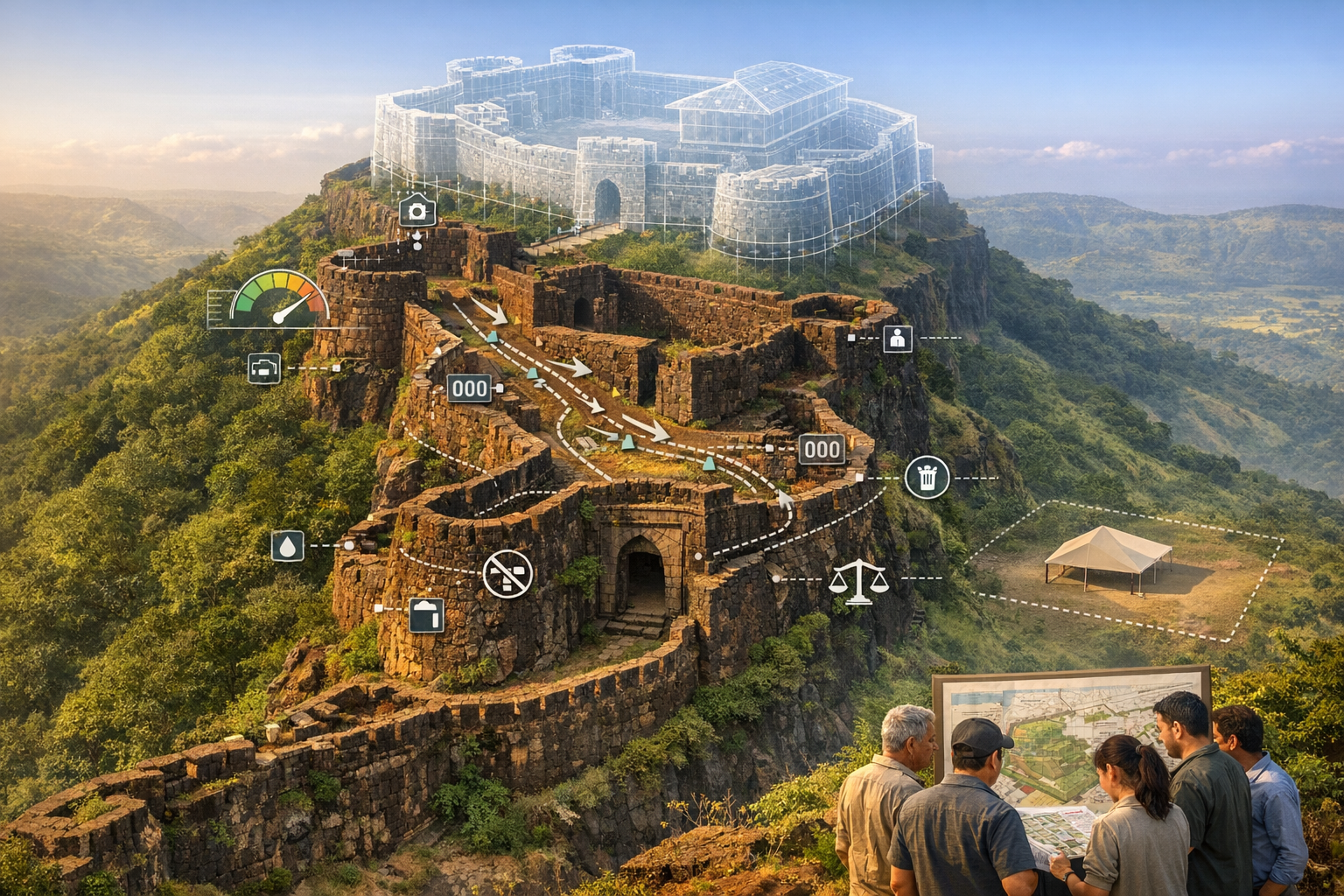
Technically, an HIA should include a structural-health baseline using non-destructive testing, vibration sensors on key spans and gateways, photogrammetry or LiDAR scans for high-fidelity documentation, moisture mapping to track damp ingress, and footfall-counters to derive peak-load profiles. A digital twin of the fortperiodically updatedcan help predict stress points under varying crowd scenarios and inform evidence-based permissions for future events.
Administrative protocols can align with ICOMOS charters and the Nara Document on Authenticity by privileging reversibility, minimal intervention, and compatibility of any temporary installations. Permissions, if granted post-assessment, should enumerate conditions: controlled access routes; decibel caps and fixed time windows; zero-fixation policies on historic fabric; non-invasive anchoring of signage; designated waste and water stations; and a mandatory post-event conservation audit with penalties for non-compliance.
Stakeholder engagement is central to a durable, dignified resolution. A multi-faith Heritage Mediation Councilcomprising conservation architects, state archaeologists, local panchayat representatives, safety experts, and community leaders from Hindu, Buddhist, Jain, Sikh, and Muslim communitiescan ensure that decisions uphold both sanctity and fairness. Such a forum advances dharmic unity by foregrounding shared responsibility for safeguarding the subcontinent’s civilisational assets.
Comparative precedents demonstrate viability. Iconic sites manage large congregations through buffer-zoning, timed permits, acoustic controls, and periodic conservation shutdowns. Where ritual intensity exceeds a monument’s carrying capacity, authorities have successfully shifted heavy-footfall components to adjacent open grounds while preserving the essence of worship. Vishalgad can adopt similar calibrations tailored to its topography and material condition.
Local livelihoods and visitor experience also matter. A heritage-first plan can improve amenities, interpretive signage, guided circuits, and responsible vending in designated areas, uplifting the local economy while reducing ad hoc pressures on the monument. When families and pilgrims encounter well-managed, dignified settings, reverence deepens and the social license for conservation expands.
A balanced pathway therefore includes: immediate risk mitigation and monitoring, a transparent HIA-led decision on event suitability and scale, relocation of high-load activities if required, and a standing review mechanism before each major congregation. Clear, public-facing communication that “this is about preserving Vishalgad for future generations” builds trust and diffuses polarisation.
In sum, the call surrounding the Urs of Rehan Malik at Vishalgad Fort should catalyse a heritage-first, law-aligned, and compassion-centered framework. Protecting the fort’s sanctity honors the memory of Chhatrapati Shivaji and the broader civilisational continuum, while respectful accommodationwhere feasible and lawfulupholds India’s plural ethos. Through unity across dharmic traditions and empathy toward all worshippers, the community can secure both continuity of devotion and the long-term survival of an irreplaceable cultural landmark.
Inspired by this post on Hindu Jagruti Samiti.