Within the expansive landscape of Hindu thought, Goddess Lakshmi is widely recognized as the luminous embodiment of śrīauspiciousness, prosperity, harmony, and the sustaining power that nurtures dharma. While the Vaishnava mainstream emphasizes her serene, sattva-aligned presence as the compassionate consort of Vishnu, a parallel and scripturally grounded strand of tradition acknowledges Lakshmi’s protective, martial, and at times “ugra” (fierce) modalities. Far from contradicting her benevolent nature, these manifestations articulate how compassion can assume decisive, kṣātra-inflected strength when the safeguarding of moral order requires it.
In Sanskrit poetics and ritual exegesis, the term ugra does not connote malice or cruelty; it signals concentrated, vigilant power that dispels disorder. When applied to Lakshmi, ugra-bhāva describes the intensified radiance of śrī harnessed for protectionan energy that arrests adharma and fortifies ethical life. This conceptual nuance becomes essential when reading textual sources, studying iconography, and understanding ritual paradigms associated with Lakshmi’s fierce forms.
Classical and medieval sources establish the theological canvas on which these forms are understood. The Śrī Sūkta (a revered Vedic hymn), Purāṇic narratives (notably the Viṣṇu Purāṇa, Padma Purāṇa, and Brahma Vaivarta Purāṇa), and the Vaishnava tantric Lakṣmī Tantra present Śrī as the cosmic potency of Nārāyaṇa, both intimately compassionate and cosmically sovereign. In the Śākta scripture Devī Māhātmya (of the Mārkaṇḍeya Purāṇa), “Mahalakṣmī” appears as one of the three primordial facets of the Great Goddess, adopting explicitly martial iconography. While the Mahālakṣmī of the Devī Māhātmya is a Śākta theological category (not merely Vishnu’s spouse), the shared name foregrounds an important intertextual dialogue about Lakshmi’s protective agency across traditions.
The Vaishnava–Śākta interface is historically rich and mutually illuminating. Pancharātra materials such as the Lakṣmī Tantra honor Śrī as the sovereign śakti of Viṣṇu, complete with mantras, kavacas, and nyāsas that outline protective and redemptive liturgies. Śrī-vidyā frameworks, while principally centered on Tripurasundarī and the Śrīcakra, frequently speak of śrī as the operative, beneficent power pervading the cosmos. Across these currents, Lakshmi’s ugra modes never undermine her essential benevolence; they disclose how compassion can become active guardianship.
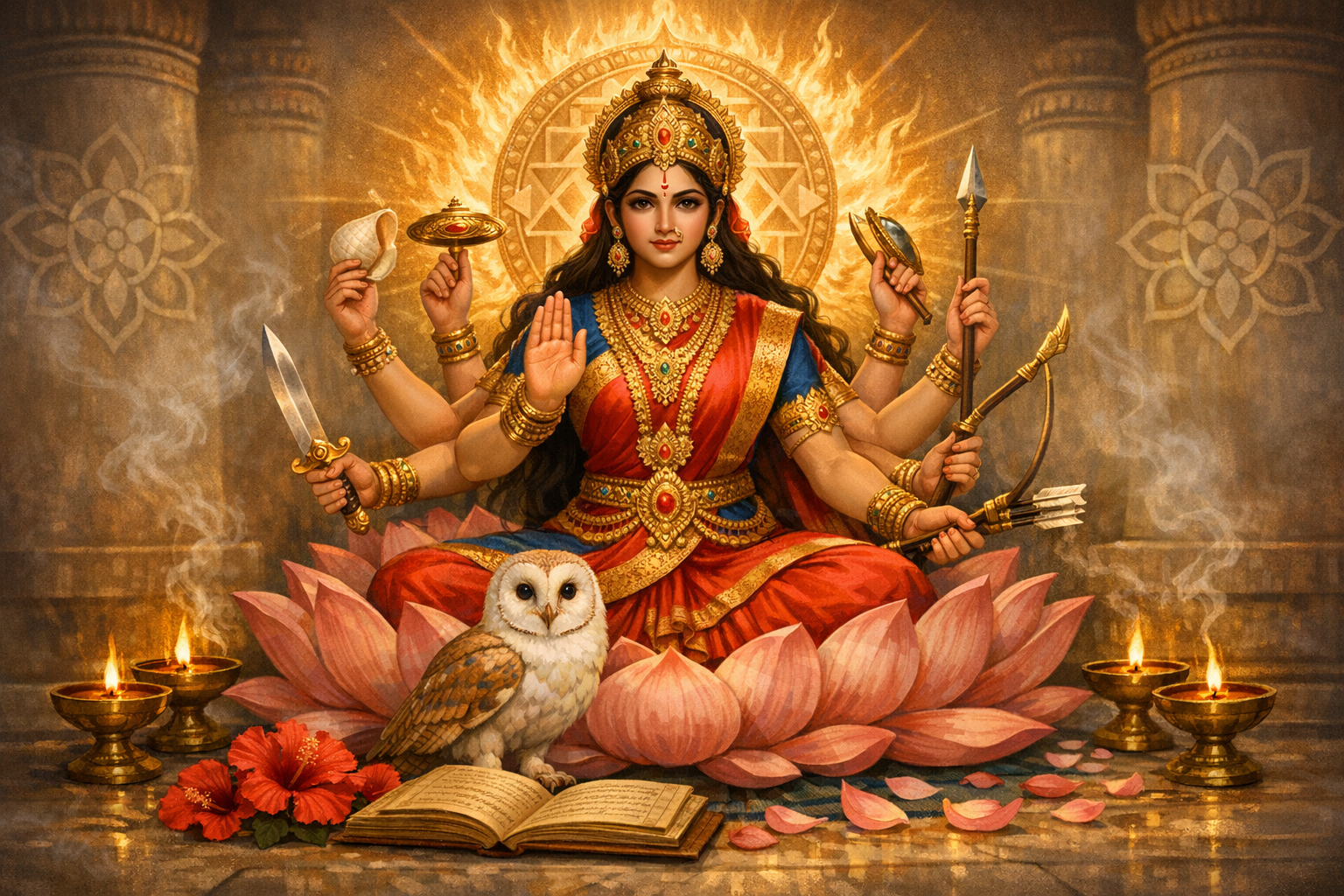
Iconographically, ugra Lakshmi departs from purely pacific depictions in selective and purposeful ways. The visage may be vigilant, the gaze wider, the prabhāmaṇḍala (aura) more flamelike, and the regalia overtly martial: śaṅkha, cakra, khaḍga (sword), śakti (spear), dhanus (bow), and śara (arrows) can appear alongside the abhaya and varada mudrās that assure fearlessness and boons. While Lakshmi’s owl (ulūka) and lotus-seat remain standard in many contexts, certain shrines and liturgical cycles emphasize leonine energy or battlefield symbolism to signal her guardianship of dharma. Even then, the countenance retains poise, integrating firmness with grace.
The popular Aṣṭalakṣmī tradition offers an instructive lens. Although most of these eight forms are serenely beneficent (Dhana Lakṣmī, Gaja Lakṣmī, Santana Lakṣmī, and others), Veera (or Dhairya) Lakṣmī and Vijaya Lakṣmī distinctly encode kṣātra and victory. Veera/Dhairya Lakṣmī embodies moral courage, resilience, and disciplined action; her attributes may include weapons that signify the readiness to defend righteousness. Vijaya Lakṣmī embodies rightful successvictory without hubris, secured in alignment with dharma. Temples that install the full Aṣṭalakṣmī suite, such as those in South India, often give these two forms a guarded, valorous iconographic treatment that makes the protective grammar explicit.
Śākta liturgies supply a second vantage point. In the Devī Māhātmya, Mahālakṣmī manifests with multiple arms and leonine vigor as the slayer of demonic forces, an image anchoring the theological claim that the Goddess’s grace can become martial when safeguarding the cosmic order. Though this Mahālakṣmī is a Śākta theological expression rather than a straightforward Vaishnava portrait of Lakshmi as Vishnu’s consort, the shared epithet preserves a profound insight: śrī is not passive. It can, and does, mobilize power when compassion alone must be shielded by strength.
Ritual culture communicates these insights through seasonal rhythms. The Navarātri cycle, for instance, typically allocates the middle triad of days to Mahālakṣmī, highlighting virtue aligned with wealth, order, and victory. In some regional lineages, Ashtamī and Navamī carry protective undertonesdevotees intensify japa, deepen vrata, or perform homas that invoke both serenity and strength. Śārada Pūrṇimā (Kojagari Lakshmi Pūjā) in the East underscores vigilance and blessing“Ko jāgarti?” (“Who keeps awake?”)a luminous allegory for alertness in prosperity and ethics alike.
The Lakṣmī Tantra contributes a tantrarāja-style articulation of Śrī’s protective modalities. Its procedural anatomymūla-mantras, bīja-mantras, kavacas, and nyāsasmaps an inner architecture of safeguarding where mantric sound, visualization, and disciplined intention consecrate a field of auspicious order. When properly transmitted and practiced, this grammar does not cultivate aggression; it formalizes watchfulness, rectitude, and the ethical resolve needed to protect one’s home, community, and the shared dharmic fabric.
Household devotional practice remains staunchly sāttvika even when acknowledging ugra resonance. Offerings stay vegetarian; flowers such as red hibiscus or lotus are chosen for their purity and radiance; lamps are lit with ghee; and abhiṣeka, where appropriate, uses pañcāmṛta in line with established vidhi. Core recitationsŚrī Sūkta, Mahālakṣmī Aṣṭakam, and the Lakṣmī Gāyatrī (“Mahalakṣmyai ca vidmahe, Viṣṇu-patnyai ca dhīmahi, tanno Lakṣmī pracodayāt”)are favored for their clarity and stability. For those who worship Lakṣmī-Narasimha, protective kavacas may be added under guidance, reinforcing the synergy between serenity and guardianship.
Temple case studies exemplify how these ideas are visually taught. In certain Aṣṭalakṣmī temples, Veera Lakṣmī is depicted with a measured readinessweapons present, posture steady, gaze composedconveying the pedagogical point that courage need not abandon grace. In major Mahālakṣmī centersKolhapur (Karvīr), for examplethe goddess’s presence blends regal authority with maternal assurance; regional āgamic traditions draw from both Vaishnava and Śākta reservoirs to educate devotees in the balance of prosperity, virtue, and vigilance.
Tantric hermeneutics frames ugra Lakshmi within the triad of icchā-śakti (will), jñāna-śakti (knowledge), and kriyā-śakti (effective action). Lakshmi’s serenity anchors icchā and jñāna; her protective forms activate kriyā to establish order. The ritual semioticsmudrās that grant fearlessness, weapons that symbolize ethical power, and mantras that stabilize awarenesswork in concert to shift practitioners from anxiety to alert composure. In this way, “fierceness” is not temperament; it is an ethical instrument.
Periods considered ritually potent for this protective grammar are observed with care. Fridays (for Śrī), the Mahālakṣmī segment of Navarātri, and auspicious tithis in the brighter fortnight (śukla pakṣa) invite intensification of sādhana. Practitioners often adopt vratās that also benefit the wider community: almsgiving that upholds dignity, study circles that transmit scriptural literacy, and service (seva) that reduces fear and want. Ugra-bhāva thereby returns to its dharmic root: protection that dignifies, empowers, and includes.
Ethically, the fiercest icon is still maternal. Devotees frequently testify to a palpable sense of refuge when circumambulating an ugra Lakshmi shrinethe mind stands straighter, the breath steadies, and a lucid confidence replaces worry. In an academic register, this could be called the internalization of kṣātra under the tutelage of śrī: moral courage moderated by compassion, vigilance without paranoia, resolve without rancor.
Cross-dharmic resonances support this reading and nourish unity among the dharmic traditions. In Vajrayāna Buddhism, “wrathful” deities are pedagogically compassionatefierceness educates, protects, and liberates from confusion. Sikh thought celebrates the sant-sipāhī ideal, uniting devotion with the responsibility to defend the vulnerable. Jain ethics, profoundly grounded in ahiṁsā, uplifts vīrya (moral strength) as an inner conquest over harmful impulses. Read together, these perspectives affirm a shared principle: protective energy is ethically meaningful only when it safeguards life, truth, and dignity for all.
Common misconceptions merit correction. Ugra is not synonymous with violence; it signifies concentrated clarity and responsibility. “Alakṣmī” (inauspiciousness) is not a fierce form of Lakshmi but a separate, cautionary figure in certain regional idioms; conflating them obscures doctrine. Nor does tantra license harmful conduct; classical āgamic texts insist on ethical discipline (yama–niyama), scriptural study, and the welfare of the social body as preconditions for advanced practice. Properly understood, the ugra register strengthens society by steadying the individual.
For students of iconography, recurring semiotic cues can guide interpretation. A lotus-throne paired with martial attributes, a flamelike prabhāmaṇḍala behind an otherwise serene face, or a temple sequence that positions Veera Lakṣmī and Vijaya Lakṣmī alongside gentler forms all signal the integrated pedagogy: wealth and virtue flourish where vigilance is humane and principled. The multiplicity of forms is not divergence; it is didacticsdistinct images teaching complementary lessons.
From a practical standpoint, a balanced sādhana for householders integrates three axes. First, daily serenity: lamp lighting, Śrī Sūkta japa, and simple offerings cultivate sattva. Second, periodic vigilance: during Navarātri or on chosen Fridays, adding Mahālakṣmī Aṣṭakam or Lakṣmī Gāyatrī elaborates the protective dimension. Third, social ethics: fair dealing, transparent livelihood, and generosity enact Lakshmi’s grace in public life. The ugra ideal then moves from the sanctum into citizenshipnonviolent, principled, and awake.
Scholarly study amplifies appreciation. The Lakṣmī Tantra’s dialogic structure, Purāṇic hymns to śrī, and the Devī Māhātmya’s martial theophanies can be read side by side to appreciate the polyvalence of “Lakshmi” across Vaishnava and Śākta discourses. Rather than fragmenting doctrine, this comparative approach clarifies a shared telos: preservation of dharma by means that are just, compassionate, and wise.
The broader cultural ecosystemfestivals, temple arts, and regional narrativesensures that these teachings remain lived knowledge. Classical dance repertoires that present victorious goddesses, temple murals that frame guardianship without intimidation, and community observances that tie prosperity to responsibility all materialize ugra Lakshmi’s lesson: abundance endures only with moral courage.
In sum, the fierce and martial manifestations of Lakshmi do not oppose her role as the giver of prosperity; they condition it. Prosperity without vigilance decays into excess; vigilance without compassion hardens into austerity. Ugra Lakshmi synthesizes both, ensuring that śrī remains life-giving, fair, and future-facing. Read within Hinduism’s own theological grammarsand in harmony with the wider dharmic ethos shared by Buddhism, Jainism, and Sikhismthis synthesis becomes a model for spiritual maturity and civilizational care.
Approached with reverence, learning, and ethical intent, ugra Lakshmi becomes a luminous teacher. She steadies households, inspires service, protects the vulnerable, and reminds communities that true wealth is inseparable from wisdom. In that reminder lies the heart of her protective grace: a radiance at once tender and unafraid.
Inspired by this post on Hindu Pad.