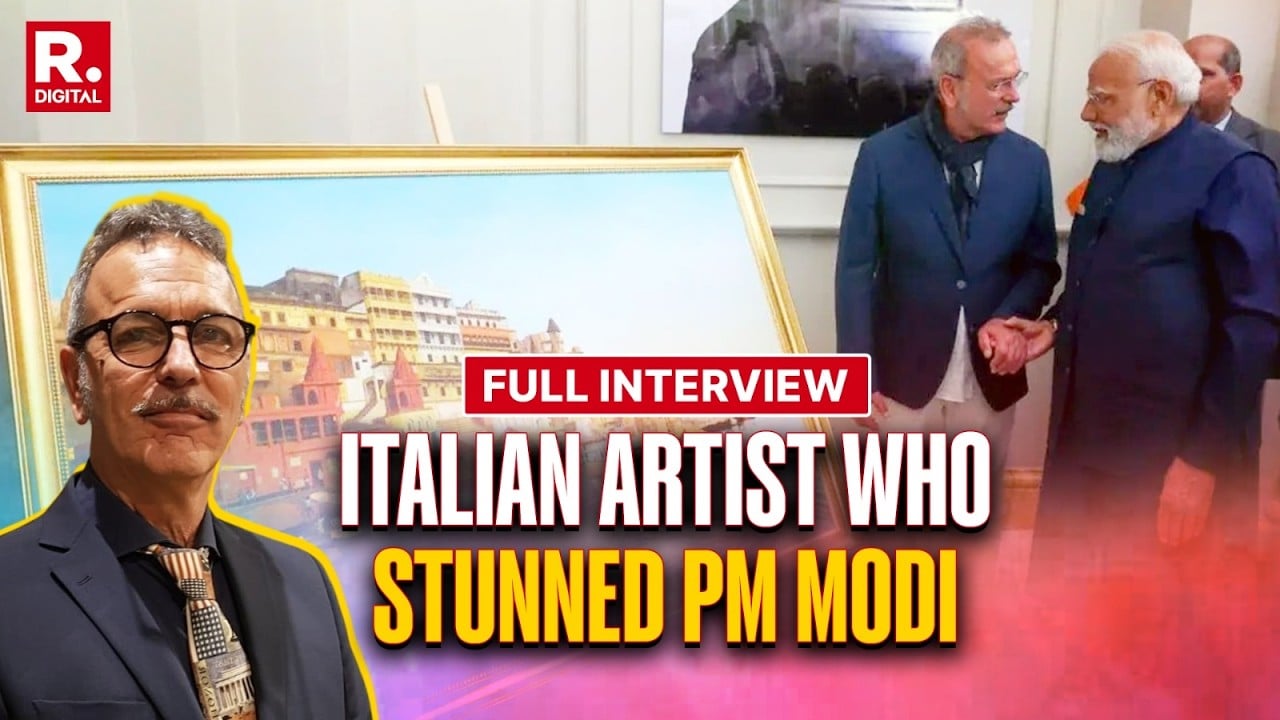
During an official visit to Italy, Prime Minister Narendra Modi met Italian artist Giampaolo Tomassettiknown in Vaishnava circles as Jnananjana Dasafor a warm exchange in Rome focused on art, Indian civilisation, and shared cultural values. The encounter, highlighted by the gifting of a Varanasi painting, was widely noted in Indian and international media as a moment where cultural diplomacy complemented statecraft.
Tomassetti’s body of work frequently engages with Indic themes and sacred geographies. The Vaishnava name Jnananjana Dasa signals a devotional orientation aligned with the bhakti tradition and with global communities such as ISKCON (International Society For Krishna Consciousness), underscoring the meeting’s resonance beyond formal protocol.
The gifted artwork centers on the iconic ghats of Kashi (Varanasi), the Ganga river, wooden boats moored along stepped embankments, and the play of early light on water and stonevisual elements that collectively evoke continuity, pilgrimage, and spiritual yearning. Such imagery is inseparable from the lived rhythms of the city: dawn mantras, temple bells, and the fluid movement of pilgrims navigating sacred space.
For many viewers, these cityscapes serve as portals into India’s sacred geography: Kashi as a tirtha of learning and liberation, Sarnath nearby as a foundational site in Buddhist history, and longstanding Jain and Sikh contributions to the subcontinent’s spiritual tapestry. In this sense, the composition invites a dharmic reading that is inclusive rather than sectarian, consonant with the ethos of Sanatana Dharma and the principle of Vasudhaiva Kutumbakam.
From a policy perspective, the Rome interaction exemplifies soft powercultivating familiarity, trust, and goodwill through art and heritage. Moments like these reinforce India–Italy cultural dialogue, deepen people-to-people ties, and provide a civilizational context to contemporary cooperation in technology, trade, and sustainability.
Crucially, the exchange communicates a unifying message across Hinduism, Buddhism, Jainism, and Sikhism: that sacred art can carry values of compassion, service, and non-violence without prescribing a single path. The painting becomes a shared cultural object through which diverse communities can recognize common ethical ground and appreciate multiple approaches to transcendence.
Sacred cityscapes have a long lineage in Indian artfrom miniature traditions to modern and contemporary interpretations that map devotion onto urban space. Artists often integrate atmospheric perspective, riverine diagonals, and temple silhouettes to render both physical place and metaphysical aspiration in a single frame, allowing viewers to contemplate the simultaneity of time, memory, and ritual.
Technically, works of this genre tend to employ layered glazes to achieve luminosity on water surfaces, calibrated value contrasts for the stone ghats, and controlled edge-work to suggest morning haze. Whether executed in oils or acrylics, the method typically balances observational fidelity with iconographic clarity, inviting contemplative viewing and sustained engagement. Color temperature shiftscool river blues against the warm ochres of sandstoneoften carry the narrative of awakening and return.
Italy’s own heritage of sacred artfrom Renaissance altarpieces to Baroque chiaroscurooffers a parallel tradition of devotion expressed through technique. Placed against that backdrop, a Kashi painting gifted in Rome functions as a bridge between bhakti aesthetics and European art canons, reinforcing civilizational dialogue rather than competition and subtly foregrounding the common pursuit of beauty, meaning, and moral imagination.
Community organizationssuch as the Italian Hindu Union and local ISKCON centersprovide the living infrastructure for such exchanges by hosting festivals, lectures, kirtan, and educational programs. Their work extends the reach of formal diplomacy into everyday cultural practice, building durable social capital that supports intercultural understanding and unity across dharmic traditions.
Digital dissemination ensured that this ceremonial moment entered public memory far beyond the meeting room. For diaspora audiences, the image of Kashi in Rome resonated as a reminder that heritage is portable yet rootedcapable of generating pride without parochialismand that shared symbols can be read with empathy across languages, regions, and faiths.
Culturally, the scene of the Ganga river also gestures toward contemporary responsibilities: conserving riverine ecologies, safeguarding ghats as heritage assets, and promoting mindful pilgrimage. Artistic attention can catalyze civic attention, aligning aesthetics with stewardship and helping translate reverence into action for preservation and sustainable tourism.
As India emphasizes cultural initiatives alongside strategic partnerships, art-focused interactions of this kind accrue symbolic capital. They complement dialogues on climate action, resilient supply chains, and knowledge exchange by keeping civilizational context in view. In practice, this strengthens trust, lowers transaction costs in cross-border collaboration, and humanizes diplomatic narratives.
Viewed holistically, the Rome meeting demonstrates how a single artwork can crystallize complex ideasIndian civilisation, dharmic pluralism, and international friendshipinto a relatable, emotionally resonant image. It shows how cultural diplomacy can be rigorous in substance, yet accessible in form, and how it can dignify multiple spiritual paths without erasing their distinctive practices.
By foregrounding Kashi through the brush of Giampaolo Tomassetti (Jnananjana Dasa), the encounter affirmed that culture is a durable bridge. It invited global audiences to see India’s sacred geography not as the possession of one community, but as an open invitation to shared understanding across the dharmic traditions, aligned with the inclusive ideal of Vasudhaiva Kutumbakam.
Inspired by this post on Dandavats.