
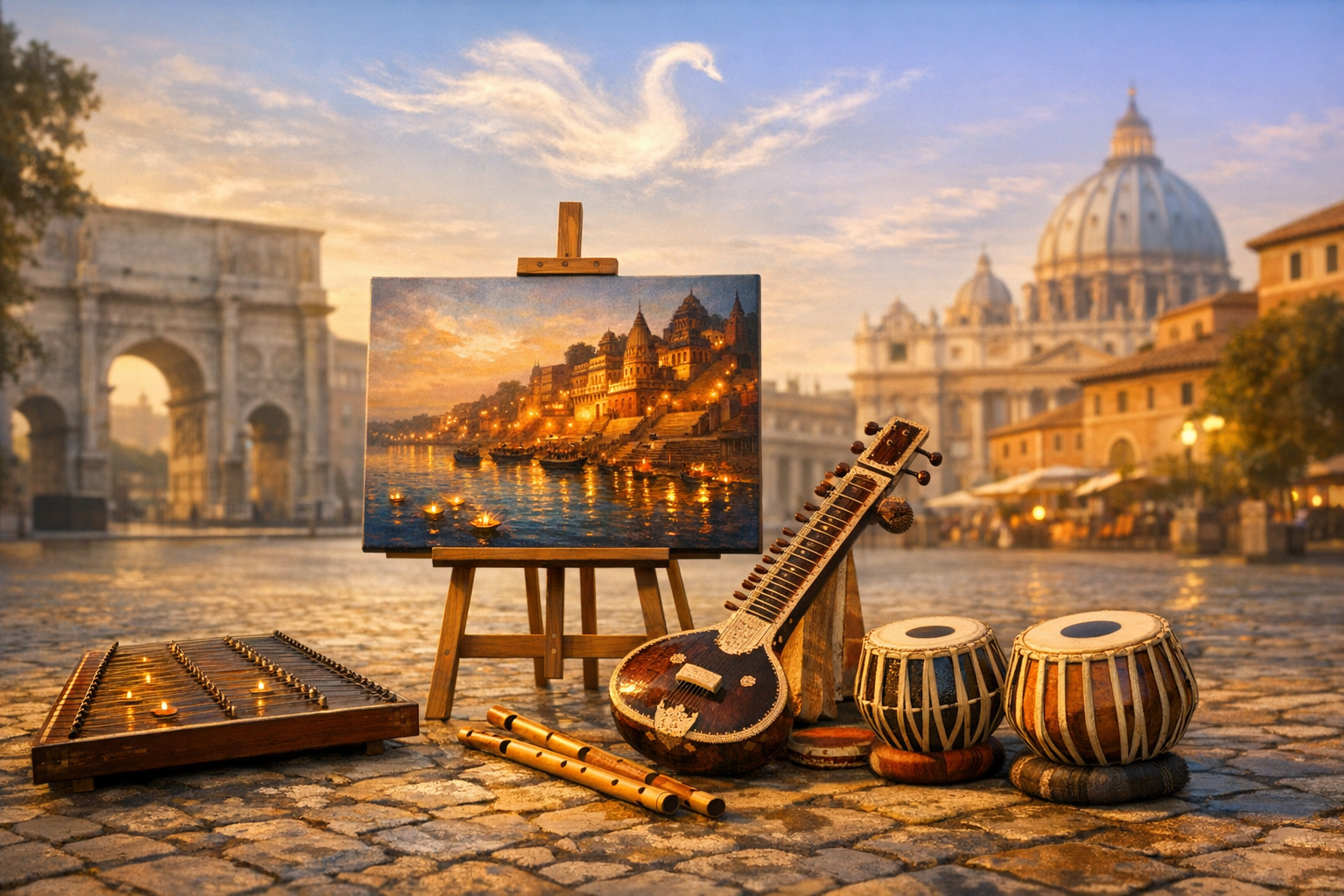
During Prime Minister Narendra Modi’s visit to Italy, Rome became an unexpected stage for a powerful act of cultural diplomacy. Italian artist Giampaolo Tomassetti unveiled a special painting of the iconic ghats of Varanasi, while five Italian artistes performed the Indian classical raga Hamsadhwani for members of the Indian diaspora. Together, these moments captured how art and music can translate sacred Indian traditions into a universal language that resonates across borders.
Tomassetti’s canvas paid homage to VaranasiKashi, the ancient urban center on the banks of the Gangesby foregrounding the ghats as living thresholds between everyday life and the sacred. The painting’s intent was not merely topographical; it sought to convey the spiritual essence that pilgrims, residents, and scholars consistently associate with Varanasi’s riverfront: continuity, ritual, and inner awakening. In this sense, the artwork functioned as a visual “tirtha,” a crossing-place between cultures.
Varanasi’s ghats embody centuries of dharmic practice. The Ganges is revered as purifying and life-giving, and the city’s ritual topography has inspired seekers and scholars across Hinduism, Buddhism, Jainism, and Sikhism. The city’s rhythmsfrom the morning surya arghya and the evening aarti to the meditative flow of pilgrimsare often cited in academic literature as exemplars of India’s “sacred geography,” where metaphysical ideas and physical spaces are deeply interwoven.
Tomassetti’s longstanding engagement with Indian civilisation since the 1980s adds context to the piece. His work reflects a studied connection with Vedic traditionsdisciplined yet intuitivewhere aesthetics is a path to knowledge (vidyā) as much as a vehicle for devotion (bhakti). The painting’s timing, coinciding with PM Modi’s presence in Italy, underscored how individual artistic inquiry can interface meaningfully with public diplomacy.
The musical counterpart to this visual tribute unfolded when Italian artistes presented Hamsadhwanian auspicious raga widely used as an invocatory piece in Indian classical musicat a community welcome. The ensemble featured Mr. Valerio Bruni (Santoor), Mr. Leo Vertunni (Sitar), Mr. Simone Mattiello (Bansuri), Mr. Francesco Gherardi (Tabla), and Mr. Nicolo Mellochi (Bansuri). Their performance demonstrated rigorous attention to raga grammar while embracing the dialogic improvisation that anchors the classical tradition.
Hamsadhwani, literally “sound of the swan,” is celebrated for its bright, uplifting character and concise, pentatonic structure. In pedagogy and performance, it frequently introduces listeners to the raga system’s core principles: tonal hierarchy (vādi–samvādi), melodic contour, and the disciplined interplay between composition and improvisation. Performing Hamsadhwani at a diaspora gathering in Rome was therefore both musically apt and symbolically resonantan invitation to collective auspiciousness.
The chosen instruments amplified this effect. The santoor’s hammered timbre produced a crystalline lattice for melodic exploration; the sitar’s sympathetic strings enriched the tonal field and anchored the raga’s identity; the bansuri’s breath-born phrasing carried lyrical immediacy; and the tabla articulated temporal architecture with clarity and nuance. Such cross-instrumental dialogue highlights core features of Indian classical performance practice: attentive listening, cyclical rhythm (tāla) awareness, and co-creative spontaneity.
As PM Modi greeted the Indian diaspora in Rome, the confluence of classical dance, instrumental music, and visual art created a multi-sensory portrait of India’s soft power. For many in the diaspora, hearing Hamsadhwani in a Roman setting evoked memory and belonging; for local audiences, it offered an accessible gateway into a sophisticated musical system that prizes both discipline and rasaemotional flavor.
From an academic perspective, the evening in Rome is a relevant case study in people-to-people diplomacy. It linked the sacred geography of Varanasi with the shared civic space of a European capital, illustrating how cultural exchange can operate beyond statecraft by fostering empathy, curiosity, and respect. It also affirmed that the stewardship of intangible heritageraga, rhythm, ritualcan be a collaborative, transnational enterprise.
Importantly, the event aligned with the dharmic ethos of pluralism. While the imagery and music drew from Hindu traditions, their contemplative qualitiesself-cultivation, compassion, and inner disciplinespeak to shared values across Hinduism, Buddhism, Jainism, and Sikhism. In this way, the performances and the painting opened a dialogic space where diverse dharmic journeys could be appreciated without hierarchy or erasure.
Cross-cultural artistry of this kind rests on respect and study. Whether in visual composition or raga interpretation, authenticity emerges from attentive learning, humility before tradition, and sensitivity to context. The Italian artistes’ engagement with Hamsadhwani and Tomassetti’s meditation on the Varanasi ghats together model how global practitioners can approach Indian classical idioms with rigor and reverence.
In sum, Rome’s moment of resonance with Varanasithrough Giampaolo Tomassetti’s painting and an Italian-led performance of Hamsadhwaniunderscored how art and music can build bridges where language may falter. It provided a timely reminder that cultural heritage thrives most vibrantly when shared: as scholarship and sādhanā, as performance and participation, and as a living invitation to unity across dharmic traditions.
Inspired by this post on Hindu Human Rights Blog.
