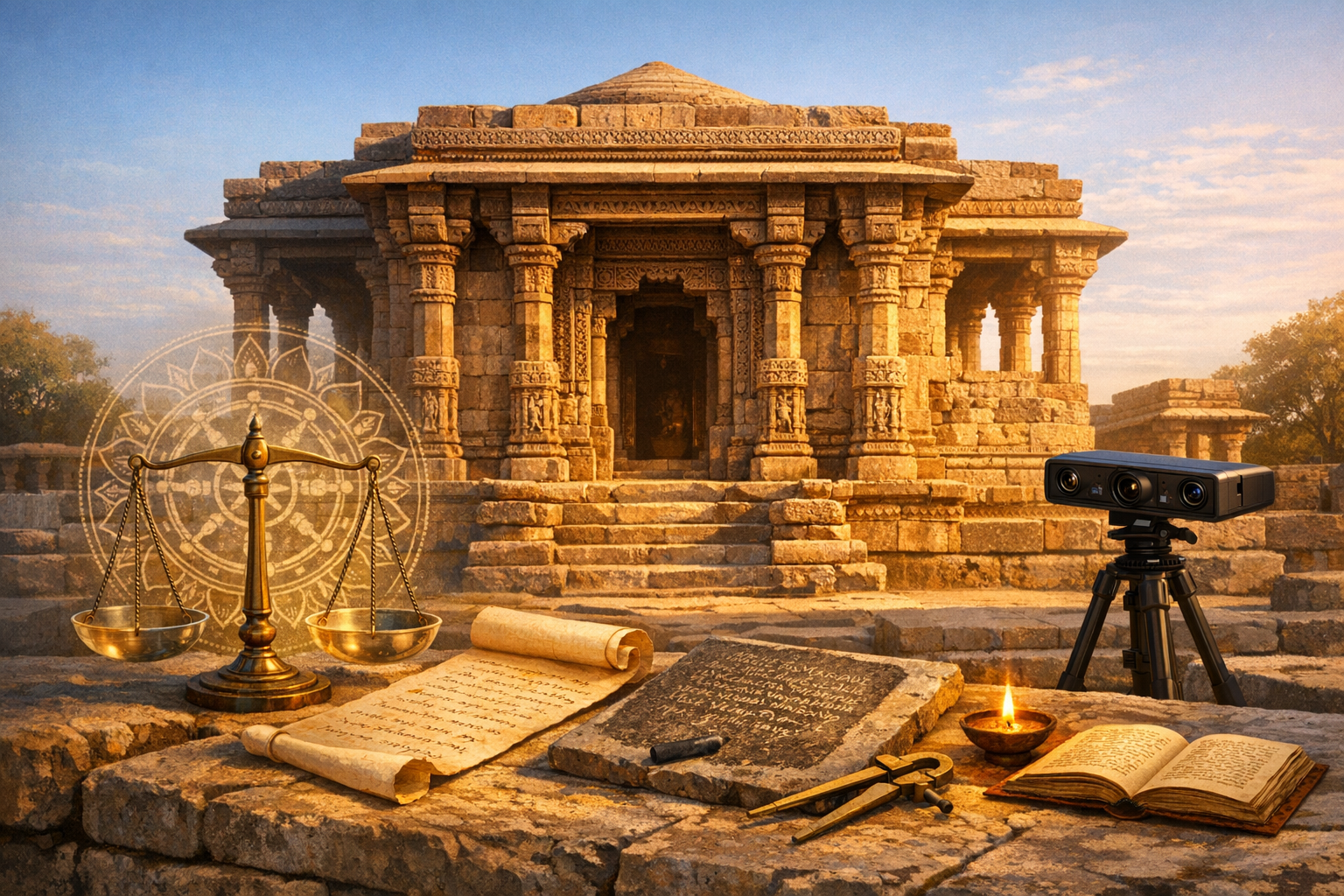
In a closely watched decision with far-reaching heritage and legal implications, the Madhya Pradesh High Court has recognized the Bhojshala complex in Dhar as a Hindu temple, anchoring its finding in a multi-layered evidentiary record. The Hindu Janajagruti Samiti welcomed the ruling as an affirmation of historical truth, while many heritage scholars have underscored the judgment’s emphasis on documentary rigor, archaeological method, and constitutional principles. Beyond juridical contours, the verdict is being read as a call to steward a shared past with care and to cultivate harmony among India’s dharmic traditions of Hinduism, Buddhism, Jainism, and Sikhism.
Situated in the historical city of Dhar, the Bhojshala complex has long been associated in local memory and scholarly literature with the Paramara-era ruler Bhoja (commonly known as King Bhoj), whose reign is remembered for patronage of learning, Sanskrit scholarship, and temple architecture. Over centuries, the site accrued physical and textual stratatemple-style pillars and motifs, inscriptions in classical Indian scripts, and later additionsthat together form a palimpsest reflecting political change, cultural continuity, and the layered reuse of sacred and civic spaces. The present-day complex has also been known locally in relation to Kamal Maula, a reminder that the site’s long history intersects with more than one community’s lived experience.
According to reporting on the case, the High Court’s analysis rested on corroborative sources typically relied upon in heritage adjudication: epigraphic references, architectural typology consistent with medieval Hindu temple design, archival and gazetteer materials, expert testimony, and records associated with the Archaeological Survey of India (ASI). Such lines of proof, examined together, supported the court’s conclusion about the site’s predominant and original sacred character. Crucially, the approach taken illustrates a standard method in historical-legal questionstriangulating text, material culture, and continuous practices where available, and situating each strand within an established academic framework.
The constitutional backdrop is central. Articles 25 and 26 of India’s Constitution guarantee freedom of conscience and the rights of denominations to manage their own religious affairs, subject to public order, morality, health, and other fundamental rights. In parallel, the Places of Worship (Special Provisions) Act, 1991, seeks to preserve the religious character of places of worship as they existed at the threshold date it specifies, while not precluding judicial determination of historical facts when courts are properly seized of disputes. Heritage protection under the Ancient Monuments and Archaeological Sites and Remains (AMASR) Act further requires conservation-sensitive management. The High Court’s reasoning, as understood from publicly available summaries, proceeds within this matrix of rights and responsibilities.
On the evidentiary plane, courts in such civil matters typically apply the preponderance-of-probabilities standard, yet give primacy to primary sources and technical expertise when historical character is at issue. Epigraphy and archaeologywhether through stylistic analysis of pillars and capitals, iconographic assessment of motifs, or examination of stratified constructionoffer critical, independently verifiable anchors. By aligning these anchors with archival records and accounts of worship, the court found the legal threshold met to declare the Bhojshala complex a Hindu temple.
The judgment also foregrounds stewardship. Recognizing a site’s religious character is not an endpoint but a beginning for structured management that integrates conservation science, lawful access, and public order. As reported, the ruling emphasizes compliance with heritage protocols, supervised access regimes consistent with constitutional guarantees, and the central role of ASI and state authorities in conservation planning. Such steps help ensure that spiritual needs, scholarship, and preservation ethics move in tandem rather than in tension.
Historically, Bhojshala has been understood not merely as a sacred space but also as a seat of learningan association that resonates across the dharmic family, where reverence for knowledge is a civilizational constant. For many visitors and heritage enthusiasts, this linkage between devotion and learning evokes a distinct emotional register: the quiet recognition that temples and pathshalas, monasteries and mathas, and gurdwaras and libraries have all, in their own ways, safeguarded wisdom, community memory, and ethical formation.
In a society as diverse as India’s, heritage rulings can easily be instrumentalized. The deeper invitation of this verdict, however, is to reinforce a mature ethic: historical clarity without triumphalism, devotion without denigration, and conservation without exclusion. Unity among Hindu, Buddhist, Jain, and Sikh communities is strengthened when care for sacred places is coupled with empathy for living communities and scrupulous adherence to law. That ethicrooted in ahimsa, daya, and satyaoffers a constructive path forward.
From a technical conservation perspective, a responsible roadmap includes high-resolution documentation, 3D photogrammetry and laser scanning for condition mapping, environmental monitoring to mitigate material decay, and epigraphic recording following established academic conventions. Visitor management can be calibrated via timed access windows, trained guides conversant with plural histories, and interpretive signage that presents peer-reviewed findings without polemic. A site-level advisory group comprising heritage professionals and scholars of Hinduism, Buddhism, Jainism, and Sikhism can guide inclusive programming consistent with the court’s directives and the AMASR framework.
For researchers and students, the Bhojshala case underscores the value of method: consult critical editions and translations of relevant inscriptions, correlate stylistic features with securely dated comparanda, and read archival gazetteers against field-verified observations. When legal disputes arise, courts are best served by disciplined submissions that distinguish between primary and secondary sources, note degrees of certainty, and clearly flag hypotheses versus established fact.
In the broader legal landscape, the judgment illustrates how constitutional rights, statutory protections, and scientific heritage methods can be harmonized. It neither collapses complex histories into simplistic narratives nor presumes that one decision predetermines others; rather, it reiterates that each site turns on its unique record. By emphasizing evidence, process, and conservation, the ruling contributes to a jurisprudence that protects both faith and the fabric of history.
Seen through a civilizational lens, the recognition of Dhar’s Bhojshala as a Hindu temple honors a long continuity of sacred learning while committing stakeholders to a future guided by scholarship, service, and sensitivity. If India’s plural heritage is to remain a living force, its care must be anchored equally in truth and compassionso that devotion deepens, knowledge expands, and communities across the dharmic family walk forward together.
Inspired by this post on Hindu Jagruti Samiti.