On 11 May 2026 in New Delhi, the Hindu Shree Foundation publicly urged the Government of India to accord a “Special Heritage” status to Sanskrit, framing the appeal as a catalyst for cultural revival, knowledge preservation, and inclusive nation-building. The proposal intersects cultural policy, education reform, and heritage preservation, and it invites a rigorous, evidence-based discussion on how Sanskrit—already notified as a Classical Language—can be safeguarded and revitalized through a clearly defined, statutory heritage framework that serves all Dharmic traditions.
Positioned at the confluence of history, philology, and civilizational memory, Sanskrit undergirds a vast corpus of scriptures, commentaries, scientific treatises, legal texts, and literary masterpieces. Its influence spans Hinduism, Buddhism, Jainism, and Sikhism, offering a shared lexicon and conceptual grammar that continue to shape ethical thought, aesthetic forms, and spiritual practices within the Indian subcontinent and the global diaspora. Any proposal to deepen protection for Sanskrit therefore warrants a holistic policy design that remains inclusive, non-coercive, and aligned with India’s constitutional commitment to linguistic and cultural diversity.
“Special Heritage” status—though not a currently codified legal category—can be conceptualized as a coordinated policy instrument that complements existing mechanisms. Sanskrit already holds “Classical Language” status under Government of India criteria (antiquity, rich and ancient literature, and a historical body of literature considered a valuable heritage). A new, heritage-centered designation would not duplicate this recognition; rather, it would target the preservation ecosystem: manuscripts, epigraphy, inscriptions, scripts, pedagogies, research, and digital infrastructure, while supporting community-based custodians and institutions engaged in Sanskrit learning and knowledge transmission.
The civilizational significance of Sanskrit is manifest across disciplines. In philosophy, it encodes sophisticated systems from Vedānta and Sāṅkhya to Nyāya and Mīmāṃsā. In the sciences, it preserves foundational work in astronomy, mathematics, medicine (Ayurveda), grammar, poetics, and statecraft. Paninian grammar provides a formal metalanguage of enduring relevance to modern linguistics and computational models. The language’s technical precision and morphological transparency make it uniquely suited to knowledge organization, philological analysis, and machine-readable representation—capabilities that are pivotal for large-scale digital preservation and scholarly collaboration.
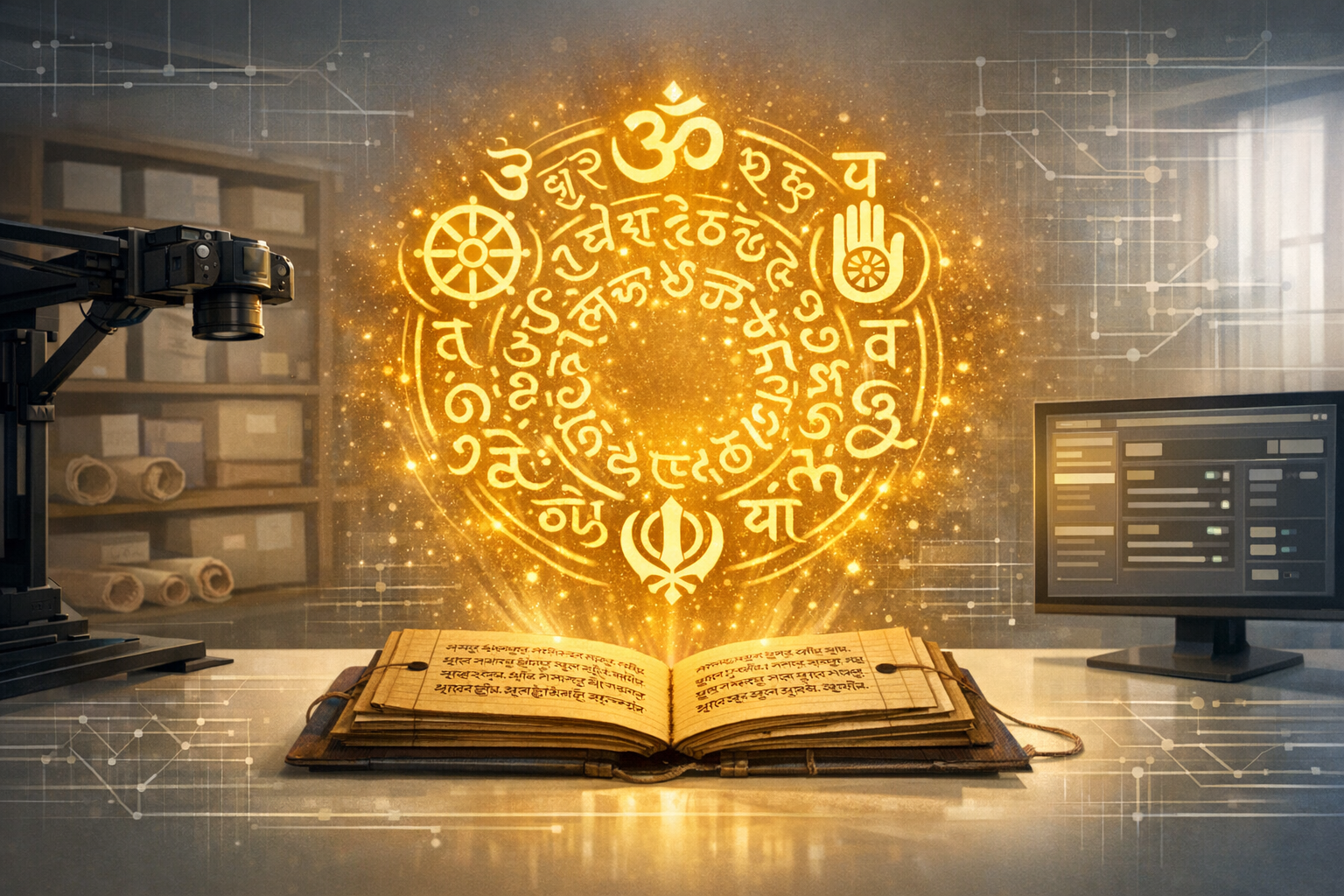
Sanskrit’s unifying role across Dharmic religions is well attested. Hindu scriptures (Veda, Upaniṣad, Bhagavad-Gita, Purāṇas) are rooted in Sanskrit, while Buddhism’s Mahāyāna corpus and “Buddhist Hybrid Sanskrit” crystallize transregional philosophical exchange. Jain traditions include Sanskrit commentarial literature alongside Prakrit canons, and Sikh scripture, while composed in Gurmukhi and multiple bhāṣās, resonates with a deep Sanskritic lexicon and includes compositions designated as Sanskrit. This shared inheritance underscores that heritage protection for Sanskrit can and should be designed as a service to the full Dharmic spectrum—Hindu, Buddhist, Jain, and Sikh—strengthening unity without erasing the uniqueness of each tradition.
From a cultural policy perspective, an elevated heritage designation could be anchored in existing institutional pathways. Within India, the Ministry of Culture, Sangeet Natak Akademi (for intangible cultural heritage), Indira Gandhi National Centre for the Arts (IGNCA), Archaeological Survey of India (ASI), and the National Mission for Manuscripts (NMM) already steward parts of the relevant ecosystem. Coordination across these entities—paired with targeted funding, standards, and capacity building—can convert a visionary appeal into measurable outcomes. International frameworks (for example, UNESCO’s approaches to intangible cultural heritage) offer additional tools for documentation, safeguarding plans, and community participation.
Education reform is central to sustainable revitalization. The National Education Policy (NEP) 2020 emphasizes Indian languages and knowledge systems, creating space to modernize Sanskrit learning without sacrificing rigor. Priority actions include: (a) specialist teacher training and fellowships; (b) competency-based curricula connecting Sanskrit to philosophy, law, ecology, ethics, and aesthetics; (c) bilingual and trilingual materials to lower entry barriers; and (d) open digital resources for “Sanskrit learning” to democratize access for schools, universities, and independent learners worldwide.
Manuscript preservation requires a technical, standards-driven roadmap. India’s repositories hold hundreds of thousands of palm-leaf and paper manuscripts across scripts such as Devanagari, Grantha, Śāradā, Nandināgari, Telugu, Malayalam, Bengali-Assamese, and Newar scripts. A national program that mandates high-resolution imaging, multispectral techniques where feasible, IIIF-compliant delivery, and TEI-XML metadata would substantially raise discoverability and scholarly value. Integration with authority files, controlled vocabularies, and persistent identifiers (DOIs/Handles) would ensure citability and long-term stewardship.
Computational infrastructure is equally decisive. Indic OCR remains challenging for historical scripts; focused investment in ground-truth datasets, script-specific OCR models, and layout analysis for complex page geometries is essential. Downstream NLP tools—sandhi-splitting, lemmatization, morphological analysis, and dependency parsing—should be consolidated into open-source pipelines. Existing resources (e.g., the Digital Corpus of Sanskrit, Sanskrit Library, GRETIL, and the Sanskrit Heritage Engine) provide firm foundations for interoperable, research-grade workflows that can scale to tens of millions of manuscript folios.
For interoperability across scripts and regions, transliteration standards matter. ISO 15919 and IAST are widely used for scholarly work; a national guideline that maps legacy encodings to Unicode and recommends canonical transliteration choices will minimize fragmentation. Such standardization enables cross-collection search, collation, and version control—particularly important when aligning manuscript witnesses, commentaries, and translations in comparative philology.
Heritage status must also address human capital. Scholarships for philology, epigraphy, and paleography; apprenticeships with traditional śāstra-paṭha lineages; and curated residencies for scholars-in-archives can regenerate tacit knowledge transmission. Simultaneously, professional pathways in museums, libraries, archives, and digital humanities will attract a new generation of curators, technologists, and educators committed to “Cultural Heritage” and “Heritage preservation.”
Curricular design should illuminate Sanskrit’s contemporary relevance. Courses linking Dharma-śāstra debates to modern jurisprudence, Ayurvedic texts to public health history, and classical poetics (alaṅkāra-śāstra) to literary criticism and performance studies can make the discipline meaningful for diverse learners. Cross-listed modules that engage Buddhism, Jainism, and Sikhism—through texts, commentaries, and art history—will model the intended unity across Dharmic religions while respecting doctrinal specificity.
Community engagement is the hinge between policy and lived culture. Many families, schools, and temples already sustain Sanskrit recitation and study circles. When children encounter verses they can decode—be it a śānti mantra or a Jain stotra—the affective link strengthens, and learning becomes self-propelled. An inclusive framework that welcomes beginners and advanced learners alike can transform curiosity into competence, and competence into stewardship.
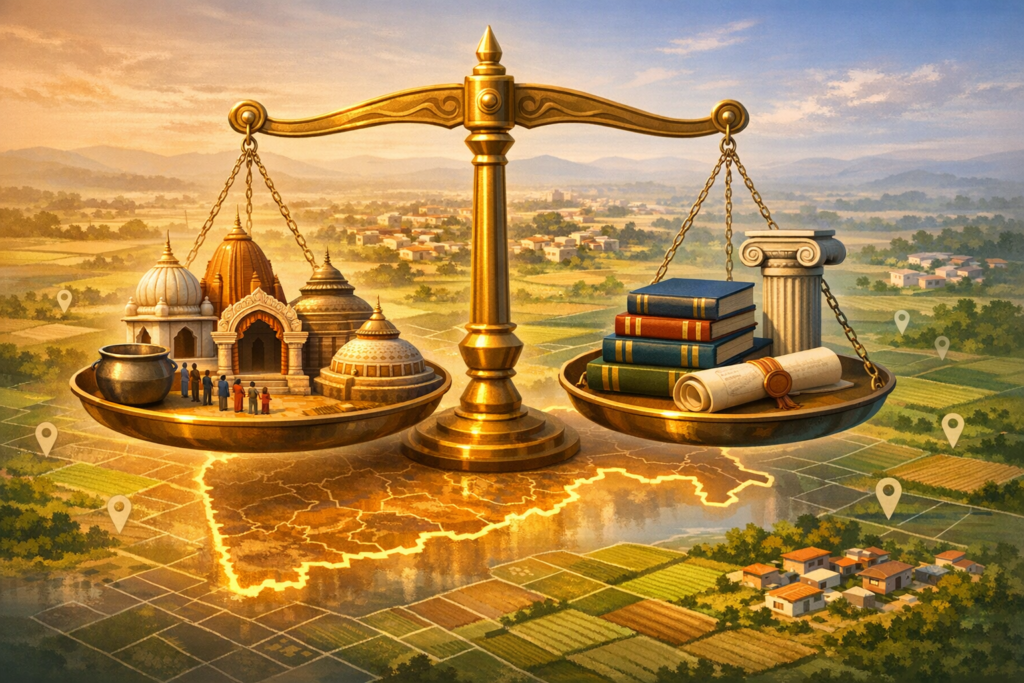
To ensure equity, a “Special Heritage” model must be non-impositional. It should not privilege one linguistic identity over another, nor diminish sister classical and regional languages. Instead, it can act as an enabling platform—funding, standards, and infrastructure—available to institutions and communities that choose to participate. This aligns with constitutional pluralism and reinforces the principle that linguistic heritage thrives through consent, collaboration, and shared benefit.
Soft power and global scholarship are further dividends. Rigorous editions and translations, research exchanges, and digital repatriation of manuscripts scattered worldwide will expand access while honoring provenance and ethics. The outputs—critical editions, bilingual readers, documentaries, and virtual exhibitions—create a cultural economy of knowledge that enriches India and its partners.
Implementation can be phased. Phase I (Years 1–2): policy notification; baseline audits of repositories and teaching capacity; pilot digitization of multi-script collections; establishment of transliteration and metadata standards; seed grants for teacher training. Phase II (Years 3–5): national-scale digitization and OCR; roll-out of NEP-aligned curricula; research fellowships; interoperable catalogues; international partnerships. Phase III (Years 6–10): comprehensive coverage of prioritized collections; advanced NLP services; public engagement programs; and long-term preservation infrastructure with recurring audits.
Measurable indicators should guide accountability: number of manuscripts digitized and fully catalogued; proportion with searchable text; teacher-training completions; student enrollments in “Sanskrit learning”; published critical editions and translations; cross-Dharmic curricular offerings; and community participation rates. Public dashboards can track progress and sustain trust.
Risk management deserves explicit attention. Potential pitfalls include politicization, duplication of effort across agencies, uneven regional participation, and insufficient attention to community custodians. Transparent governance, ethical guidelines, and independent peer review can mitigate these risks. Crucially, heritage work must center the lived custodians—scholars, monks, nuns, priests, librarians, archivists, and educators—who carry Sanskrit’s traditions forward.
In sum, the Hindu Shree Foundation’s appeal invites a constructive, nation-scale conversation. A “Special Heritage” framework—if carefully designed—can protect manuscripts and scripts, modernize teaching, stimulate research, and deepen unity among Dharmic traditions. By pairing policy vision with technical rigor and community inclusion, India can safeguard Sanskrit as a living, evolving inheritance and a shared civilizational asset for Hinduism, Buddhism, Jainism, and Sikhism alike.
Inspired by this post on Struggle for Hindu Existence.