Paada Pujaalso spelled Paada Poojadenotes the veneration of the feet of a revered person or deity, using water, flowers, aromatic substances, and offerings. Across the spectrum of Hindu Dharma and sister traditions in the Dharmic family, the ritual expresses hospitality, humility, and the recognition of divinity as present in a guest, a guru, or a murti. Far from a mere custom, it crystallizes theological, ethical, and psychological insights that have guided social life and spiritual practice for millennia.
Questions frequently heard in satsangs and homesWhy is Paada Puja performed, and what is its significance?invite a multi-layered answer. In older times, travelers often arrived dusty and fatigued; washing the feet was a practical welcome. Over time, this hospitable gesture was elevated into a sacred act, aligning with the dictum Atithi Devo Bhava, the celebrated ideal of honoring the guest as divine.
Within Hindu worship frameworks, Paada Puja is embedded in the Śodashopachāra (sixteenfold) and Pañcopachāra (fivefold) sequences. Among the earliest upacharas is padyamoffering water to wash the feetalong with arghyam (water with fragrant substances) and achamaniyam (sipping water for purification). These offerings signal the shift from everyday courtesies to ritualized recognition that the divine is being invoked and served with meticulous care.
The symbolism of the feet is central. The feet represent contact with the earth, steadiness, and the foundation upon which all movement and accomplishment rest. In devotional literature, clasping or bowing to the feet indicates surrender of ego, alignment with dharma, and receptivity to grace. Theologically, Paada Puja embodies the movement from pride to humility, from separateness to communion.
Scriptural and classical sources frequently extol the sanctity of the feet. The Bhagavata Purana narrates the descent of the Ganga as śrī viṣṇupāda-jātāthe holy river flowing from the stride of Vishnurendering “pāda tīrtha” and “charanamrita” (the sanctified water that has bathed the divine feet) deeply auspicious. In the Ramayana, Bharata enshrines the padukas (sandals) of Rama on the throne, the famous paduka-pattābhisheka, to signify righteous governance under Rama’s authority even in his physical absence.
Guru veneration intensifies this motif. The widely recited Guru Paduka Stotram (traditionally attributed to Adi Shankaracharya) praises the guru’s sandals as destroyers of ignorance and conduits of wisdom. Sri Vaishnava tradition treasures Vedanta Desika’s Paduka Sahasram, a poetic ocean celebrating the Lord’s padukas. Temple customs such as the śāṭāri (symbolic representation of the Lord’s feet placed upon the devotee’s head, as at Śrī Vaishnava temples) embody this living continuity.
Paada Puja is not confined to one school. In Shaiva hymnody, Shiva’s feet are extolled as refuge and release; in Vaishnava practice, the Lord’s footprints and padukas are potent icons of presence. The breadth of the practice demonstrates that honoring the feet is a shared devotional grammar, not the property of any single sect.
Cross-Dharmic resonances deepen this picture of unity. In Buddhist cultures, Buddhapadavenerated footprints of the Buddhaare revered in place of anthropomorphic images in some sites, emphasizing presence through absence and humility through symbolism. In Jain traditions, charan-vandan and the worship of sacred footprints (charan, charan paduka) of Tirthankaras honor perfect conduct and spiritual attainment without attachment to bodily form. Early Sikh history records charan-pahul (foot-wash initiation) in some communities before Khande di Pahul was established, while the enduring ethos of seva, humility, and reverence for the Guru undergirds Sikh practice today. Together, these examples affirm a shared Dharmic intuition: reverence expressed through honoring the feet cultivates humility and aligns the heart with truth.
Contemporary teachers often explain Paada Puja in accessible terms: it is an expression of gratitude and a training in humility, not an endorsement of personality cults. When directed to a guru, it honors the principle of enlightened guidance; when directed to a deity, it completes the upacharas that sacralize the relationship between devotee and the divine; when offered to elders or honored guests, it embodies refined hospitality rooted in sacred values.
Psychologically, Paada Puja is a transformative exercise. Bowing, washing, and adorning the feet channel attention away from self-importance. Devotees frequently report a softening of the heart, an upsurge of gratitude, and a renewed capacity for disciplined service. In communities, the ritual supports social harmony by institutionalizing respect for wisdom, age, hospitality, and mutual care.
Ethically, Paada Puja encodes reciprocal dignity. True reverence does not demean one who offers it; rather, it elevates both giver and receiver through shared acknowledgment of something greater than eitherthe dharma that holds the community together. The act is voluntary, contextual, and relationship-sensitive, guided by consent, propriety, and shared understanding.
In the liturgical setting, Paada Puja can be seen both as a standalone rite and as an element within a larger abhishekam. The procedural details vary by sampradaya, but certain elements recur, each with specific meaning and care.
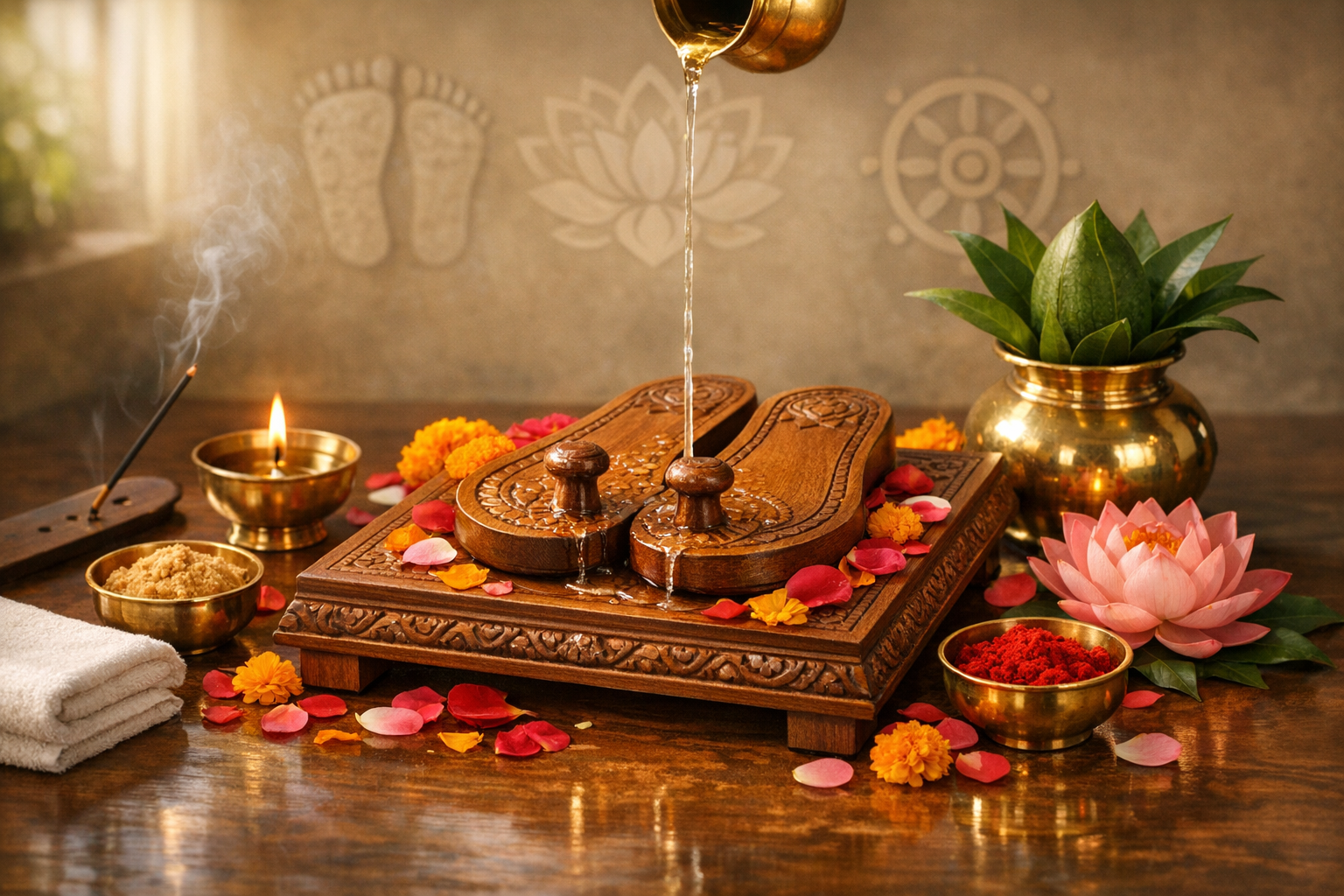
Preparation: A clean asana is arranged for the honored person or the padukas representing the guru or deity. A dedicated vessel for water, a small tray, soft towels, sandalwood paste, kumkum, flowers, and incense are prepared. The space is kept dignified and simple, facilitating attention rather than spectacle.
Invocation: With quiet recitation, the presence of divinity is invited, and the intention of the rite is clarifiedgratitude, purification, and inner alignment. Silence or soft kirtan centers participants.
Washing: Water at a comfortable temperature is gently poured over the feet or padukas. In many traditions, ingredients such as turmeric, rose water, or saffron are added for fragrance and sanctity. Each pour is measured and respectful, never hurried.
Adorning: The feet or padukas are patted dry and anointed with sandal paste; a tilak may be applied; fresh flowers are offered. The simplicity of the gesture underscores dignity and restraint.
Offering and arati: Incense, lamps, and sometimes naivedya are offered, acknowledging the presence of the sacred. The arati symbolizes the devotee’s resolve to hold lighted awareness around the guiding principle represented by the guru or deity.
Dakshina and pranam: Where appropriate, dakshina is offered as a token of responsibility and gratitude; a respectful pranam completes the exchange. Charanamrita (the sanctified water that washed the feet) may be partaken reverently, in accordance with tradition and consent.
Closing: Blessings are received, concluding with quiet reflection. Many families observe a brief moment of silence to “seal” the intent of humility and service.
Regional variations illustrate the living texture of Paada Puja. In South India, elaborate guru-pada pujas are common on Guru Purnima; in Sri Vaishnava temples, the śāṭāri (symbolizing the Lord’s feet) is placed upon devotees’ heads, followed by distribution of tirtham; in many households, elders’ feet are honored during life-cycle ceremonies and festival days, weaving sacredness into family life.
Life-cycle rites also mirror these values. Gṛhya-sutra traditions preserve madhuparka and related hospitable upacharas for honored guests or key participants in rites of passage. While the degree of formality differs by community, the underlying ideal remains constant: relationships are sanctified through gestures of reverent welcome.
From a philosophical vantage, Paada Puja integrates jñāna (discriminative understanding), bhakti (devotion), and karma (duty-bound action). The mind understands why humility matters, the heart feels reverence, and the hands perform a concrete act that trains character. In this way, the ritual unites insight, love, and service.
Concerns about hierarchy or misinterpretation deserve thoughtful attention. Paada Puja is not meant to assert superiority or to license domination. Properly understood, it is a consent-based, context-sensitive rite that channels reverence toward dharma, wisdom, and the divinenot toward unexamined authority. Communities sustain its purity by ensuring transparency, propriety, and alignment with shared ethical norms.
Hygiene, care, and consent are integral to contemporary practice. A dedicated vessel is used; participants confirm comfort and boundaries; minimal water is employed; and the ritual is adapted for elders’ or teachers’ needs. In some settings, symbolic anointment of padukas replaces physical washing, retaining meaning while honoring practical considerations.
As a unifying thread across Dharmic traditions, Paada Puja invites recognition of a common spiritual grammar: humility before truth, gratitude for guidance, and devotion to service. Whether one bows to the guru’s padukas, venerates Buddhapada, honors Jain charan, or expresses seva in Sikh practice, the shared ethic is unmistakablereverence refines the heart and strengthens communal bonds.
Modern practitioners often describe the experiential impact: a quieting of mental restlessness, a release of defensiveness, and a surge of affectionate gratitude. In families, children who witness or participate in respectful, well-explained rites learn that dignity and humility are not opposites but companions in a life of character.
In summary, the significance of Paada Puja is threefold. Historically, it refines hospitality; ritually, it completes the architecture of worship through padyam and related upacharas; spiritually, it transforms the mind by rehearsing humility, gratitude, and devotion. Its endurance across centuries and communities testifies to a deep civilizational insight: honoring the feet is a simple act that trains the soul in the highest values.
When framed in this light, the question “Why Paada Pooja?” finds a clear answer. It is performed because it preserves sacred hospitality, enlivens worship, and cultivates virtues that sustain personal growth and social harmony. It is significant because it embodies unity in diversityHinduism, Buddhism, Jainism, and Sikhism each recognize, in their own ways, that reverence enacted with the hands can awaken wisdom in the heart.
Thus, Paada Puja stands as a timeless and transformative ritualat once intimate and theological, personal and communalensuring that humility, gratitude, and service remain living principles within the Dharmic world.
Inspired by this post on Hindu Pad.