The rise and fall of the University of Mysore offers a precise lens on how intellectual ecologies flourish and then fragment when academic cultures are displaced by factional politics. Accounts from Maharaja’s College during A.N. Murthy Rao’s time depict a cohort of students animated by a thirst for knowledge, nourished by the lectures and discourses of teachers whose authority rested on mastery of sources and personal integrity. Within a generation, however, the same corridors reportedly witnessed identity-based cliques, crowd-fuelled disruptions, and bouts of vandalismsymptoms of a deeper institutional drift from scholarship to spectacle.
The contrast is historically situated. The milieu Murthy Rao described belongs to the 1930s. By the time S.L. Bhyrappaborn in 1931entered BA in 1950–51, the constellation of luminaries from the classic Mysore tradition had largely disappeared. Scholars formed in that rigorous lineage had dwindled in number and many of those who remained had been sidelined. Figures of the stature of M. Hiriyanna, noted for authority in original texts, had “returned to the womb of Time.” The textures and consequences of this decline are documented with fidelity in Bhyrappa’s Bhitti.
Two representative cases illustrate the structural maladies that crept into university life. Each points to the same mechanism of decay: when institutional incentives cease to reward excellence, scholarship recedes, mentorship withers, and students are left without intellectual direction.
First, the case of Prof. H.K. Raja Raoan authoritative scholar in philosophyreveals how identity-driven prejudice and bureaucratic injustice can embitter even the most erudite minds. Contemporary testimonies recount that, within the University of Mysore, episodic discrimination in appointments and advancement eroded not only morale but also the transmission of knowledge from teacher to student. The predictable outcome followed: students received inadequate guidance, research cultures frayed, and cynicism supplanted curiosity.
A second, equally telling, case is that of Professor N. Balasubrahmanyateacher and later close associate of S.L. Bhyrappa. Bhyrappa records the dispiriting tenor of his colleague’s experience at the University of Mysore:
“Among those who acquired multifaceted scholarship in the University of Mysore, Balasubrahmanya was the last. He joined service when the university had fallen on bad times, when true scholarship was not valued. His colleagues, instead of respecting his scholarship told him to his face, ‘We didn’t ask you to study so much; you studied to satisfy your itch.’ This appalling attitude naturally flourished in a climate in which caste alone became the sovereign qualification… Even in purely practical matters such as the reprinting of his books, the university did not behave with courtesy.”
These episodes are not merely personal tragedies; they are system-level signals. When recruitment, promotion, and intellectual authority become detached from demonstrated learning and responsible pedagogy, a university’s core functionadvancing and safeguarding knowledgeloses its anchor. Multiple testimonies from the post-Independence era suggest that such patterns did not arise in isolated corners; they proliferated through public institutions that gradually prioritized identity and expedience over competence and enquiry.
A reflective coda is found in H.M. Nayak’s foreword to Mysore Diary, which soberly contrasts celebratory institutional histories with lived scholarly memory:
“The University of Mysore is now celebrating its diamond jubilee. I heard that a history of it has been published recently. I have no doubt that that history will be a mere list of years. Such a history will have no soul. This ‘Mysore Diary’ enables us to hear the profound breath of this great institution that is seventy-five years old.”
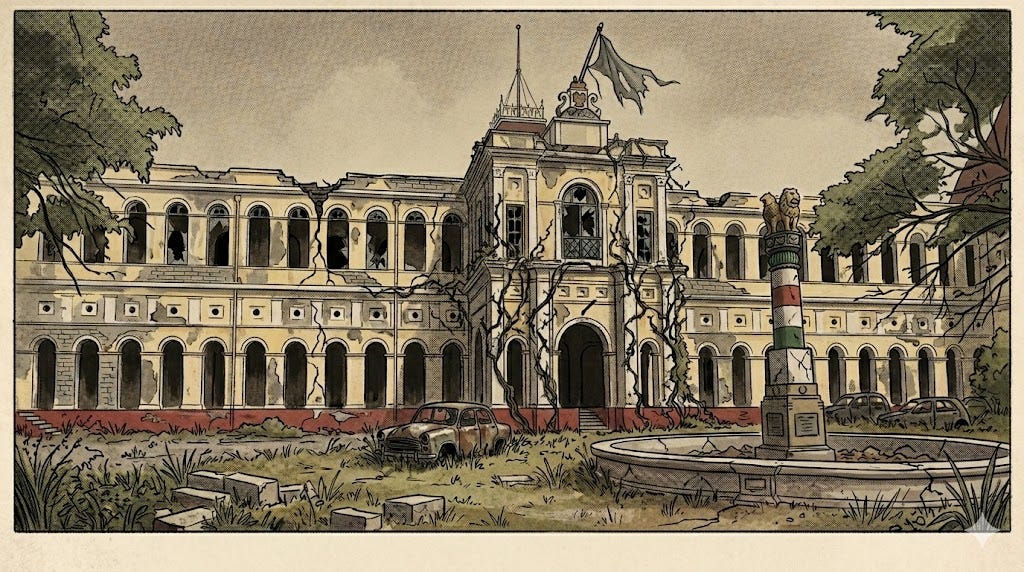
Four decades on, observers recorded that Maharaja’s Collegeonce a sanctuary of learninghad deteriorated into a space literally described as a cattleshed and a donkey stable. Reports noted that rooms intended for teaching were littered with cow dung and donkey excreta. Regardless of whether such images are symbolic or literal in each recounting, their force lies in the shared judgement: the civic and intellectual custodianship owed to a great university had been neglected.
One historical element is often left implicit: D.V. Gundappa, father of B.G.L. Swamy, also labored selflessly for the advancement of the University of Mysore. His involvement forms part of a wider continuum of scholar-householders and civic-minded administrators who regarded the university as a sacred trustan institution to be held to the highest standards of rigor, civility, and responsibility.
The birth of this “Kashi of Knowledge” rested on the noble resolve of a Rajarshi and his enlightened Diwan. Its weakening, by contrast, is repeatedly linked in narratives to partisan ministerial interference and a drift from Dharma-aligned governance to short-term political calculus. In an arresting, ironic inversion, some chroniclers have quipped that as an emblem of decline, the motto might well read: Na hi ajñānena sadṛśam there is nothing equal to ignorance.
॥ Sā vidyā yā vinaśyati ॥
That is knowledge which leads to destruction.
These lines should not be taken as a counsel of despair; rather, they function as a diagnostic mirror, clarifying what must be corrected to restore institutional health. Read with care, the Mysore story illuminates general pathologies seen in higher education whenever academic freedom, ethical governance, and scholarly mentorship are subordinated to factional advantage.
From a systems perspective, three reinforcing vectors of decline emerge. First, governance capture: appointments and promotions drift from transparent, scholarly criteria toward ideological or identity calculus. Second, incentive decay: workloads, evaluation standards, and rewards cease to privilege primary-text competence, peer-reviewed output, and responsible teaching. Third, culture erosion: student life gravitates from study circles and debate to factional mobilization and episodic violence, displacing the seminar room with the street.
Countervailing forces must be equally systemic. A restoration programrooted in the shared civilizational values of Hinduism, Buddhism, Jainism, and Sikhismcan realign Indian higher education around a Dharma-informed ideal of knowledge: truthful enquiry (satya), compassion and non-harm (karuṇā/ahiṁsā), self-discipline (tapas), and service (sewa). The following blueprint translates those values into actionable institutional design.
Governance and integrity: Establish merit-anchored search committees with external scholars of unimpeachable credentials to vet appointments and promotions. Publish role descriptions, selection rubrics, and conflict-of-interest disclosures. Anchor vice-chancellor and dean evaluations to measured academic outcomes and campus well-being indicators. Enforce due process rigorously so that both equity and excellence are protected by the same transparent procedures.
Scholarly standards and curriculum: Prioritize primary-text competence across disciplinesespecially in philosophy, literature, and historyby building language pathways in Sanskrit, Kannada, Pāli, Prakrit, and Persian as relevant. Encourage text-seminars that model the guru-śiṣya ethic of precision, humility, and dialogue. Institute capstone theses at the BA level with oral defense, ensuring that undergraduate formation trains students in evidence, argument, and accountable authorship.
Research ecosystems: Create field-normalized benchmarks for output (e.g., peer-reviewed publications, critical editions, translations of primary sources), along with incentives for long-horizon projects such as philological editions and annotated commentaries. Support editorial training, manuscript preservation, and digital repositories so that knowledge stewardshipcentral to all Dharmic traditionsbecomes quotidian academic practice rather than occasional initiative.
Mentorship and faculty development: Pair junior faculty with senior mentors across specializations to transmit method, ethics, and craft. Offer annual workshops in research design, textual methods (including nyāya and mīmāṁsā reasoning), and classroom pedagogy. Reward supervisors for timely, ethical completion of student theses and for demonstrable alumni outcomes in academia and public service.
Student culture and civic life: Replace factional grouping with interest-based academic societies (textual studies circles, logic and debate forums, laboratory guilds). Encourage interfaith and inter-school colloquia that foreground shared Dharmic valuesahiṁsā, sewa, śraddhā, and vivekaas norms of discourse. Institute restorative processes for conflicts, coupled with firm, impartial sanctions against vandalism and intimidation.
Metrics and accountability: Track teacher–student ratios, time-to-degree, publication quality, library acquisitions in primary texts, seminar hours per student, and verified reductions in plagiarism and misconduct. Publish annual “state of scholarship” reports so that stakeholdersstudents, parents, alumni, and citizenscan see where the university stands and how it is improving.
Endowments and public trust: Establish endowed chairs honoring exemplars such as M. Hiriyanna, D.V. Gundappa, and other scholar-citizens associated with Mysore’s legacy. Ring-fence endowments for libraries, laboratories, and manuscript conservation. Invite alumni and community leaders from all Dharmic traditions to co-steward these funds, reinforcing the civic sacredness of the university’s mission.
Ethical charter across Dharmic unity: Promulgate a concise charter that binds administration, faculty, and students to the pursuit of truth without malice; to dialogue without derision; and to service without self-advertisement. Across Hindu, Buddhist, Jain, and Sikh lineages, the archetype is constant: knowledge is a disciplined love for reality. Such a charter harmonizes plural paths under a common vowlearning that uplifts life.
The historical recollections from Bhitti, Mysore Diary, and accounts of B.G.L. Swamy and H.M. Nayak are not merely elegiac. They are diagnostic instruments. They show how a university can be builtthrough devotion to texts, teachers, and truthand how it can be unbuiltthrough neglect of merit, politicized gatekeeping, and cultural cynicism. They also indicate how to rebuild: by re-enshrining competence, integrity, and fraternity as the lived grammar of campus life.
Seen in this light, the University of Mysore can again become a beacon: a place where scholarship is exacting, governance is ethical, and campus life is gracious; where Hindu, Buddhist, Jain, and Sikh students recognize themselves as co-heirs to a shared civilizational responsibility; and where the measure of success is neither noise nor notoriety but the quiet, cumulative deepening of understanding from one generation to the next.
If the twentieth century’s cautionary epigrams warned of knowledge misusedNa hi ajñānena sadṛśam and ॥ Sā vidyā yā vinaśyati ॥the task of the twenty-first is their reversal: to ensure that what the university knows becomes what society can trust, and what students learn becomes what communities can live by.
Inspired by this post on Dharma Dispatch.