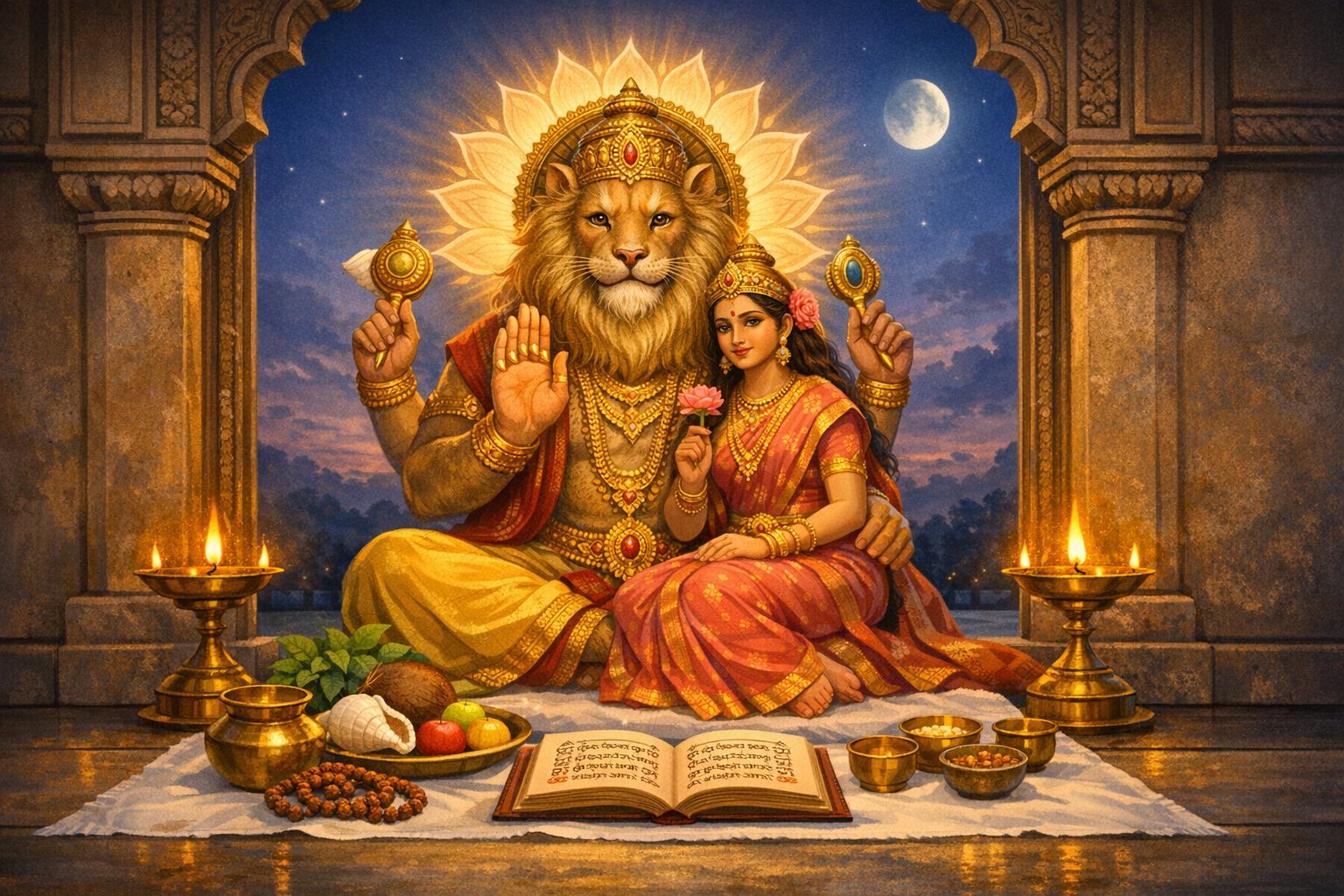
On Sri Narasimha Caturdashi (Sri Nrsimha-caturdasi)the appearance day of Lord Narasimha, observed on Vaishakha Shukla Chaturdashipractitioners revisit a piercing insight from Srimad-Bhagavatam linking divine accessibility to inner detachment. “My Lord, Your Lordship can easily be approached, but only by those who are materially exhausted. One who is on the path of [material] progress, trying to improve himself with respectable parentage, great opulence, high education and bodily beauty, cannot approach You with sincere feeling.” (SB 1.8.26)
The Sanskrit idea behind this verse is captured in the expression akincana-gocaram“accessible to those who are devoid of material claims.” In Kunti’s prayer, the phrase janmaishvarya-shruta-shribhih edhamana-madah puman emphasizes how birth, wealth, learning, and beauty can inflate pride (mada), clouding sincerity. By foregrounding akincanya (having nothing to claim as one’s own), the text points to a devotional modality in which humility and truthfulness become the very means of approach.
Narasimha’s avatara thematically embodies this teaching. The Lord appears as man-lion to protect Prahlada and reestablish dharma, affirming that divine grace stands with the vulnerable, fearless devotee who has relinquished the false securities of power and possession. The worship of Narasimha on this day thus becomes a practice of courage rooted in surrender: letting go of self-conceit to stand transparently before the Absolute.
The narrative context clarifies the theological precision of this avatara. Hiranyakashipu’s boonsno death by human or beast, inside or outside, day or night, by weapon or on land, sea, or skyare resolved at twilight (sandhya), on the threshold, with the Lord assuming neither purely human nor animal form, using nails rather than wielded weapons, and placing the demon on His lap (SB 7.8). The resolution is not merely mythical craft; it encodes the Vedic intuition that ultimate reality transcends conceptual binaries.
Timekeeping for the observance follows the lunisolar reckoning. Sri Narasimha Caturdashi falls on Vaishakha Shukla Chaturdashi. Many communities emphasize evening worship, recalling the twilight emergence of the Lord, while fast breaking (parana) is calibrated by the local panchang so that it does not contravene the operative Chaturdashi tithi. Because regional traditions vary, practitioners often consult authoritative almanacs to align vrata and puja with sunrise, dusk, and tithi boundaries in their locality.
Traditional vrata emphasizes simplicity and inner focus. Some observe a day-long fast, breaking it after the prescribed window; others keep a fruit-and-water (phalahara) or milk fast, guided by health and capacity. The vrata’s spiritual center is not austerity for its own sake but the cultivation of akincanyaloosening the hold of entitlement and prideso that devotion gains clarity and depth.
A widely practiced home observance begins with a sankalpa to honor Narasimha’s protective grace and to internalize the humility taught in SB 1.8.26. Devotees may perform achamana, light a lamp, and offer panchopachara or shodashopachara worship. Tulasi leaves, incense, lamps, flowers, and simple naivedya are offered, accompanied by kirtan or silent japa. The intention is to pray for fearlessness (abhaya) alongside compassion, aligning personal ethics with the protective, dharmic impulse of the avatara.
Abhisheka (ritual bathing) of Lakshmi-Narasimha murtis with panchamrita (milk, curd, ghee, honey, sugar) followed by clean water is common. Many conclude with arati and distribution of prasada. Where feasible, temple darshan adds a communal dimension that amplifies devotion and learning through shared recitation, pravachan, and service.
Core recitations on this day include the Narasimha-kavacha (Brahmanda Purana) and well-known stotras such as Sri Lakshmi-Narasimha Karavalamba Stotram (traditionally attributed to Adi Shankaracharya). A protective mantra frequently chanted is: “ugram viram maha-vishnum jvalantam sarvato mukham nrisimham bhishanam bhadram mrityor mrityum namamy aham.” Devotees also chant the Vishnu Sahasranama and Narasimha Gayatri: “Om Nrisimhaya vidmahe, vajra-nakhaya dhimahi, tanno narasimhah prachodayat.”
Scriptural anchors for the day include Srimad-Bhagavatam’s Narasimha-lila (SB 7.5–7.10), the prayer of Kunti (SB 1.8.26), and Upanishadic reflections such as the Nrisimha Tapaniya Upanishad. Across these sources, the common thread is that bhakti matures when claims of superiority recede and truthfulness, gratitude, and surrender advance.
Theologically, akincanya does not demand social deprivation; it asks for detachment from the pride that wealth, learning, lineage, or appearance can generate. The verse plainly states that such adornments often breed mada (conceit), which obstructs sincerity. In contemporary terms, status signalstitles, metrics, platformscan eclipse inwardness, making this observance a timely corrective that recenters character over display.
Prahlada’s simplicity and unwavering remembrance exemplify the verse’s aspiration. His devotion is not transactional; it is transparent. The Narasimha avatara, therefore, is not a promise of unexamined partisanship but an assurance that the Divine stands with fearless integrity and protects those who protect truth, compassion, and dharma.
These themes resonate across the wider dharmic family. In Buddhism, renunciation (nekkhamma) and the dismantling of clinging are essential to right intention; humility disarms ego’s claims, much like akincanya. In Jainism, aparigraha (non-possessiveness) and anekantavada (many-sidedness) restrain dogmatism and entitlement, opening the way to authentic insight. In Sikhism, conquering haumai (egoism) through Naam Simran and seva aligns daily life with humility and service. Sri Narasimha Caturdashi, read through SB 1.8.26, thus becomes a shared ethical meditation on curbing pride and expanding compassion.
This cross-traditional consonance affirms that spiritual protection is inseparable from moral responsibility. Fearlessness (abhaya) is sustained not by domination but by charactertruthfulness, non-violence, self-restraint, and care for all beings. The festival therefore invites practitioners to pair devotion with service: protecting the vulnerable, speaking honestly, and embodying steadiness amid uncertainty.
Temple traditions add vivid texture to the observance. Ahobilam in Andhra Pradesh venerates the Nava-Narasimha (nine manifestations), highlighting both wrathful and benevolent aspects unified in protection and grace. Yadadri (Yadagirigutta) in Telangana celebrates Lakshmi Narasimha with elaborate alankarams and community seva. Simhachalam near Visakhapatnam is renowned for Chandanotsavam in the Vaishakha season; many also mark Narasimha Jayanti with special worship. In urban centers, shrines such as the Nacharam Lakshmi Narasimha Swamy Temple host extended kirtan and discourse, emphasizing both ritual and reflection.
For households and diaspora communities without ready temple access, the observance can be simple yet rigorous: keep the tithi focus, reduce distractions, chant the mantras with attention, read from the Bhagavata Purana (especially SB 7.8), and reflect on SB 1.8.26’s challenge to pride. Where fasting is difficult, adopting a sattvic diet and dedicating time to study and service preserves the vrata’s spirit.
Ultimately, Sri Narasimha Caturdashi is a pedagogy of the heart. By holding Kunti’s prayer close“tvam akincana-gocaram”devotees learn that what surrenders is not responsibility or excellence but conceit. What is embraced is not passivity but the courage to be truthful, compassionate, and steadfast, trusting that such integrity is itself sheltered by the Divine.
Primary sources and further reading: Srimad-Bhagavatam 1.8.26; Srimad-Bhagavatam 7.5–7.10; Vishnu Purana 1.17; Nrisimha Tapaniya Upanishad; Narasimha-kavacha (Brahmanda Purana); Sri Lakshmi-Narasimha Karavalamba Stotram. Consultation of a reliable regional panchang is recommended for exact tithi windows and parana timing.
Inspired by this post on Dandavats.