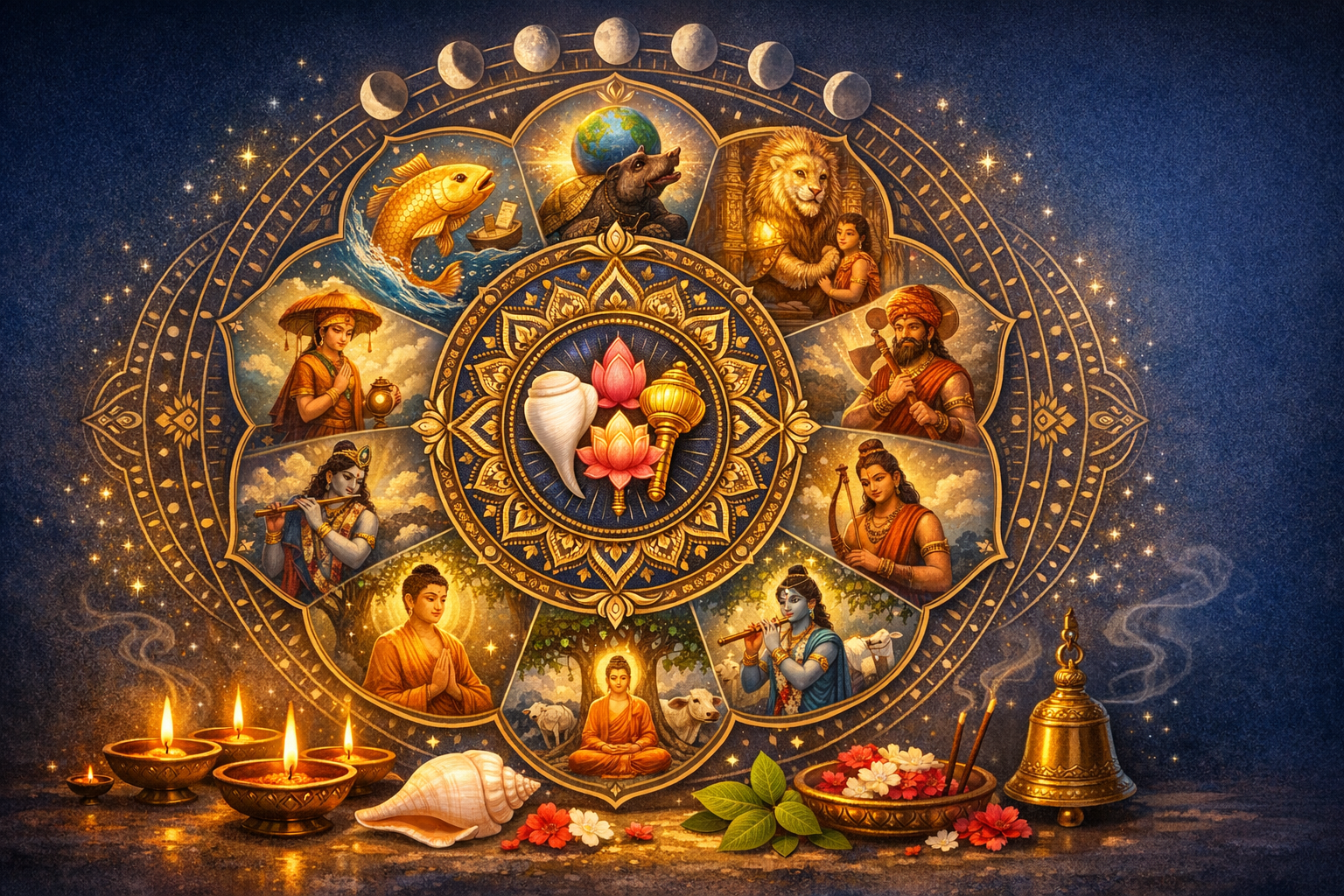
Dasavatara Jayanti 2026–2027 marks a sacred cycle of observances celebrating the ten principal incarnations of Lord Vishnucollectively known as the Dasavatara. The term “Dasavatara” simply means “ten avatars,” and a classical list appears in the Garuda Purana (1.86.10–11). Across the Dharmic world, these Jayantis become milestones for reflecting on dharma, restoring balance in personal life, and honoring the cosmic roles Vishnu assumes to protect creation.
“Jayanti” denotes the birth appearance day of a deity or enlightened being, celebrated on specific lunar tithis determined by the Hindu calendar (Panchang). In 2026–2027, the cycle runs broadly from Chaitra (March/April 2026) through Phalguna (February/March 2027), with exact dates varying by region, Panchang tradition (Amanta vs Purnimanta), and local sunrise-based tithi boundaries. This guide presents the standard tithi framework and widely accepted practices, enabling readers to align observances in harmony with local calendars.
Classical tradition situates the avatars within the yuga cycle as follows: Matsya, Kurma, Varaha, and Narasimha in Satya Yuga; Vamana, Parashurama, and Rama in Treta Yuga; Krishna in Dvapara Yuga; and Buddha and Kalki in Kali Yuga. While some Vaishnava lineages list Balarama instead of Buddha, many living Dharmic traditions find unity in recognizing Buddha as an avatara of Vishnu, emphasizing the shared civilizational values of ahimsa, compassion, and wisdom that animate Hinduism and Buddhism alike.
Calendrical method for Jayanti calculation relies on identifying the correct tithi and, where prescribed, the appropriate part of the day (madhyahna for Rama and Parashurama; nishita for Krishna; pradosha-related for Narasimha). Because tithis can begin and end between civil midnights, observance follows the tithi prevailing at sunrise unless tradition specifies a special window (e.g., Janmashtami at midnight during Ashtami with Rohini nakshatra in many Vaishnava calendars). Readers are advised to confirm local timings from a reliable regional Panchang or temple notice to account for longitude, latitude, and local rules (Smarta vs Vaishnava).
Matsya Jayanti (commonly observed on Chaitra Shukla Tritiya): This Jayanti venerates the fish-incarnation that preserves knowledge and life through the cosmic deluge. Worship typically includes recitation of Vishnu Sahasranama, offerings of water and lamps, and sankalpa for protection of the earth’s waters and ecological balance. In some regions, Matsya Jayanti is kept on a different tithi (e.g., a Dwadashi tradition); practitioners may follow their family or temple parampara.
Kurma Jayanti (Vaishakh Purnima): Celebrated on the full moon known also as Buddha Purnima/Vesak, this Jayanti honors the cosmic Tortoise who supported the churning of the ocean (Samudra Manthana) and stabilized the worlds. The confluence with Buddha Purnima offers a profound opportunity for Dharmic unity: devotion to Vishnu’s Kurma avatara harmonizes naturally with meditation, metta (maitrī-bhāvanā), and compassionate service associated with the Buddha’s life and teachings.
Varaha Jayanti (most commonly Bhadrapada Shukla Tritiya; in some traditions, Varaha Dwadashi): This observance venerates the Boar-incarnation that rescues Bhudevi (Earth) from cosmic depths, symbolizing the restoration of dharma and ecological steadiness. Puja emphasizes gratitude to the earth, ethical consumption, and preservation of heritage sitesan ethos shared across Dharmic traditions concerned with sacred geography and environmental responsibility.
Narasimha Jayanti (Vaishakh Shukla Chaturdashi, observed during daytimemadhyahna/pradosha rules vary by sampradaya): The Man-Lion avatara embodies ferocious compassion, destroying tyranny while upholding the child-devotee Prahlada’s faith. Many observe a fast until pradosha, chant Narasimha stotras, and pray for courage that is firm yet benevolent. The day invites reflection on righteous protection (kshatra) serving sattvic ends.
Vamana Jayanti (Bhadrapada Shukla Dwadashi, often coinciding with the Thiruvonam nakshatra in Kerala’s Onam season): The Dwarf-Brahmachari reclaims cosmic order through three strides, reminding devotees that humility can reframe power, property, and pride. Traditional worship includes offering rice preparations, lamps, and dana (charity), with special focus on honoring guests and serving community kitchenspractices also cherished in Sikh seva and Jain dana traditions.
Parashurama Jayanti (Vaishakh Shukla Tritiya, concurrent with Akshaya Tritiya): The warrior-sage Parashurama signifies tapas, discipline, and righteous restraint in the use of force. Observance features midday worship, study of dharma texts, and vows to align personal strength with ethical responsibilityechoing principles recognized across Dharmic lineages for cultivating inner mastery.
Rama Navami (Chaitra Shukla Navami, observed around midday): Commemorating the birth of Sri Rama, Maryada Purushottama, this Jayanti centers on the Ramayana’s teachings of duty, compassion, and governance balanced by justice. Families often read passages from the Ramayana, perform kirtan, and offer simple prasad, cultivating familial cohesion and moral clarity.
Krishna Janmashtami (Bhadrapada Krishna Ashtami, midnight observance with Rohini nakshatra in many traditions): Celebrating the birth of Sri Krishna, devotees fast until midnight, sing kirtan, and offer milk-based prasad. Vaishnava and Smarta calendars may differ by a day depending on tithi–nakshatra combinations; temples advise local timings. The Jayanti invites reflection on the Bhagavad-Gita’s call to live with courage, self-mastery, and devotion.
Buddha Jayanti (Vaishakh Purnima, Vesak): Many Vaishnavas accept Buddha as Vishnu’s avatara who turns society toward compassion and non-violence when ritualism eclipses insight. The day’s shared celebration among Buddhists and Hindus models a civilizational ethic of dialogue and mutual reverence. Practices include meditation, reading life episodes of the Buddha, vegetarian meals, and acts of compassion for all beings.
Kalki Jayanti (commonly observed on Shravana Shukla Dwadashi in several calendars): The prophesied avatara embodies the eventual restoration of dharma at the end of the age. Devotees use the Jayanti to renew vows of ethical living nowtruthfulness, stewardship, and couragerather than dwell on apocalypse. Study of Puranic passages, silent japa, and charity frame the day constructively.
During 2026–2027, the practical sequence for most communities will flow as follows, subject to local Panchang: Chaitra brings Rama Navami and often Matsya Jayanti; Vaishakh features Parashurama Jayanti, Narasimha Jayanti, and Kurma Jayanti together with Buddha Purnima; Shravana accommodates Kalki Jayanti in many regions; and Bhadrapada hosts Krishna Janmashtami, Vamana Jayanti (with Thiruvonam), and Varaha Jayanti. Diaspora communities should confirm temple announcements to account for time zones and sunrise-based tithi shifts.
Ritual focus across all Dashavatar Jayantis includes sankalpa for loka-kalyana (welfare of all beings), recitation of Vishnu Sahasranama, and simple offerings of tulasi leaves, flowers, lamps, and naivedya suitable to family tradition. For those seeking a single universal mantra that honors all incarnations, Om Namo Narayanaya remains widely accepted across lineages. Where feasible, families may add readings from Bhagavata Purana, Vishnu Purana, or the relevant avatar-katha in regional languages.
Fasting and food practices vary by health and tradition: some observe nirjala (water-only) fasts until the prescribed time window; many keep a phalahara or sattvic fast; elders and children adopt moderated observances with medical prudence. The intent of vrata is inner refinement rather than austerity for its own sake; where health requires, devotional remembrance, study, and charity fully honor the Jayanti spirit.
Temple-centric observances often include abhishekam to Vishnu or the respective avatar, special alankara, and community satsang. In regions where Kurma Jayanti coincides with Vesak, temples and Buddhist viharas sometimes coordinate joint service projectstree planting, food drives, or interfaith reflectionembodying the shared Dharmic commitment to compassion, truth, and non-harm.
Harmonizing calendar differences requires a few technical notes. First, Amanta (month ends at new moon) and Purnimanta (month ends at full moon) systems label months differently, but the tithi itself and the day’s essence do not change. Second, certain Jayantis require observing during a specified part of the day (e.g., Rama Navami at madhyahna; Janmashtami at nishita). Third, Vaishnava and Smarta traditions may prioritize nakshatra–tithi combinations differently, leading to alternate dates; both are valid within their paramparas.
Scriptural framing helps deepen the observances. The Bhagavad-Gita (4.7–8) declares the cyclical descent of the Divine“dharma-saṁsthāpanārthāya”to restore balance and protect noble souls. The Puranas, especially the Bhagavata Purana and Vishnu Purana, supply the narrative and theological foundations for each avatara’s role. Reading and contemplation integrate ritual with understanding, turning festivals into avenues of inner transformation.
For many households, these Jayantis structure the devotional year. Families wake before dawn, light lamps, and recite stotras that elders learned from their grandparents. Children shape butter lamps, friends share prasada, and diaspora communities gather after work for kirtan. The continuity of these practicespersonal, familial, and communalhas quietly safeguarded Dharmic memory for centuries.
Unity across Dharmic traditions is both a historical fact and a living opportunity during Dasavatara Jayanti 2026–2027. The inclusion of Buddha as an avatara, the Jain emphasis on ahimsa mirrored in many Jayanti fasts, and the Sikh ideal of seva realized through community kitchens together reaffirm a shared civilizational ethic: inner discipline, truthfulness, compassion, wisdom, and service. These observances, approached with mutual respect, strengthen social harmony and deepen spiritual maturity.
Practical planning for 2026–2027 involves three steps. First, note the Jayanti’s canonical tithi and any time-of-day constraint. Second, consult a trusted local Panchang or temple schedule to resolve geographic and tradition-specific variations. Third, prepare a simple puja with lamps, flowers, and readings; add charity or service in the name of the avatara honored that day. When done with sincerity, even a brief, well-focused observance becomes spiritually luminous.
In sum, Dasavatara Jayanti 2026–2027 offers a complete spiritual syllabus for households and communities: remembrance of the Divine’s compassionate “descent,” study of scriptures, ethical renewal through vrata, and acts of service that benefit all beings. Observed with clarity about tithi rules and generosity toward diverse traditions, these Jayantis turn the calendar year into a living pilgrimage across the ten luminous doorways of Vishnu’s grace.
Inspired by this post on Hindu Pad.