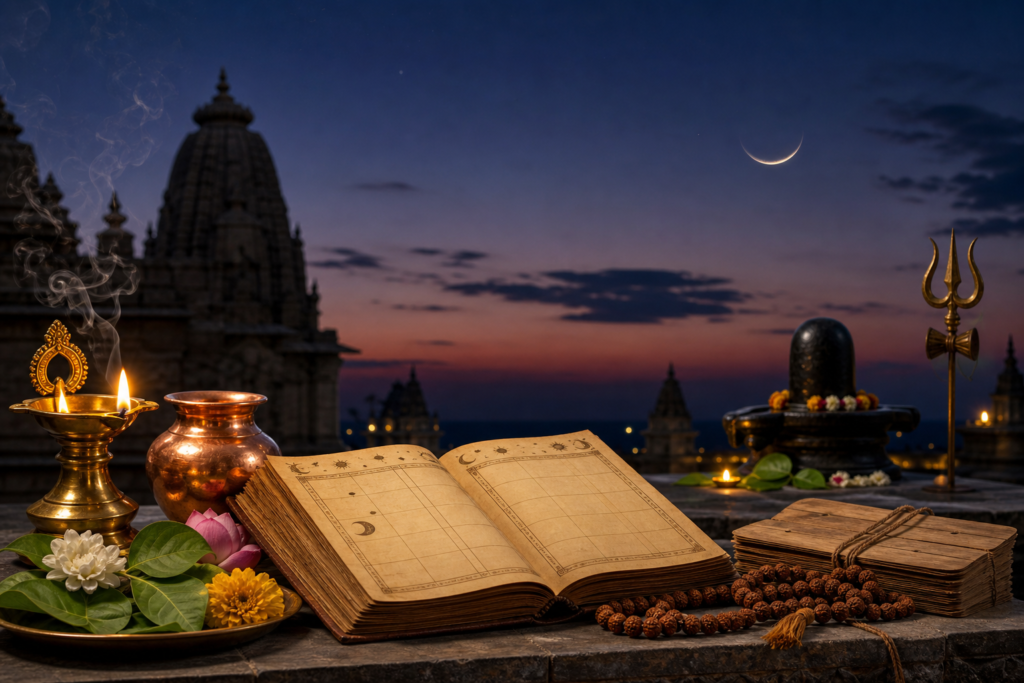
Tuesday, April 28, 2026 aligns in the Hindu calendar with Shukla Paksha Dwadashi tithi (twelfth lunar day of the waxing phase) in most regions. Shukla Paksha Dwadashi tithi prevails until 7:22 PM (IST) on April 28; from that moment onward, it becomes Shukla Paksha Trayodashi tithi (thirteenth lunar day). Local Panchang listings may show slight differences owing to longitude, latitude, and the computational tradition followed.
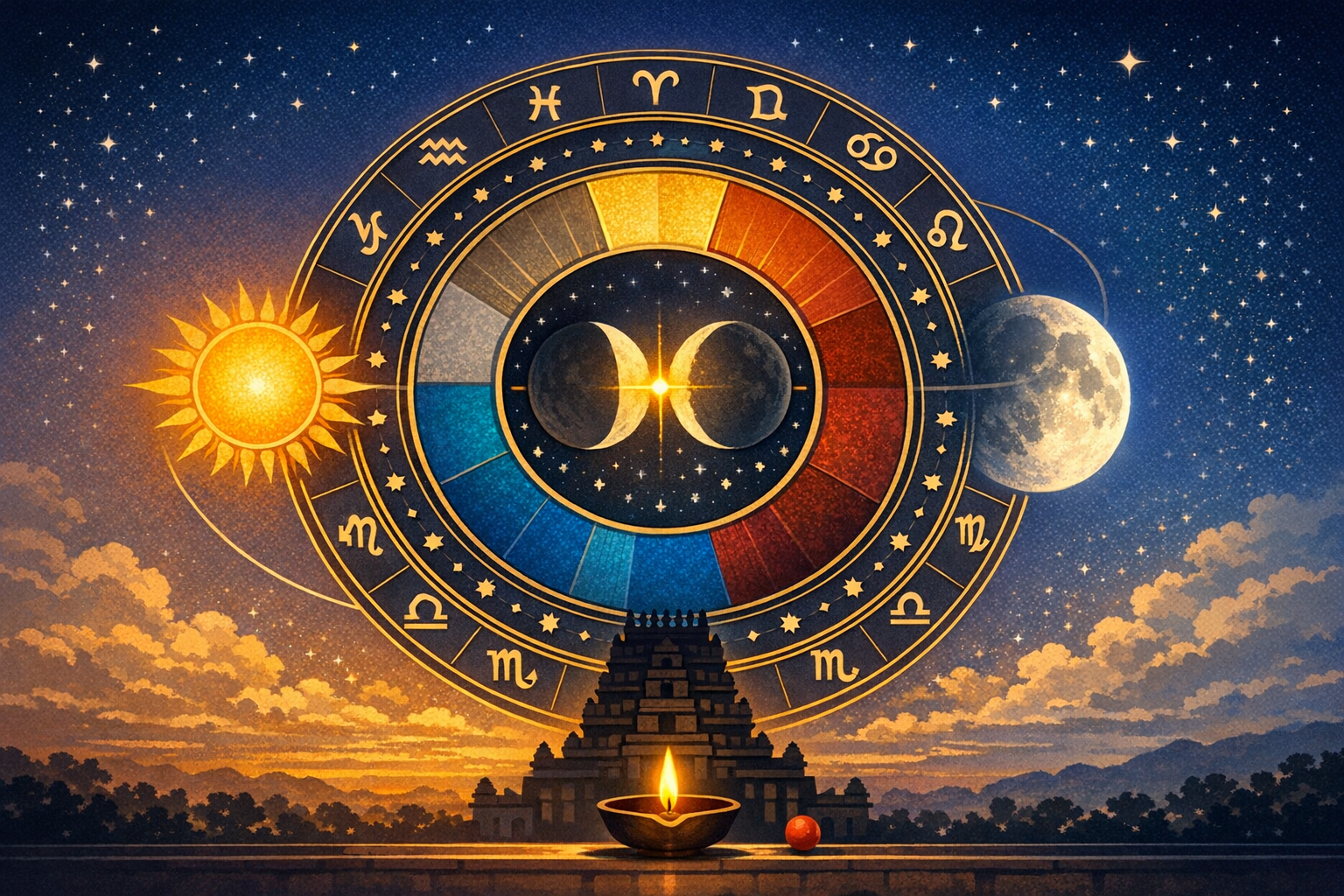
In technical terms, a tithi is defined by the geocentric angular separation (elongation) between the Moon and the Sun in the sidereal (nirayana) zodiac. Each tithi spans 12° of lunar-solar separation. Dwadashi corresponds to the interval from 132° to 144°; the instant the elongation surpasses 144°, Trayodashi commences. Because these thresholds can occur at any moment of the civil day, a tithi may begin or end during daylight, twilight, or night.
For daily observance and sankalpa, the tithi that prevails at local sunrise is generally taken as the day’s prevailing tithi in regional almanacs. However, observance-specific rules (such as Ekadashi Parana or Pradosha for Trayodashi) may depend on the tithi prevailing at certain windows (e.g., after sunrise for Parana or around evening twilight for Pradosha), which is why exact transition timessuch as 7:22 PM todaymatter for temple rites and home puja planning.
This date falls on a Tuesday (Mangalavara), traditionally associated with disciplined energy, initiative, and resolve. Many households dedicate Tuesday devotions to Hanuman and also to Skanda or Durga according to regional custom, aligning everyday effort with a spirit of courage and service. The day’s rhythmvara (weekday) paired with the waxing-lunar Dwadashioften supports steady, constructive activities that benefit from continuity and focus.
Spiritually, Shukla Paksha Dwadashi is considered auspicious for Vishnu worship, charitable offerings, and balanced re-entry to a normal routine after any Ekadashi fasting observed the previous day. Ekadashi Parana (concluding the fast) is traditionally performed on Dwadashi after sunrise and within the tithi, following one’s sampradaya guidelines; if Ekadashi has extended beyond sunrise, Parana is adjusted accordingly while ensuring it remains within Dwadashi. Such careful timing preserves both the devotional intent and the canonical precision cherished in the Panchang tradition.
After 7:22 PM IST, the day enters Shukla Paksha Trayodashi. Evening observances are guided by whether Trayodashi overlaps the Pradosha Kaal (the twilight window around sunset). When Trayodashi prevails during this window on a Tuesday, the observance is known as Bhauma Pradosha, a Shiva-centered vrata emphasizing restraint, reflection, and purification. Where Trayodashi does not touch the local Pradosha Kaal today, the Pradosha observance shifts to the following evening as per standard vrata rules.
Regarding Shubh Muhurat (auspicious windows), a widely used neutral and generally favorable period is the Abhijit Muhurat, centered on the local solar noon and lasting approximately 48 minutes (about 24 minutes before and after true noon). While suitable for many undertakings, specific life events (e.g., weddings, griha-pravesha) still require personalized matching with lagna, nakshatra, and doṣa-clearing, underscoring the need to consult the local Panchang or a qualified jyotiṣa.
For routine planning, practitioners traditionally avoid the day’s Rahu Kalam, Yamagandam, and Gulika Kaal, which are computed by dividing the local daylight into eight equal parts from sunrise to sunset. On Tuesdays, Rahu Kalam typically falls in the mid-afternoon (often approximated as 3:00 PM–4:30 PM when sunrise is near 6:00 AM), Yamagandam often mid-morning (about 9:00 AM–10:30 AM), and Gulika Kaal around midday (about 12:00 PM–1:30 PM). Actual spans vary with latitude, season, and sunrise time, so location-specific calculation is essential.
Nakshatra and Chandra Rashi (the Moon’s sign) for April 28, 2026 will depend on the Moon’s sidereal longitude at one’s location and time. A reliable Panchang or astronomy-based calculator using the Lahiri ayanamsa (commonly adopted across India) will give precise values. As a quick reference for interpretation: Ashwini and Bharani (with the first quarter of Krittika) map to Mesha (Aries); the latter quarters of Krittika, Rohini, and the first two quarters of Mrigashira map to Vrishabha (Taurus); such quarter-wise (pada) mapping continues across the zodiac and determines the day’s Chandrabala and Tarabala for individuals, guiding personalized task selection in sync with the Moon’s placement.
The five limbs of the Panchangtithi, vara (weekday), nakshatra, yoga, and karanacollectively inform auspicious timing. While tithi and vara shape the day’s broad mood, nakshatra refines the qualitative tenor of actions. Yoga (derived from the sum of the sidereal longitudes of Sun and Moon) and karana (half-tithis) add operational nuancehelping decide whether a task benefits more from initiating energy, consolidation, or careful review.
Regional almanacs may differ based on computation methods. Drik (observational/astronomical) Panchang relies on modern ephemerides and precise sunrise times, while traditional vākya systems use canonical mean motions. Furthermore, variations in ayanamsa and temple traditions can shift festival observances by a day across regions. The time noted here (7:22 PM IST) reflects the drik convention commonly adopted in most regions; local listings should always take precedence for ritual exactitude.
The Panchang’s emphasis on mindful timekeeping resonates across the dharmic familyHinduism, Buddhism, Jainism, and Sikhismwhere lunar rhythms have historically informed fasting cycles, community gatherings, and contemplative practice. While nomenclature and calendrical rules differ (for instance, Buddhist Uposatha or Jain paryushana observances, and Sikh commemorations historically referenced in the Bikrami system alongside the Nanakshahi calendar), the shared intention is harmonizing inner discipline with the cosmos and fostering inter-community goodwill.
In practical terms, households may anchor important communications, study, planning, and charitable activities in the stable current of Shukla Paksha Dwadashi through the day, favoring the Abhijit Muhurat where applicable and navigating around Rahu Kalam. After 7:22 PM, activities attuned to reflection, moderation, and evening worship align with the onset of Shukla Paksha Trayodashi, keeping an eye on whether local Pradosha Kaal is touched today or deferred to the next evening.
Key takeaway: April 28, 2026 features Shukla Paksha Dwadashi tithi until 7:22 PM (IST), followed by Shukla Paksha Trayodashi tithi. The date’s Panchang guidanceaugmented by local nakshatra and Chandra Rashi, and sensitive use of Shubh Muhurat while avoiding Rahu Kalamsupports a day of steady progress, respectful observance, and unity-conscious practice in harmony with the broader dharmic traditions.
Inspired by this post on Hindu Blog.