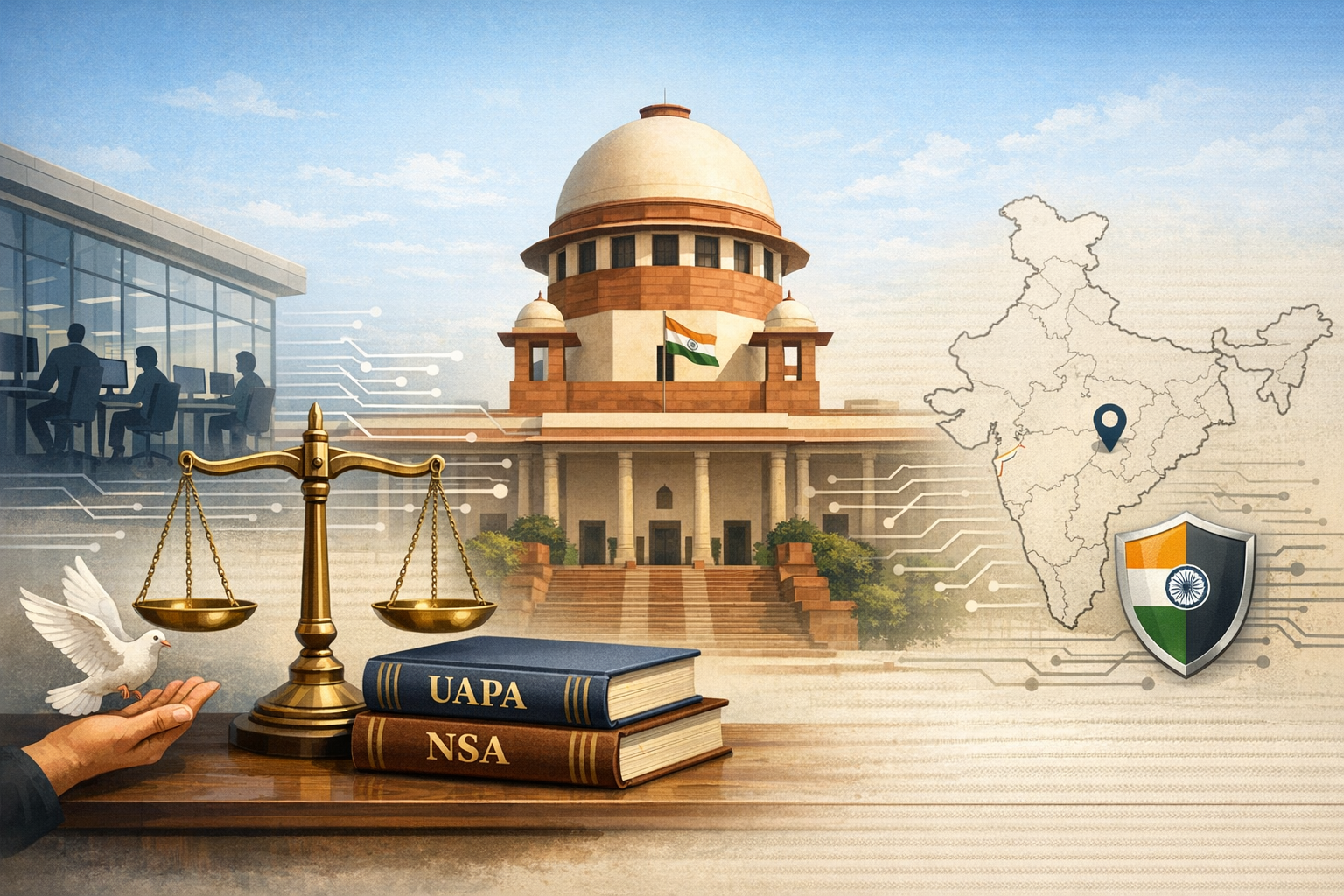
The Supreme Court of India has been moved in a petition arising from allegations at a Tata Consultancy Services (TCS) facility in Nashik, where organised, coerced religious conversions are reportedly claimed. The plea seeks a declaration that such coerced or forced conversions, if found to be organised and systematic, be treated as a “terrorist act” under the Unlawful Activities (Prevention) Act (UAPA), together with prospective action under the National Security Act (NSA). Given the gravity of both the charge and the remedies sought, the matter raises complex intersections of constitutional rights, criminal law thresholds, corporate governance, and national security doctrine.
At the threshold, it is important to separate allegation from adjudication. No court has yet made factual findings in the public domain on the specific events alleged at TCS Nashik, and the presumption of innocence remains foundational. The Supreme Court’s role at this stage, if it takes cognisance, would typically be to identify the appropriate legal framework, clarify evidentiary thresholds, and ensure that any investigative and preventive measures are consonant with constitutional guarantees and due process.
India’s constitutional architecture provides the primary lens. Articles 25 and 26 protect the freedom of conscience and the right freely to profess, practice, and propagate religion, subject to public order, morality, health, and other fundamental rights. Jurisprudence in Rev. Stainislaus v. State of Madhya Pradesh (1977) held that the right to “propagate” does not extend to a right to convert another person by force, fraud, or allurement. Subsequent constitutional reasoning, including in Shafin Jahan v. Asokan K.M. (2018), has emphasised that an adult’s autonomy to choose a partner and, by necessary implication, a belief system, is constitutionally protected. Taken together, the Court’s approach condemns coercion while protecting voluntary choice.
Within this framework, allegations of forced conversion are cognizable concerns. Multiple Indian states have “Freedom of Religion” laws addressing conversion by force, fraud, or inducement; the Indian Penal Code (IPC) also covers related conduct, including criminal intimidation (Sections 503–506), conspiracy (Section 120B), and promoting enmity or deliberate acts intended to outrage religious feelings (Sections 153A, 295A, 298), subject to strict proof and constitutional safeguards. Where the allegations arise in workplaces, corporate compliance, labour law, and internal grievance mechanisms also come into play.
The most contested legal question in the current plea is whether organised, coerced conversions could—on evidence—be classified as a “terrorist act” under UAPA Section 15. The statutory text defines a terrorist act primarily through the use of violence or methods “of whatever nature” intended to threaten the unity, integrity, security, or sovereignty of India; or to strike terror in people by causing death, injury, damage to property, disruption of essential services, or similar grave effects. Indian courts have consistently treated UAPA as an exceptional statute, to be applied to conduct that meets these high thresholds of violence, intimidation, or large-scale disruption.
As a matter of legal analysis, for coerced conversion to be subsumed under UAPA, the conduct would likely need to be shown as systematically violent or terrorising, with an intent or effect of spreading fear beyond the immediate victims, disrupting public order at scale, or undermining national security. This is a very high bar. Absent elements of violence, severe intimidation, or a demonstrable design to terrorise the public or a section thereof, the application of UAPA risks overbreadth and potential conflict with proportionality principles articulated by the Supreme Court in several fundamental rights cases.
The petition’s alternative or parallel request—to apply the National Security Act—raises its own constitutional sensitivities. The NSA authorises preventive detention to maintain public order or the security of the state, but its use is scrutinised closely by constitutional courts given the serious civil liberty implications. Where alleged wrongdoing is better addressed through specific penal provisions and targeted investigation, courts often prefer those ordinary channels to the blunt instrument of preventive detention.
From a rule-of-law perspective, a calibrated pathway typically begins with a thorough, independent fact-finding exercise and, where applicable, invocation of regular criminal law. If emerging facts meet higher thresholds indicating a terror design or large-scale public order threat, specialised agencies and statutes can then be engaged. Such sequencing safeguards both national security imperatives and civil liberties, ensuring that severe legal instruments like UAPA and NSA are reserved for conduct squarely within their ambit.
The TCS Nashik allegations, though specific, implicate wider questions about workplace culture, corporate governance, and religious freedom. India’s top listed companies, including technology firms, are already subject to the Companies Act, 2013 (notably Section 177 on vigil mechanisms for whistle-blowing in listed and prescribed companies) and SEBI’s Listing Obligations and Disclosure Requirements (LODR). The Business Responsibility and Sustainability Report (BRSR) framework, mapped to the National Guidelines on Responsible Business Conduct (NGRBC), also encourages robust policies against discrimination and for safeguarding dignity at work. In practice, this means clear codes of conduct, confidential grievance channels, impartial investigations, anti-retaliation commitments, and periodic independent audits.
Where allegations concern coerced or organised religious activity, internal corporate mechanisms should be designed to: record complaints promptly; preserve electronic and documentary evidence; trigger independent inquiry panels with external experts where warranted; and refer matters to law enforcement when criminality is suspected. While internal processes cannot replace the criminal justice system, they can help ensure early, credible documentation and reduce intimidation or retaliation within the workplace.
From an evidentiary standpoint, any criminal inquiry will depend heavily on witness testimony, contemporaneous communications, and digital artefacts. Under the Indian Evidence Act, 1872, electronic records are admissible subject to Section 65B certification and chain-of-custody integrity. Careful preservation of devices, chats, emails, access logs, and CCTV footage (where lawful and available) can materially influence whether alleged coercion is substantiated. Victim and witness protection measures, though uneven across jurisdictions, are best practice where sensitive allegations are involved.
In parallel, labour and employment regulators can reinforce expectations for safe and respectful workplaces. Although India does not have a single omnibus anti-discrimination statute for private employment, state Shops and Establishments Acts, standing orders, and model HR codes converge on employee dignity and non-coercion. While the POSH Act addresses sexual harassment specifically, its procedural discipline—constitution of committees, timelines, confidentiality—can inform corporate approaches to other sensitive complaints, adapted to the applicable law.
The social context also matters. India’s plural fabric is anchored in the dharmic ethos shared across Hinduism, Buddhism, Jainism, and Sikhism: respect for conscience, ahimsa (non-violence), and the primacy of personal choice in spiritual matters. Coercion, manipulation, or intimidation in the realm of belief runs counter to these civilisational values. Affirming dharmic unity requires unequivocal rejection of any form of pressure to convert, coupled with equal respect for the right of adults to voluntarily embrace or leave any faith.
Public discourse can support this balance by staying issue-focused rather than identity-focused, by condemning coercive tactics irrespective of the groups involved, and by encouraging interfaith dialogue within workplaces and communities. Polarisation rarely solves complex problems; principled, rights-based approaches do. Where allegations surface, the appropriate response is robust fact-finding, victim-centric support, and proportionate application of law—never collective stigmatisation.
Important jurisprudential guardrails bear recalling. The Supreme Court has, in different contexts, cautioned that extraordinary statutes must be invoked only where clearly warranted by the facts and legislative purpose. The UAPA’s bail framework (Section 43D(5)), for instance, departs from ordinary criminal law, reflecting the statute’s exceptional character. Courts have also emphasised that restrictions on fundamental rights must satisfy the tests of legality, necessity, and proportionality. These standards would likely animate any judicial engagement with prayers to apply NSA and UAPA to workplace-related allegations of coerced conversion.
Accordingly, a pragmatic enforcement roadmap may proceed in layers. First, ensure prompt, impartial, and trauma-informed preliminary inquiries, prioritising victim safety and data preservation. Second, if prima facie evidence suggests criminal intimidation, conspiracy, or other IPC offences, register FIRs and conduct professional investigation with prosecutorial oversight. Third, if the facts, scale, and methods point to violence or terror elements meeting UAPA thresholds, escalate to specialised agencies under proper judicial supervision. Preventive detention under NSA should be considered only as a last resort where imminent threats to public order or state security are demonstrable and cannot be mitigated through ordinary processes.
For corporate India, the episode is a governance stress test. Boards should review codes of conduct to explicitly prohibit any form of religious coercion; strengthen whistle-blower channels under Section 177 of the Companies Act; commission independent culture audits; and train managers to recognise, de-escalate, and report sensitive issues. Clear, consistently enforced rules that protect conscience and prohibit pressure—whether subtle or overt—create safer, more productive teams and reduce reputational, legal, and operational risk.
Employees, too, benefit from clarity. Knowing that their workplace upholds freedom of conscience while condemning coercion can ease the anxiety that allegations of this nature inevitably generate. In India’s technology sector—where diverse teams collaborate across cities, languages, and traditions—such assurances are essential to morale and retention. A rights-respecting, dharmic-aligned culture is also a competitive advantage with clients and investors increasingly attentive to ESG and BRSR disclosures.
For investigators and prosecutors, the lesson is evidentiary discipline. Proving coercion requires establishing absence of free, informed consent, often over a period of time and through a pattern of conduct. Documentary traces, third-party corroboration, and expert testimony on psychological pressure can strengthen cases where threats are implicit rather than overt. Where digital communications are central, early acquisition and lawful preservation prevent data loss and bolster admissibility under Section 65B.
For civil society and faith leaders across Hindu, Buddhist, Jain, and Sikh communities, the pathway forward emphasises unity and inclusion. Community-led hotlines, confidential counselling, and interfaith workshops can reduce vulnerability to coercive tactics while affirming that voluntary spiritual journeys are welcome and protected. Social capital built on trust and mutual respect is the best inoculation against both coercion and polarisation.
In the judicial forum, the Supreme Court’s eventual handling of the TCS Nashik plea could clarify several open questions: What evidentiary markers distinguish individual criminality from an “organised” scheme? When, if ever, do patterns of non-violent but coercive conduct cross into the conceptual terrain of terrorism under UAPA? How should courts balance the urgent need to deter coercion with the equally compelling imperative to protect voluntary religious choice and avoid over-criminalisation?
Even as the legal process unfolds, it is prudent to avoid sweeping generalisations. Allegations against individuals or entities must be tested case by case; broad-brush narratives risk undermining social cohesion and the credibility of legitimate complaints. Upholding both facets—robust action against proven coercion and steadfast protection of freedom of conscience—reinforces India’s constitutional promise and its dharmic heritage of pluralism.
Ultimately, the plea to apply NSA and UAPA to coerced conversions underscores a societal demand for strong deterrents against any encroachment on personal belief. Whether those specific statutes are the right tools will turn on facts and legal thresholds. Regardless of the outcome, the imperative remains constant: create workplaces and communities where faith can neither be imposed nor impeded, and where the unity of India’s dharmic traditions—rooted in dignity, non-violence, and freedom of conscience—guides both policy and practice.
Inspired by this post on Struggle for Hindu Existence.