Vishwakarma, celebrated as the divine architect and master of crafts across the Indic world, reveals a compelling landscape of regional interpretation. While the core theological identity remains constantVishwakarma as the cosmic maker and patron of artisansthe deity’s iconography, ritual calendar, and social meanings vary across India. Bengal’s Biswakarma Puja, in particular, reframes the pan-Indian archetype through a distinctive visual grammar and workplace-centered ritual life, offering a vivid study in cultural adaptation within Hindu traditions.
Classical sources anchor Vishwakarma’s identity. Rigveda 10.81–82 hymns portray Viśvakarman as the “all-maker,” imbuing form and order into the cosmos. Later Puranic narratives consolidate this profile: Vishwakarma forges Indra’s vajra from Dadhichi’s bones, crafts Viṣṇu’s Sudarśana Chakra, and shapes Śiva’s triśūla. Shilpa-śāstra traditionssuch as Mānasāra, Mayamata, and allied technical corporasystematize the ethos of measurement, proportion, and tool-use, casting Vishwakarma as the tutelary presence behind the disciplines of architecture, sculpture, metallurgy, and design.
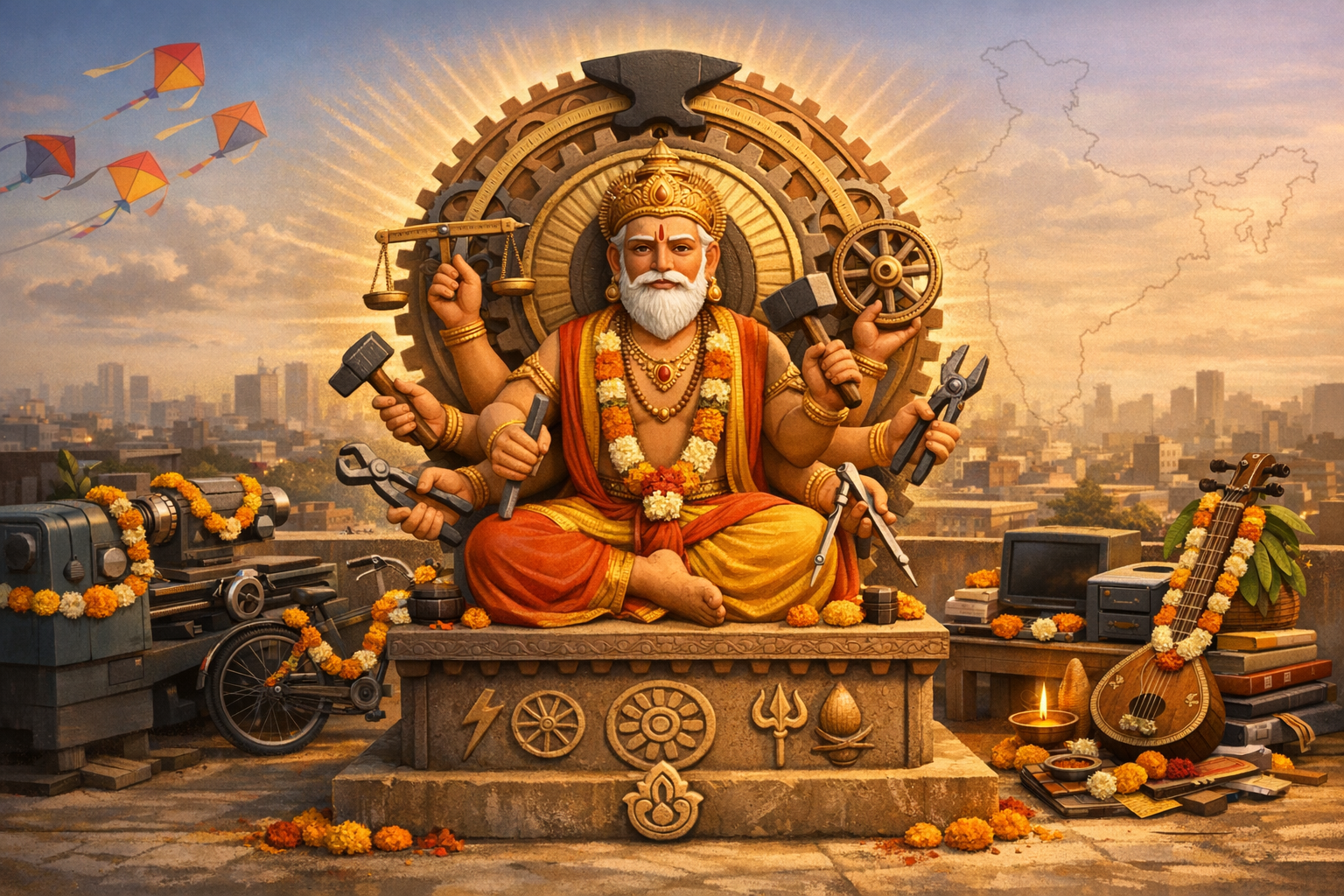
Iconographically, a pan-Indian template presents Vishwakarma with multiple arms holding tools of creationmeasuring scale, adze, mallet, chisel, and pincerssometimes accompanied by a sacred text or akṣamālā to signify knowledge and method. Visual traditions alternate between a white-bearded elder who embodies experience and a regal, ageless figure symbolizing timeless craft. A hamsa or, at times, an elephant may appear as vahana, while the background often alludes to workshops, forges, or celestial palaces attributed to his genius.
Bengal reimagines these shared motifs in ways that are immediately recognizable during Biswakarma Puja. Held on Kanyā Saṅkrānti, typically in mid-September, the festival moves devotion from strictly domestic or temple contexts into rooftops, industrial sheds, machine rooms, and design studios. The deity’s presence is rendered through large, vibrant clay icons whose attributespliers, hammers, chisels, wheels, and measuring cordsforeground the dignity of craft and labor. This spatial shift, bringing sanctity directly into sites of making, is central to Bengal’s interpretation.
Bengali icons often emphasize a kinetic tableau: a profusion of tools radiates around the deity; anvil, vice, and gear motifs echo the modern workshop; and allusions to mythic commissionsthe vajra for Indra or airborne craft evocative of the Pushpaka vimānafunction as narrative cues. The visual idiom draws on the region’s long clay-modelling traditions and pandal aesthetics, producing an immersive environment where artisanal pride and theological symbolism converge.
Ritually, Bengal’s Biswakarma Puja blends śilpa (craft) and śraddhā (devotional intent). Machine worship is explicit: lathes, motors, bicycles, printers, and computers are garlanded and anointed with turmeric and vermilion. Prayers invoke safety, precision, and creative excellence. The offering of prasad often includes khichuri and seasonal sweets, and the day unfolds as a collective affirmation that tools, when consecrated and responsibly used, extend dharma through everyday workmanship.
Equally emblematic is Bengal’s tradition of kite-flying on Biswakarma Puja. Rooftops become communal amphitheaters, where multicolored kites punctuate the sky. Beyond play, the act reads as a cultural metaphor for aspiration and masteryan embodied lesson in balance, wind-sense, and incremental skill. Many Bengalis recall rooftop gatherings as formative memories of intergenerational transmission, where elders taught knotting, line-coating, and maneuvering, subtly linking craft values to family and neighborhood life.
Elsewhere in India, the same devotional centerline branches into distinct calendars and visual choices. Across much of North and West India, Vishwakarma Jayanti is likewise observed around Kanyā Saṅkrānti, but the visual field commonly features calendar-art idioms: a dignified, often white-bearded Vishwakarma seated in a composed posture, flanked by essential tools and celestial insignia. Guild-centric communitiesPanchal, Lohar, Suthar, Sonarlead ceremonies in workshops and markets, underscoring the deity’s occupational patronage.
In South India, core themes of Vishwakarma reverence surface strongly through Ayudha Puja during Navarātri. Here, tools, vehicles, books, and musical instruments are ritually cleaned, adorned with mango leaves and sandal paste, and placed before deities, with Saraswati Puja often providing a complementary lens of knowledge-worship. While some households display Vishwakarma images, the liturgical focus tilts toward consecrating the implements of work and learningan approach that harmonizes Vishwakarma’s ethos with the wider Śākta and Vaiṣṇava landscapes of Navarātri.
Odisha, culturally close to Bengal, shares many eastern traits: Biswakarma Puja remains robustly workplace-centered, with widespread participation by artisans, boat-builders, and industrial units. In states like Gujarat and Rajasthan, the day can become a de facto “guild festival,” where repair, maintenance, and calibration acquire ritual significance. Across these regions, a consistent throughline is the sacralization of skill, safety, and precision in craft and engineering.
This regional spectrum is intelligible through art-historical context. Bengal’s clay-icon and pandal cultureshaped by centuries of image-making excellencenaturally favors large, narrative-rich tableaux. Western and northern idioms, deeply shaped by lithographic and calendar-art dissemination since the late nineteenth century, consolidate a more static yet dignified portraiture. Southern practices fold Vishwakarma into an integrated liturgical arc where Ayudha Puja internalizes the deity’s meaning through the consecration of implements rather than elaborate figural display.
Despite visual divergence, the semantic core is strikingly stable. Every tool in Vishwakarma’s hands speaks to a layer of dharmic meaning. The measuring cord and scale echo ṛtacosmic order through proportion. The chisel and adze signify tapasdisciplined transformation of the raw into the refined. The wheel suggests both technology and cyclical time. When a text or akṣamālā appears, method and knowledge are privileged alongside manual skill. These attributes travel across regions with only modest rearrangement, ensuring theological continuity beneath aesthetic variety.
The festival’s social economy further explains its longevity. Artisan and engineering communities across Indiablacksmiths, carpenters, goldsmiths, masons, weavers, printers, and now coders, designers, and machinistsrecognize in Vishwakarma a guardian of standards and safety. Tool-worship doubles as a quality ritual: sharpening, oiling, recalibrating, and cleaning precede veneration, embedding maintenance culture into devotional routine. This practical theology tacitly advances sustainability through repair and reuse.
In Bengal, this workplace devotionalism acquires distinctive urban layers. Print shops, foundries, garages, and now co-working studios stage Biswakarma Puja as both rite and professional affirmation. Temporary shrines might integrate gears, belts, cables, and drafting instruments, translating the ancient craftsman’s profile into the idiom of contemporary industry and design. The affective registerpride in workmanship, hopes for accident-free operations, and gratitude for mentorspermeates the event.
Textually and ritually, these patterns resonate across the wider dharmic family. In Hinduism, Ayudha Puja sacralizes implements; in many Jain communities, Navaratri season also brings reverence to tools, scriptures, and craft discipline; in Sikh traditions, the ethos of seva, kar-seva, and the sanctity of workmanship foster a parallel valorization of skill and labor; and in Buddhist art-historical milieus, the crafting of images and ritual implements is governed by codified canons that echo the same ethic of proportion and care. Such convergences underscore a shared dharmic regard for knowledge, practice, and the moral responsibilities of making.
Bengal’s Biswakarma Puja also invites a comparative reading with Navarātri’s Saraswati Puja. The former privileges tools and their skilled application; the latter emphasizes learning and refined expression. Together they map a full arc from method to mastery, a complementarity reflected in many Indian households and institutions where both festivals are observed with equal devotion.
An historical lens clarifies why these differences persist with integrity. Regional art schools, material availability, transmission lines of craft guilds, and local festival ecologies all shape how Vishwakarma is envisioned. Clay-rich Bengal evolves spectacular, narrative-driven icons; lithographic lineages elsewhere stabilize familiar portraits; temple-centric South India embeds the deity’s meaning into the ritual cadence of Navarātri. The result is not doctrinal fragmentation but a federated coherence that exemplifies unity in diversity.
Contemporary designers, engineers, and artisans increasingly read Vishwakarma through a professional lens. In studios and labs, the festival becomes a reflective pause: safety audits, workflow reviews, and upgrades are scheduled alongside puja. Educational institutions leverage the day to foreground design ethics, ergonomic practice, and the responsibility that attends technological power. In this way, devotion sustains a culture of care.
From a semiotic perspective, Bengal’s striking icons function as public pedagogy. By staging Vishwakarma amid machines and tools, the imagery asserts the sanctity of everyday labor. It also contests the false binary between sacred and secular by demonstrating that attention, precision, and accountability are themselves spiritual disciplines. Many participants carry this sensibility back into daily routineskeeping toolkits in order, honoring craft lineages, and mentoring apprentices with patience.
In summary, the difference between Vishwakarma in Bengal and other regions of India lies less in theology than in emphasis and medium. Bengal amplifies the narrative and occupational dimensions through immersive clay icons and workplace-centered rites; North and West India often stabilize the image through dignified portraiture within guild festivals; South India integrates Vishwakarma’s ethos into Ayudha Puja, sacralizing implements in the broader matrix of Navarātri. Across all, the same divine architect presides over a living dialogue between knowledge, method, and making.
This diversity is not merely tolerated; it is constitutive of India’s dharmic fabric. By honoring regional idiomsBiswakarma Puja in Bengal, Jayanti observances in the North and West, and Ayudha Puja in the Souththe broader community preserves theological continuity while enabling local creativity. The shared reverence for craft and conscientious work unites devotees across Hinduism, Buddhism, Jainism, and Sikhism, sustaining a resilient, interrelated culture of skill, service, and spiritual intent.
Inspired by this post on Hindu Blog.