
Reports emerging on 12 April 2026 described a widely shared video from Ahmedabad in Gujarat that purportedly shows a group confronting Muslim street vendors and demanding that they vacate a locality identified in the exchange as a “Hindu area.” A voice in the clip can be heard saying, “Only Hindus Can Work Here,” a statement that immediately triggered public debate on legality, ethics, and the potential for escalation. Regardless of the ultimate provenance or context of the footage, the issues raised are significant: the rule of law governing street vending, the constitutional commitments to equality and livelihood, and the collective responsibility to preserve communal harmony in urban public spaces.
The incident matters for three reasons. First, it cuts to the heart of constitutional guarantees protecting equal access to public spaces and the right to practice any profession. Second, it tests whether administrative decisions about markets and sidewalks remain grounded in law rather than social gatekeeping. Third, it challenges communities to resolve tension without sliding into cycles of resentment and retaliation, keeping with India’s civilizational ethos of coexistence and the ideal of Vasudhaiva Kutumbakam.
Under the Constitution of India, equality before the law (Article 14) and equal protection of the laws are bedrock principles. Article 15 restrains the State from discriminating on the grounds of religion, race, caste, sex, or place of birth; while it speaks to State action, criminal law also addresses private acts that incite hatred or obstruct lawful activity. Article 19(1)(g) confers the right to practice any profession or to carry on any occupation, trade, or business, subject to reasonable restrictions by law in the interests of the general public. Article 21 protects life and personal liberty, which jurisprudence has linked to the ability to work with dignity and safety in public spaces.
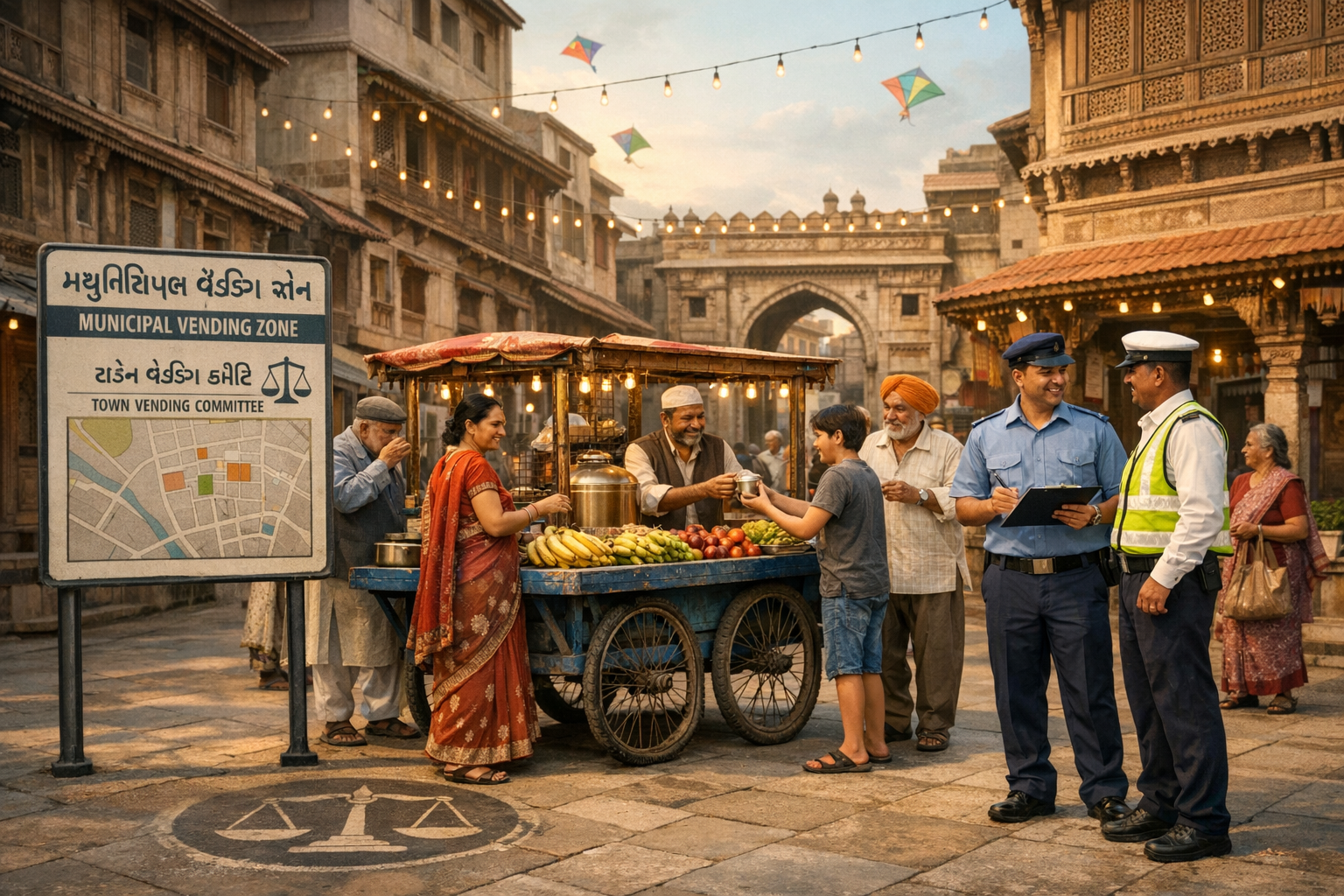
The Street Vendors (Protection of Livelihood and Regulation of Street Vending) Act, 2014, provides the central statutory framework. It requires a survey of vendors, the issuance of vending certificates, and the formation of Town Vending Committees (TVCs) to designate vending, restricted, and no-vending zones through a consultative and evidence-based process. The Act prohibits arbitrary eviction or relocation and sets up grievance-redress mechanisms. Crucially, it anchors regulation in due processensuring that any restriction on vending is a matter of urban design and public order applied neutrally, never of religious or communal identity.
Supreme Court jurisprudence has long recognized street vending as a protected economic activity. In Sodan Singh v. NDMC (1989), the Court affirmed that hawking is part of the right to carry on trade under Article 19(1)(g), subject to reasonable restrictions. Earlier guidance in Bombay Hawkers Union (1985) emphasized that regulation must balance public convenience and the right to livelihood. Later cases reiterated that carefully framed schemes, not vigilantism or ad hoc bans, are the lawful route. These decisions collectively signal that any exclusion of vendors must be rooted in law and urban planning, not in communal preferences or social coercion.
Where a crowd obstructs vendors based on religious identity or threatens them, criminal law may become relevant. Depending on facts established by investigation, provisions commonly considered by authorities in similar episodes include Section 153A of the Indian Penal Code (promoting enmity between groups), Section 505(2) (statements conducing to public mischief), Section 341 (wrongful restraint), and Sections 503–506 (criminal intimidation). Unlawful obstruction of a person’s lawful trade can also attract action. Separately, the Supreme Court’s guidance in Tehseen S. Poonawalla v. Union of India (2018) urged proactive policing and administrative measures to curb mob vigilantism and hate-motivated incidents.
The administrative locus for street vending in Ahmedabad lies with the municipal corporation and its Town Vending Committee, which should maintain updated vending plans, signage, and grievance channels. Lawful restrictions typically concern pedestrian flow, emergency access, heritage conservation, sanitation, and traffic safety. Unlawful restrictions include community-imposed religious bars or neighborhood decrees that have no statutory basis. In short, the State may regulate vending by due process and for public interest, but private parties have no authority to draw communal lines around economic participation in public streets.
Socioeconomic stakes are high. India has millions of street vendors whose incomes are often daily and precarious. Forced removalsespecially when identity-baseddeliver immediate livelihood shocks, disrupt family finances, and increase the risk of indebtedness. Ahmedabad’s storied markets, from Manek Chowk’s dynamic night bazaar to neighborhood lanes in historic pols, have long demonstrated how mixed communities can coexist commercially. The health of these markets depends on predictable rules, fair rotation or zoning where needed, and an unequivocal rejection of communal gatekeeping.
Episodes like the viral clip also unfold in an environment saturated with accelerated social-media circulation. Short, decontextualized videos can unleash outrage, copycat behavior, or retaliatory rhetoric. Responsible verification and timely, transparent updates from local authorities help check rumor cascades. In parallel, community influencers, religious leaders, and civil society organizations can proactively frame such moments in terms of constitutional values, local bylaws, and shared civic responsibilities rather than identity-based blame.
India’s civilizational inheritance offers a constructive compass. Hindu thought emphasizes Sarva Dharma Sambhava and the practical ethic of loka-sangraha (upholding societal order). Jain principles foreground Ahimsa and Aparigraha, encouraging restraint and non-harm. Buddhist teachings highlight compassion (karuṇa) and mindful speech that de-escalates conflict. Sikh tradition enshrines seva and the protection of the vulnerable. These dharmic traditions, distinct yet convergent on respect and responsibility, can inform local compacts in which residents and traders alike commit to non-discrimination, fair dealing, and peaceful problem-solving.
For public authorities, three priorities are essential. First, ensure immediate, even-handed policing to prevent intimidation or obstruction of lawful vending, coupled with incident documentation and, where warranted, legal action in line with the IPC and local laws. Second, accelerate TVC-led processescompleting surveys, issuing certificates, and publishing clear vending maps and rulesso that every vendor and resident can see what is permitted, where, and why. Third, institutionalize a grievance-to-resolution timeline with multilingual hotlines, on-site mediation, and periodic public briefings that reinforce that the rule of law, not social vetoes, governs public space.
For vendors, practical safeguards help. Keeping copies (physical or digital) of vending certificates or municipal receipts, photographing stall setups within permitted zones, and promptly reporting any obstruction to the local police station and TVC office build a documented trail. Legal aid organizations and helplines can assist with drafting complaints, filing Right to Information requests for vending plans, and, if necessary, approaching the State Human Rights Commission or filing writ petitions under Article 226 in the High Court to protect livelihood rights.
For residents and market associations, constructive pathways are available when congestion, hygiene, or access are concerns. The legitimate route is municipal engagement: propose time-of-day vending rotations, request additional sanitation facilities, or seek re-marking of pedestrian corridors through the TVCnot identity-based exclusion. Many Indian cities have successfully piloted hawker plazas, off-street bays, and load–unload windows that reconcile walkability with livelihood. These are transport and design solutions, not communal ones.
For media and platforms, accuracy and de-escalation are paramount. Label unverified claims, protect the privacy and dignity of individuals where possible, and avoid headlines that absolutize one quote into a community-wide stance. Where a phrase such as “Only Hindus Can Work Here” appears in a clip, present it contextually as an allegation under verification and link it to the legal and ethical stakes without amplifying antagonism. Audiences benefit when coverage explains what the Constitution and the Street Vendors Act actually provide, distinguishes lawful regulation from unlawful discrimination, and foregrounds remedies that keep communities together.
Urban design and management reforms can reduce friction structurally. Wayfinding and curb management, cashless fee collection for vending permits, shaded micro-markets, and scheduled waste pick-up near vending clusters have all shown promise. Clear signage stating that vending is regulated by the municipality and that discrimination or intimidation is unlawful can deter vigilantism. Public-awareness campaigns led jointly by municipal bodies and interfaith councils can reinforce that market diversity is an asset to Ahmedabad’s identity and to Gujarat’s economy.
Early-warning indicators deserve attention: repeated circulation of communalized boycott calls; physical blocking of carts or vehicles; stigmatizing graffiti or stickers; and sudden shifts in market composition driven by fear rather than policy. When such signals appear, rapid convening by ward-level peace committeesbringing together Hindu, Muslim, Jain, Sikh representatives, traders, municipal engineers, and traffic policecan reset the conversation around safety, access, and fairness.
From a policy perspective, the core principle is simple. Public space is a shared civic asset regulated by law. No communitymajority or minorityhas the authority to impose categorical religious bars on who may work or trade on a public street. Where vending must be limited, the reasons must be secular and objectivepedestrian capacity, emergency egress, or environmental impacttested through TVC procedures, published criteria, and appeal rights. This approach aligns with constitutional equality, safeguards livelihoods, and preserves the social trust that local economies require.
Ahmedabad’s history offers a reservoir of practices for coexistence: negotiated hours for markets abutting temples and mosques, staggered festival-day arrangements, and shared stewardship of cleanliness in mixed lanes. Reaffirming these habitsgrounded in dignity, reciprocity, and lawful processcan convert moments of strain into opportunities for civic renewal. When communities act from the shared dharmic commitment to non-harm, service, and truthfulness, the city’s plural marketplaces can remain both vibrant and just.
In conclusion, the viral clip has sparked necessary scrutiny of how India’s constitutional and statutory frameworks meet the everyday realities of trade, identity, and public order. The legal answers are clear: identity-based expulsion from public vending spaces is impermissible; regulation must be by due process and in the public interest; intimidation is actionable. The ethical answers are equally clear: uphold compassion, restraint, and mutual respect across traditions; resolve problems through institutions, not through crowds. By centering law, design, and dharmic values of coexistence, Ahmedabadand Gujarat more broadlycan protect livelihoods, prevent polarization, and model the Communal Harmony that India’s democracy promises.
Inspired by this post on Struggle for Hindu Existence.
