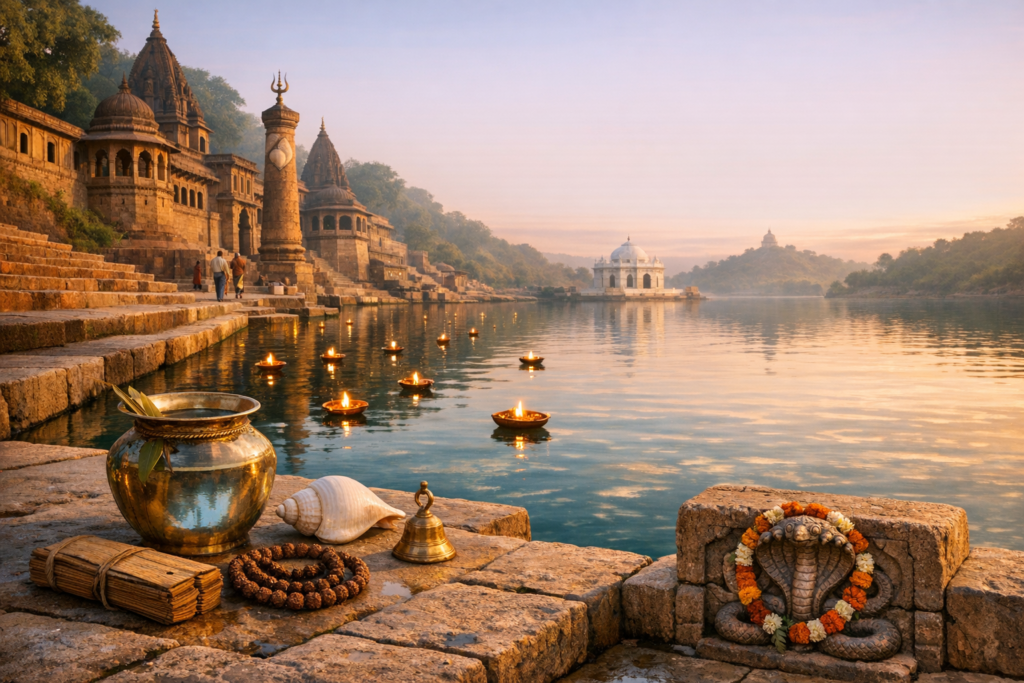
Saturday, April 11, 2026, in the Hindu calendar (Panchang) observes Krishna Paksha Navami (the ninth lunar day of the waning or dark fortnight) until approximately 8:40 PM, after which Krishna Paksha Dashami (the tenth lunar day) prevails for the remainder of the night in most regions.
All Panchang elements are location- and timezone-sensitive. The 8:40 PM transition is to be understood as a general guideline; local sunrise, longitude, latitude, and daylight-saving rules can shift exact moments slightly. For muhurta-critical observances, verification with a region-specific Panchang or panchangam is recommended.
Tithi denotes the lunar day measured by the longitudinal separation between the Moon and the Sun. Each tithi spans an elongation interval of 12 degrees. Navami corresponds to an elongation from 96° to 108°, and Dashami spans 108° to 120°. Because the Moon’s apparent speed varies, tithi length is not fixed; consequently, a tithi can begin or end at any clock time within a civil day.
Krishna Paksha, the waning half, traditionally emphasizes introspection, steadiness, and consolidation of effort. Devotional practice (sadhana), scriptural recitation, and seva (service) often feel naturally aligned with this fortnight’s contemplative rhythm. Many households use such days to review ongoing commitments, simplify routines, and cultivate inner clarity.
As a tithi, Navami signifies a turning point in the fortnight: energies that were gathered earlier tend toward refinement. While there is no pan-Indic vrata universally fixed to every Krishna Paksha Navami, customary activities include domestic puja, japa, study of Srimad Bhagavata, Ramayana, or Vishnu Sahasranama, and quiet charitable initiatives. If a home tradition requires a Navami-specific observance, it should ideally be completed before the tithi ends at about 8:40 PM.
With the onset of Dashami after 8:40 PM, the lunar day supports closure and completion. It is considered conducive to wrapping up pending tasks, documenting learnings, and preparing for the final arc of the waning half. Gentle disciplines—mindful breathwork, a brief evening dhyana (meditation), and gratitude practices—fit well with Dashami’s consolidating tone.
Saturday (Shaniwara) traditionally honors Shani. Many devotees observe simple austerities, light sesame-oil lamps, or engage in acts of compassion and justice-oriented charity. The day’s ethos—patience, responsibility, and steady effort—harmonizes with the waning fortnight’s reflective mood, making April 11, 2026, doubly suitable for disciplined sadhana and thoughtful planning.
Most festival and vrata rules in the Hindu calendar prioritize the udaya tithi (the tithi prevailing at local sunrise). Certain observances, however, require vyapti at pradosha (twilight), nishita (midnight window), or arunodaya (pre-dawn). On April 11, Navami prevails through the day until evening, making day-time Navami observances straightforward in regions where local Panchang confirms this span.
Panchang comprises five core elements: tithi (lunar day), vara (weekday), nakshatra (lunar mansion), yoga (Sun–Moon sum-based yogas), and karana (half-tithi segments). While the present focus is on tithi and weekday, nakshatra, yoga, and karana further nuance the day’s qualities and should be consulted locally for muhurta-sensitive undertakings.
Nakshatra and Rashi (the Moon’s sidereal sign) on April 11, 2026, will vary slightly by location and exact computation parameters (e.g., chosen ayanamsa, commonly Lahiri in India). Nakshatra informs emotional tone and ritual flavor, while the Moon’s Rashi colors the mind’s tendencies. For accurate planning—particularly for samskaras, travel, or signing agreements—refer to a reliable regional Panchang or Jyotisha resource.
The notion of “good time” (Shubh Muhurat) blends universal principles with local astronomy. Two broadly accessible anchors are Brahma Muhurta, a 48-minute window in the pre-dawn period ideal for meditation and japa, and Abhijit Muhurta, approximately 48 minutes centered on local solar noon, often treated as generally auspicious for undertakings that cannot be scheduled in a fuller muhurta.
Rahu Kalam, Yamaganda, and Gulika Kaal are daylight segments traditionally avoided for initiating significant tasks. They are computed by dividing the day’s sunrise-to-sunset duration into eight equal parts and assigning segment numbers per weekday. On Saturdays, these windows typically occur in the earlier half of the day, but exact spans depend on local sunrise and should be calculated or looked up for one’s city.
Choghadiya, widely used in western India and beyond, divides day and night into time blocks categorized as Amrit, Shubh, Labh (favorable), Chaal (neutral), and Rog, Kaal, Udveg (unfavorable). Selecting Amrit, Shubh, or Labh for starting routine tasks or travel can be a practical alternative when a detailed muhurta is not feasible. Because Choghadiya rotates with sunrise, consult a location-specific chart for April 11.
Technical note on calendar frameworks: Tithi reckoning is nirayana (sidereal), and regional traditions may follow Amanta (month ending on Amavasya) or Purnimanta (month ending on Purnima) systems. Vikrama and Shaka eras run concurrently in practice. These frameworks do not alter the Navami-to-Dashami transition described here but may influence month naming conventions and festival placement across regions.
In an inclusive dharmic spirit, the contemplative arc of Krishna Paksha aligns well with practices cherished across Hinduism, Buddhism, Jainism, and Sikhism—meditation, scriptural reflection, compassionate seva, and community harmony. Families often find that scheduling shared study or kirtan in the evening—transitioning into Dashami—strengthens collective intention and intergenerational bonds.
Planning suggestions for April 11, 2026: complete any Navami-specific rites before about 8:40 PM; schedule new or routine initiatives within Shubh/Amrit/Labh Choghadiya or during Abhijit Muhurta; avoid local Rahu Kalam, Yamaganda, and Gulika for fresh starts; reserve the evening for reflective Dashami-friendly closures, documentation, or gratitude offerings.
Finally, remember that Panchang decisions are best made with both precision and discernment. Use a trusted, city-specific Panchang to confirm nakshatra, Moon’s rashi, yoga, karana, sunrise/sunset, and the exact Navami-to-Dashami tithi changeover for April 11, 2026. With accurate data and steady intent, the day’s sacred timing becomes a practical guide for harmonious action.
Inspired by this post on Hindu Blog.