Astro numerology in Hinduism integrates the time-tested principles of Jyotisha (Hindu astrology) with numeric symbolism to interpret patterns in planetary motion, calendric cycles, and human experience. Rather than treating numbers as isolated omens, this tradition studies how numbers arise naturally within the architecture of the cosmosthrough rāśi (signs), nakshatras (lunar mansions), tithi (lunar days), vara (weekday), and dasha (periods)and then correlates those counts with the lived rhythms of individuals and communities.
Classical sources such as Brihatparasara Horasastram and Brihajjataka discuss the computational and interpretive backbone of Hindu astrology, including the distinctive ashtakavarga system. Ashtakavargaliterally the “group of eight”quantifies planetary contributions to each zodiacal sign and thereby anchors transit (gochara) judgments in a transparent, number-driven framework. This synthesis of astronomy, calendrics, and arithmetic reasoning is an enduring hallmark of Hindu intellectual history.
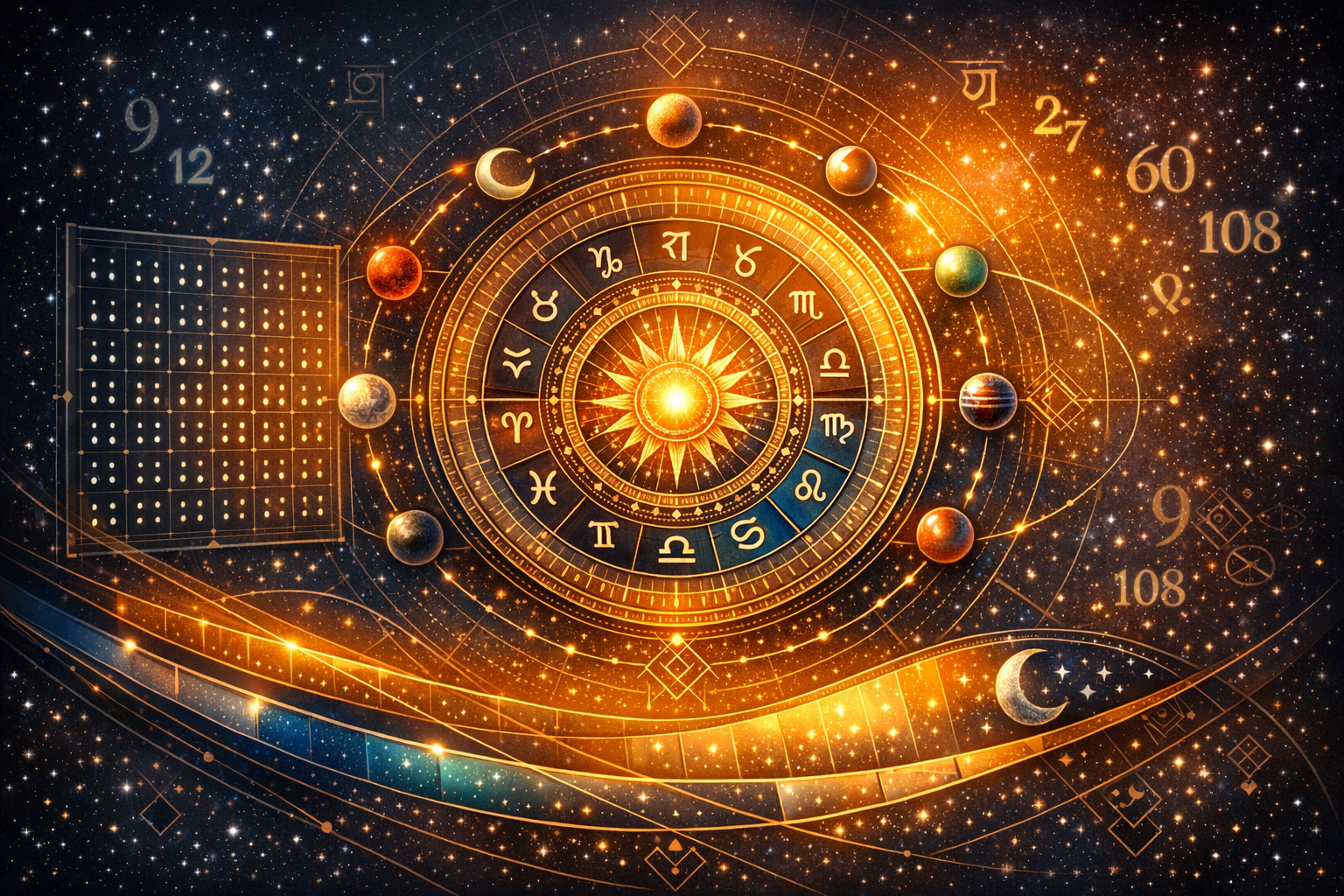
Numbers pervade Jyotisha in precise ways: the nine grahas, twelve rāśis, twenty-seven nakshatras (with 108 padas), sixty-year samvatsara cycles, and the famed Vimshottari dasha scheme. Each count encodes a different cadence in timedaily (Panchang), monthly (tithi cycles), yearly (samvatsara), and multi-year (dashas)allowing analysts to locate events within nested temporal harmonics rather than isolated moments. This is the working language of astro numerology: numbers as measures of cosmic order rather than mere tokens of luck.
Everyday practice reflects this integration. Households across India and the broader Dharmic world often consult the Panchang to align travel, ceremonies, and new beginnings with auspicious combinations of tithi, nakshatra, and vara. Regional methods such as Choghadiya segment day and night into quality-marked intervals (e.g., Amrit, Shubh, Labh, Char, Rog, Kaal, Udveg), providing a practical, time-of-day filter. These customs, shared in different forms among Hindu, Buddhist, Jain, and Sikh communities, foster a felt connection to time as a living, ethical companion rather than a neutral backdrop.
Within this landscape, ashtakavarga offers a structured, numerical lens for transits. It evaluates how each planet “votes”by giving or withholding points (bindus)for each zodiac sign, based on the natal disposition of the chart. Two complementary tables result: Bhinnashtakavarga (BAV), which records a planet’s sign-by-sign scoring, and Sarvashtakavarga (SAV), which aggregates the seven classical planets’ BAVs to show the sign’s overall support for transiting results.
Bhinnashtakavarga (BAV) is prepared separately for each planet. Under well-defined classical rules, a sign receives either a point (bindu) or a dash (rekhā/zero) from that planet. The distribution of bindus across the twelve signs summarizes where a planet tends to deliver smoother outcomes during transits. Although the specific bindu totals vary by chart, the conceptual takeaway is straightforward: higher BAV scores for a planet in a given sign usually moderate adversity and unlock opportunities when that planet transits the sign.
Sarvashtakavarga (SAV) then sums the BAV contributions of all seven planets to each sign, yielding a 12-sign profile of overall transit potential. Interpreters often treat a sign’s SAV above the midrange as resilient and supportive of growth, while markedly low SAV warns of friction when multiple planets congregate there. Because SAV collapses multi-planet sentiment into a single index, it complements fine-grained BAV checking for the transiting planet under review.
Transit (gochara) reading with ashtakavarga follows clear heuristics. For instance, a Saturn transit through a sign with robust Saturn BAV and healthy SAV tends to temper the heavier side of Saturn’s symbolism and emphasize constructive consolidation, skill-building, and long-return gains. Conversely, the same transit across a sign with sparse Saturn BAV and weak SAV calls for prudencecareful pacing, debt control, and emphasis on ethical guardrails. The method builds forecasts on a numeric scaffold rather than on generalities about planetary nature alone.
In responsible practice, ashtakavarga is integrated with dasha-bhukti timing, rāśi and bhāva analysis, aspects (drishti), strengths (e.g., shadbala), and yogas. A typical sequence might be: identify the operative Vimshottari dasha, assess the relevant planet’s dignity and yogas, check its BAV distribution and the SAV of the target sign, and then fine-tune with Panchang factors (tithi, nakshatra) on event dates. The result is a multi-layered, reproducible judgment blending astronomy, arithmetic, and textual rules.
Hindu astro numerology also preserves indigenous number-encoding systems that signal the civilizational depth of arithmetic culture. The bhooth sankhya convention encodes numerals in Sanskrit verse by substituting number-bearing words (e.g., eye = 2, Veda = 4), enabling scholars to embed large constants in easily memorizable meters. The Katapayadi scheme maps aksharas to digits, allowing planetary constants, calendric parameters, or geodesic values to be stored and transmitted in poetic linesan elegant bridge between literature and computation used by astronomers and mathematicians.
A distinct, later stream of ank-jyotish (popular numerology) assigns planetary affinities to single digits1 (Sun), 2 (Moon), 3 (Jupiter), 4 (Rahu), 5 (Mercury), 6 (Venus), 7 (Ketu), 8 (Saturn), 9 (Mars)and studies date-of-birth or name totals for personality cues and timing. While such practices can be culturally meaningful and sometimes helpful for personal reflection, classical texts emphasize that they should complementnot replacecore astrological analysis centered on rāśi, bhāva, dashas, and ashtakavarga.
Naming traditions illustrate how sound, number, and sky coordinate. Many families select syllables based on the child’s janma nakshatra and its pada, aligning the seed sound (bīja) with the graha and elemental tone of the birth moment. Some also consult Panchang and Choghadiya to time the namakarana samskara. These choices reflect a shared Dharmic ethos: harmonize personal intention with time’s texture, whether in Hindu, Buddhist, Jain, or Sikh contexts, where respect for calendric rhythms often shapes collective observances.
A concise, technical workflow shows the craft at work. Suppose professional changes are under consideration: first, establish the operative Vimshottari dasha and the functional role of the relevant grahas for the lagna (Ascendant) and rāśi. Next, inspect the target sign’s SAV and the transiting planet’s BAV for that sign; a high BAV/SAV stack indicates supportive bandwidth for transition. Then, narrow windows with Panchangfavoring aligned tithis and nakshatrasand cross-check yogas and aspects. Such layered validation minimizes noise and keeps decisions grounded in repeatable criteria.
From a Dharmic-unity perspective, the shared commitment to time-awareness stands out. Hindu almanacs, Buddhist calendrical rites, Jain festival timings, and Sikh community observances all treat time as morally significant. Even where scriptural emphases differ, the underlying aspiration is similar: align intention, restraint, and service (seva) with auspicious opportunities, and meet challenging periods with equanimity, compassion, and ethical clarity.
Equally important are limitations and ethics. Astro numerology does not override free will, Dharma, or societal responsibilities; it provides context. Strong ashtakavarga scores are not license for risk-taking without prudence, just as low scores do not doom outcomes when preparation, community support, and wise counsel are present. Classical seers consistently framed Jyotisha as a soteriological aidcultivating self-knowledge, accountability, and compassionrather than as deterministic fatalism.
For modern readers, several practical guidelines improve reliability: prefer source-grounded methods (BAV and SAV) over ad hoc numerological claims; integrate dasha and bhukti timing; use Panchang to select dates rather than to force decisions; and document assumptions and outcomes for learning. Over time, this fosters an evidence-informed approach consistent with the analytical spirit found in Brihatparasara Horasastram and Brihajjataka.
Historically, figures like Varahamihira stand at the confluence of astronomy, mathematics, and interpretive craft. Their works preserved computational rigorvisible in ashtakavarga’s point systems and in mnemonic number encodings such as bhooth sankhyaalongside a humane ethic of counsel. The transmission of these methods through Sanskrit literature, regional practice, and contemporary Panchang usage shows an unbroken concern for anchoring choice in discernment.
In sum, Hindu astro numerology is best understood as a disciplined engagement with time and number. Ashtakavarga provides a quantitative scaffold for transit analysis; Panchang offers a daily interface for action; and numerical conventions like bhooth sankhya and Katapayadi reveal a culture where poetry and calculation co-evolved. When applied with humility and unity across Dharmic traditions, these tools encourage wiser decisions, steadier hearts, and a life more attuned to cosmic order.
Inspired by this post on Hindu Blog.