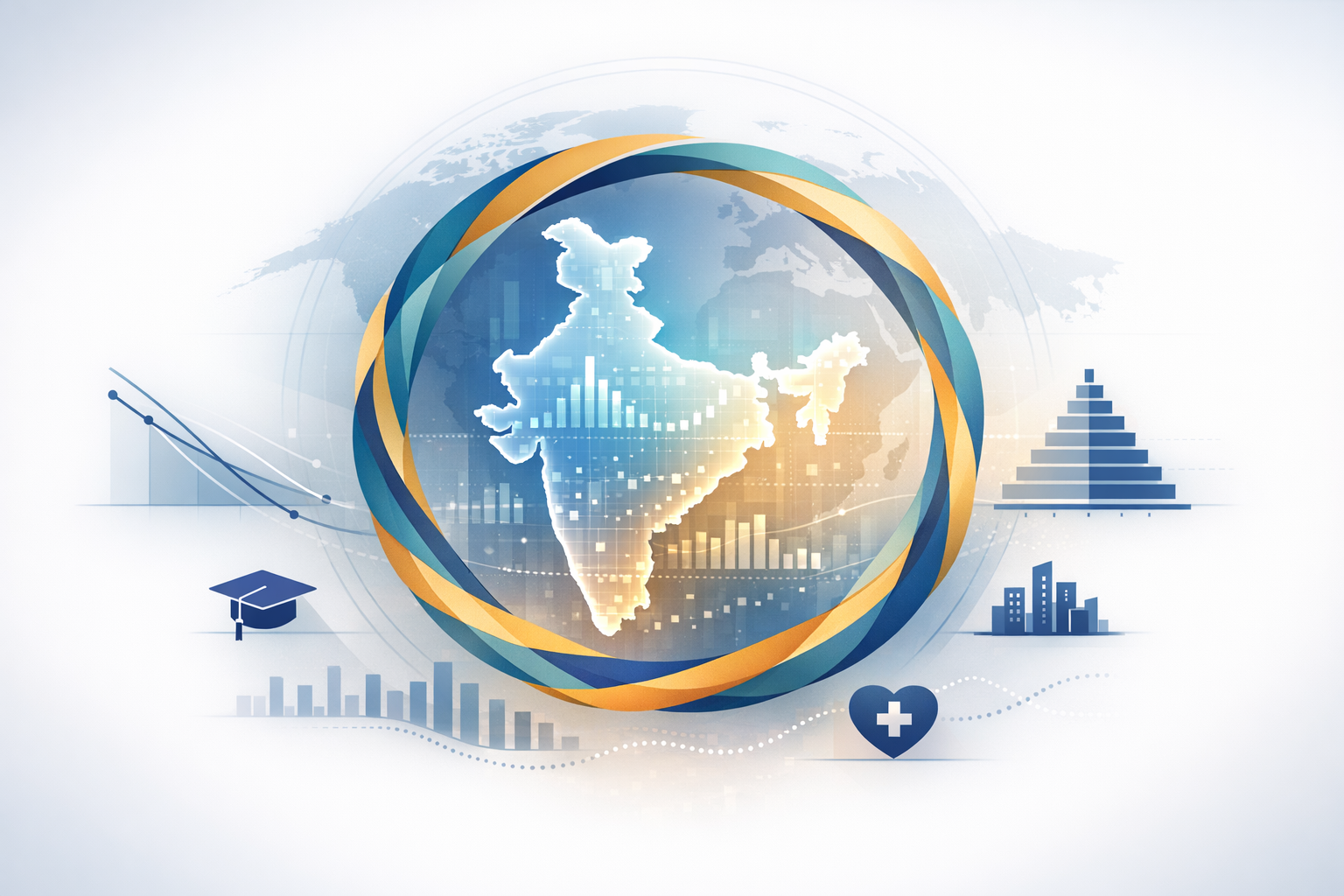
Conversations about global and Indian demography often begin with a striking observation from the Pew Research Center’s projections: Muslims are the world’s fastest-growing major religious group. This analysis synthesizes Pew’s long-horizon global modeling with India’s most reliable public datasets (Census 2011 and NFHS-5, 2019–21) to clarify what the data does—and does not—say. It also situates demographic change within a wider ethos of unity in diversity, affirming the shared civilizational values of Hinduism, Buddhism, Jainism, and Sikhism, and emphasizing social cohesion across all communities.
Precision begins with definitions. “Decadal population growth” refers to percentage change over a ten-year window. Comparisons can be made two ways: by growth rates (percent change) or by absolute increases (headcount change). A phrase sometimes used in public debate—“higher than the aggregate growth of Christians, Hindus, and Jews”—is not a standard measure in demographic science and does not appear in Pew’s framing. Pew’s consistent finding is more specific and methodologically clear: Muslims grow faster in percentage terms than each other major group, largely because of higher average fertility and a younger age structure. That conclusion is robust across multiple editions of Pew’s global projections.
Globally, Pew attributes the relatively rapid growth of the Muslim population to two structural drivers. First, fertility: in many Muslim-majority countries, total fertility rates (TFRs) have historically been above the global average, though they have been falling in recent decades. Second, age structure: Muslims have the youngest median age among major religious groups, which creates more births even as fertility declines. By contrast, Christian growth is buoyed by high fertility and a youthful population in sub-Saharan Africa but is tempered by aging and religious switching in parts of Europe and the Americas. Hindus grow steadily, driven by South Asia’s large base population and continuing improvements in health and longevity, while Jews are a small global share whose numbers are shaped by both fertility (notably among Haredi communities) and migration dynamics (especially to Israel). Across all groups, rising education, urbanization, and women’s empowerment are converging long-run fertility downward.
It is important to parse headlines with care. Pew’s work does not claim that Muslim population growth “exceeds the aggregate of Christians, Hindus, and Jews” in a combined sense. Rather, it consistently shows Muslims as the fastest-growing major group relative to each of the others individually. Earlier projections suggested Muslims could approach parity with Christians by mid-century and potentially surpass later in the century if differentials persist, while more recent updates underscore uncertainty because fertility has been falling faster than expected in several Muslim-majority countries. The core inference remains: the growth-rate gap is primarily a consequence of demography (age and fertility), not of mass conversion.
India’s starting point is well-established in the 2011 Census, the latest comprehensive enumeration by religion. Hindus comprised 79.8% of the population, Muslims 14.2%, Christians 2.3%, Sikhs 1.7%, Buddhists 0.7%, and Jains 0.4%. Over 2001–2011, decadal growth rates differed by group: Muslims grew faster than the national average, while Hindus, Christians, Sikhs, Buddhists, and Jains recorded lower rates to varying degrees. With the 2021 Census postponed, rigorous decadal updates by religion are not yet available; analysis therefore relies on high-quality sample surveys for interim insight.
India’s most authoritative fertility picture comes from NFHS-5 (2019–21). The national TFR stands around replacement level (approximately 2.0). Group-wise, Muslims continue to exhibit a higher TFR than Hindus, but the gap has narrowed sharply over the past two decades. NFHS-5 places Hindu TFR below replacement and Muslim TFR only modestly above replacement. This convergence is consistent with global experience: as female education rises, child survival improves, and urbanization accelerates, fertility declines across all communities. In short, the direction of change—slower growth and demographic convergence—is clear, even as the precise pace will vary by state and socioeconomic context.
State-level variation matters more than national averages. In southern states such as Kerala and Tamil Nadu, all communities—Hindus, Muslims, Christians, Buddhists, Jains, and Sikhs—exhibit low fertility, reflecting decades of investment in schooling, primary health care, and women’s empowerment. In states such as Bihar and Uttar Pradesh, fertility remains higher across communities, not because of religious identity per se but due to structural drivers like lower average years of schooling for women, delayed gains in child survival, and rural-urban differentials. When comparing growth across communities, analysts control for these background factors, which explains why once-sizable gaps narrow as development indicators rise.
Religious switching and migration play a far smaller role in India’s religious composition than fertility and age structure. Pew’s 2021 study on India found minimal net religious switching at the population level, with reported flows roughly balancing out. International migration does not substantially alter national religious shares. Consequently, almost all medium-term change will be driven by the interaction of age structure (the relative share of people in childbearing ages) and continued fertility convergence.
What do these dynamics imply for the next two decades? Three scenarios are illustrative. First, a baseline convergence scenario in which Muslim fertility continues to decline faster than Hindu fertility, gradually narrowing the growth-rate gap and stabilizing religious shares. Second, an accelerated convergence scenario—associated with rapid gains in girls’ secondary completion, women’s labor-force participation, and urbanization—in which fertility for all communities falls slightly below replacement, leading to broad stabilization and eventual aging. Third, a slower convergence scenario—if development gains stall—in which the fertility gap persists longer, keeping Muslim growth rates above Hindu growth rates but still trending downward over time as education and health investments continue incrementally. Across all scenarios, India’s overall demographic transition remains the dominant story: smaller families, longer lives, and a steady shift toward an older age structure.
For households, these trends are visible in everyday life long before they appear in national tables. Families across communities are prioritizing education, investing in daughters’ futures, and spacing births for better maternal and child health. Classrooms in fast-growing districts feel more crowded, while aging parents in developed districts need more care infrastructure. These shared, relatable experiences cut across religious lines and bring the discussion back to common aspirations: dignity, opportunity, and stability for the next generation.
Policy levers that enhance social cohesion and equitable development also narrow fertility differentials. Evidence-backed priorities include ensuring universal girls’ secondary education, strengthening primary health systems (especially maternal and newborn care), expanding access to nutrition and immunization, improving sanitation, and supporting safe, affordable urban housing. These are universal goods—consistent with the dharmic emphasis on compassion (karuṇā), non-harm (ahiṁsā), and shared duty (dharma)—that uplift all communities without singling any out.
Framing the issue with care is essential. Terms that ascribe hostile intent to demographic change obscure the underlying, evidence-based reality: India’s transition is driven by development and age structure, not by organized religious strategies. Constructive public discourse recognizes demographic facts, respects religious freedom, and affirms the unity of Hinduism, Buddhism, Jainism, and Sikhism alongside India’s other faiths. The guiding principle is clear: unity in diversity, supported by data, advanced through inclusive development, and anchored in constitutional values.
Methodological notes and limits deserve explicit mention. Pew’s global projections are scenario-based models drawing on United Nations population data, country-level fertility trends, age structures, and patterns of migration and religious switching where available. For India, the last religion-wise census baseline is 2011; until the next census is completed, interim inferences must rely on NFHS, SRS, and triangulation with administrative indicators. As new data become available, projections should be updated, with special attention to state and district heterogeneity. Using standardized, transparent methods ensures that analysis remains comparable over time and genuinely helpful to planners, educators, and community leaders.
Key takeaways are straightforward. Globally, Muslims remain the fastest-growing major religious group in percentage terms due chiefly to fertility and youthfulness, with growth differentials narrowing as fertility declines. In India, religion-wise growth-rate gaps have narrowed markedly as the demographic transition advances, and medium-term shifts will be shaped far more by education, health, and women’s empowerment than by migration or conversion. The most responsible response is not alarm but action: accelerate inclusive development so that demographic dividends are realized equitably, elders receive dignified care, and every child—across all faiths—has a fair start.
Inspired by this post on Struggle for Hindu Existence.