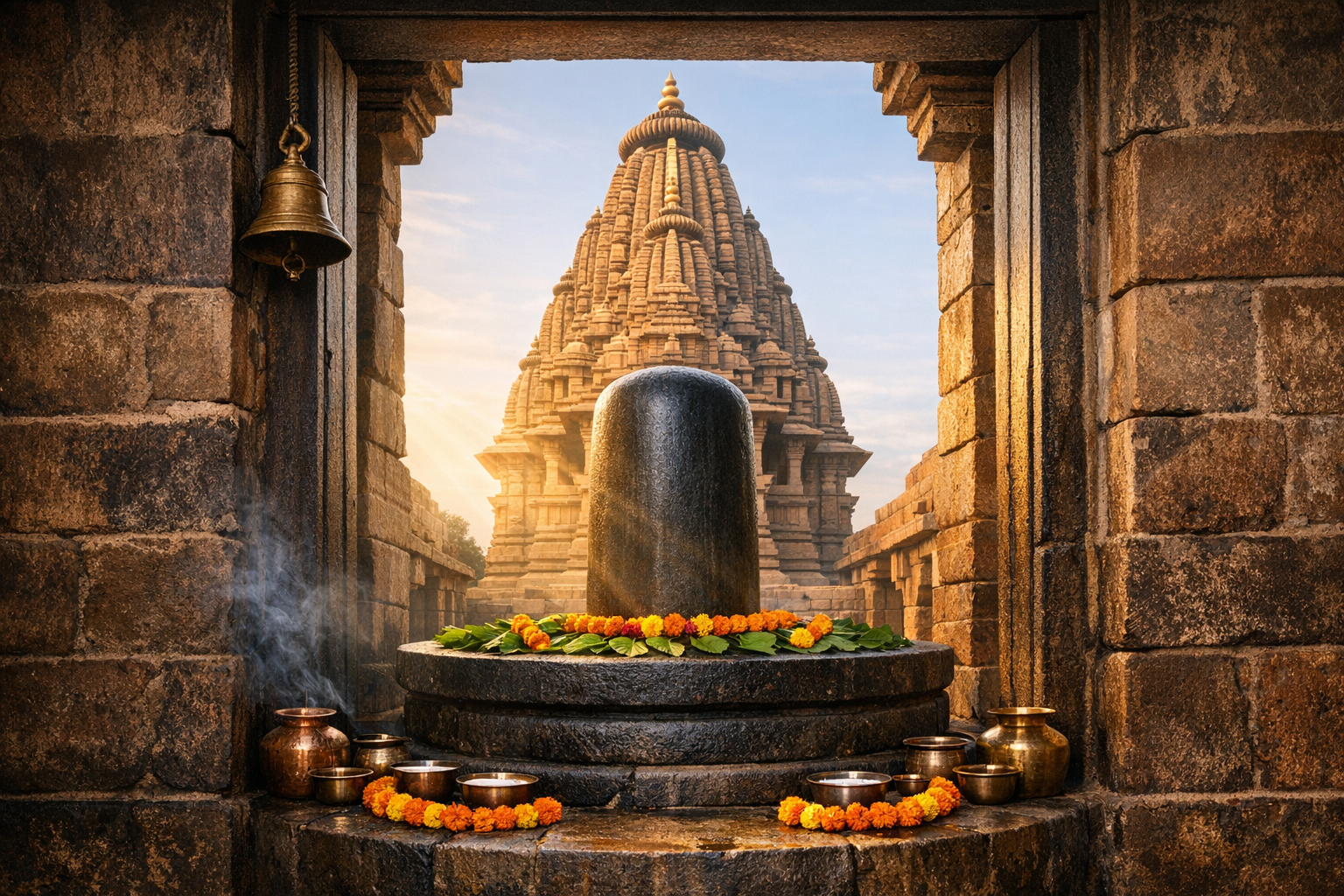
Matangeshwar Temple (Matangeshvara) in Khajuraho, Madhya Pradesh, exemplifies a rare continuity of sacred practice: it is a living Shiva temple where daily worship has persisted for roughly a millennium. The sanctum enshrines a colossal Shivling that devotees revere as “living,” commonly believed to rise imperceptibly with time. Within the wider Khajuraho Group of Monumentsrecognized as a UNESCO World Heritage Sitethis shrine anchors the spiritual life of Bundelkhand while illuminating the historical depth of Hindu temple culture in India.
Historically situated in the Chandela dynasty’s cultural sphere (circa 10th–11th century CE), Matangeshwar Temple helps map the evolution of Khajuraho’s temple-building program. While Khajuraho is globally celebrated for sculptural exuberance and architectural innovation, Matangeshwar’s significance rests equally on ritual continuity: it is among the few Khajuraho temples where worship never lapsed. The Archaeological Survey of India (ASI) oversees the site, balancing conservation standards with the living needs of a major place of pilgrimage.
Architecturally, the shrine follows the Nagara (North Indian) idiom. A soaring latina (rekha-prasada) shikhara culminates in an amalaka and kalasha, while the plan is organized around a square garbhagriha (sanctum), often approached through a short antarala and a modest mandapa. Compared with Khajuraho’s more ornate edificessuch as Kandariya MahadevaMatangeshwar’s surfaces are notably restrained, an austerity that throws the liturgical focus onto the sanctum and its monumental Shivling. The masonry, composed of finely worked sandstone typical of the region, sits on a proportioned plinth that lends the superstructure compositional balance.
The temple’s identity is inseparable from its extraordinary Shivling: a monolithic stone emblem of unusual height, set within a circular yoni-pīṭha. The lingam’s scale establishes an immediate sense of presence; devotees approach it with bilva leaves, water, milk, and Panchamrita offerings, observing quiet, rhythmic darshan queues. The aura of living sanctitysustained through centuries of prāṇa-pratiṣṭhā (ensoulment) and daily ritualrenders the icon not only a symbol but, in lived experience, a being in relationship with the community.
The widely held local conviction that the Shivling “grows” over time forms an integral part of Matangeshwar’s intangible heritage. From an academic standpoint, such a phenomenon may be read as a layered cultural narrativeone that encodes faith, continuity, and the temple’s perceived vitality. Scholars occasionally suggest prosaic mechanisms (e.g., minute mineral accretions from repeated abhiṣeka, thermal expansion–contraction cycles, or visual perception effects due to plinth settlement and changing sightlines). Yet, regardless of mechanism, the belief itself functions as a powerful devotional grammar, reinforcing the community’s sense that the deity remains vibrantly present in history.
Ritual life at Matangeshwar is active and carefully structured. Daily worship includes abhiṣeka with water, milk, and Panchamrita, the offering of bilva and flowers, recitations from the Rudra hymns, and evening āratī. On Maha Shivaratri, the temple becomes the devotional epicenter of Khajuraho, drawing large congregations for night-long vigil, kirtan, and darshan. The festival’s cadencefasting, sacred bathing, linga worship, and communal singingreaffirms the temple’s role as a living institution where liturgy, music, and community converge.
As a case study in living heritage, Matangeshwar illustrates how architecture and ritual co-produce meaning. The relative restraint of the superstructure intensifies focus on liturgy, while the continuous accretion of offerings literally and symbolically binds the community to the sanctum. This synergy also informs conservation decisions: ASI custodianship must preserve fabric and form without impeding the cyclical practices that make the site spiritually legible to devotees.
The temple’s living tradition resonates across the broader Dharmic familyHinduism, Buddhism, Jainism, and Sikhismwhere reverence for sacred spaces, ethical practice, and community service overlap. Aniconic and symbolic forms in early Buddhist stupas, Jain sthāpanās, and the Sikh emphasis on living scripture and seva reflect complementary ways of experiencing the sacred. Seen through this inclusive lens, Matangeshwar becomes not only a Shaiva shrine but also a shared civilizational asset that affirms unity in spiritual diversity.
Heritage management at Matangeshwar underscores a familiar tension between conservation and active worship. Liquids used in abhiṣeka, lamp soot, and floral residues can affect stone surfaces over long durations. In response, conservators and temple managers typically combine gentle cleaning regimes, improved drainage, protective flooring around the yoni-pīṭha, and crowd-flow planning during peak periods, especially on Maha Shivaratri. Such measures aim to protect the historic fabric while safeguarding the ritual ecosystem that sustains the shrine’s identity.
For visitors, the temple offers an encounter with both monumental form and living practice. Modest attire, removal of footwear, and adherence to darshan queues are expected. Photography norms may vary; sensitivity during puja hours is advisable. Early mornings and evenings, when chants and bells animate the mandapa, are especially evocative for those studying temple acoustics, liturgical choreography, or community dynamics in sacred spaces.
From a historical and art-historical perspective, Matangeshwar contributes to understanding Khajuraho’s architectural sequence. Its disciplined Nagara profile, centered ritual economy, and continuous worship furnish a baseline for comparing more elaborate contemporaries within the complex. The temple thus assists scholars in tracing typological shiftsplan articulation, shikhara refinement, and programmatic sculptural densitywhile keeping focus on the primary axis of Shaiva devotion.
In sum, Matangeshwar Temple embodies a synthesis of antiquity and immediacy: a Chandela-era sacred architecture still animated by daily ritual, a colossal Shivling entwined with a powerful devotional narrative of growth, and a heritage landscape in which the ASI’s custodial mandate and community piety work in tandem. Read within the generous ethos of the Dharmic traditions, the shrine stands as a beacon of unity in diversityinviting study, reverence, and responsible stewardship for generations to come.
Inspired by this post on Hindu Blog.