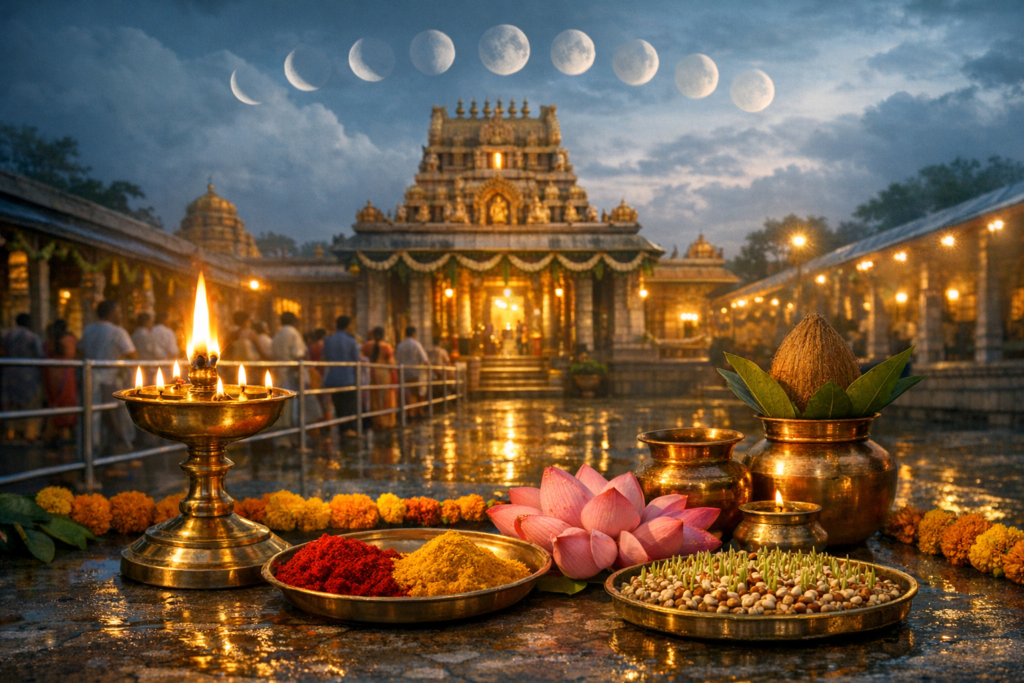
The Marathi Calendar and Panchang for 2026–2027, compiled by Uttaradi Math, presents a regionally aligned almanac for Maharashtra based on the Parabhava Nama Samvatsara of Shalivahana Śaka 1948. Spanning March 19, 2026 to April 6, 2027, it consolidates core vedic time-reckoning parameters and lists auspicious windows (shubh muhurat) for Vivah muhurat, Mundan ceremony, Upanayan, and Griha Pravesh alongside fasts, festivals, and daily observances relevant to Marathi households. Structured for practical use and spiritual rhythm, it supplies the technical backbone required to plan samskaras and celebrations with confidence.
In Maharashtra, a regionally calibrated Marathi Panchang carries social and spiritual weight that extends well beyond date-keeping. Families rely on it to synchronize ritual life—lighting the lamp at dusk, observing Ekadashi fasts with precise parana timing, and anchoring life-cycle ceremonies to auspicious combinations of Tithi, Nakshatra, and Yoga. The annual ritual of beginning a fresh almanac evokes continuity; elders often share memories of Gudi Padwa as children raise the gudi, and many describe the reassurance that arises when cherished events align with benevolent planetary hours.
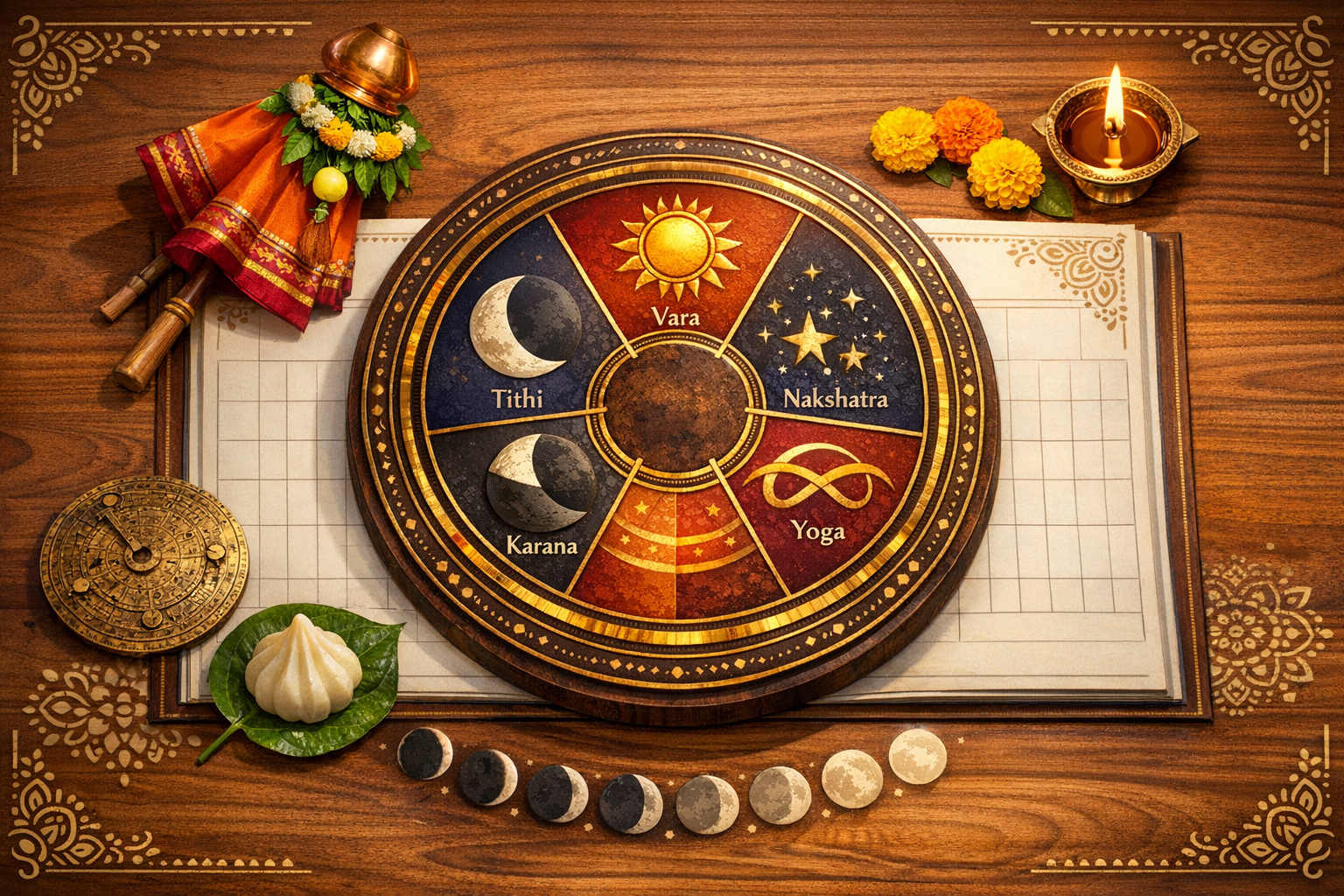
Technically, a Panchang rests on five foundational limbs—Tithi (lunar day), Vara (weekday), Nakshatra (lunar mansion), Yoga (solar–lunar angular sum), and Karana (half-tithi segment). Together with sunrise and sunset times, these five inform muhurat selection. The Marathi Panchang includes commonly referenced cautionary intervals such as Rahu Kalam, Yamaganda, and Gulika Kala, and, for those who apply them, community practices like Choghadiya, Tarabalam, and Chandrabalam. These computations enable granular alignment of sacred acts with favorable celestial patterns.
Parabhava Nama Samvatsara corresponds to Shalivahana Śaka 1948, mapping to the Gregorian span of 2026–2027. In the Maharashtrian context, the ceremonial new year begins on Chaitra Shukla Pratipada—celebrated as Gudi Padwa—falling on March 19, 2026 in this cycle and concluding on April 6, 2027 as the next year commences. The 60-year Jovian cycle assigns a unique name to each year; Parabhava follows Vishvavasu in sequence, sustaining an ancient cadence that weaves cultural memory with astronomical order.
Month reckoning in the Marathi system is Amanta, wherein lunar months run from Amavasya to the next Amavasya. This differs from the Purnimanta method (common in many northern regions), which counts months from Purnima to Purnima. Although month labeling diverges, festival observances generally converge on the same Tithi nationwide because the underlying lunar criteria remain the same; the Panchang makes those criteria transparent and regionally accurate for Maharashtra.
Selecting shubh muhurat for samskaras requires synthesizing multiple Panchang elements. Favorable Tithis are paired with auspicious Nakshatras, supportive Yogas, and unblemished Karanas while steering clear of impediments (such as Vishti/Bhadra for many acts), and avoiding Rahu Kalam, Gulika Kala, and Yamaganda in local daylight. Individual horoscopy, when considered, refines these general windows; nonetheless, the calendar’s computed intervals provide a reliable baseline for community-wide planning.
For Vivah muhurat, communities typically prefer concordant combinations such as Dwitiya, Tritiya, Panchami, Saptami, Dasami, Ekadashi, or Dwadashi under conducive Nakshatras, while many avoid the Chaturmasya span and certain dosha-laden pairings per regional parampara. The Panchang’s marriage muhurats integrate these rules with local sunrise and weekday strengths, equipping families to shortlist dates before consulting a family purohit or astrologer for personalization.
Griha Pravesh often distinguishes the house-consecration rites (Vastu Shanti) from the first formal entry, with months like Vaishakh, Jyeshtha, and Magha traditionally considered agreeable in many Maharashtrian lineages. The Panchang enumerates day-level and intra-day muhurats, clarifies avoidance of Bhadra (Vishti Karana) where applicable, and assists in coordinating priests, household members, and craftsmen so that sacred acts occur in synchrony with benevolent time bands.
For Upanayan (sacred-thread ceremony) and Mundan (Chudakarana), the almanac’s pairing of Tithi and Nakshatra again guides selection, with numerous traditions favoring Uttarayana periods for Upanayan and spring–early summer spans for Mundan. Because customs vary by gotra, shakha, and regional lineage, the Panchang functions as a shared baseline, to be fine-tuned through counsel with elders and gurus.
Vrata observances—Ekadashi, Pradosh, Sankashti Chaturthi, Amavasya, and Purnima among others—depend on precise start–end times of Tithi around sunrise and moonrise, including rules for fasting and parana. The Panchang provides these exact boundaries for Maharashtra, safeguarding adherence to dharmic injunctions such as observing Ekadashi from sunrise to the appropriate break-fast window on Dwadashi and ensuring moonrise timings for Sankashti Chaturthi are locally relevant.
Festival sequencing across 2026–2027 includes Gudi Padwa as the year’s gateway, followed by Ram Navami, Hanuman Jayanti, Akshaya Tritiya, Guru Purnima, Ganesh Chaturthi (a defining observance in Maharashtra), Sharad Navaratri with Vijayadashami (Dusserah), Deepavali, Makar Sankranti, Magha Purnima, Maha Shivaratri, and Holi. The Panchang’s presentation of Tithi, Nakshatra, and sunrise-based corrections ensures that each festival’s devotional core is observed at the right moment by Marathi-speaking communities worldwide.
While grounded in Hindu ritual life, the astronomical scaffold of this Panchang resonates across dharmic traditions. Vaishakh Purnima underpins Vesak for many Buddhist communities; Kartika Purnima aligns with Guru Nanak Jayanti in the Sikh tradition; Jain observances such as Paryushan and Anant Chaturdashi are keyed to Bhadrapada timings. By sharing a common lunisolar grammar even as practices vary, the Panchang fosters unity-in-diversity among Hindu, Buddhist, Jain, and Sikh communities and strengthens the shared civilizational rhythm.
Reading the daily page becomes intuitive with familiarity. Users can scan Tithi progression around sunrise, verify Nakshatra spans for the night’s observances, consult Rahu Kalam and Gulika Kala to time travel or transactions, and confirm Karana and Yoga before finalizing samskaras. The almanac also marks rare anomalies such as kshaya (skipped) or adhika (intercalary) occurrences, when applicable, so that planning anticipates month-length variations intrinsic to lunisolar timekeeping.
Small differences among Panchang publications may occur owing to distinct computational traditions (e.g., choice of siddhanta tables or local coordinate assumptions). Such divergences are typically measured in minutes, yet for muhurat-sensitive acts, local verification remains prudent. The Uttaradi Math compilation is designed for Maharashtra’s usage context and aligns to Indian Standard Time with sunrise-based corrections suitable for the region’s latitude–longitude envelope.
For practical planning, households often shortlist dates from the Panchang months ahead, then confer with elders and priests to incorporate family-specific considerations. Wedding venues, travel itineraries, or home-completion milestones can then be scheduled to land within the shubh muhurat’s core window, ideally centered near the Panchang’s indicated midpoint to preserve a safety margin around boundary times.
This Parabhava-year Marathi Panchang thus operates on two levels at once: it is a technical reference for Tithi, Nakshatra, Yoga, Karana, and muhurat computation; and it is a cultural companion that guides families through festivals and samskaras with grace. Anchored in Maharashtrian tradition yet harmonized with the broader dharmic calendar ecosystem, it offers a precise and unifying framework for 2026–2027, helping communities live by sacred time with clarity and confidence.
Inspired by this post on Hindu Blog.