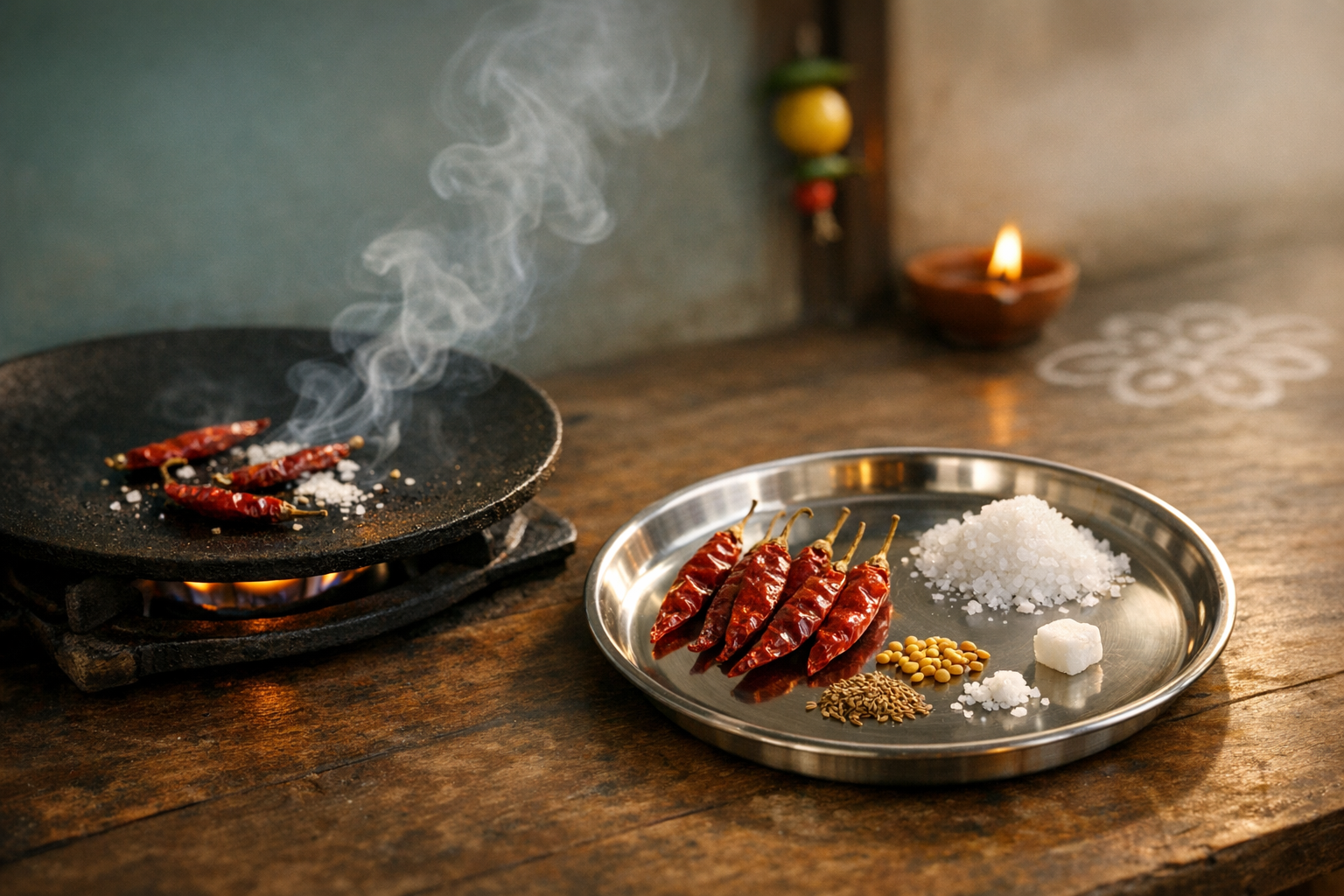
Across Hindu households, a familiar protective rite unfolds whenever a child is praised for extraordinary beauty, a new vehicle arrives, or a milestone is achieved. Elders gently circle dried red chillies and a handful of salt before a person or object and then consign the bundle to fire or a heated surface. In many regions this act is called nazar utarna, drishti nivarana, or kanna drishti tegalu. The ritual operates as a compact grammar of household protection, blending domestic piety, apotropaic symbolism, and an ethics of care that has traveled intact through generations.
Within the broader Dharmic worldview, the so‑called “evil eye” is framed not as an independent malevolent force but as the subtle burden of attentionenvy, excessive admiration, or unguarded glancesthat may disturb equilibrium. Sanskrit and Prakrit sources speak of inauspicious influences (dṛṣṭi doṣa, abhichāra) and of rakṣāprotective measuresmeant to restore balance. While the specific use of chillies and salt belongs to lokācāra (customary practice), the Atharvaveda’s concern with averting harm and the Gṛhya‑sūtras’ domestic rites contextualize why such home‑based protections are culturally intelligible and ritually meaningful.
Ethnographically, the rite serves moments of visibilitywhen success, beauty, or novelty draws pronounced attention. The material vocabulary is simple: dried red chillies (mirchi), coarse salt (sendha namak or sea salt), sometimes mustard seeds (sarson), ajwain, or a small piece of camphor. A related traveling talismanthe nimbu‑mirchi (lemon‑chilli charm)is widely hung from vehicles and storefronts as a moving perimeter of protection, while housefront figures such as the drishti bommai or nazar battu operate as static decoys for unwanted gaze.
Symbolically, red chillies communicate heat (tejas) and a purifying sting, aligning with Agni’s transformative role in Hindu ritual life. Salt is a classical purifiercrystalline, hygroscopic, and historically valued as a cleanser in domestic and maritime cultures alike. Mustard seeds and ajwain add pungency, reinforcing the semiotics of sharpness that dissolves torpor. Together, these materials enact a miniature rite of transmutation: what begins as sticky, uninvited attention is carried by circling gestures, given to flame, thinned into smoke, and dispersed.
Performance is straightforward yet precise. Families commonly choose an odd number of chillies, add a palm of coarse salt, and circle the bundle clockwise around the head and bodyoften three or seven timesdrawing the arc from head to foot to symbolically sweep away residue of gaze. The materials are then offered to firea kitchen flame, a hot tawa, or glowing charcoaluntil popping, crackling, and smoke signal completion. Ashes are allowed to cool and are respectfully discarded in a place where they will not be stepped upon.
Interpretive heuristics have accumulated in household lore: loud popping suggests the attention was “strong”; a sharp, eye‑watering smoke indicates “heavy drishti.” From a material perspective, these effects are unsurprisingmoisture trapped in chilli skins expands and bursts; vaporized capsaicinoids irritate mucous membranes; salt can crackle on contact with heat. Yet the underlying meaning remains clear: the transformation dramatizes release, and the shared act secures psychological relief, gratitude, and closure.
Ayurvedic language helps illuminate the rite’s cultural coherence, even if it does not prescribe this specific practice. Heat (tejas) and pungency (katu rasa) are associated with dispersion and clearing, while salt’s lavana rasa integrates and grounds. The combined sensory profilebright color, sharp aroma, crackling soundsaturates the senses and reinforces sankalpa (intention), which classical Hindu traditions consider vital to ritual efficacy.
The ritual’s legitimacy rests in the larger Dharmic acceptance of sadācāragood customas a source of dharma alongside revealed and recollected texts. Household protections thus belong to a living archive of Sanatana Dharma that privileges practical wisdom, compassion, and non‑harm. The rite’s minimalism is its strength: it asks little, centers family bonds, and re‑anchors attention in ethical gratitude rather than suspicion.
Regional vocabularies vary, while intent remains constant. In North India, nazar utarna and nazar battu are common idioms; in Tamil Nadu, drishti pariharam or drishti suṭṭi employs chillies, salt, mustard, and sometimes cotton wicks; in Karnataka, kanna drishti tegalu names the same protective sweep; in Gujarat and Maharashtra, households frequently use nimbu‑mirchi and small, quick chili‑salt firings after celebrations. Across Bengal, Odisha, Andhra, Telangana, and Kerala, related home remedies and protective icons appear in forms appropriate to local ethos.
Crucially, such protections are shared across Dharmic communities. Many Buddhist households recite protective parittas alongside simple home safeguards; Jain families emphasize inner purity and may supplement with gentle nazar‑clearing customs; Sikh households rely on Ardas and scriptural recitation while acknowledging everyday practices that guard newborns and newlyweds from excessive attention. This shared, non‑exclusive culture of rakṣā affirms unity in diversitydistinct paths, common care.
Ethically, the ritual rests on two guardrails. First, it avoids scapegoating, disparagement, or blame; the concern is with attention’s residue, not with labeling a person as harmful. Second, it orients the household toward gratitude: after the rite, families commonly offer thanksthrough a brief prayer, a diya, or a moment of silencere‑centering the achievement or blessing in humility and shared joy.
Practical considerations are important. Burning chillies releases pungent vapors; ventilation is essential, and those with asthma or respiratory sensitivity should maintain distance. The act should be brief, supervised, and away from children and pets. If fire use is constrained, circling and then placing the materials on a hot tawa under an exhaust, or substituting with a short camphor offering, offers safer control while preserving the rite’s symbolic arc.
For contemporary urban living, families often time the rite when public attention spikeshomecomings, school honors, media features, vehicle deliveries, or housewarmings (Griha Pravesh). Some prefer Tuesday or Saturday for their traditional associations with Mars (Mangal) and Saturn (Shani), though weekday selection is a matter of local practice rather than scriptural mandate. What matters is intention, simplicity, and respect.
From a cultural‑historical lens, chili‑salt protections are apotropaic ritesacts that “turn away” harm by staging, concentrating, and transforming it. They function as micro‑theaters of resilience, where Agni, color, sound, and scent collaborate to convert stickiness into smoke. As a living branch of Hindu customs, they sit alongside threshold kolams, toranas, and auspicious sounds as everyday architectures of safety.
The ritual also bears social science value. Collective performance reduces anxiety, provides closure, and binds participants through synchronized actionmechanisms long recognized in anthropology and psychology. Regardless of individual belief, the rite’s choreography delivers a cognitive reset, distributes care work among family members, and keeps domestic space ethically tuned.
In sum, the dried‑chillies‑and‑salt rite is a lucid, time‑honored expression of Sanatana Dharma’s household intelligence: minimal in means, generous in meaning, and capacious enough to welcome practice across Hinduism, Buddhism, Jainism, and Sikhism. It safeguards without accusing, purifies without excess, and reminds families that attention is powerfuland that gratitude, restraint, and gentle protection keep that power aligned with well‑being.
As with all household observances, this rite complements rather than replaces practical caremedical attention, security measures, and prudent privacy. It is best understood as cultural heritage in action: an intimate pedagogy of protection where material, mantra, and mindfulness converge, renewing the home’s moral atmosphere and celebrating the shared Dharmic commitment to compassion, balance, and harmony.
Inspired by this post on Hindu Blog.