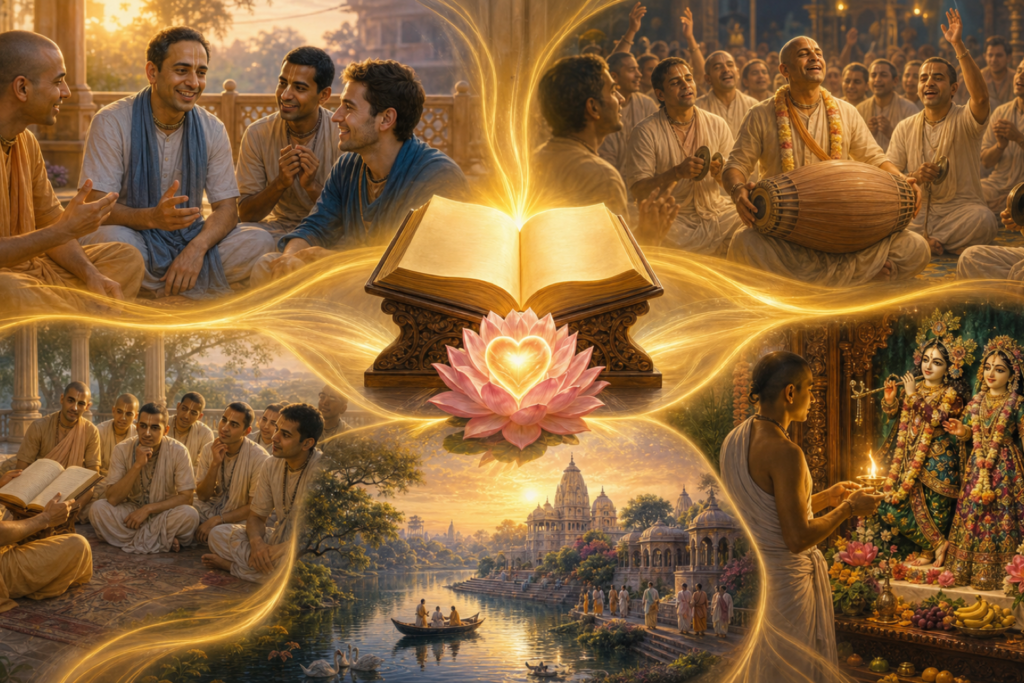
Srimad-Bhagavatam (3.29.11-12) describes devotional consciousness with a clarifying metaphor of flow and inevitability. "The manifestation of unadulterated devotional service is exhibited when one's mind is at once attracted to hearing the transcendental name and qualities of the Supreme Personality of Godhead, who is residing in everyone's heart. Just as the water of the Ganges flows naturally down towards the ocean, such devotional ecstasy, uninterrupted by any material condition, flows towards the Supreme Lord." This vision presents bhakti not as forced effort but as a natural current of the heart, moving toward its source.
In explicating this, Srila Prabhupada states a principle of enduring relevance: "No material condition can stop the flow of the devotional service of a pure devotee." Read as lived philosophy, the statement offers a framework for resilience. Obstacleswhether external pressures or internal fluctuationsdo not define devotion; they simply contour the channel through which devotion moves, like riverbanks shaping the Ganga’s descent.
The Ganges metaphor invites a practical insight: sustainable spiritual life emerges when hearing and remembranceśravaṇa and kīrtanabecome as habitual as breathing. When the mind is “at once attracted” to the Divine Name and qualities, attention reorients from anxiety to presence. Practitioners across dharmic traditions affirm this redirection: Sikh Naam Simran focuses awareness on the Divine through the Shabad; Buddhist recollection (Buddhānusmṛti) steadies perception through the qualities of awakening; Jain commitment to ahiṁsā and inner equanimity refines the stream of intention. Such convergences underscore unity in spiritual diversity without erasing distinct paths.
Facing reality while living with ideals thus becomes an integrated discipline rather than a divided life. Short, steady practiceslistening to sacred recitations during commutes, brief mantra recollection between tasks, mindful breath conjoined with a chosen Name before challenging conversationstranslate metaphysics into daily method. Over time, these micro-acts train attention to “flow naturally,” so devotion is not postponed to the future but lived in the present.
This orientation protects against discouragement. When setbacks arise, the question shifts from “Why is this happening?” to “How can the current continue?” In behavioral terms, the strategy is continuity over intensity; in scriptural terms, it is niṣṭhāunwavering steadiness. The heart learns to return, again and again, to hearing and remembrance, which anchor ethical clarity and emotional balance.
Within Hindu spiritual traditions, bhakti provides both an affective and epistemic pathway: love clarifies perception. Yet the broader dharmic family echoes the same telos of inner alignment: Sikhism’s emphasis on remembrance and service (seva), Buddhism’s cultivation of compassion (karuṇā) and insight (prajñā), and Jainism’s interior discipline (samyak-darśana and aparigraha) all converge on a life guided by truth and care for all beings. Religious harmony is strengthened when these parallels are appreciated as complementary streams feeding a single ocean of awakening.
Ultimately, the verses portray a promise: when attention is nourished by sacred hearing and genuine service, devotion acquires the momentum of a river. Life’s trials become banks that guide, not barriers that block. In this way, one faces reality while living with idealsby allowing bhakti to flow like the Ganges toward the Divine, uninterrupted and deeply human.
Inspired by this post on Dandavats.