

If you are considering a return to a Dharmic path, the first question is not whether someone can arrange an impressive ceremony. It is whether your sincere resolve can become a dignified, recognized, and durable return.
If you help lead a temple, mandali, or community, the same question applies from the other side. A sound process must protect freedom of conscience, respond to the person’s actual circumstances, and end in real belonging. The restorative framework associated with Devala-Smriti offers a practical way to do that without confusing accountability with permanent exclusion.
Start with the right problem: restoration, not punishment
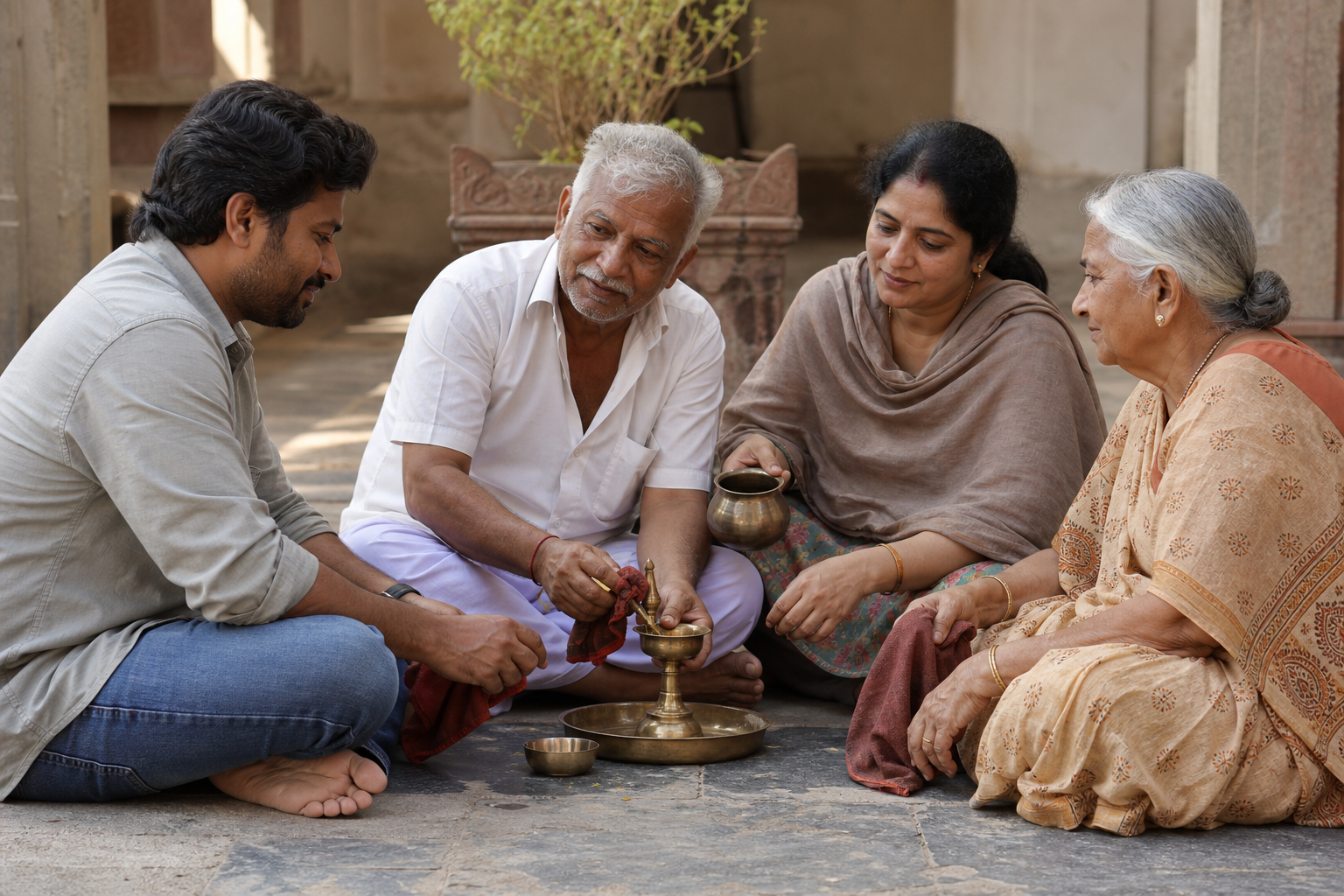
Ghar-wapsi is a recent Hindi expression, but the underlying Dharmic vocabulary is much older. Paravartana, shuddhi, and prayaschitta describe related but distinct parts of a return: turning back, restoration or purification, and corrective expiation.
That distinction prevents a serious mistake. Not every person seeking reintegration has committed the same kind of wrong. Someone separated from ancestral practice through coercion should not automatically be treated like someone repairing a freely broken vow. A person who never previously belonged to the tradition may need initiation and instruction rather than a fictional account of return. A practitioner who remained Hindu but neglected a discipline may need recommitment without any ceremony of readmission.
Before discussing a rite, identify what is actually being restored:
- Spiritual commitment: the person wants to resume worship, discipline, or allegiance to a Dharmic path.
- Lineage relationship: the person wants to reconnect with a sampradaya, guru-parampara, temple tradition, or inherited practice.
- Ethical standing: a specific vow or duty was breached and requires acknowledgment or repair.
- Community belonging: the person seeks ordinary participation in collective religious life after a period of separation.
The domain commonly called Mlecchita-shuddhih is especially relevant here. It preserves the possibility of reintegration after estrangement through foreign customs or movement across faith boundaries. It does not establish one automatic rite for every person, nor does it make every historical purity rule timeless. It establishes the more important principle that estrangement need not be irreversible.
So do not begin by asking, What penalty must this person undergo? Ask, What relationship was interrupted, what harm actually occurred, and what would responsible restoration require? That change of question is the difference between a restorative process and a punitive performance.
Read Devala-Smriti as a method, not a frozen checklist

The tenth-century setting commonly assigned to Devala-Smriti matters because it places the work amid trade, political change, mobility, and widening cross-cultural contact. Its value lies in responding to changing conditions while preserving ethical and communal continuity. Its later use in nibandhas and regional digests also shows that Dharmic jurists and ritual specialists interpreted rules through practice rather than treating one compact formulation as the last word for every locality.
The traditional test of desha-kala-patra gives you three concrete questions to ask.
- Desha, or place: Which sampradaya, temple, sangha, or local community will receive the person? A rite should be intelligible to the community whose recognition matters, not merely to an organizer from elsewhere.
- Kala, or time: Which historical rules still carry their intended ethical purpose under present conditions? Earlier concerns arose around sea journeys, famine, conflict, migration, coercion, and contact with unfamiliar communities. A response created for one disruption should not be transferred mechanically to a different situation.
- Patra, or person: What were this person’s intention, prior commitments, degree of choice, actual conduct, capacity, and present resolve? The remedy should fit the individual rather than the label attached to the case.
This contextual reading does not mean that anything goes. It means that enduring principles govern the interpretation of contextual rules. Devala-Smriti’s ethical frame emphasizes satya, ahimsa, shaucha, daya, and dama: truthfulness, non-injury, disciplined purity, compassion, and self-restraint.
Use those principles as a hard test. Does the proposed process tell the truth about what happened? Does it avoid coercion and needless injury? Is the required observance proportionate to the person’s responsibility and capacity? Will completion end the person’s exclusion? If a community cannot answer those questions clearly, it needs better interpretation before it needs a bigger ceremony.
This also exposes a common misreading of tradition. Adaptation is not the abandonment of standards. It is the disciplined work of preserving the purpose of a standard when circumstances change. Mechanical repetition can be less faithful than careful application when the old rule no longer addresses the condition in front of you.
Use a seven-part process for a responsible homecoming

Historical forms varied by region and community, so no single modern script can honestly claim universal authority. The decision-making process can still be made clear. The following sequence keeps consent, accountability, ritual, and social recognition in their proper order.
- Establish free intention. Ask the person to state, privately and in their own words, which path they wish to follow and why. Family members, activists, and religious organizers should not answer for them. Consent to return is also separate from consent to publicity. If the decision depends on threats, humiliation, or material pressure, stop; a coerced homecoming contradicts the conscience-centered basis of Dharmic return.
- Classify the case accurately. Distinguish resumption after a lapse, return after voluntary adherence elsewhere, return after coercion or inherited separation, and first entry into a Dharmic tradition. Classification determines whether the person principally needs instruction, initiation, prayaschitta, shuddhi, public acknowledgment, or some combination. It also prevents the insulting assumption that every returnee must confess the same fault.
- Choose a competent authority. Seek a guru, acharya, lineage representative, or learned assembly recognized by the tradition concerned. If community acceptance is part of the goal, involve the community that will actually receive the person. Ask which requirements are essential, which are local custom, what textual or customary basis supports them, and what will count as completion.
- Identify responsibility without manufacturing guilt. Record only what is necessary: earlier vows, the degree of freedom involved in leaving, any concrete harm, any unresolved obligation, and the person’s present commitment. Coercion reduces moral responsibility; actual injury to another person may increase the need for restitution. Do not turn a returnee’s history into campaign material or demand a dramatic denunciation as proof of sincerity.
- Select a proportionate observance. Traditional means of correction include vrata, dana, pilgrimage, fasting, disciplined self-correction, and ritual action. Their purpose is transformation and repair, not suffering for its own sake. When an identifiable person or community was harmed, a symbolic rite should accompany appropriate restitution rather than replace it. When separation resulted from coercion, a heavy penance may wrongly place blame on the person returning. No bodily austerity should be imposed when it would cause injury; a non-injurious observance can serve the restorative purpose.
- Perform a lineage-appropriate rite. A simple structure may include a voluntary sankalpa, instruction in the commitments being undertaken, an approved act of purification or recommitment, and acknowledgment by the relevant community. The exact mantra, sacrament, vow, or initiation belongs to the tradition’s competent authority. Do not improvise a supposedly ancient universal formula from slogans or social-media fragments.
- Complete the return through belonging. Before the ceremony, agree on what recognition will mean afterward. Depending on the community, that may include access to worship, religious instruction, festivals, seva, shared meals, family observances, and ordinary communal duties. If those who perform the rite intend to keep the person under permanent suspicion, the process is not yet restorative. Arrange continued guidance after the first gathering so that the return develops into practice rather than ending as an event.
The order is important. Authority does not come before consent. Expiation does not come before an accurate account of circumstances. Public ceremony does not come before agreement about recognition. When that sequence is reversed, the returnee becomes an object of the event instead of the moral agent at its center.
Communities should also write down their procedure in plain language. State who can guide a case, how privacy will be protected, which observances may be adapted, how disputes will be reviewed, and what rights and responsibilities follow recognition. Transparency prevents two people in similar circumstances from receiving radically different treatment merely because they approached different officeholders.
Protect conscience without flattening Dharmic traditions

The Vedic Vratya-stoma provides an early precedent for admission and reintegration through expiatory rite. Its importance is civilizational as well as ritual: Sanatana Dharma possessed a conceptual door through which people at the margins could enter or re-enter disciplined communal life. That precedent should not be repackaged as a ready-made universal ceremony for every modern person.
Comparable restorative patterns also appear across the wider Dharmic family. Buddhist monastic discipline permits re-ordination, Jain pratikraman joins reflection with renewed ethical effort, and Sikh practice recognizes re-initiation and community-guided rectification. The family resemblance is meaningful: failure need not produce permanent exile, and renewed commitment can be made socially intelligible.
These practices are not interchangeable. A Hindu council cannot determine Buddhist ordination, a Jain institution cannot prescribe Sikh re-initiation, and a Vedic precedent does not erase the authority of a living sampradaya. If you seek return within a particular tradition, take counsel from that tradition’s recognized teachers and institutions. Dharmic unity is strengthened by cooperation across traditions, not by collapsing their distinct disciplines into one ceremony.
Whether you are a returnee or an organizer, treat the following as warning signs:
- The same penance is assigned regardless of coercion, intention, harm, or capacity.
- Someone else narrates the person’s convictions while the returnee is given no private opportunity to speak.
- Publicity is treated as proof of sincerity or made a condition of recognition.
- An authority cannot distinguish a lineage requirement from a regional custom or personal preference.
- The ceremony is precisely planned, but ordinary participation afterward remains vague.
- Humiliation, denunciation, or continuing stigma is presented as necessary for purification.
- Historical reintegration is used to justify pressure on people who have not freely asked to return.
A proportionate observance may demand honesty, discipline, and restitution. It should not demand self-erasure. The practical measure of success is not the size of the gathering. It is whether a willing person can undertake a clear commitment, satisfy intelligible requirements, and then live the chosen dharma without being trapped indefinitely in the status of outsider.
Key takeaways
- The modern expression ghar-wapsi is recent, but Dharmic pathways of return, purification, expiation, and readmission are historically rooted.
- Devala-Smriti is most useful as a restorative method: examine context, assign proportionate responsibility, guide corrective practice, and restore belonging.
- Classify the case before prescribing a rite. Return after coercion, repair after a voluntary breach, resumption of practice, and first initiation are not the same situation.
- Free intention, competent guidance, and clear community recognition are indispensable. Public spectacle is not.
- A completed rite must lead to ordinary participation. If exclusion continues without a defined reason or endpoint, reintegration has not been completed.
If you are beginning this process, prepare one page before approaching a religious authority. State the path you wish to follow, the circumstances of your separation, any obligation you believe remains unresolved, and the community relationship you hope to restore. Then ask for three clear answers: why a particular observance fits your case, what completion requires, and what recognition will mean afterward. A sound Dharmic process should make those answers clearer, not more mysterious.
References
- Dharma Dispatch – Ancient Roots of Ghar-Wapsi: The Complete, Evidence-Based Guide to Dharmic Homecoming
- Dharma Dispatch – Complete Introduction to the Devala-Smriti: Discover Proven Ethics for Unity and Renewal
- Dharma Dispatch – Essential Guide to the Devala-Smriti: Discover a Proven Medieval Blueprint for Dharma Unity
- Dharma Dispatch – The Complete Vratya-stoma Guide: How Schopenhauer, Emerson, Elst, Frawley Embraced Sanatana Dharma
