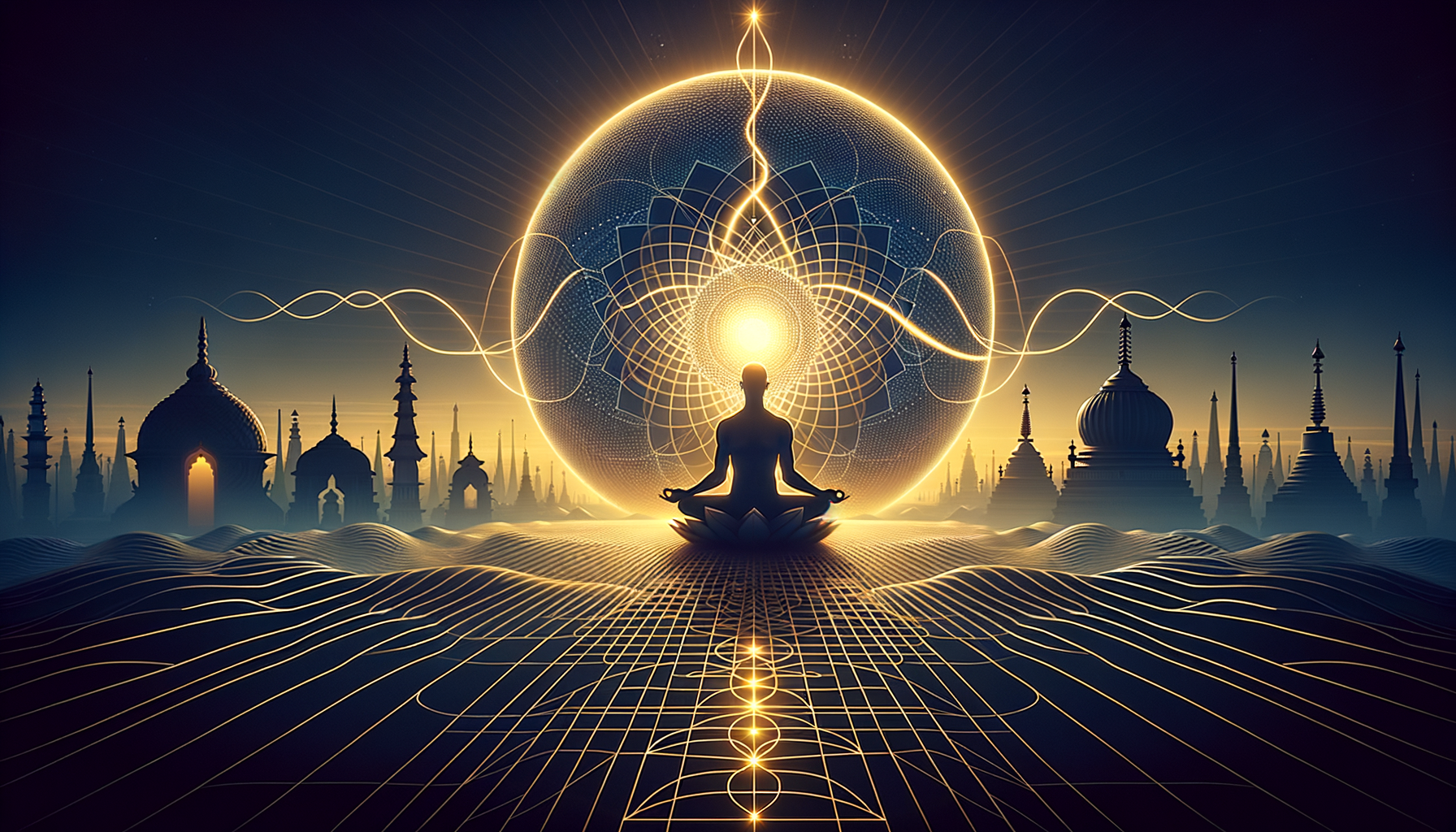
Across daily life—when a lamp flickers on, when breath steadies the mind, or when sunlight warms the skin—the question quietly returns: What is the real source of energy? Within dharmic traditions, a consistent insight emerges. Matter, in itself, displays no creative agency; it is animated, directed, and transformed by living energy. In this view, matter can be understood as latent energy, a potential awaiting activation. Tracing that activation leads naturally to the inquiry into origin—ultimately, to the ground of consciousness that empowers all change.
In Hindu philosophy and Vedanta, this inquiry is expressed as the relation between Brahman, the Supreme Reality, and Shakti, the dynamic power that manifests as prakriti. When energy engages matter, form and function arise; without that animating power, matter remains inert. The notion that matter is a condensed mode of energy resonates with the modern intuition that form and force are convertible, while remaining a philosophical claim about ultimate causality rather than a physical derivation.
Consider an accessible analogy: electrical devices do not create electricity; they channel it. Following the wire back leads to a generator, and further back to the prime mover. In a similar way, tracing the chain of energies that animate body, mind, and world points beyond secondary causes to a primary ground. The Upanishads describe this ground as that from which beings arise, by which they live, and into which they return—a comprehensive source that encompasses and exceeds all material configurations.
Dharmic perspectives approach this ground with diverse yet harmonious emphases. Buddhism, eschewing a creator deity, elucidates pratityasamutpada (dependent origination): energies and forms arise interdependently, and the quality of experience turns on the clarity of awareness. Jain thought distinguishes jiva (conscious life) from ajiva (matter), viewing jiva’s inherent energy as clouded by karmic accretions that disciplined conduct and insight can dissolve. Sikh wisdom proclaims Ik Onkar and Hukam, affirming a pervading Order and Presence through which life moves, and by whose remembrance (Naam) vitality is oriented toward truth. These approaches differ in language and method, yet converge on a lived insight: energy and awareness are inseparable in meaningful action.
Dialogue with science can sharpen, not flatten, this understanding. Physics recognizes matter–energy transformation, often symbolized by E=mc2, while dharmic inquiry extends into the domains of consciousness, value, and purpose. Classical yogic language speaks of a continuum from gross (sthula) to subtle (sukshma), and practices such as pranayama engage prana as the operative bridge between body and mind. This is not a claim of scientific identity but an invitation to integrative clarity: empirical description and contemplative realization can illuminate different facets of the same reality.
The practical implications are immediate. When breath is refined (pranayama), attention steadied (dhyana), and conduct aligned with dharma—ahimsa, satya, and compassionate service—energy ceases to scatter and begins to serve insight and wellbeing. Across Hinduism, Buddhism, Jainism, and Sikhism, the shared disciplines of mindfulness, ethical restraint, and remembrance cultivate inner coherence, transforming latent capacity into luminous presence. This is energy stewardship at the most intimate scale.
Thus, the question “What is the real source of energy?” opens a comprehensive vision. Matter is potential; living energy activates potential; consciousness—or the ground named Brahman, approached through Naam, clarified through mindfulness, and purified through discipline—anchors and orients that activation. Recognizing this unity fosters both inner harmony and interfaith concord within the dharmic family. When energy is guided by wisdom, individual life aligns with a larger order, and the world itself becomes a field for awakened, compassionate action.
Inspired by this post on Hindu Pad.