A recent debate on X, initiated by Sameer in response to an article in The Print by Karanjeet Kaur, questions whether Gen Z’s cultural choices reflect conservatism or something more transformative. The discussion positions Gen Z not as retreating into religious orthodoxy but as catalyzing a confident, contemporary revival of dharmic culturespanning Hinduism, Buddhism, Jainism, and Sikhismthrough new forms of expression and community life.
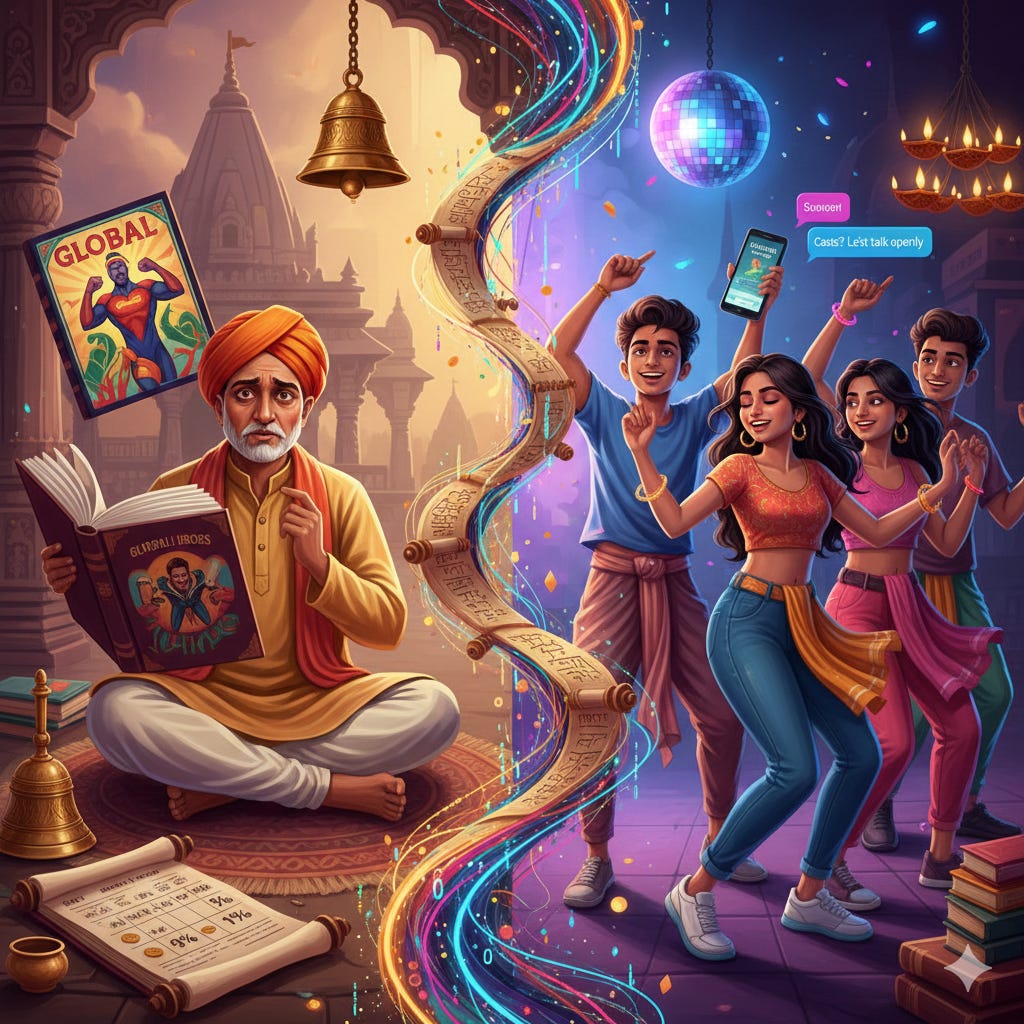
Sameer argues that Gen Z is actively reclaiming and modernising Indian culturethrough phenomena such as “Bhajan Raves,” renewed interest in ethnic clothing, and spiritual tourism that favors places like Mathura over drug-alcohol-Goa. Rather than signalling a retreat to rigid traditionalism, these trends indicate cultural creativity, decolonization of self-understanding, and a reset of assumptions that equate modernity with Westernization.
In articulating the intergenerational dynamic, Sameer observes that, “Boomers and millennials continually moral policed speech, belief, and identity for decades,” adding that, “Millennials and boomers are not ‘neutral observers’ here. They are the repressed generation that has been convinced that anything Indian and culturally oriented is ‘conservative’ and ‘regressive’. GenZ is proud and aggressive because boomers were apologetic and docile.” Read charitably, this perspective highlights a transitionfrom apology to assurance, from inherited defensiveness to cultural confidencenow embodied by younger Indians.
Two implications follow. First, Gen Z appears ready to inherit, reinterpret, and extend civilizational traditions. Second, Boomers and Millennials have a timely opportunity to create space for this expressionmoving from gatekeeping toward mentoringso that a living continuum across Hindu, Buddhist, Jain, and Sikh lineages is strengthened rather than fragmented.
From a Gen X vantage point, situated between Boomers and Millennials, it is clear why earlier generations often treated culture as a fixed structure anchored in ritual and discipline. Many were schooled through Western curricular frameworks and mediated by socialist-communist-influenced media and intelligentsia, which framed Indic traditions through reductive lenses. Lacking institutional backing, rigorous research access, or cultural powerand frequently focused on economic survivalmany opted to preserve what they could, sometimes defensively, to safeguard continuity.
This protective stance, though well-intentioned, sometimes produced a rigid social posture in which ritual form overshadowed experiential essence. In parallel, some families shielded their Gen Z children from inherited certainties, sensing that portions of their knowledge base had been filtered through external narratives. That prudence also introduced ambiguities for younger cohorts who now seek authentic, research-grounded engagement with dharmic heritage.
Over time, many discovered a productive dissonance: attempts to fit dharmic culture into a singular, Western definition of “culture” simply did not hold. The comfort with plurality, paradox, and processso characteristic of dharmic thoughtemerged as a core strength rather than a flaw. This realization aligns with calls, including those by Rajiv Malhotra, to study civilizational knowledge through its own categories, methodologies, and intellectual idioms.
Culture is not static; it evolves through inquiry, practice, and shared life. A constructive path forward invites Gen Z to partner with older generations in researching, examining, debating, rectifying, and deepening understandingacross Hinduism, Buddhism, Jainism, and Sikhism. Common values such as dharma (ethical order), ahimsa (non-harm), seva (service), and shraddha (reverent commitment) provide a unifying scaffold. Contemporary formswhether “Bhajan Raves,” textile revival, pilgrimage and meditation circuits, or community seva projectscan responsibly renew the civilizational fabric while honoring its philosophical depth.
For Boomers and Millennials, a posture of neutrality in observation and generosity in mentorship is more fruitful than moral policing. Practical steps include backing archival and translation initiatives, supporting community sabhas and intergenerational dialogues, and fostering research consortia that bridge traditional knowledge with modern scholarship. An updated gurukul ethoswhere learning is experiential, dialogic, and rigorouscan help decolonize language, expand horizons, and reduce reflexive labeling of new expressions as “regressive” or “conservative.”
Evidence across cities and campuses suggests that Gen Z is already co-authoring this dharmic renaissance: blending bhakti with contemporary music, turning heritage textiles into identity statements, choosing sacred geography alongside leisure, and seeking inner clarity through meditation and yoga. If this momentum is supported with critical scholarship and intergenerational trust, the likely outcomes include cultural continuity, social cohesion, ethical innovation, and a confident civilizational voiceone that welcomes plurality while remaining rooted.
The moment is auspicious. With Gen Z’s energy, Gen X’s lived memory, and Boomers’ institutional experience, the path toward a unified, research-informed, and future-ready dharmic culture is not only plausible but already underway.
Inspired by this post on RightViews.