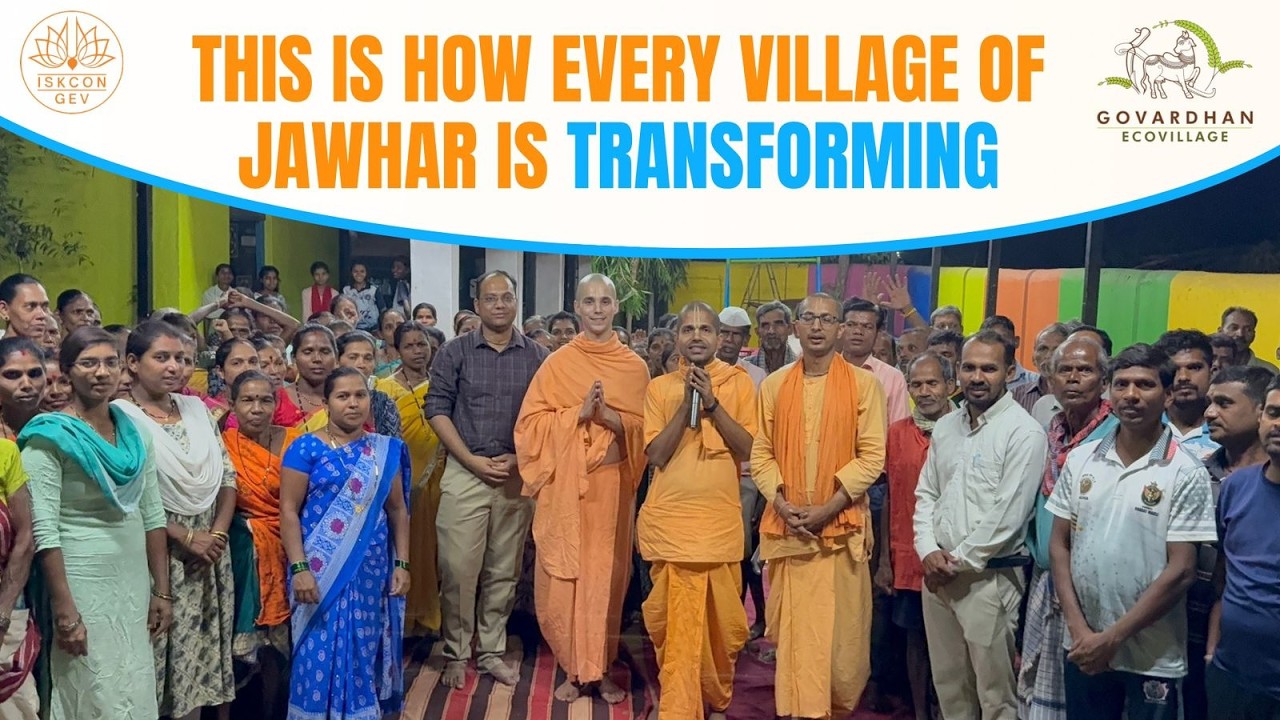
Viewed through the quiet realism of village life, the film captures an ordinary morning that begins before sunrise: tools lifted, cattle tended, water collected, and fields prepared. Into this rhythm arrive brahmacharis from Govardhan Eco Village (GEV), and the social atmosphere perceptibly shifts. Their kirtan functions as more than music; it becomes a shared pulse that synchronizes steps, voices, and intentions, drawing households into a single circle. In that moment, service (seva) presents itself not as an event but as a living relationship that strengthens Community service and dignifies Village life.
Seva in the dharmic traditions—Hinduism, Buddhism, Jainism, and Sikhism—rests on an ethical triad of compassion (karuna/daya), non-harm (ahimsa), and generosity (dana/seva). Despite varied theologies and practices, each lineage honors disciplined service to others as a pathway to inner refinement and social good. This unity in spiritual diversity makes community engagement a reliable bridge between faiths and social groups, especially in multi-religious Indian villages where collaboration is essential for shared well-being and Environmental Sustainability.
Govardhan Eco Village is known as an eco-spiritual campus associated with ISKCON (International Society For Krishna Consciousness) that works at the intersection of Bhakti Tradition, Environmental Sustainability, and rural outreach. In the filmic vignette, visiting brahmacharis model a low-cost, high-trust approach: arrive consistently, sing together, listen carefully, and leave behind simple artifacts that reinforce shared values. The focus remains non-sectarian; participation is voluntary; and the benefits are civic rather than confessional, aligning service with the inclusive spirit of India’s dharmic heritage.
From a development lens, the baseline constraints of Village life are familiar: income seasonality, time poverty, gendered labor divisions, and limited access to formal services. Against this backdrop, small but well-sequenced interventions often outperform expensive top-down plans. Group singing and collective action supply the social glue required for any technical solution—water harvesting, waste segregation, agroforestry, or kitchen gardens—to take root and endure.
Research in ethnomusicology, social neuroscience, and community psychology indicates that synchronized singing reduces perceived stress, elevates mood, and increases prosocial behavior via entrainment and oxytocin-mediated bonding. Durkheim’s notion of collective effervescence clarifies what the video shows: kirtan concentrates attention, equalizes status in the circle, and temporarily upgrades trust. That trust is enabling infrastructure for Community service—people become more willing to coordinate, share tools, and pursue common goods that benefit everyone.
Kirtan also operates as public pedagogy. Melody and rhythm make ethical ideas memorable across literacy levels, while call-and-response formats democratize participation. Importantly, the practice resonates across dharmic families: Vaishnava kirtan aligns in spirit with Sikh kirtan and naam simran, with Buddhist chant, and with Jain stavan—preserving Unity in Diversity while honoring local idioms and strengthening social cohesion without erasing distinct traditions.
The film’s stickers and calendars are not merely giveaways; they are micro-nudges. As behavior cues, they exploit salience and repetition: a calendar above the hearth reminds a household of fasts, festivals, cleaning days, water-use norms, and communal gatherings; a sticker at a handpump reinforces hygiene messages. Such artifacts anchor new habits without coercion, translating inspiration from the kirtan circle into daily routines that sustain Environmental Sustainability and public health.
Seva logistics matter. Effective teams schedule short, predictable visits; use participatory rural appraisal to map needs; invite elders, women, and youth into decision cycles; and keep feedback loops open. Simple governance practices—transparent task lists, shared tools, and public check-ins during evening bhajans—reduce friction and invite accountability. Over time, these practices normalize cooperation, making Community development a habit rather than a project.
Eco-conscious practice then follows naturally. Typical village-facing modules include kitchen-garden composting, low-cost bio-inputs (e.g., jeevamrut and vermicompost), greywater reuse, native tree planting for Biodiversity conservation, and source-segregation of waste to support a circular economy. None of this requires large capital; it requires social capital, which devotional singing and consistent presence steadily build and renew.
Public health nudges integrate seamlessly with such gatherings: handwashing drills near the water point, menstrual hygiene education led by local women, and collective shramdaan for cleaning shared paths. When delivered in a respectful, non-intrusive manner, these practices lower barriers to adoption and align with Sustainable Development Goals related to health, water, responsible consumption, climate resilience, and resilient communities.
Educational yields are equally tangible. Calendars double as learning aids for children—marking tithis, seasons, and local festival cycles—while stickers illustrate do-and-don’t cues in agriculture, sanitation, and road safety. Over time, these low-cost media cultivate place-based literacy, strengthen intergenerational exchange, and keep community priorities visually present where families make daily decisions.
Women’s self-help groups and youth clubs often emerge as the engine of continuity. Shared singing reduces social distance, after which skill sessions—kitchen entrepreneurship, basic bookkeeping, seed saving, or first aid—gain traction. Participants frequently report increased self-efficacy and reduced isolation, two predictors of durable Community development and inclusive Village life.
Evaluation can be rigorous without being burdensome. Mixed-methods dashboards combine (a) short pre-post perception scales on trust and well-being, (b) behavior tallies such as attendance and waste segregation compliance, (c) Most Significant Change stories captured quarterly, and (d) Social Return on Investment sketches for panchayat partners. A clearly articulated Theory of Change links kirtan-led cohesion to measurable outcomes in cleanliness, water stewardship, mutual aid, and livelihood diversification.
Ethical safeguards keep the work inclusive. Informed consent, opt-in participation, and a stated no-proselytization norm protect freedom of conscience. Facilitation teams explicitly welcome neighbors across Hindu, Buddhist, Jain, and Sikh backgrounds, recognizing that seva belongs to all and that compassion, non-violence, and truthfulness are shared civilizational assets. This commitment to Unity in Diversity ensures that spiritual practice and Community service remain open, respectful, and non-coercive.
Scalability rests on peer learning. Training-of-trainers models, village-to-village immersion visits, and coordination with government schemes—Swachh Bharat, Jal Shakti Abhiyan, and the National Rural Livelihoods Mission—create momentum without mission drift. The approach remains modular: begin with kirtan to build trust, deploy micro-nudges to stabilize habits, and layer eco-practices as the circle strengthens—maintaining fidelity to local culture while meeting Sustainable Development Goals.
By the film’s end, the picture that remains is simple and robust: work begins at dawn, but the day refocuses when the singing starts. In the cadence of kirtan and the quiet persistence of stickers and calendars, a village experiences seva not as a campaign but as culture. Hearts gather; hands follow; and Environmental Sustainability becomes a shared habit rather than a slogan—evidence that spiritual music and humble artifacts can help lift rural futures together.
Inspired by this post on Dandavats.