
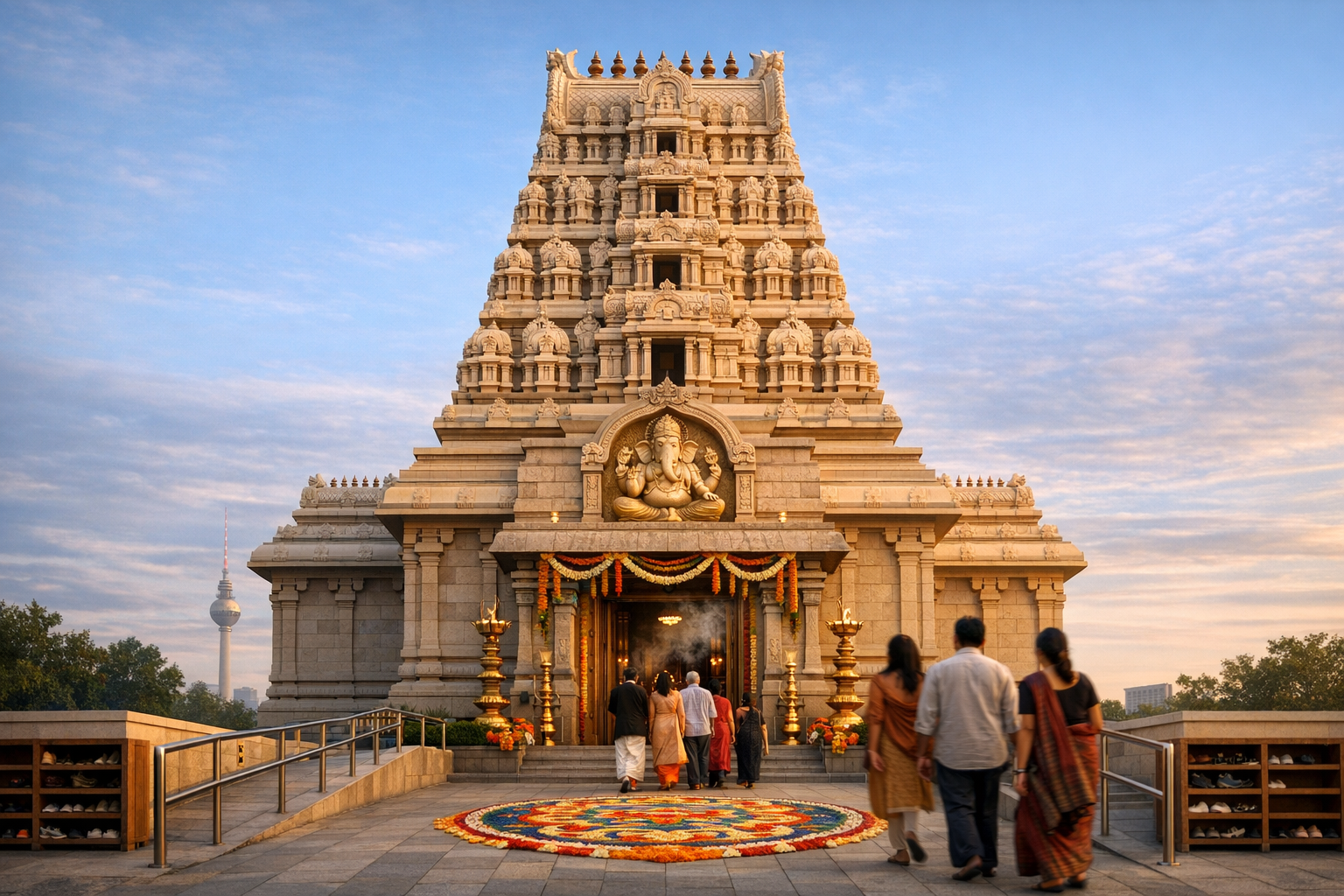
Berlin’s grand Sri Ganesha Temple has opened to the public, widely described as one of Europe’s largest Hindu shrines and marking a historic milestone for Germany’s plural religious landscape. The inauguration represents far more than the consecration of a sacred space; it signals a durable cultural institution for the Hindu diaspora and a welcoming venue for all who value the dharmic traditions of Hinduism, Buddhism, Jainism, and Sikhism. In the heart of a global city, the temple offers a visible, dignified home for spiritual practice, cultural education, and community service.
In recent decades, Berlin has emerged as a nexus of intercultural exchange, and the establishment of a major Hindu temple underscores the city’s commitment to religious freedom and cultural heritage. Publicly accessible Hindu temples abroad traditionally function as community anchors, uniting generations through festivals, music, language, and shared service. The Berlin temple’s scale and design indicate long-term investment in spiritual life and civic engagement, positioning it as a model for inclusive cultural infrastructure in Europe.
Dedication to Sri Ganeshathe remover of obstacles, patron of learning, and guardian of auspicious beginningscarries a universal symbolism that resonates well beyond Hindu communities. Across the dharmic family, values such as ahimsa (non-violence), dana or seva (service), and satya (truth) reinforce a shared civilizational ethos. In this context, the temple’s opening affirms a vision of unity in religious diversity, honoring distinctive practices while cultivating mutual respect among Hindu, Buddhist, Jain, and Sikh communities.
The architectural language of contemporary Hindu temples abroad typically harmonizes classical forms with modern building standards. While design specifics vary by site, diaspora temples often incorporate characteristic elements such as a garbhagriha (sanctum), a vimana or shikhara above the sanctum, and sculptural programs that narrate sacred themes. In Europe, such projects carefully integrate acoustic design for Vedic chanting, barrier-free accessibility, and compliance with stringent safety and environmental regulations, ensuring that devotional environments remain both traditional and welcoming.
Ritual life in major Ganesha temples generally includes daily puja, periodic abhishekam, and communal arati, alongside observances of Sankashti Chaturthi and grand celebrations for Ganesh Chaturthi. Educational and reflective programstalks on darshanas (philosophical systems), yoga sessions, or introductions to Indic artstend to complement ritual practice. Within a dharmic-unity framework, institutions frequently host dialogues that highlight parallels across traditions (for example, shared commitments to compassion, learning, and service), while maintaining fidelity to each community’s distinct liturgy and norms.
Community-facing initiatives typically form the backbone of such temples’ outreach. Offerings may include language instruction, classical dance and music training, youth mentorship, senior support, and volunteer opportunities that build intergenerational bonds. During major festivals, open-house programs invite Berliners of all backgrounds to experience the temple’s cultural heritage, deepening intercultural awareness and civic friendship. These activities help turn ritual spaces into living classrooms for pluralism.
Institutional governance in Germany commonly follows transparent nonprofit models, often through registered associations (eingetragener Verein, e.V.) or comparable structures, with clear statutes, community representation, and audited accounts. While organizational details differ by institution, best practices usually include child-safeguarding protocols, privacy protections, crowd-management plans for festivals, and sustained neighborhood dialogue to ensure good relations with local residents and civic authorities.
Educational programming can extend to public lectures, reading groups, and exhibitions that explore Sanskrit sources, regional languages, and the history of temple traditions. Explorations of iconographysuch as the eight forms of Ganesha described in the Mudgala Puranahelp contextualize artwork and ritual within the broader arc of Indic knowledge systems. Carefully curated content supports rigorous learning while inviting constructive engagement with contemporary European scholarship on South Asia.
Interfaith and intercommunity collaboration is integral to the temple’s civic purpose. In cosmopolitan settings like Berlin, Hindu temples often participate in citywide forums, open cultural nights, and dialogue initiatives alongside Buddhist viharas, Jain sanghas, Sikh gurdwaras, churches, synagogues, and mosques. Such activities emphasize shared ethical commitmentscare for the vulnerable, neighborliness, and ecological responsibilitywhile modeling a principled respect for theological difference.
For youth and young professionals, the temple typically functions as a “third place,” nurturing identity formation through volunteerism, arts, and peer networks. Many second-generation community members seek spaces that honor tradition while embracing contemporary creativity and service. By providing structured leadership opportunities and digital-first outreach, the temple helps translate timeless values into modern civic contributions.
Accessibility and hospitality are essential to visitor experience. Clear multilingual signage, shoe-removal and photography guidelines, and allergen-conscious prasadam practices support a culture of welcome. Barrier-free design enables participation by individuals of all abilities, and dedicated quiet areas accommodate reflection, meditation, or sensory breaks during large gatherings. These measures ensure that devotional spaces remain inclusive and dignified.
Environmental stewardship aligns with both dharmic ethics and European regulatory expectations. Contemporary temples increasingly adopt energy-efficient systems, responsible materials, and waste-segregation practices appropriate to high-footfall events. Even incremental stepsreuse of festival décor, sustainable catering, or well-planned public transport guidancecan significantly reduce the ecological footprint of major religious festivals.
Risk management and safety protocols underpin large festival operations. Typical measures include advance registration for peak events, queuing systems that maintain orderly darshan, coordination with local authorities for traffic and emergency services, and volunteer training in first aid and safeguarding. Reliable operations build neighborly trust and demonstrate that cultural vibrancy and public safety can advance together.
Economically, the temple is poised to benefit both local artisans and the broader visitor economy. Traditional crafts, music, and culinary offerings can spur microenterprise and heritage-linked livelihoods. Over time, well-run cultural institutions are known to generate repeat visitation, educational tourism, and collaborative programming with museums, universities, and city cultural officesmultiplying social and economic value for Berlin.
Europe’s Hindu cultural landscape has diversified steadily, and Berlin’s Sri Ganesha Temple complements established centers across the continent. Each institution reflects its community’s distinct migration histories and devotional lineages, yet together they contribute to a continental tapestry grounded in religious freedom, civic responsibility, and reciprocal learning. In this sense, the Berlin temple strengthens a Europe-wide ecosystem of dharmic heritage and dialogue.
The opening also carries symbolic significance for dialogue within the dharmic family. While each tradition maintains its unique theology and liturgy, the shared emphasis on compassion, truth, disciplined practice, and service provides fertile ground for collaborative learning and community-building. Programs that spotlight common ethical commitmentswithout erasing differencecan deepen trust and model constructive coexistence for a wider public.
Looking ahead, the temple’s long-term impact will be measured by three interlocking outcomes: sustained spiritual life (regular worship, festive observances, and personal transformation), robust cultural education (language, arts, and scholarship), and public value (service, dialogue, and civic partnership). By aligning operations with these aims, the institution can stand as a beacon of religious pluralism, cultural heritage preservation, and community well-being.
Berlin’s Sri Ganesha Temple thus emerges as a landmark for the Hindu diaspora and a shared cultural asset for the city. Its presence invites residents and visitors alike to encounter living traditions, to learn with humility and rigor, and to participate in a model of unity in religious diversity. In doing so, the temple strengthens the social fabric while honoring a timeless aspiration: may knowledge, compassion, and service flourish for the good of all.
Inspired by this post on Struggle for Hindu Existence.
