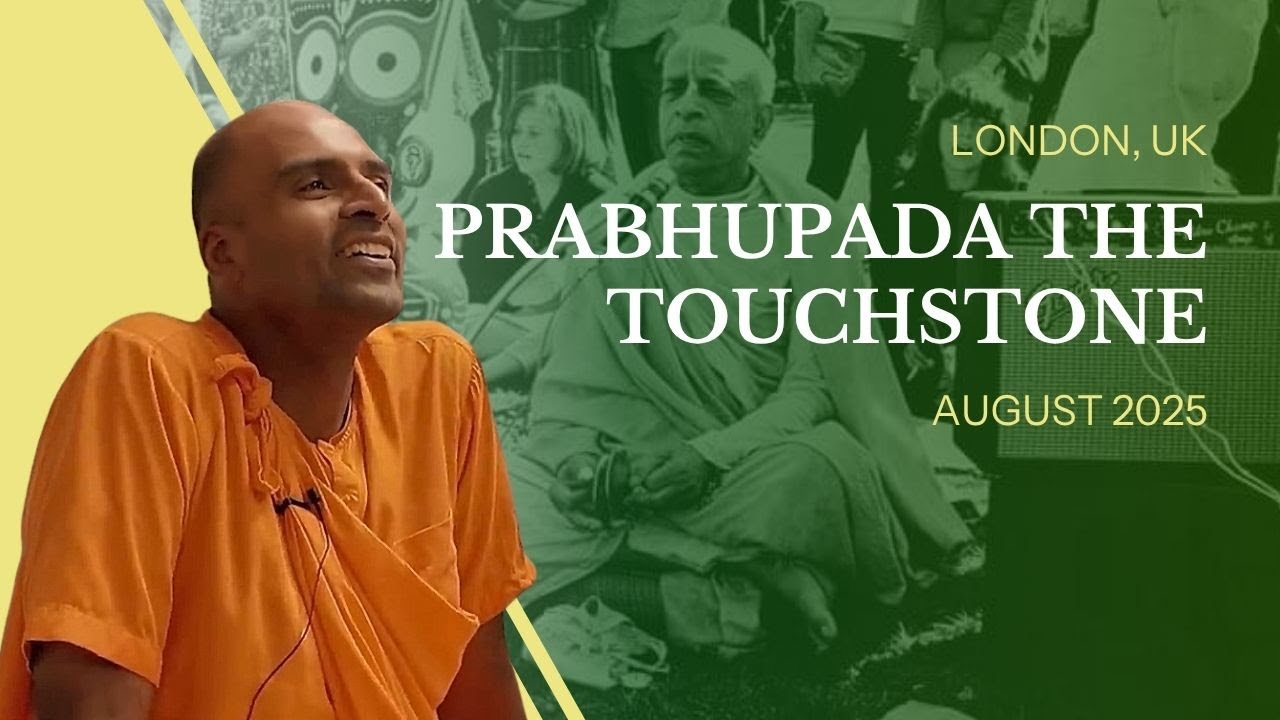
At a London gathering themed “Prabhupada the Touchstone,” HH S.B. Keshava Swami engaged a question that often troubles seekers: if Krishna already knows everything that will happen, what is the purpose of human effort? The inquiry echoes a classical philosophical tension between divine omniscience and human agency, and it surfaces repeatedly in discussions on Sanatana Dharma, particularly in relation to the Bhagavad Gita.
In the Gita, Krishna affirms omniscience“I know past, present, future, I know all living beings but Me nobody knows”yet the same text vigorously calls for purposeful action, dharma, and responsibility. The apparent contradiction softens once the difference between knowing and causing is clarified: knowledge of an event does not produce the event. Just as an astronomer’s accurate prediction does not cause an eclipse, Krishna’s omniscience does not compel human choices.
Dharmic philosophy reconciles this through karma and puruṣārtha. Karma shapes tendencies and probabilities, while puruṣārtha preserves the space for conscious, value-guided choice. Hence, the Gita’s exhortations to actnishkama karma, svadharma, and disciplined effortare not negated by omniscience; rather, they are validated by a cosmos where moral agency is meaningful. Far from endorsing fatalism, Krishna repeatedly urges Arjuna to act with clarity, devotion, and responsibility.
Srila Prabhupada’s life exemplifies this synthesis. Revered as a “touchstone” for transforming potential into lived spirituality, his decisive, service-centered action in bhakti-yoga demonstrates how disciplined choices can align with the divine will without surrendering personal responsibility. Such alignment neither denies destiny nor diminishes effort; it reframes effort as a conscious participation in a reality known by Krishna but still authored through one’s choices.
Convergence across dharmic traditions supports this view of meaningful agency. Buddhism emphasizes cetanā (volition) within dependent origination; Jainism underscores self-effort in purifying karma; Sikhism harmonizes hukam with active seva and simran. Together, Hinduism, Buddhism, Jainism, and Sikhism affirm that foreknowledgedivine or cosmicdoes not erase the ethical weight of action. This unity in spiritual diversity preserves freedom, accountability, and the possibility of transformation.
Practically, this means choosing lucid action over paralysis: clarifying intention (sankalpa), serving without ego (nishkama karma), and reflecting daily on consequences and compassion. For many practitioners, such habits reduce anxiety about “destiny” and cultivate steadiness, integrity, and hope. By integrating scriptural insight with lived discipline, the question “What is the point of acting?” becomes an invitation to act wisely and wholeheartedly.
Thus, Krishna’s omniscience invites responsibility, not resignation. The Gita’s messageread through a dharmic lensdissolves the paradox: act well, align with dharma, and let knowledge guide without coercing. In this way, shared wisdom across dharmic paths advances unity, deepens spiritual confidence, and sustains purposeful engagement in a world already known, yet still shaped, by human choice.
Inspired by this post on Dandavats.