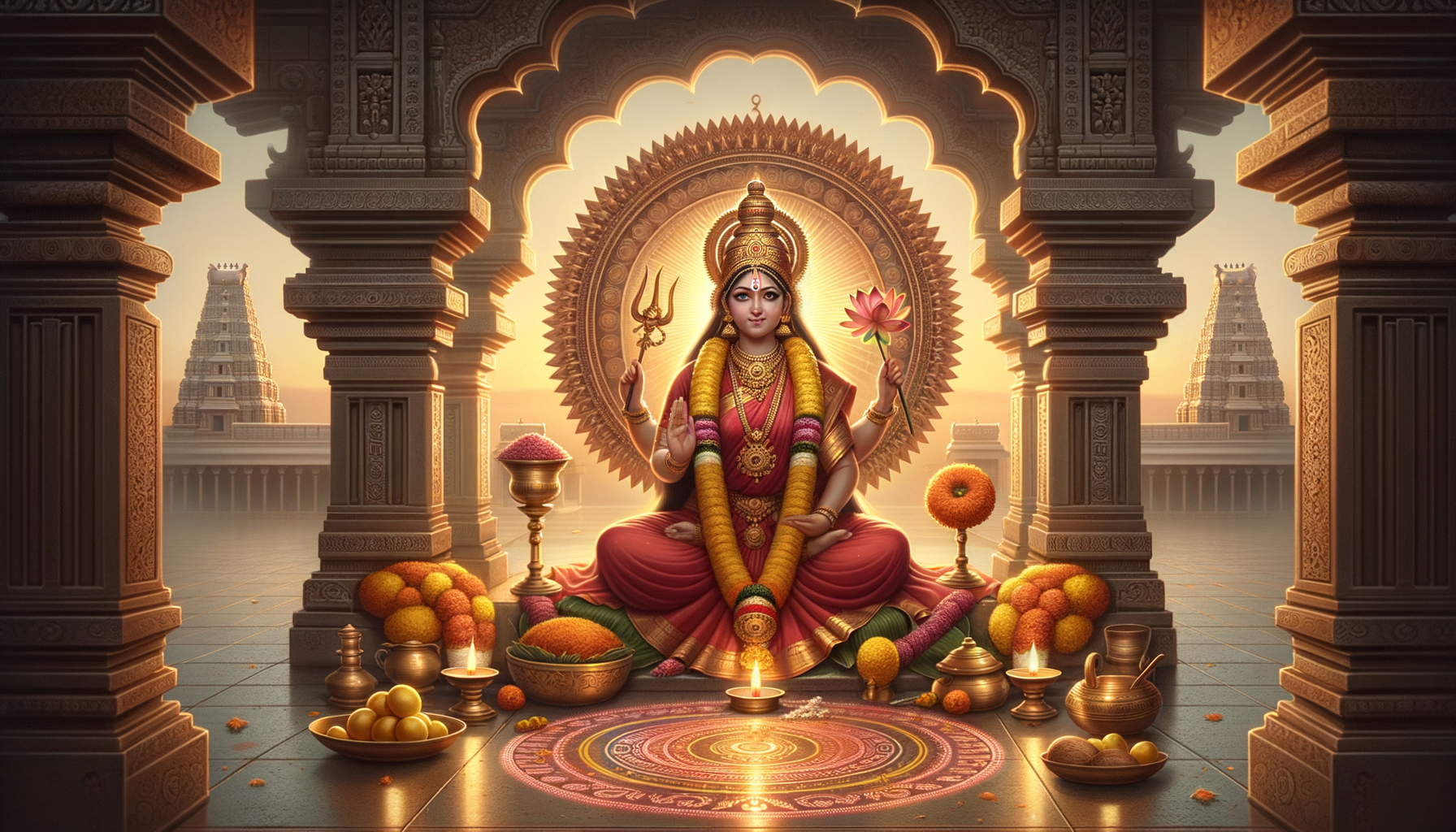
Angalamma Potri, Potri refers to a revered cycle of 108 praises dedicated to Ma Angalamman, a powerful manifestation of Ma Adhiparashakthi. Venerated widely across South Indiaespecially in Tamil NaduMa Angalamman is honored as the Kula Devata by numerous families, making her worship a cornerstone of regional Hindu traditions and cultural heritage.
As a form of Devi and Shakti, Ma Angalamman embodies protection, compassion, and righteous strength. Devotees often recite the 108 praises to invoke her blessings for familial well-being, social harmony, and inner resilience. The phrase “Angalamma Potri, Potri” encapsulates a rhythmic offering of gratitude and reverence that sustains devotional continuity across generations.
The number 108 holds profound significance in Hindu spirituality, symbolizing cosmic completeness and the unity of microcosm and macrocosm. Within this devotional framework, the 108 praises on Ma Angalamman function as a disciplined sadhana, reinforcing focus, humility, and mindful remembrance. Practitioners report that regular recitation creates an atmosphere of sanctity in the household, aligning daily life with dharmic values.
In Tamil Nadu, temples dedicated to Ma Angalamman are distributed across urban and rural landscapes, reflecting a deep historical continuity of worship. Rituals associated with Angalamma Potri, Potri commonly include offerings, community singing, and seasonal observances such as Navaratri, when Shakti worship is foregrounded. These practices strengthen communal bonds and affirm a shared spiritual identity rooted in devotion and service.
The cultural impact of Ma Angalamman worship extends beyond ritual into everyday ethicsencouraging charity, truthfulness, and mutual respect. As a Kula Devata, she functions as a moral anchor for families, guiding rites of passage and reinforcing intergenerational transmission of knowledge, songs, and sacred narratives. In this way, devotion becomes a living tradition that enriches both private and public spheres.
Situated within the broader dharmic ecosystem, the reverence for Ma Angalamman exemplifies values that resonate across Hinduism, Buddhism, Jainism, and Sikhismcompassion, non-violence, self-discipline, and unity in diversity. This inclusive outlook promotes harmonious coexistence and highlights the shared ethical core of South Asian spiritual traditions, without imposing a singular path of practice.
From a heritage perspective, Angalamma Potri, Potri preserves regional identity while inviting scholarly interest in temple traditions, vernacular liturgy, and the lived experience of faith in South India. For researchers and practitioners alike, these 108 praises offer insight into how devotion, aesthetics, and community life intertwine within Tamil cultural history.
For the global diaspora, the recitation of the 108 praises serves as a bridge to ancestral memory, enabling continuity of the Kula Devata tradition across borders. Families often maintain these practices at home altars or local temples, reinforcing a sense of belonging and transmitting the spiritual legacy of Ma Angalamman to younger generations.
In sum, Angalamma Potri, Potri is more than devotional poetryit is a complete pathway of remembrance and renewal. Rooted in the worship of Ma Angalamman as Ma Adhiparashakthi, it offers a disciplined, uplifting, and culturally grounded practice that supports personal well-being, community cohesion, and the unity of dharmic traditions.
Inspired by this post on Hindu Pad.