
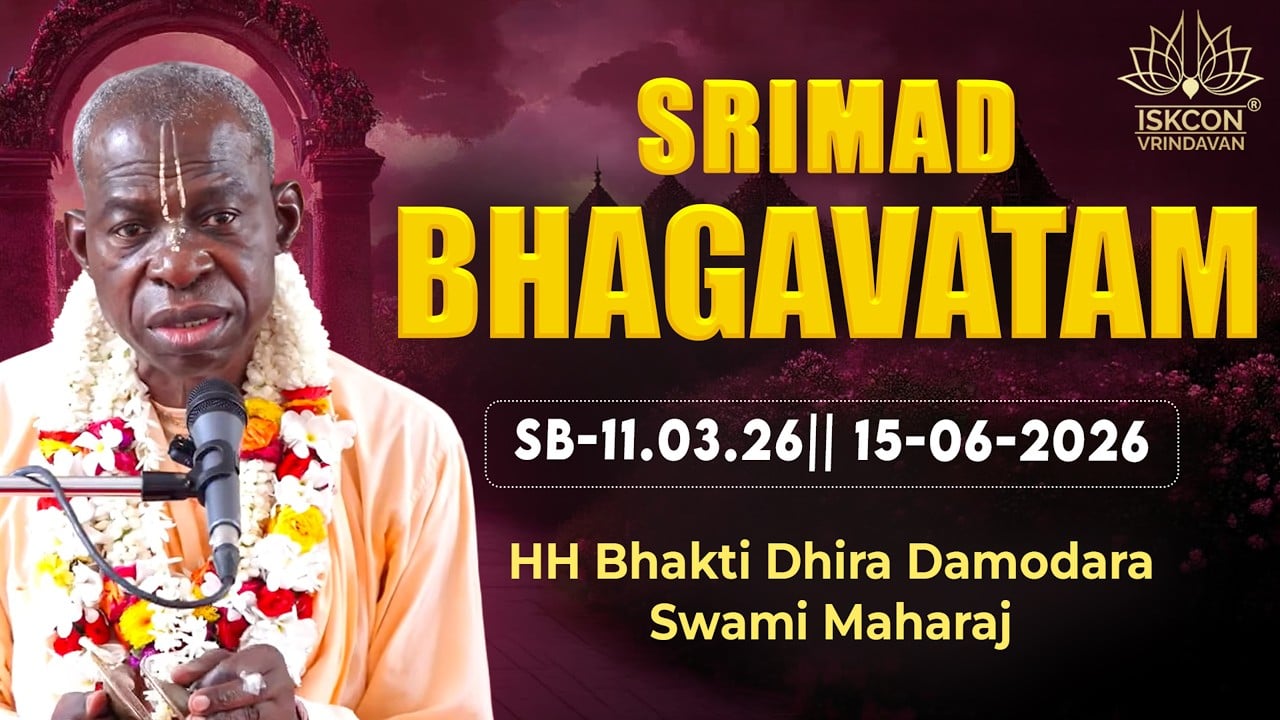
Śrīmad-Bhāgavatam 11.3.26 compresses an entire discipline of spiritual formation into a single verse: trust sacred knowledge, refuse contempt for other scriptures, govern thought, speech, and action, speak truthfully, and regulate both the mind and the senses. In the ISKCON Vrindavan recording dated 15 June 2026, the verse provides the textual focus for HH Bhakti Dhira Damodara Swami Maharaj. Its subject is not withdrawal from life but the transformation of ordinary human faculties into instruments of clear understanding, ethical conduct, and devotion.
The published page supplies the lecture recording rather than a full transcript. Accordingly, this study remains anchored to the cited Sanskrit verse, its immediate narrative setting, and its established Vaiṣṇava commentarial context. It does not assign unverified stories or individual statements to the speaker. Instead, it develops the intellectual and practical significance of the text while preserving the devotional setting in which the discourse was presented.
The focal text: Śrīmad-Bhāgavatam 11.3.26
श्रद्धां भागवते शास्त्रेऽनिन्दामन्यत्र चापि हि ।
मनोवाक्कर्मदण्डं च सत्यं शमदमावपि ॥ २६ ॥
śraddhāṁ bhāgavate śāstre
’nindām anyatra cāpi hi
mano-vāk-karma-daṇḍaṁ ca
satyaṁ śama-damāv api
A careful interpretive translation reads as follows: one should cultivate steadfast confidence in scripture centered upon Bhagavān, refrain from denigrating other sacred texts, firmly discipline the mind, speech, and actions, remain truthful, and bring both the inner mind and the outward senses under responsible control.
The verse within its narrative setting
The verse appears in the eleventh canto’s account of King Nimi and the nine Yogendras. Chapter Three, traditionally titled “Liberation from the Illusory Energy,” examines māyā, the instability of material satisfaction, the need for authentic spiritual guidance, and the practices through which a person can become free from misidentification and compulsive action. King Nimi asks how even a materially absorbed person may cross an energy that appears otherwise insurmountable. Śrī Prabuddha answers through a graduated program rather than through an isolated technique.
The sequence is important. Verse 21 directs a sincere seeker toward a qualified guru. Verse 22 presents faithful service and instruction. Verse 23 addresses association, compassion, friendship, and humility. Verses 24 and 25 describe cleanliness, austerity, tolerance, study, simplicity, nonviolence, equanimity, contemplative awareness, detachment, and contentment. Verse 26 then integrates scriptural confidence, intellectual restraint, truthful communication, and self-governance. Verses 27 and 28 move explicitly into hearing, glorifying, remembering, chanting, offering, charity, and devotional dedication.
This placement makes SB 11.3.26 a bridge. The verse connects foundational character formation with explicitly devotional activity. Ethical discipline is therefore neither an optional ornament nor the final goal. It prepares the person to hear accurately, remember steadily, serve without duplicity, and direct every faculty toward Bhagavān. Bhakti is presented as a disciplined reorientation of life, not merely as an emotion experienced during worship.
A technical reading of the Sanskrit
The verse continues the grammatical force of the earlier instruction that a disciple should learn or cultivate the disciplines of bhāgavata-dharma. Its principal terms therefore function as an interconnected catalogue. Śraddhām indicates faith or committed confidence; bhāgavate śāstre locates that confidence in scripture related to Bhagavān; anindām identifies freedom from denigration; mano-vāk-karma-daṇḍam describes firm regulation of mind, speech, and action; satyam denotes truthfulness; and śama-damau presents the paired disciplines of governing the mind and governing the external senses.
Śraddhā: disciplined confidence rather than unexamined belief
Within bhakti theology, śraddhā is more precise than vague optimism. It is a stable confidence that devotional practice has a coherent object, a trustworthy method, and a transformative purpose. The traditional definition cited in connection with this verse describes śraddhā as the conviction that service to Kṛṣṇa properly fulfills the deeper intention of spiritual duty. Such confidence gives direction to study and practice, but it does not remove the need for interpretation, ethical accountability, or guidance.
Śraddhā should not be confused with credulity. Credulity accepts claims merely because they are emotionally attractive, socially rewarded, or spoken by an impressive personality. Disciplined faith operates within a framework of guru, śāstra, and sādhu: qualified guidance, authoritative teaching, and a community of realized or serious practitioners. These sources provide mutual checks. A private impulse cannot automatically be elevated into revelation, and institutional authority cannot legitimately cancel truthfulness, compassion, or responsible conduct.
Faith in this setting is also practical. A person cannot test the fruit of a discipline without practicing it consistently enough for its structure to become intelligible. Study clarifies the goal, practice generates experience, and reflection examines whether conduct is becoming less selfish, less reactive, and more service-oriented. Śraddhā supplies the perseverance needed for that process without predetermining every conclusion or excusing every human interpretation.
Bhāgavate śāstre: scripture oriented toward Bhagavān
The expression bhāgavate śāstre refers to sacred literature that directly discloses the nature, qualities, activities, names, and service of Bhagavān. Śrīmad-Bhāgavatam is the most immediate example in this context, but the phrase also indicates a theological orientation. Scripture is not treated simply as an archive of ancient information. It is approached as a disciplined means of hearing about the Supreme, understanding the self, recognizing māyā, and learning how knowledge should become devotionally embodied.
This approach requires hermeneutics—the responsible interpretation of texts. A passage must be read in relation to its language, genre, narrative situation, wider canon, teaching lineage, and intended spiritual end. Extracting a sentence from its setting and using it to justify anger, superiority, or self-interest contradicts the regulatory disciplines named in the same verse. Scriptural fidelity is therefore measured not only by accurate quotation but also by intellectual honesty, context, and the character produced through interpretation.
Anindā: conviction without contempt
Anindā is the refusal to indulge in nindā—denigration, malicious fault-finding, or contemptuous speech. The phrase anindām anyatra extends this restraint toward other scriptures. It does not require a practitioner to pretend that all texts make identical claims or possess the same function within every tradition. It requires disagreement to remain truthful, informed, proportionate, and free from the desire to humiliate another community.
This distinction is academically significant. Critical analysis evaluates evidence, identifies differences, and may challenge harmful interpretations. Denigration reduces a complex tradition to a caricature and treats its adherents as unworthy of a fair hearing. SB 11.3.26 supports strong commitment while placing an ethical boundary around polemics. A practitioner may explain why one theological conclusion is preferred, yet the explanation should not depend upon distortion, selective quotation, ridicule, or hostility.
Anindā also disciplines internal religious debate. Vaiṣṇava communities, other Hindu sampradāyas, Buddhist schools, Jain traditions, and Sikh lineages all contain interpretive diversity. Responsible dialogue distinguishes between a doctrine, a historical institution, an individual’s conduct, and an entire population. Criticism becomes more accurate when directed toward a specific claim or action rather than toward a collective identity.
Mano-vāk-karma-daṇḍam: one ethic across three domains
The compound mano-vāk-karma-daṇḍam joins thought, speech, and action within a single structure of accountability. Daṇḍa can denote a rod or instrument of discipline, but here it signifies firm regulation rather than aggression or self-punishment. The verse does not permit a fragmented morality in which kind words conceal malicious intent, private devotion excuses harmful action, or apparently good behavior is used to cultivate pride.
The mental domain includes attention, intention, memory, fantasy, resentment, and the stories through which experience is interpreted. The verbal domain includes spoken conversation, writing, teaching, messaging, reposting, and silence used either wisely or manipulatively. The domain of karma includes embodied behavior, habitual routines, professional decisions, financial choices, and actions performed through technological systems. Contemporary forms may change, but the threefold field of responsibility remains recognizable.
The term daṇḍam should not be read as a command to hate the mind or body. Vaiṣṇava commentary commonly interprets control positively: the faculties become purified by being engaged in Kṛṣṇa’s service. The hand can prepare or distribute prasādam, the voice can speak truth or participate in kīrtana, the intellect can study śāstra, and the mind can remember the Lord. Regulation succeeds through purposeful redirection, not through creating an inert personality.
Satya: truthfulness as spiritual alignment
Satya requires more than avoiding obvious lies. It asks whether speech corresponds to what is known, whether uncertainty is acknowledged, whether relevant context is concealed, and whether a statement is designed to inform or manipulate. A technically accurate sentence can still mislead when essential qualifications are omitted. Truthfulness therefore concerns the integrity of communication as a whole.
Bhagavad-gītā 17.15 offers a useful companion principle by associating verbal discipline with speech that is truthful, beneficial, appropriately pleasing, and not needlessly agitating. This does not convert satya into evasive politeness. It means that truth should be communicated in a manner suited to its ethical purpose. Timing, tone, evidence, and the listener’s legitimate welfare all matter. Harshness is not proof of courage, just as pleasantness is not proof of truth.
Śama and dama: inner and outer governance
Śama generally denotes the settling, restraint, or governance of the mind. Dama denotes regulation of the external senses. Their pairing recognizes a reciprocal process. Unregulated sensory input continually stimulates thought, while repeated thoughts intensify the search for corresponding objects. A person who attempts to calm the mind while feeding it endless provocation creates an avoidable conflict. A person who restricts external behavior without examining desire may merely drive the same pattern underground.
The reference to the mind within mano-vāk-karma-daṇḍam and the later appearance of śama are not redundant. The first expression establishes accountability across the whole field of intention and conduct. Śama emphasizes a cultivated inner condition in which attention can become steady rather than compulsively reactive. Dama complements it by regulating the sensory channels through which impressions enter and impulses seek expression.
Together, śama and dama form a feedback system. Sensory contact influences attention; attention shapes thought; thought conditions speech and action; repeated action becomes habit; and habit alters what the mind notices and desires. Devotional practice intervenes throughout this cycle. Hearing and chanting provide constructive sensory engagement, remembrance trains attention, service restructures action, and truthful association supplies correction.
Three integrated dimensions of the verse
SB 11.3.26 may be understood through three mutually dependent dimensions. Its epistemic dimension concerns what deserves trust: bhāgavata-śāstra. Its relational dimension concerns how convictions are expressed: without denigration and with truthfulness. Its regulatory dimension concerns how a person becomes capable of living those convictions: discipline of mind, speech, action, and senses. Removing any one dimension destabilizes the others.
Faith without self-regulation can become impulsive sectarianism. Self-regulation without truth can become image management. Truth without anindā can be weaponized as humiliation. Respect without discernment can decline into relativism. Discipline without a positive devotional object can become sterile repression. The verse avoids these imbalances by holding conviction, respect, truth, and self-mastery together.
Guru, community, and accountable interpretation
Because verse 26 follows the instruction to seek a qualified spiritual master, its disciplines are not presented as a self-invented program. The guru is expected to understand scripture in realization and to be free from narrow material motivation. The disciple is expected to serve without duplicity, ask sincerely, associate with devotees, and cultivate ethical steadiness. Authority and responsibility therefore operate in both directions.
Authentic guidance should deepen satya, śama, dama, humility, and service. If an interpretation repeatedly produces deception, uncontrolled hostility, exploitation, or contempt, the fruits conflict with the qualities listed in the text itself. This does not make subjective preference the final authority. It does establish that a scriptural interpretation must be examined alongside the ethical and devotional formation it generates.
Community is equally important because self-assessment has limits. A person can rename anger as zeal, attachment as loyalty, or avoidance as renunciation. Mature association helps reveal these substitutions. Devotees remind one another of the goal, provide models of regulated conduct, and make correction possible without reducing spiritual life to solitary introspection.
A foundation for unity among Dharmic traditions
The instruction to avoid denigrating other scriptures offers a constructive basis for dialogue among Hindu, Buddhist, Jain, and Sikh traditions. Unity does not require merging their metaphysics or treating distinct paths as interchangeable. These traditions differ on the nature of the self, ultimate reality, divine personhood, liberation, revelation, and religious authority. Academic integrity requires those differences to remain visible.
At the same time, meaningful ethical correspondences deserve recognition. Hindu traditions preserve multiple disciplines of mind, speech, body, truthfulness, non-harm, sensory restraint, contemplation, and devotion. Buddhist paths give sustained attention to right speech, right action, mental cultivation, and freedom from compulsive craving. Jain teaching places exceptional emphasis on ahiṁsā and includes the three guptis, or restraints of mind, speech, and body. Sikh teaching joins remembrance of the One with truthful living, honest work, disciplined conduct, and sevā.
These correspondences constitute a shared ethical grammar, not proof of doctrinal identity. Each tradition places the disciplines within its own account of bondage, agency, knowledge, and liberation. Vaiṣṇava bhakti directs regulated faculties toward loving service to Bhagavān. Buddhist practice is interpreted through its own analyses of suffering, impermanence, and non-attachment. Jain practice operates within a distinctive account of jīva, karma, and liberation. Sikh practice is shaped by devotion to Ik Oankar, the Guru’s wisdom, nām, truthful labor, and service.
Such precision strengthens unity because respect based on accurate understanding is more durable than unity based on slogans. Anindā permits a community to articulate its deepest convictions without making contempt a mark of loyalty. It also encourages each community to resist misinformation about the others, especially when inflammatory fragments circulate without linguistic, historical, or doctrinal context.
A disciplined Dharmic dialogue would therefore ask several questions before making a public claim: Is the source authentic? Has the passage been read in context? Does the interpretation represent the tradition’s recognized range of views? Is a historical abuse being confused with an entire doctrine? Is criticism directed toward a specific proposition or toward the dignity of a whole population? These questions apply śraddhā, anindā, satya, and self-control to intertradition relations.
Self-mastery in an age of constant stimulation
The verse has unusual relevance in a media environment that continually solicits attention and rewards immediate reaction. A notification can trigger curiosity, irritation, fear, comparison, or outrage within seconds. The mind supplies a narrative, speech turns that narrative into a comment, and bodily action publishes it to an audience. Mano-vāk-karma is no longer confined to face-to-face conduct; a momentary impulse can be copied, archived, and distributed widely.
Śama begins by making the impulse observable. The appearance of a thought is not identical with a considered judgment, and an emotion is not automatically an instruction. A short pause allows the practitioner to distinguish direct knowledge from assumption, principle from wounded pride, and useful intervention from the desire to retaliate. This pause is not passivity. It creates the conditions for accurate and proportionate action.
Vāk-daṇḍa becomes a form of digital ethics. Before sending or sharing material, a person can test whether it is verified, relevant, fair, and expressed without needless degradation. Reposting a falsehood does not become truthful because the person did not compose it. Hiding behind anonymity does not erase responsibility. Satya applies to captions, edited clips, headlines, private messages, public comments, and strategic silence.
Karma-daṇḍa extends responsibility beyond visible bodily movement. Scheduling a message, delegating a harmful task, designing a deceptive process, or allowing an automated system to act without proper oversight can still have ethical consequences. The technical distance between intention and outcome does not dissolve agency. Devotional integrity asks whether the full chain of action serves truth, welfare, and spiritual purpose.
Dama addresses the management of inputs. Sensory restraint need not require abandoning technology or social participation. It can involve selecting what enters attention, limiting exposure to material that predictably produces agitation, protecting time for study and japa, and refusing the assumption that every stimulus deserves a response. The relevant questions concern quality, quantity, timing, and purpose.
A person who has sent a harsh message and regretted it already understands the emotional logic of the verse. The injury often begins before the words appear: attention fixes upon an offense, the mind rehearses a hostile interpretation, the senses search for confirming material, and speech releases the accumulated reaction. Repair must therefore address the entire sequence rather than only its final sentence.
Truthfulness in family, professional, and public life
In family life, satya and anindā encourage direct communication without character assassination. A specific action can be discussed without declaring the whole person worthless. Śama helps prevent an old grievance from controlling a new conversation, while dama limits the sensory and emotional escalation that occurs when every accusation is immediately answered. The aim is neither forced agreement nor silent resentment, but truthful engagement governed by dignity.
In professional life, truthfulness includes accurate reporting, honest attribution, transparent uncertainty, and resistance to convenient distortion. A responsible person distinguishes observed fact, inference, recollection, and hearsay. When an error is discovered, correction should be prompt and proportionate. This practice is spiritually relevant because repeated small evasions train the same mind later expected to approach scripture and self-examination honestly.
In public religious communication, the standard becomes especially demanding. A speaker may defend a tradition firmly, correct false claims, and document injustice. Yet the argument should not depend upon invented quotations, decontextualized images, collective blame, or mockery of sacred identities. The credibility of dharmic advocacy is strengthened when evidence and restraint remain visible even under provocation.
A practical daily framework
A morning practice can begin by establishing the verse’s positive center. Scriptural hearing or reading gives attention a deliberate object before external demands fragment it. Mantra-japa, prayer, or contemplative remembrance steadies the mind. A concise intention may then be formed: thought should be observed, speech should remain truthful and non-denigrating, action should be offered in service, and sensory choices should support rather than undermine that purpose.
An input discipline can follow. The practitioner identifies which forms of media, conversation, food, entertainment, or social contact reliably weaken attention or intensify unhelpful impulses. Regulation should be specific rather than theatrical. A modest boundary that is consistently observed has greater formative value than an extreme restriction adopted publicly and abandoned privately.
A speech discipline can use four tests: Is the claim true to the best available knowledge? Is the relevant uncertainty disclosed? Is the expression beneficial or necessary in the present setting? Can it be communicated without contempt? Not every sentence must be pleasant, and not every true fact must be announced immediately. The tests help align accuracy, purpose, timing, and manner.
A midday pause can examine whether the morning intention still governs conduct. If agitation has taken control, a brief return to mantra, measured breathing, scripture, or silence can interrupt the sequence before it becomes speech or action. The purpose is recovery, not self-condemnation. Discipline becomes durable when a lapse leads to correction rather than to shame followed by abandonment.
An evening review can consider mind, speech, and action separately. Which thoughts received unnecessary attention? Which words were accurate, useful, exaggerated, or hurtful? Which actions expressed service, and which reinforced compulsion? What sensory input shaped those outcomes? Where repair is required, the next step may involve apology, clarification, restitution, or a more realistic boundary for the following day.
Weekly study with qualified guidance adds depth. A verse should be examined through its Sanskrit terms, chapter context, established commentaries, and practical implications. Questions and doubts need not be treated as failures of faith. When expressed sincerely, they can protect śraddhā from becoming superficial and help distinguish the teaching itself from an individual’s incomplete understanding.
Common misreadings of the verse
The first misreading equates control with repression. Repression denies or conceals an impulse without understanding it, often leaving its underlying force intact. Spiritual regulation recognizes the impulse, evaluates it in relation to dharma and devotion, and redirects energy toward constructive engagement. The senses are not declared evil; they are trained to serve a coherent purpose.
The second misreading equates verbal discipline with muteness. Silence can prevent impulsive harm, but silence may also protect deception, avoid responsibility, or abandon someone who requires truthful support. Vāk-daṇḍa means governance of speech, not the permanent cessation of speech. Kīrtana, teaching, encouragement, correction, testimony, and apology can all be disciplined uses of the voice.
The third misreading treats bluntness as superior truthfulness. Satya does not authorize cruelty. A statement should be supported, contextualized, and communicated for a legitimate purpose. Conversely, concern for harmony must not become an excuse for suppressing evidence or refusing necessary correction. Satya and anindā work together: truth prevents sentimental evasion, while non-denigration prevents truth from becoming a weapon of ego.
The fourth misreading turns respect for other scriptures into the claim that every doctrine is identical. Anindā requires fairness, not homogenization. Traditions can disagree deeply and still describe each other accurately. Mature pluralism protects both conviction and dignity. It neither trivializes theological difference nor converts difference into hostility.
The fifth misreading reduces śraddhā to religious identity. Affiliation, vocabulary, clothing, or public enthusiasm cannot substitute for transformed conduct. The verse tests faith through truthfulness, restraint, and the ethical use of human faculties. When identity becomes an excuse for uncontrolled speech or contempt, the behavior contradicts the very discipline the identity is supposed to represent.
The transformative logic of bhakti
The deepest contribution of SB 11.3.26 is its refusal to separate devotion from character. The mind that remembers Kṛṣṇa is the same mind that must be protected from resentment and distortion. The speech that chants sacred names is the same speech that must remain truthful in ordinary conversation. The body that bows before the Deity is the same body whose daily actions must reflect responsibility and service.
Self-control is therefore not a private achievement displayed as spiritual superiority. It creates availability for service. A less distracted mind can hear more carefully. A truthful voice can be trusted. Regulated senses reduce the pressure of compulsive acquisition. Respect for other sacred paths makes dialogue possible. Firm śraddhā supplies direction without requiring contempt as proof of commitment.
The verse also explains why spiritual growth can feel both demanding and hopeful. Habitual reactions are deeply practiced, so they do not disappear through a single resolution. Yet every moment of attention offers a new point of intervention. A thought can be examined, a sentence can remain unsent, an error can be corrected, a sense can be redirected, and an action can become an offering. Transformation occurs through repeated alignment.
For a listener approaching HH Bhakti Dhira Damodara Swami Maharaj’s discourse, SB 11.3.26 provides a rigorous lens: authentic faith should produce intellectual steadiness, disciplined communication, ethical action, and devotional focus. The verse calls for conviction without arrogance, restraint without lifelessness, truth without cruelty, and respect without loss of discernment. Its ideal is not merely a controlled person but a person whose faculties have become coherent in service to the highest spiritual aim.
Conclusion
Śrīmad-Bhāgavatam 11.3.26 presents self-mastery as an integrated spiritual science. Śraddhā establishes the source of orientation, bhāgavata-śāstra supplies sacred knowledge, anindā governs relations with other traditions, satya protects communication, mano-vāk-karma-daṇḍa aligns intention and conduct, and śama-dama regulate the inner and outer instruments of experience. Practiced together, these disciplines offer a durable path from reaction to reflection, from fragmentation to integrity, and from self-centered control to loving devotional service.
Primary references: Śrīmad-Bhāgavatam 11.3.26 and Chapter Three, “Liberation from the Illusory Energy”. The source recording is HH Bhakti Dhira Damodara Swami Maharaj, ISKCON Vrindavan, 15 June 2026.
Inspired by this post on Dandavats.











Leave a Reply
You must be logged in to post a comment.