
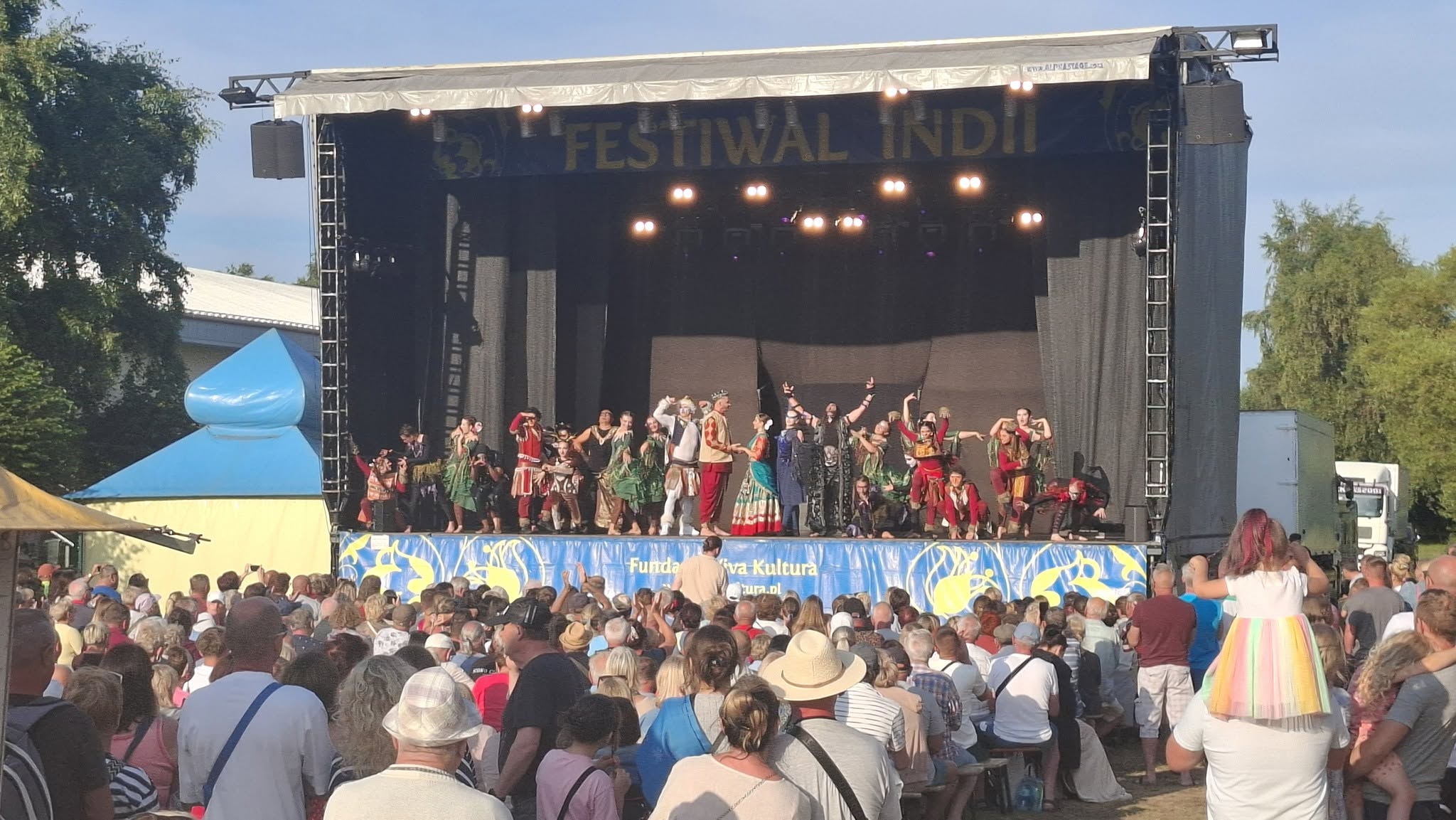
A three-day encounter with Indian devotional culture
The Hare Krishna–associated India Festival in Dźwirzyno, Poland, presents Indian food, music, dance and devotional culture in an accessible public setting. According to the supplied announcement, the festival takes place from 14 to 16 July on the square behind the amphitheatre, near the Yacht Club and Klonowa Street. Admission is described as free. The notice does not identify the year, daily opening hours or a detailed performance schedule, so those particulars should be confirmed through the event’s official local information channels before any journey is planned.
Although the original notice is brief, the festival belongs to a much larger history of cultural exchange. Hare Krishna events combine religious practice with forms that can be encountered by people of many backgrounds: collective singing, rhythmic music, dance, philosophy and vegetarian food. This combination can transform an ordinary public square into a temporary meeting place where devotion is expressed not only through formal teaching but also through sound, movement, hospitality and shared attention.
What “Hare Krishna” means
The expression “Hare Krishna” commonly refers to the International Society for Krishna Consciousness, or ISKCON, as well as to the devotional mantra at the centre of its public identity. ISKCON was founded in New York in 1966 by A. C. Bhaktivedanta Swami Prabhupada. It belongs to the Gaudiya Vaishnava tradition, a devotional school of Hinduism whose theology and practices developed in eastern India and were profoundly shaped by Sri Caitanya Mahaprabhu during the late fifteenth and early sixteenth centuries.
Gaudiya Vaishnavism understands Krishna as the supreme personal reality and regards loving devotion, or bhakti, as the principal means of spiritual realization. Its philosophical framework is often described as acintya-bhedābheda: the inconceivable simultaneous unity and distinction between the Divine, individual living beings and the world. This position affirms a deep relationship among all existence without erasing meaningful differences between the worshipper and the object of worship.
The movement’s best-known practice is the chanting of the mahā-mantra: Hare Krishna, Hare Krishna, Krishna Krishna, Hare Hare; Hare Rama, Hare Rama, Rama Rama, Hare Hare. In Gaudiya Vaishnava interpretation, the names invoke Krishna, Rama and the Divine’s spiritual energy. Chanting is therefore understood as direct devotional address rather than a performance whose value depends solely on musical skill.
Kirtan as theology expressed through sound
At a Hare Krishna festival, music frequently takes the form of kirtan, a participatory practice in which a lead singer offers a phrase and the assembled group responds. This call-and-response structure reduces the distance between performer and audience. A person may listen quietly, sing after the leader, keep time with the rhythm or simply observe. Participation is voluntary, and prior knowledge of Sanskrit, Indian music or Hindu theology is not required.
The characteristic sound of Gaudiya Vaishnava kirtan is often created with the mṛdaṅga, a double-headed drum, and karatālas, small hand cymbals. Harmonium and other instruments may also be used in contemporary settings. Repeated melodic cycles, changes in tempo and alternating vocal leadership allow the music to develop gradually. The result can move from reflective chanting to vigorous collective singing while retaining the mantra as its structural and devotional centre.
Repetition in this context should not be mistaken for a lack of content. Within bhakti practice, repetition stabilizes attention and continually returns awareness to the divine names. From a broader social perspective, shared rhythm and coordinated vocal response can also create a strong sense of connection among participants. Such effects help explain why kirtan can feel emotionally immediate even to a newcomer, although devotional chanting should not be presented as a substitute for professional medical or psychological care.
Dance as embodied devotion
Dance provides a visible extension of the festival’s musical life. In many bhakti traditions, the body is not treated merely as an obstacle to spiritual reflection; it can become an instrument of reverence. Coordinated steps, raised arms and movement in time with kirtan give physical form to attention and joy. For observers, this can be one of the clearest demonstrations that Hindu devotional practice includes contemplative, intellectual, artistic and embodied dimensions.
The announcement promises music and dance but does not identify individual performers or specific classical and folk traditions. It would therefore be inaccurate to assign particular dance forms to the programme without further documentation. India possesses numerous regional performance systems, each with its own history, vocabulary, religious associations and technical discipline. A responsible account distinguishes confirmed programme information from the wider cultural context in which an India Festival operates.
Food, hospitality and the meaning of prasada
Food is another important point of contact. Hare Krishna communities are widely known for vegetarian cooking, and food offered within a devotional setting may be described as prasada, meaning divine grace or mercy. In practice, prasada is food prepared with care, offered to Krishna and then shared. Its significance lies not only in ingredients or culinary technique but also in the devotional intention that surrounds its preparation and distribution.
ISKCON kitchens generally exclude meat, fish and eggs, and many preparations also omit onion and garlic in accordance with the community’s understanding of a devotional diet. These conventions should not be generalized to every Indian household or every Hindu tradition. Indian vegetarianism contains substantial regional and doctrinal diversity, while many Indian communities follow other foodways. The supplied event notice mentions a range of flavours but does not provide a menu or confirm that every item available at the site is ritually offered prasada.
For visitors, culinary curiosity is best accompanied by practical awareness. Anyone managing allergies, gluten intolerance or other dietary requirements should obtain ingredient information directly from the food provider. Vegetarian status alone does not establish that a dish is free from dairy, nuts, sesame, gluten or cross-contact. This distinction is especially important at a busy outdoor festival, where unfamiliar dish names may not communicate every ingredient.
The original description uses the language of “exotic” flavours, but a more precise approach recognizes Indian cuisines as established cultural systems rather than novelties. Spices, grains, legumes, vegetables, dairy products and cooking fats are combined differently across regions and communities. Encountering such food at a festival can encourage appreciation, but meaningful appreciation also involves learning the names, origins and religious or social contexts of particular dishes whenever that information is available.
An India Festival cannot represent all of India
The title “India Festival” signals a broad cultural frame, while the Hare Krishna identity gives the event a more specific devotional centre. These two levels should not be confused. India contains many languages, regions, philosophies, ritual traditions and artistic lineages. Gaudiya Vaishnavism offers one influential expression of Indian spirituality, but it does not stand for every Hindu school or for the full religious and cultural diversity of the subcontinent.
This distinction strengthens rather than diminishes the festival’s educational value. Visitors can encounter a clearly situated tradition while recognizing that Hinduism includes Vaishnava, Shaiva, Shakta, Smarta and numerous regional and community-based forms. Buddhism, Jainism and Sikhism likewise emerged in South Asian historical environments while maintaining their own scriptures, institutions, doctrines and identities. Respectful unity among Dharmic traditions does not require their differences to be collapsed.
Shared ethical themes can nevertheless support dialogue. Compassion, disciplined conduct, service, self-examination and concern for the well-being of living beings appear in distinct ways across Hindu, Buddhist, Jain and Sikh traditions. A public cultural festival can provide a welcoming setting in which these resonances are noticed without claiming that all traditions teach precisely the same theology.
Why the Polish setting matters
Dźwirzyno’s Baltic coastal setting gives the festival a particular social character. Summer public spaces bring together local residents, domestic travellers and international visitors who may have very different levels of familiarity with Indian religion. A square behind an amphitheatre is not a temple, classroom or private retreat. It is a civic environment in which devotional expression becomes publicly visible and encounters people who may approach it as faith, art, cultural education or simple curiosity.
Such encounters are a form of cultural translation. Sanskrit concepts must be explained in another linguistic and social environment; traditional instruments must function within modern amplification systems; and practices rooted in a religious lineage must remain understandable to visitors who have not studied that lineage. Successful translation preserves the tradition’s integrity while allowing newcomers to engage without pressure or embarrassment.
The festival also demonstrates that Indian cultural heritage is not confined by geography. Communities carry devotional practices across borders, while local audiences interpret them through their own experiences. This exchange is not entirely one-directional: the host environment influences how an event is staged, explained and received. The resulting festival is simultaneously connected to Indian tradition and situated within contemporary Polish public life.
Accessibility and the significance of free admission
Free admission, as stated in the announcement, lowers an important barrier to cultural participation. People can approach the programme briefly, remain for an extended period or leave if it does not meet their interests or sensory needs. This open structure is particularly suited to kirtan, where the boundary between audience and participant can remain flexible.
Financial accessibility does not automatically guarantee full inclusion. Outdoor surfaces, crowd density, amplified sound, weather, seating and access to sanitation can affect people with mobility, sensory or health requirements. The brief source notice supplies no detailed accessibility information. Visitors who require specific accommodations would therefore need current information from the venue or local event channels.
How respectful participation works
No religious commitment is required simply to listen to music, observe dance or learn about a tradition in a public festival setting. Those who choose to join a chant can follow the response led by the singers. Those who prefer not to participate can remain attentive observers. Respect is expressed through ordinary conduct: allowing others space, avoiding disruption, supervising children near instruments and technical equipment, and following instructions from event or venue personnel.
Photography should be guided by consent and context. A public performance may be intended for documentation, but individual worshippers, children and people eating or praying should not automatically be treated as visual material. If a temporary sacred area, altar or exhibition has its own rules, those rules deserve the same consideration that would be shown in any religious or cultural setting.
Visitors may also encounter unfamiliar devotional gestures, clothing, images or food practices. These elements are best approached with informed curiosity rather than immediate judgment. Asking concise, respectful questions can open valuable conversation, while recognizing that a volunteer or performer cannot be expected to explain the whole of Hindu philosophy in a brief exchange.
The emotional force of collective celebration
The most memorable dimension of a festival is often difficult to reduce to a timetable. A drum rhythm gathering strength, a refrain answered by strangers and a meal shared in an unfamiliar place can create a temporary sense of belonging. For a practising devotee, that experience may be understood as service and remembrance of Krishna. For another visitor, it may become an encounter with generosity, artistic discipline or a culture previously known only through books and media.
That emotional openness is most valuable when paired with intellectual care. Enjoyment should not depend on romanticizing India as timeless, mysterious or culturally uniform. Nor should a public presentation be treated as a complete account of a complex religious tradition. The festival is better understood as an entry point: a vivid, situated experience capable of inspiring further study and respectful conversation.
Responsible festival practice
An outdoor gathering near the Baltic coast also carries environmental responsibilities. Reusable serving materials, clearly marked waste stations, careful management of food waste and respect for nearby residents can align practical festival organization with the ethical language of stewardship and non-harm. The source notice does not specify which environmental measures will be used, but these considerations provide an appropriate standard for evaluating any contemporary public celebration.
Weather planning is equally relevant. Coastal conditions can change quickly, and sun, rain or wind may affect outdoor programming. Appropriate clothing, drinking water and attention to official safety guidance can make participation more comfortable. Because no weather policy or alternative indoor venue appears in the supplied information, current local announcements remain the appropriate source for operational changes.
Confirmed information at a glance
The supplied announcement identifies the event as an India Festival associated with Hare Krishna culture. It gives the dates as 14–16 July, places the gathering on the square behind the amphitheatre near the Yacht Club and Klonowa Street in Dźwirzyno, and states that admission is free. It specifically highlights food, music, dance and atmosphere. It does not provide a year, daily schedule, named performers, menu, accessibility plan or weather contingency, and those details should not be inferred from the promotional image alone.
A cultural bridge built through shared experience
The Hare Krishna Festival in Poland is significant because it brings a living bhakti tradition into an open civic space. Its combination of mantra, rhythm, movement and food makes abstract ideas such as devotion, service and hospitality tangible. At its best, the event can encourage informed appreciation of Gaudiya Vaishnavism, broader Indian culture and the diversity of Dharmic traditions while allowing each visitor to determine the depth and form of personal engagement.
The festival’s enduring value therefore lies beyond spectacle. It offers an opportunity to meet difference without fear, to distinguish respectful learning from cultural simplification and to experience how a religious tradition communicates through more than doctrine alone. In the shared space created by music, dance and food, cultural exchange becomes not an abstract ideal but a human encounter.
Inspired by this post on Dandavats.
