
A resolution turns a legal dispute into a political test
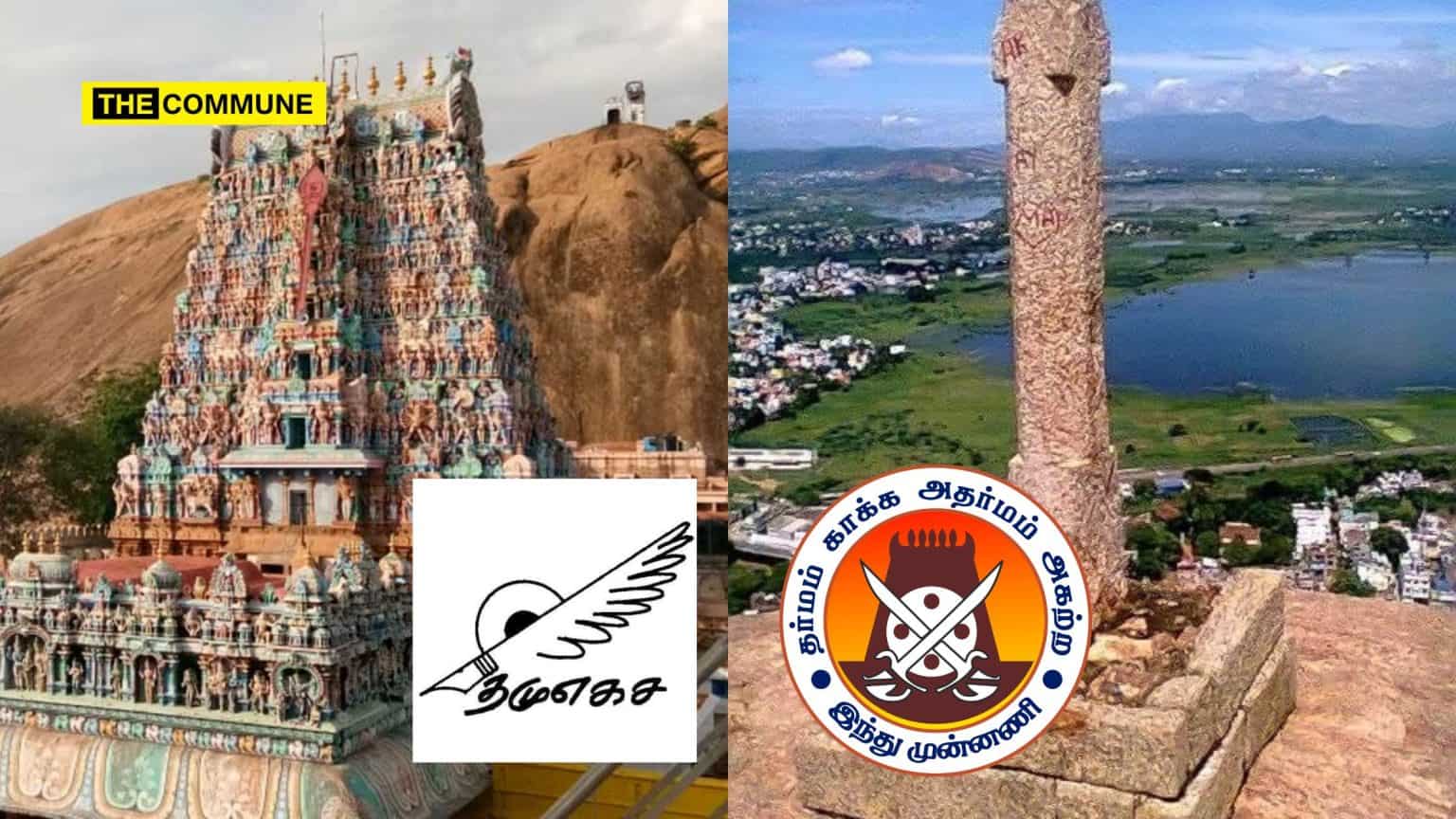
The Thirupparankundram Deepam dispute acquired a new political dimension in July 2026 when Hindu Munnani demanded action against the Tamil Nadu Progressive Writers’ and Artists’ Association, also known as the Tamil Nadu Murpokku Ezhuthalar Kalaignargal Sangam. The demand followed a resolution reportedly adopted by the association’s state executive committee opposing a Madras High Court judgment concerning the lighting of the Karthigai Deepam at the Deepathoon, a stone lamp pillar on Thirupparankundram hill in Madurai. Hindu Munnani issued its statement on 8 July 2026, and The Commune reported the controversy on 9 July.
The dispute cannot be understood merely as an exchange of accusations between two ideologically opposed organisations. It involves several distinct questions: what the High Court actually directed, whether criticism of a judgment amounts to defiance, how religious freedom interacts with public order, what evidence would justify government action, and how a culturally significant site can be administered without turning disagreement into communal hostility. Separating these issues is essential because emotionally charged labels can otherwise obscure the legal and factual record.
The triggering report was based substantially on Hindu Munnani’s statement. It did not reproduce the complete text of the writers’ association’s resolution, provide the association’s legal reasoning, or include a detailed response from the association or the Tamil Nadu government. Those omissions matter. Hindu Munnani’s assertions are therefore accurately described as allegations and demands rather than independently established findings. An academic assessment must distinguish what has been verified from what one interested party has claimed.
Hindu Munnani framed its criticism through two rhetorical questions: “நீதிமன்ற உத்தரவை முற்போக்கு எழுத்தாளர்கள் மதிக்க மாட்டார்களா?” and “திருப்பரங்குன்றம் விஷயத்தில் சட்டத்தை மீறுவதுதான் முற்போக்கு எழுத்தாளர்களின் கொள்கையா?” The questions asked, in substance, whether progressive writers respected judicial orders and whether violating the law had become their policy in the Thirupparankundram matter. This framing treated opposition to the judgment as evidence of resistance to lawful authority, although the precise language and intended effect of the association’s resolution were not supplied in the report.
Hindu Munnani also alleged that the association had repeatedly advanced positions hostile to Hinduism under the banner of progressive cultural activity. It argued that the request to light the Maha Deepam reflected the religious aspirations of Murugan devotees across Tamil Nadu and that a resolution opposing the judicial ruling disregarded those aspirations. This was a forceful political interpretation, but it remained an interpretation. Determining whether the resolution criticised Hindu practice, questioned the location of the ritual, challenged the court’s legal reasoning, or called for actual non-compliance requires the primary document.
The statement further connected the resolution to a broader campaign surrounding the judgment. Hindu Munnani referred to the documentary titled Thirupparankundram Files, seminars critical of the ruling, and protests directed against the judge who delivered the original order. It alleged that several organisations had participated in these activities and accused the writers’ association of joining efforts capable of provoking communal unrest. The source report did not establish the association’s precise institutional relationship with every film screening, seminar, or protest mentioned. Each activity would therefore require separate verification rather than being treated as part of a single proven conspiracy.
On that basis, Hindu Munnani urged the Tamil Nadu government to intervene immediately and initiate action against the association. The demand placed the state in a sensitive position. A government is responsible for enforcing judicial directions and preserving public order, but it must also protect lawful speech, association, artistic expression, religious freedom, and procedural fairness. Any official response must consequently identify the conduct under examination, the law allegedly violated, and the evidence supporting that allegation.
What the Madras High Court actually ordered
Terminology has contributed to public confusion. News reports sometimes use “Maha Deepam” as a general description of the ceremonial lamp, while the litigation and operative directions principally refer to the Karthigai Deepam and the Deepathoon. The place name also appears as both Thirupparankundram and Thiruparankundram in media reports and judicial materials. These variations do not necessarily describe different rituals or locations, but precision remains important when evaluating competing claims about custom, property, access, and implementation.
The immediate litigation arose from petitions seeking the lighting of the Karthigai Deepam at the Deepathoon in addition to the customary locations used by the Arulmigu Subramania Swamy Temple. On 1 December 2025, a single judge of the Madurai Bench directed the temple management, or Devasthanam, to light the lamp at the Deepathoon as well as at the usual places. The direction was not framed as an unrestricted right for any individual or crowd to enter the hill and conduct the ritual independently.
A Division Bench comprising Justices G. Jayachandran and K.K. Ramakrishnan pronounced its common judgment on 6 January 2026 in a large group of writ appeals. The bench examined earlier litigation, including the civil proceedings associated with O.S. No. 4 of 1920, the subsequent Privy Council history, a 1996 High Court order, and later cases concerning the location of the lamp. After considering arguments about title, customary practice, archaeological protection, public order, temple administration, and the nearby dargah, the bench retained the requirement that the Devasthanam light the lamp at the Deepathoon.
The operative safeguards are as important as the permission itself. The judgment directed the Devasthanam to perform the lighting through its own team during the Karthigai Deepam festival. Members of the public were not to accompany that team. The size of the team was to be determined in consultation with the Archaeological Survey of India and the police, while the District Collector was assigned responsibility for coordination and supervision. The Archaeological Survey of India was also authorised to impose conditions necessary to preserve protected monuments and archaeological features on the hill.
The ruling therefore created a regulated administrative arrangement rather than an open-ended authorisation for mass access. It recognised the religious purpose of the ceremony while assigning defined roles to the temple administration, heritage authorities, police, and district administration. That distinction is significant because public debate has sometimes reduced the controversy to the binary claim that the court either permitted or prohibited devotees from lighting a lamp. The judgment instead prescribed who should conduct the ritual, where it should occur, and which safeguards should govern it.
The long procedural history also demonstrates why simplified assertions about an undisputed custom are inadequate. Earlier proceedings addressed ownership of different parts of the hill, access to the dargah, the customary place of lighting, requests for alternative locations, and the state’s public-order concerns. The January 2026 bench interpreted that history in favour of a supervised Deepathoon ceremony. Other parties continued to contest aspects of that interpretation, which explains why the dispute did not end with the Division Bench ruling.
By late June 2026, the Tamil Nadu government had reportedly approached the Supreme Court to challenge the January judgment. Contemporary reporting indicated that the state’s petition was filed on 11 June and disclosed during later High Court proceedings. This appellate development is essential context for evaluating a resolution adopted in July. Filing an appeal does not itself establish that the challenged judgment has been stayed or reversed; that depends on orders passed by the appellate court. No final Supreme Court determination was identified in the materials reviewed for this account.
Opposing a judgment is not identical to disobeying it
The central analytical error in much of the public debate is the tendency to treat disagreement, appeal, non-compliance, obstruction, and contempt as interchangeable. They are not. A civil-society organisation may argue that a judgment is legally flawed, socially harmful, or historically mistaken. It may advocate an appeal or legislative response. Such criticism can be severe without necessarily becoming unlawful. Disobedience, by contrast, involves failure by a person or institution bound by an operative direction to comply with it. Obstruction involves conduct intended to prevent lawful implementation. Contempt is a legal determination governed by specific standards and judicial procedure.
This distinction does not pre-judge the association’s resolution. If the resolution merely expressed disagreement and supported appellate review, describing it as a policy of law-breaking would be premature. If it called on officials to ignore an operative order, obstructed implementation, threatened judicial officers, or promoted hostility between communities, a different legal assessment could follow. Only the exact text, surrounding speeches, subsequent conduct, and applicable court orders can establish where the resolution falls on that spectrum.
The constitutional framework protects interests on more than one side. Article 19(1)(a) protects freedom of speech and expression, while Article 19(1)(c) protects the right to form associations, subject to constitutionally permitted restrictions. Article 25 protects freedom of conscience and the right freely to profess, practise, and propagate religion, subject to public order, morality, health, and the other provisions of the Fundamental Rights chapter. The Constitution of India requires these freedoms to be considered together rather than allowing one to erase the others.
Calls for criminal or administrative action must also be tied to a clearly identified legal threshold. Section 196 of the Bharatiya Nyaya Sanhita, for example, addresses the promotion of enmity or disharmony between groups and conduct prejudicial to communal harmony. Its application requires examination of the exact words, context, statutory elements, and likely effect of the conduct. A political label such as “anti-Hindu,” “anti-progressive,” or “communal” cannot substitute for that analysis. Nor should a demand for enforcement be treated as proof that an offence has occurred.
Criticism of judges demands similar precision. Reasoned scrutiny of a judgment is part of constitutional public life, particularly when litigation concerns religion, heritage, and state authority. Personal threats, intimidation, campaigns designed to obstruct adjudication, or knowingly false allegations against a judge are categorically different. Hindu Munnani’s reference to protests against the judge therefore requires details about what was said and done, who organised the events, and whether the association itself participated. Collective attribution without evidence risks converting legitimate concern for judicial independence into partisan accusation.
The most defensible understanding of “government action” is consequently broader than punishment. It may include publishing the operational status of the court order, coordinating with the Devasthanam, police, District Collector, and Archaeological Survey of India, assessing genuine security risks, responding to representations from all parties, and investigating specific allegations through ordinary legal procedures. Punitive measures should follow only when supported by evidence, a valid statutory basis, notice to the affected organisation, and an opportunity to respond.
Why the ritual carries significance beyond administration
For many Murugan devotees, the lighting of a Deepam is not a decorative event or a minor scheduling question. Light bears ritual associations with knowledge, divine presence, auspiciousness, and the removal of darkness. A family that returns to a sacred site during the Karthigai season may experience the lamp as part of an inherited religious memory connecting several generations. Administrative terms such as access control, monument protection, and deployment plans are necessary, but they do not fully capture that emotional and cultural significance.
Residents, heritage officials, and worshippers associated with other institutions on the hill may experience the same dispute through different concerns. They may focus on crowd safety, the protection of archaeological remains, established routes of access, property boundaries, or the risk that political mobilisation could disturb local coexistence. Recognising those concerns does not diminish Hindu religious rights. It acknowledges that sacred geography can hold overlapping histories and that responsible administration must protect worship without presenting another community’s presence as an obstacle to be defeated.
Thirupparankundram is particularly sensitive because the hill contains an ancient Murugan temple complex and a dargah near the higher summit, alongside archaeological and historical features. The High Court’s detailed operational conditions reflected this layered environment. A supervised ceremony conducted by the temple team, with heritage and security coordination, offers a legal model in which ritual continuity and public peace are treated as mutually compatible rather than inherently opposed.
Hindu Munnani described the demand for the Deepam as reflecting the wishes of Tamil Nadu’s Hindu majority. Numerical scale may demonstrate political and social importance, but constitutional rights do not depend solely on majority status. Religious freedom protects individuals and institutions, while equality and due process constrain state action affecting both majorities and minorities. The strongest argument for facilitating the ritual is therefore not simply that many people desire it, but that a competent court issued a detailed direction designed to accommodate worship, heritage protection, and security.
The evidence needed for a fair assessment
The first missing document is the complete resolution of the Tamil Nadu Progressive Writers’ and Artists’ Association. A reliable assessment would identify its adoption date, exact wording, stated grounds, intended audience, and any action it requested from members or public officials. It would also determine whether the resolution opposed the ritual itself, the selection of the Deepathoon, the judicial reasoning, the enforcement procedure, or the wider political campaign surrounding the site. These positions may overlap, but they are not legally or ethically identical.
The second requirement is a direct response from the association. It should be invited to address Hindu Munnani’s allegations of anti-Hindu advocacy, participation in campaigns against the judgment, and intent to provoke unrest. The third is a formal statement from the government explaining whether any complaint has been received, whether an inquiry has begun, and which legal provisions are being considered. Without these responses, the public record remains structurally one-sided.
Each additional allegation also needs to be tested separately. The documentary’s producers, sponsors, screenings, and claims should be identified. Seminar programmes and recordings should establish who spoke and what was argued. Protest footage, police records, and organisers’ statements should clarify whether criticism crossed into intimidation or obstruction. Finally, any allegation of communal incitement should quote the language at issue and explain its context. This evidence-based method prevents guilt by association and protects the credibility of legitimate complaints.
A responsible path through the dispute
The Tamil Nadu government’s immediate responsibility is institutional clarity. It should state whether the High Court judgment remains operative, disclose any relevant Supreme Court directions, and publish a practical implementation plan when the festival approaches. If the state believes compliance would conflict with heritage law, public safety, or another binding order, it should seek explicit judicial clarification or relief. Ambiguity encourages competing groups to define the legal position through slogans, which increases the possibility of avoidable confrontation.
The writers’ association can contribute to clarity by releasing the resolution in full, identifying the historical or legal materials on which it relied, and expressly stating whether it supports compliance with operative judicial orders while pursuing appeal or criticism through lawful means. Such transparency would permit the public to evaluate the resolution on its actual merits rather than through an opponent’s characterisation. It would also demonstrate that intellectual dissent and respect for constitutional procedure can coexist.
Hindu Munnani can strengthen its case by documenting specific conduct instead of relying principally on broad ideological descriptions. If it possesses evidence of incitement, obstruction, threats, or organised non-compliance, that material should be submitted to the appropriate authorities and tested through due process. A commitment to lawful remedies is especially important when an organisation’s central argument is that judicial directions deserve respect.
Media organisations also carry a substantial responsibility. Reports should distinguish the court’s operative directions from political summaries, identify allegations as allegations, seek responses from the accused organisation, and explain the pending appellate posture. Terms such as “hilltop,” “Deepathoon,” “Maha Deepam,” and “Karthigai Deepam” should be used carefully because imprecise descriptions can materially alter readers’ understanding of the dispute. Headlines may attract attention, but legal and religious controversies require accuracy beyond the headline.
A dharmic and pluralistic approach does not require silence about threats to Hindu religious practice. It requires truthfulness, restraint, evidence, and a refusal to convert a ritual dispute into hostility toward entire communities. Hindu, Buddhist, Jain, and Sikh traditions possess distinct histories and doctrines, yet their contemporary unity is strengthened when sacred rights are defended through non-violence, disciplined debate, and constitutional process. Those principles are compatible with respect for Muslim residents and the dargah community whose history is also connected to the hill.
The Thirupparankundram controversy ultimately tests whether Tamil Nadu’s institutions and civil society can manage religious disagreement without sacrificing either worship or dissent. Hindu Munnani’s demand deserves to be recorded and examined, but the writers’ association must be judged by its actual resolution and conduct. The High Court’s order deserves accurate description, while the continuing appellate process must also be acknowledged. A durable resolution will emerge not from reciprocal accusations but from transparent evidence, precise legal procedure, protected religious practice, and a shared commitment to communal harmony.
Source note: The immediate controversy is drawn from The Commune’s report of 9 July 2026 and the Hindu Munnani statement it described. The legal background is based on the Madras High Court’s common judgment pronounced on 6 January 2026, the constitutional provisions governing expression and religious freedom, and subsequent reporting on the Tamil Nadu government’s Supreme Court appeal. The full association resolution and a comprehensive response from the association were not reproduced in the triggering report; conclusions about its meaning should therefore remain provisional until those primary materials are available.
Inspired by this post on Hindu Post.


Leave a Reply
You must be logged in to post a comment.