
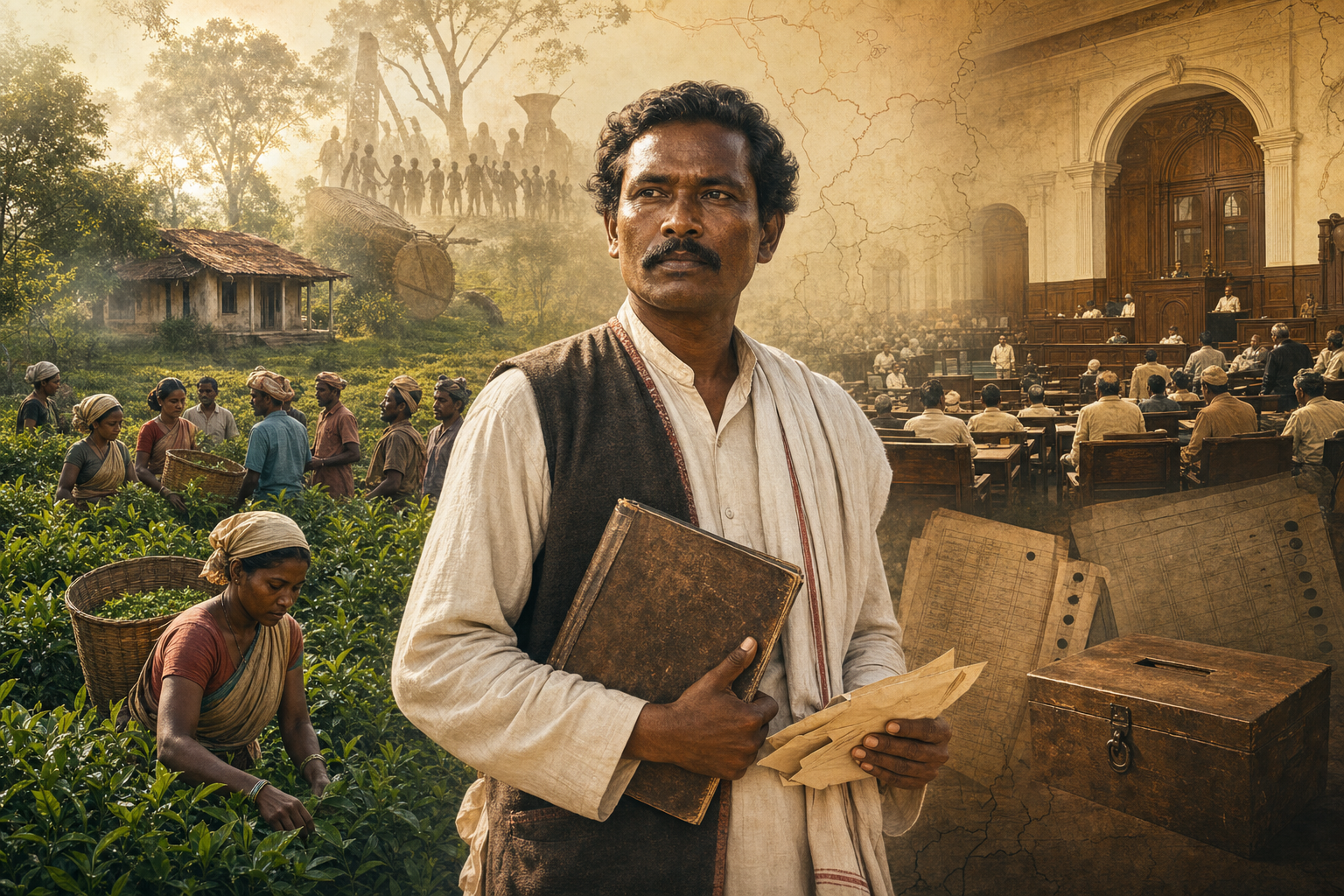
The house that history almost passed by
In Sreemangal’s Purbasha residential area, an ageing house stands among newer buildings without a plaque, a museum marker or any public sign that it is associated with a legislator. Its weathered exterior is easy to overlook. Yet published reporting identifies it as the house built by Jibon Santal, a tea garden labour sardar who became a trade-union organiser and an elected representative. The building therefore carries a history far larger than its walls: the history of colonial plantation labour, Indigenous resistance, democratic participation and the fragility of public memory.
Jibon Santal’s career connected social worlds that colonial power had worked hard to keep apart. He moved from a tea estate hierarchy into collective labour organisation, and from a community pushed to the political margins into the Assam Provincial Legislative Assembly. After Partition altered the border around Sylhet, accounts of his life record a second electoral victory in the East Bengal legislature in 1954. His journey was not merely an exceptional rise by one determined individual. It demonstrated that plantation workers could organise as a constituency, formulate public demands and enter institutions that had rarely treated them as political equals.
A careful reconstruction must also begin with an archival warning. No reliable birth date, full chronology, substantial body of personal papers or comprehensive collection of speeches has yet been made publicly available. His name appears as both Jibon and Jiban in English-language records, while Santal and Santhal are variant spellings. Some biographical details survive principally through journalism, union memory and regional history. Those limitations do not make the story less important; they make it essential to separate verified facts from reasonable interpretation and to identify precisely what still needs investigation.
The Santal Hul: resistance before representation
The political meaning of Jibon Santal’s life becomes clearer when placed beside the Santal Hul of 1855–1856. Hul, also written Hool, is commonly translated as “uprising” or “rebellion.” The movement began publicly on 30 June 1855 at Bhognadih, in what is now Sahibganj district in Jharkhand. That date is commemorated as Hul Diwas or Santal Rebellion Day, not simply as the anniversary of a battle but as a declaration that an exploited people possessed the authority to define justice for themselves.
The uprising emerged from a specific political economy. Santal cultivators had faced mounting rent demands, indebtedness, land alienation, predatory moneylending, coercive revenue practices and abuse by police and other intermediaries. Colonial arrangements that had first encouraged settlement in the Damin-i-Koh region did not protect Santal households from the expanding network of officials, zamindars, traders and mahajans who could convert debt into dispossession. The crisis was therefore not a spontaneous eruption of anger. It was the result of institutions that transferred risk downward while placing meaningful legal redress beyond the reach of those most affected.
On 30 June, more than 10,000 Santal men and women reportedly assembled at Bhognadih under the leadership of Sidhu Murmu, Kanhu Murmu, Chand Murmu and Bhairab Murmu. Messages were sent across villages, and colonial authority was openly challenged. The Government of India’s Digital District Repository describes the movement as a major Indigenous resistance to colonial rule before 1857. Its spread across parts of present-day Jharkhand, Bihar and West Bengal showed that communities dismissed as politically peripheral could coordinate action over a wide territory.
The imbalance of military power was severe. Santal fighters relied largely on bows, arrows, axes, spears and local knowledge, while the East India Company could deploy organised troops and firearms. Colonial forces eventually suppressed the Hul with overwhelming violence. Thousands were killed, although precise totals differ across sources and should not be presented as a settled figure. The defeat of the armed uprising did not erase its political achievement: it exposed the depth of rural and Indigenous grievances and forced the colonial state to acknowledge that ordinary administration had failed.
One institutional consequence was the creation of the Santal Parganas as a separate administrative district under Act XXXVII of 1855. The official history of Pakur district directly connects that measure to the Hul. The reform, however, should not be romanticised as full justice. Administrative separation could recognise a crisis without restoring the dead, reversing every land loss or dismantling the wider structures of colonial extraction. The Hul’s durable significance lay as much in its moral vocabulary—dignity, land, autonomy and resistance—as in the limited concessions that followed.
There is no need to invent a direct organisational line from the rebels of 1855 to Jibon Santal in the twentieth century. The connection is historical and ethical rather than a documented chain of command. The Hul established a repertoire of refusal: marginalised people could reject imposed inferiority, organise collectively and demand control over the conditions of their lives. Jibon later translated comparable principles into the languages of union membership, elections, legislative procedure and public representation.
From the Chotanagpur plateau to the tea estates of Sylhet
Jibon Santal was born at Majdihi Tea Estate in present-day Moulvibazar District. At the time relevant to his early life and political career, Sylhet formed part of Assam, a provincial arrangement created under British rule and maintained until the 1947 referendum and Partition. His family descended from labourers brought from Bihar and the Chotanagpur plateau to work in the expanding tea plantations. That migration placed Santal and other Adivasi communities inside a commercial landscape designed primarily around the requirements of tea production.
Colonial recruitment did more than relocate labour. It produced plantation settlements in which work, housing, rations, medical provision, schooling and local authority were often tied to the same estate. Geographic isolation and dependence on estate-controlled resources sharply limited workers’ bargaining options. A wage dispute could therefore affect not only income but also food security, shelter, healthcare and the prospects of the next generation. This is why plantation labour history cannot be reduced to a single wage figure: it concerns an entire system of social reproduction.
The position of labour sardar must be understood within that structure. A sardar typically served as an intermediary who supervised or coordinated groups of workers, communicated instructions and mediated between labourers and estate authority. The role could bring status and practical influence, but it remained subordinate to management. A sardar stood close enough to workers to understand their grievances and close enough to authority to encounter the limits imposed on advocacy. That tension helps explain why the post could become a training ground for labour leadership as well as a site of conflict.
Available accounts describe Jibon as a respected sardar at Majdihi. He knew plantation hardship not as an outside observer but as a person formed within the estate world. Poverty, exhausting work, discrimination and insecurity were conditions shared by families around him. His authority appears to have rested on more than a job title: fellow workers trusted him to raise concerns that management preferred to contain.
That advocacy carried a cost. Biographical reporting states that his challenges to plantation authority over workers’ rights led to conflict with management and the loss of his position. The precise dispute and date require further documentary research, but the consequence is central to the story. Dismissal could have ended his public life. Instead, it shifted the basis of his leadership from a management-recognised office to collective legitimacy among workers.
This transformation was politically important. As a sardar, Jibon operated vertically inside an estate hierarchy. As an organiser, he worked horizontally across gardens, communities and local networks. The change converted personal credibility into institutional capacity. It also revealed a principle familiar throughout labour history: when an intermediary role cannot resolve structural grievances, workers may need an organisation able to bargain, document abuse and act collectively.
Building the Srihatta tea workers’ union
Jibon dedicated himself to organising tea labourers across the Sylhet region and worked with Indian National Congress leaders Purnendu Kishore Sengupta and Nikunja Bihari Chowdhury. Their collaboration joined estate-level knowledge to wider legal and political networks. That alliance mattered because plantation workers required more than sympathy: they needed an organisation capable of maintaining membership, developing demands, communicating across dispersed gardens and negotiating with employers and the state.
The Srihatta Tea Labourer’s Union was formally established at Kulaura on 3 June 1948. Contemporary English renderings vary, and the organisation is also described as the Srihatta District Tea Workers’ Union. A later history of the movement records Purnendu Kishore Sengupta as founding president, Jibon Santal as founding vice-president and Nikunja Bihari Chowdhury as general secretary. The organisation eventually became known as the Bangladesh Tea Workers’ Union. The founding date is independently repeated in a 2025 study of trade-union practices in Bangladesh’s tea industry.
The variation in the union’s English name should not be mistaken for evidence of separate organisations without further proof. Srihatta is the historical name associated with Sylhet, while “labourer” and “worker” are translation choices found in different accounts. Good archival practice would retain every recorded form as an alternative name, attach dates to organisational changes and preserve the original-language wording wherever it survives. This approach prevents search systems from separating records that belong to the same institutional history.
The union’s demands were both material and civic: fair wages, humane working hours, healthcare, adequate housing, education and respect for workers as full members of society. These issues were mutually dependent. Higher wages could not compensate for inaccessible treatment during illness; estate housing offered little security if employment could be withdrawn arbitrarily; and a school without the resources to keep children enrolled could not break intergenerational dependence on plantation work. The phrase “human dignity” gathered these separate claims into a coherent programme.
Technically, a functioning union changes the information and bargaining structure of a workplace. It enables workers to aggregate grievances, elect representatives, establish procedures, negotiate collectively and record whether agreements are implemented. It can also reduce the risk that a single complainant will bear the full cost of challenging management. Jibon’s achievement was therefore not limited to speaking courageously. He helped create an institution through which many workers could speak together.
The demands remain recognisable in the present. In 2024, the International Labour Organization reported that Bangladesh had 159 tea gardens across seven districts employing approximately 100,619 workers, about half of them women. The same ILO account described tea workers as among the country’s most marginalised communities and emphasised decent work, rights awareness, collective bargaining and dialogue among workers, employers and government. Those findings do not mean that nothing has changed since Jibon’s era; they show that the institutional questions he confronted have not lost their relevance.
Modern research also cautions against treating a union’s historical name as proof of effective representation in every period. Worker participation, transparent elections, accountable leadership and credible bargaining are continuing requirements. Remembering Jibon should therefore inspire scrutiny rather than nostalgia. The most faithful tribute to a founding organiser is a labour institution in which workers can actually shape decisions that affect their wages, safety, housing and families.
The 1946 electoral breakthrough
Jibon Santal’s election to the Assam Provincial Legislative Assembly in 1946 was remarkable, but its institutional setting deserves precise explanation. The colonial electorate was restricted, and representation was organised through general, communal and special-interest constituencies rather than universal adult suffrage. Sreemangal had a Tea Gardens Labour Constituency. An academic study drawing on government records reports 11,449 voters on its electoral roll and states that eligibility required permanent employment in one or more qualifying tea gardens for at least 180 days.
That arrangement was contradictory. A labour constituency gave plantation workers a formally distinct voice, yet it also confined them within a category designed by the colonial state. Many residents of the province remained excluded by property, status or other franchise qualifications. Jibon’s victory must therefore be read neither as full democracy nor as a token gesture. It was a real electoral mandate won inside a deeply unequal political system.
Standing for the Indian National Congress, Jibon won the Sreemangal seat and entered the legislature from a social position rarely represented there. A tea garden sardar and labour organiser now occupied the same chamber as ministers, lawyers, landlords and established political figures. The symbolic force of that passage is difficult to overstate: the plantation was no longer only an object of regulation or commercial policy; through him, it became a political constituency represented by someone rooted in its labouring community.
Primary legislative material confirms his presence. The digitised Assam Assembly proceedings of 9 September 1946 list “Srijut Jiban Santal” among members participating in a division, and the proceedings of 17 March 1947 record him in another vote. These entries provide firmer evidence than later recollection alone: they establish that he was present within the working procedures of the House and took part in recorded decisions.
Later accounts credit him with advocating for tea labourers, Indigenous communities and other neglected groups. That description is consistent with his organising career, but a complete assessment of his legislative interventions requires more than membership lists. Questions, motions, committee records, budget debates, petitions and constituency correspondence should be searched systematically. Until that work is completed, the strongest formulation is that his election and documented participation gave marginalised plantation communities an unusually direct presence in provincial government, while the exact scope of his speeches remains an open research question.
Partition changed the state, not the constituency’s needs
The political geography around Jibon changed abruptly in 1947. Sylhet, which had been administered as part of Assam since 1874, was subjected to a referendum on whether it would remain in Assam or join East Bengal in Pakistan. Most of the district, including Sreemangal in present-day Moulvibazar, became part of East Bengal. A representative elected under British Indian provincial institutions consequently found his constituency placed within a new state, while the tea estates and their labour relations remained on the same ground.
This continuity matters. Partition transformed citizenship, party alignments, administrative chains and minority politics, but it did not automatically resolve low wages, estate dependence, social discrimination or limited access to public services. Jibon’s post-Partition public life suggests that he treated labour representation as a responsibility that survived constitutional rupture. The people who had elected him still required a political voice, even though the name and jurisdiction of the legislature had changed.
Regional histories and biographical accounts report that Jibon was elected again in 1954 as a United Front candidate, from a reserved minority constituency in the Sreemangal region, to the East Bengal Provincial Assembly. The 1954 election occurred amid broad opposition to Muslim League rule and produced a decisive United Front victory in the province. Because readily accessible primary electoral documentation on Jibon’s individual result remains limited, this second victory should be cited to those regional accounts while researchers continue searching official gazettes, nomination papers and complete constituency returns.
Even with that evidentiary caution, the reported re-election is historically significant. It places Jibon on both sides of the 1947 divide: first as a Congress representative in colonial Assam and later as a United Front representative in East Bengal. Few careers illustrate so clearly how a locally rooted movement could persist through imperial withdrawal, Partition and the reorganisation of provincial politics. His public identity was anchored less in a changing border than in the workers and marginalised communities he represented.
Why did such a life disappear from public memory?
The surviving record is strikingly thin. The published profile on which this reconstruction is based reports that the Bangladesh Tea Workers’ Union possesses only limited information about its founding vice-president. Few photographs are known, personal papers have not been systematically preserved and family history remains poorly documented. The same reporting states that members of his family continue to live in the house he built in Sreemangal, yet the building has no official recognition of the political history associated with it.
This is not merely an unfortunate gap around one person. Archives tend to preserve the paperwork of governments, employers and social elites more reliably than the records of workers whose organisations may have lacked secure offices, trained archivists or conservation budgets. Partition could disperse files across Assam, Bangladesh and private collections. Humidity, fragile paper, repeated relocation and changing institutional leadership could cause further loss. These are plausible mechanisms rather than proven explanations in Jibon’s individual case, but they indicate where an investigation should look.
Language and metadata create another layer of disappearance. A database search for “Jibon Santal” may miss a colonial record indexed as “Jiban Santal,” while “Santhal,” “Sonthal,” “Srihatta,” “Sylhet,” “Srimongal” and “Sreemangal” can lead to separate result sets. The honorific “Srijut” also appears in Assembly proceedings. A serious digital archive should link these variants through authority records so that spelling differences do not fragment one life into several apparently unrelated identities.
The Purbasha house is therefore both evidence and warning. It gives the story a material location, but a building cannot explain itself. Without oral testimony, documentary provenance and public interpretation, later generations may see only an old residence on valuable urban land. Once altered beyond recognition or demolished, it would be impossible to recover the spatial setting in which family memory and regional political history still meet.
What responsible preservation would require
The first task should be a community-led oral-history project. Researchers could identify descendants, former neighbours, retired tea workers, union veterans and local historians, then record interviews with informed consent. Each interview should be dated, transcribed, translated where necessary and accompanied by metadata describing the speaker’s relationship to the events. Memories should be cross-checked rather than forced into a single seamless narrative, because disagreement can reveal how public memory was formed.
The second task should be a distributed documentary search. Relevant collections may include Assam Assembly debates, electoral rolls, Congress papers, East Bengal government gazettes, United Front election records, labour-department files, union constitutions and minutes, tea-estate correspondence, local newspapers, photographs and land documents connected to the house. Optical character recognition should be run against all known spelling variants, followed by human review. Digital files should use persistent identifiers, multiple backups and clear source descriptions so that later researchers can verify every claim.
The third task should be a professional heritage assessment of the Purbasha property, undertaken only with the owners’ consent. That assessment should document ownership history, construction phases, materials, present condition and alterations through measured drawings and high-resolution photography. Recognition need not immediately turn a family home into a museum. A historically accurate plaque, a municipal heritage listing, a small digital exhibition or scheduled educational visits may preserve public meaning without displacing residents or freezing the house as a lifeless monument.
Ethics are as important as technique. Tea-worker and Santal histories should not be extracted from families, published without consent and then controlled by distant institutions. Interviewees and descendants should receive copies of recordings and documents; culturally sensitive material should have appropriate access restrictions; and community representatives should share authority over description and interpretation. Preservation is most credible when the people whose history is being preserved remain participants rather than research subjects.
Education provides the fourth pillar. Hul Diwas on 30 June can connect the 1855 uprising to later forms of organisation without suggesting that every episode was identical. A teaching module could trace a clear sequence: land and dignity in the Hul, labour control on tea estates, union formation in 1948, electoral representation in 1946 and 1954, and the unfinished work of labour rights today. Such a sequence helps students understand that resistance can move from rebellion to institution-building while retaining its demand for justice.
Unity without erasing Santal distinctiveness
Santal communities possess distinctive Indigenous traditions and are also internally diverse in religious practice. Their history should not be compressed into a category that they did not choose or presented as valuable only when it resembles another tradition. A platform committed to unity among Hindu, Buddhist, Jain and Sikh communities can extend the same ethic of dignity and pluralism toward Santal and other Indigenous peoples. Solidarity becomes stronger when it protects difference, rejects forced homogenisation and recognises shared struggles against exploitation and exclusion.
That principle also clarifies the contemporary value of Jibon Santal’s life. His importance does not depend on turning him into an uncritical icon. It rests on the practical route he opened from lived hardship to collective organisation and from organisation to representation. For young readers, the lesson is concrete: democratic institutions become more representative only when communities develop leadership, preserve evidence, build accountable organisations and insist that public policy include people ordinarily treated as invisible.
Jibon Santal transformed the authority of a tea garden sardar into the responsibility of a union organiser and legislator. The Santal Hul had shown that people denied justice could confront an empire; his later career showed that resistance could also enter a legislature, negotiate through institutions and survive a change of state. Remembering him therefore joins two histories too often kept apart—the history of Indigenous anti-colonial struggle and the history of organised labour in Bangladesh.
The appropriate response is more than an annual tribute. It is a programme of research, preservation and public recognition: secure the oral histories, identify the papers, index the legislative record, document the house and make the results accessible to the communities from which they came. Only then will future generations be able to see that South Asian democracy was shaped not only by celebrated national leaders, but also by plantation workers who demanded the right to speak in their own name.
Research note: The reconstruction draws on the original profile, official accounts of the Santal Hul, digitised Assam Legislative Assembly proceedings, research on the 1946 Sreemangal labour electorate, histories of the Srihatta tea workers’ union and International Labour Organization material on plantation work in Bangladesh. Where a claim currently rests on biographical or regional reporting rather than an accessible primary record—especially the details of Jibon Santal’s 1954 election—it is identified as such. That distinction is not a weakness; it is a roadmap for the archival work still required.
Inspired by this post on Hindu Post.
